

Traditional annual budgeting methods fail in modern petroleum finance because static fiscal plans cannot adapt to extreme market volatility, shifting oil prices, and operational disruptions. Fixed annual targets force energy companies into rigid resource allocation models that create massive financial inaccuracies within 90 days of implementation.
Petroleum operations run in dynamic environments governed by geopolitical shifts, commodity price swings, and supply chain disruptions. Standard annual budgets freeze assumptions 12 to 18 months in advance. Financial teams waste up to 40% of their operational planning time negotiating arbitrary spend allocations that become obsolete before the fiscal year begins. This disconnect causes severe misalignments between capital expenditure and actual field operations.
Modern energy firms require agile financial frameworks that align operational execution with market realities. Continuing to rely on static annual budgets exposes petroleum organisations to capital misallocation, cash flow shortages, and delayed investment responses during commodity downturns.
What is the strategic role of rolling forecasts and zero based budgeting in enterprise financial transformation?
Rolling forecasts and zero based budgeting establish a continuous, driver-based financial control system that replaces historical spending assumptions with real-time operational metrics. This strategic integration enables petroleum enterprises to dynamically reallocate capital, eliminate waste, and maintain 18-month financial visibility across volatile market cycles.
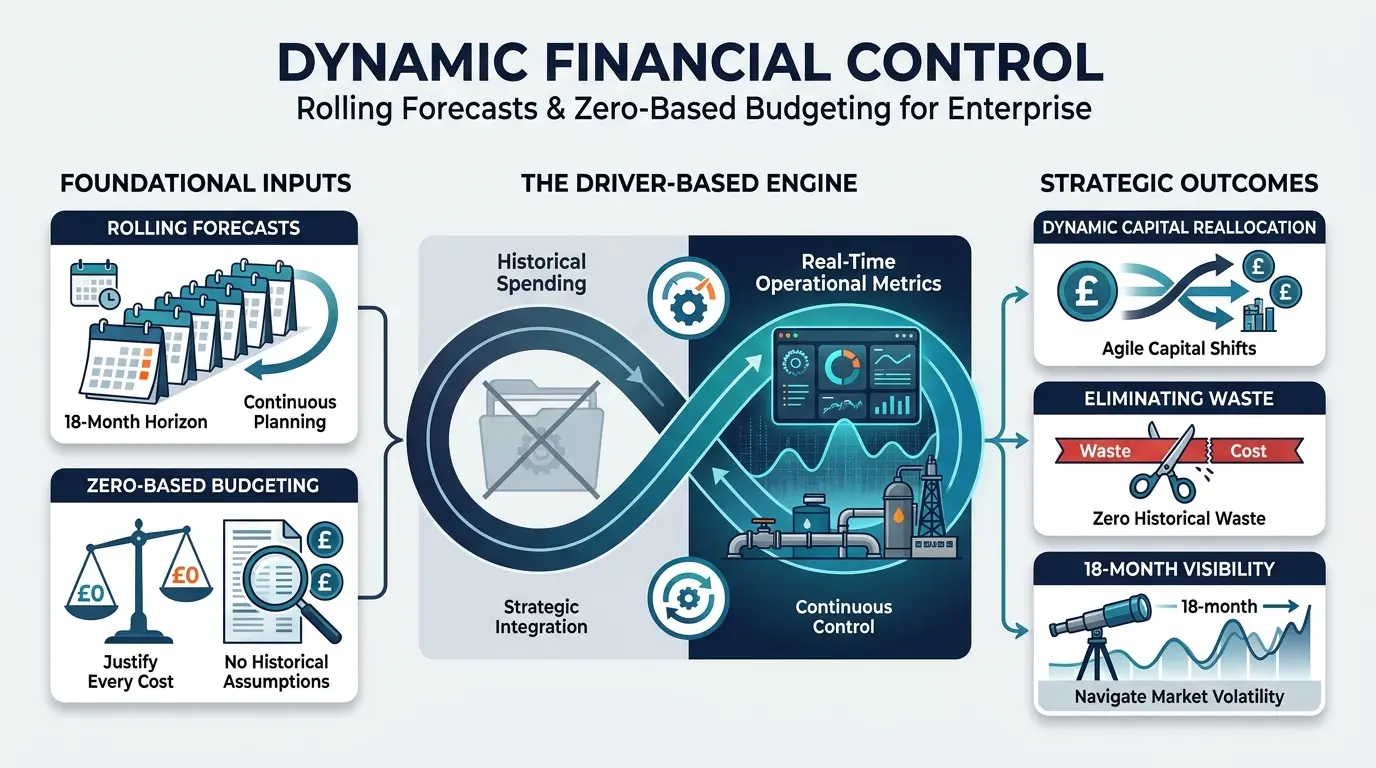
The combination of these two methodologies transforms petroleum finance from an administrative tracking exercise into a strategic growth driver. Zero based budgeting requires managers to justify every operating expense from a zero base at the start of each planning cycle, eliminating legacy inefficiencies and cost inflation built into historical baselines. Meanwhile, the rolling forecast cycle extends visibility beyond standard fiscal year boundaries by adding a new quarter or month as each period closes, ensuring a continuous 12-to-24-month horizon.
Integrating these frameworks allows enterprise finance teams to build structured driver based planning systems. Financial targets connect directly to physical operational drivers such as rig count, production volumes, pump maintenance schedules, and refining throughput rather than arbitrary percentage adjustments.
How do rolling forecasts work in oil and gas corporate environments?
Rolling forecasts operate in oil and gas corporate environments by continually updating financial projections based on defined reforecast triggers, commodity market shifts, and operational performance metrics. Finance teams maintain a moving 12-to-24-month planning horizon, adding a future period as each current operating quarter closes.
Implementing a continuous forecasting model requires structured corporate governance and disciplined data collection across exploration, production, refining, and commercial divisions.
1. Identifying core reforecast triggers
Petroleum markets fluctuate rapidly, making scheduled quarterly updates insufficient during periods of high volatility. Organisations define explicit reforecast triggers, such as crude price movements exceeding 10%, major equipment failures, regulatory policy changes, or significant exchange rate shifts. When a trigger trips, financial planners initiate an immediate out-of-cycle update to recalibrate revenue expectations and operating margins.
2. Executing driver based planning models
Finance leaders link financial line items directly to physical operational drivers rather than spending history. Upstream production volumes, daily extraction costs, lease operating expenses, and pipeline tariffs serve as input metrics. When field managers update operational forecasts, the financial model instantly updates projected revenues, cash flows, and working capital requirements across the enterprise.
3. Calculating the latest estimate and outlook
Operating units update their latest estimate and outlook at monthly intervals to track immediate deviations from strategic goals. This process compares year-to-date actual financial performance against current operational plans, giving executive boards actionable foresight into potential cash flow shortfalls or capital surplus opportunities months before standard audit cycles detect them.
How is zero based budgeting implemented step by step across enterprise teams?
Zero based budgeting is implemented step by step by dissecting departmental activities into cost packages, evaluating their necessity from a zero base, and ranking expenditures against strategic corporate objectives. Corporate teams eliminate spending padding and rebuild operating costs from line-item operational requirements.
Transitioning to a zero-based model demands structured execution across all business units to ensure full transparency and budget accountability.
1.Define Decision Units and Cost Packages:Deconstruct corporate operations into measurable activity modules.
Organisations break down operating divisions into distinct decision units such as offshore drilling ops, refinery maintenance, or subsea logistics. Department heads isolate every individual activity into a granular cost package detailed with headcount, equipment usage, and software expenses.
2.Build Zero-Based Justifications:Eliminate historical spend baselines and legacy allocations.
Managers build budget requests starting from zero, justifying every line item based on direct operational necessity and projected return. teams demonstrate how each requested expense directly supports field production, compliance, or risk reduction rather than citing previous years' budget allowances.
3.Rank and Prioritise Expenditure Packages:Align capital allocation with strategic corporate outcomes.
Executive steering committees evaluate cost packages across departments using standardized financial and risk criteria. Teams rank packages in order of strategic importance, funding high-impact operational needs first while cutting low-priority administrative expenditure.
4.Integrate Planning Tools and Governance:Deploy automated enterprise performance management systems.
Finance teams load approved cost packages into centralized planning software, setting up spending thresholds, approval workflows, and continuous compliance monitoring systems across all corporate divisions.
What core financial skills, frameworks, and tools are required for financial planning transformation?
Financial planning transformation requires core skills in financial modelling, driver identification, and variance analysis, supported by zero based budgeting frameworks and enterprise performance management tools. Professionals must combine deep technical petroleum accounting knowledge with cross-functional corporate communication expertise.
Building modern financial capability across enterprise teams involves three distinct operational layers:
Technical skills and analytical competencies
Finance professionals must master forecast accuracy tracking methods to quantify prediction variance and refine predictive models over time. Key capabilities include:
Building dynamic cash flow and capital allocation models tailored to commodity pricing scenarios.
Calculating variance sensitivity across operational volume, price, and foreign exchange factors.
Evaluating risk exposure and managing contingency and management reserve allocations for major capital projects.
Translating complex field data from offshore operations into board-level strategic choices.
Frameworks and methodologies
Corporate teams deploy activity based budgeting alongside zero based principles to trace indirect overhead expenses directly to production activities. Combining these models reveals hidden operational inefficiencies in support functions like procurement, technical services, and enterprise IT.
Planning tool integration
Excel spreadsheets cannot maintain complex rolling models across multi-billion-dollar enterprise operations. Modern organisations rely on specialized enterprise performance management tools integrated with core ERP databases. Centralized software engines update operational models in real time, automate driver inputs, and enforce governance rules across globally distributed operating teams.
How do organisations structure corporate learning and workforce development for finance teams?
Organisations structure corporate learning for finance teams through hybrid training frameworks, practical simulation labs, and targeted skill gap assessments. L&D professionals align learning modules with live corporate budgeting cycles to ensure immediate operational application and measurable skill acquisition.
Capability development initiatives require structured planning to transform complex financial theory into consistent workplace performance.
HR leaders and L&D directors identify employee skill gaps by assessing financial teams on advanced forecasting techniques, EPM software proficiency, and operational business acumen. Building robust capability requires structured learning formats. Combining online technical modules with intensive, instructor-led practical workshops lets professionals master complex financial concepts without disrupting daily operational schedules.
Corporate training programs use case-based learning, financial simulation labs, and scenario-driven role plays using real petroleum dataset models. Participants practice building rolling forecast cycles, managing out-of-cycle reforecast triggers, and establishing zero-based justifications for major field projects.
To successfully navigate this strategic transition, enterprise financial decision-makers often look to benchmark their methodologies and evaluate structured professional development frameworks against industry standards. Evaluating specialized programs—such as the Budgeting & Forecasting: Rolling & Zero-Based Techniques Training Course—helps organisations assess training scope, practical methodology, and implementation models needed for long-term workforce upskilling.
What measurable outcomes and business impact does financial forecasting training produce?
Financial forecasting training produces measurable outcomes, including up to a 35% improvement in forecast accuracy, a 15% reduction in non-essential operating expenses, and a 50% decrease in budgeting cycle duration. These enterprise capabilities directly boost team productivity, capital efficiency, and executive decision velocity.
Structured capability development delivers clear financial and operational improvements across energy firms:
Higher Forecast Accuracy: Teams consistently achieve tighter variance bands when comparing rolling forecasts to quarterly financial outcomes.
Cost Optimization: Implementing zero-based principles helps teams identify and eliminate duplicate vendor contracts, underutilized assets, and administrative waste.
Faster Planning Cycles: Automated planning workflows and clear driver models cut months off standard annual budget cycles.
Stronger Capital Allocation: Leadership can redeploy capital to high-yield exploration and production projects faster during favorable market shifts.
Better Retention and Retention Rates: Upskilling finance professionals increases employee engagement, lowers turnover, and builds a resilient internal leadership pipeline.
Which corporate teams and energy sectors benefit most from rolling forecast and zero based budgeting models?
Upstream exploration teams, midstream logistics operators, downstream refining units, and central corporate finance departments benefit most from rolling forecasts and zero based budgeting models. These approaches give high-capital, high-risk business units the operational agility required to navigate complex global supply chains.
Different petroleum operating sectors apply these advanced financial frameworks to solve unique operational challenges:
Upstream exploration and production
Exploration and production divisions face extreme capital intensity and long project lead times. Rolling forecasts give upstream teams the flexibility to adjust drilling schedules, reallocate rig commitments, and manage field development expenses as crude prices change. Zero based budgeting forces asset managers to justify field operating costs, preventing legacy cost inflation on mature producing assets.
Midstream and pipeline logistics
Transport, storage, and pipeline infrastructure operations rely on tight capacity management and long-term contracts. Activity based budgeting and driver based planning enable midstream managers to link operating costs directly to throughput volumes, pumping power requirements, and terminal handling charges, ensuring stable margins during volume downturns.
Downstream refining and petrochemicals
Refineries operate on narrow crack spreads and high maintenance overheads. Downstream financial teams use rolling forecasts to project refining margins, crude slate acquisition costs, and plant turnaround expenses over an 18-month window. Zero based budgeting helps plant managers justify maintenance, turnaround, and engineering support services to keep operating costs competitive.
Corporate finance and business development
Centralized corporate finance functions use integrated planning models to manage enterprise liquidity, debt covenants, and capital allocation across business units. Financial leaders gain the clarity needed to balance immediate operating requirements against long-term energy transition projects and strategic acquisitions.
What common problems and misconceptions hinder financial forecasting transformation?
Common problems that hinder financial forecasting transformation include treating zero based budgeting as a one-off cost-cutting exercise, relying on static Excel spreadsheets, and delivering generic training programs disconnected from actual petroleum operations. Overcoming these pitfalls requires strong executive governance, modern planning software, and practical, industry-specific capability development.
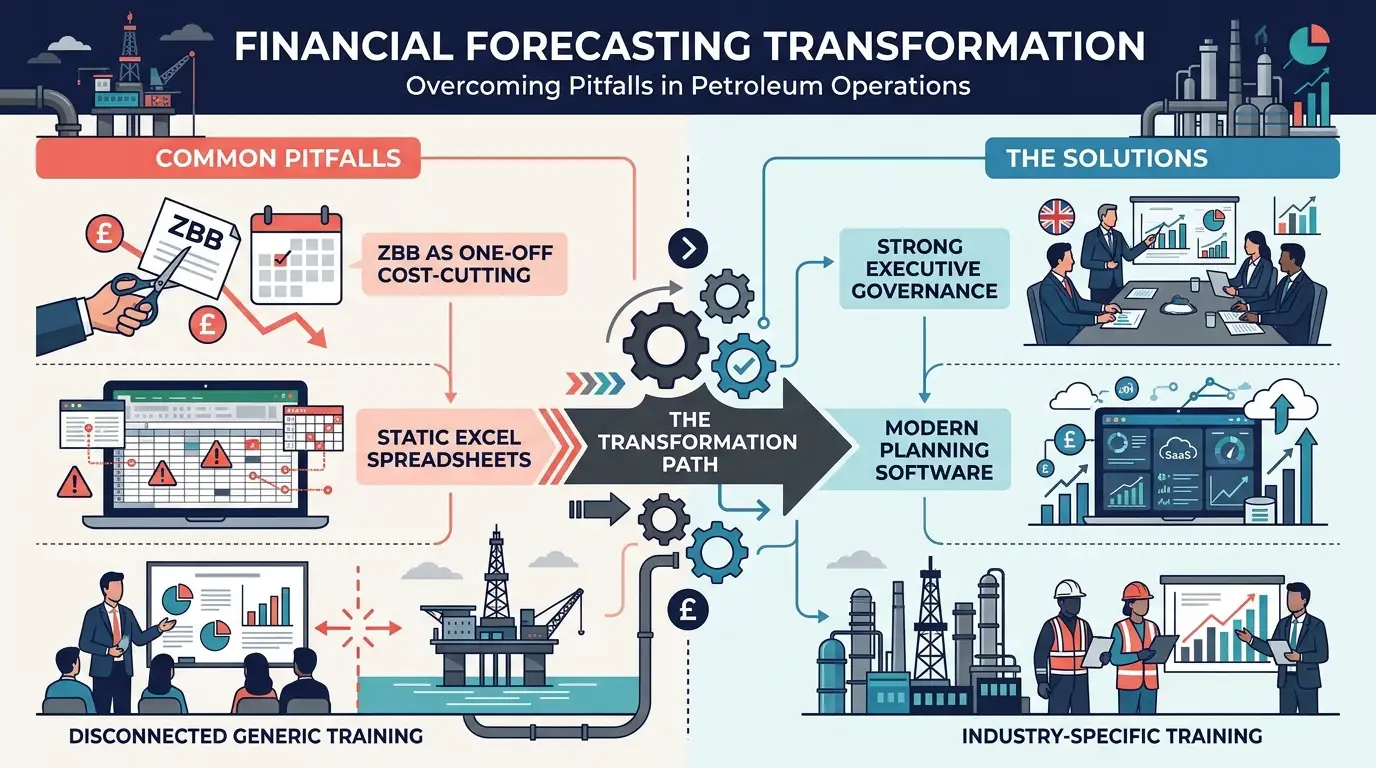
Organisations often stumble during implementation because of key operational misconceptions:
Misconception: Zero based budgeting is just an extreme cost-reduction tool. ZBB is an resource-allocation framework designed to move capital from low-value activities to strategic growth drivers, not simply cut costs across the board.
Misconception: Rolling forecasts require updating every budget line item monthly. Effective rolling forecasts focus on high-impact strategic drivers rather than tracking minor administrative expenses.
Pitfall: Relying on legacy spreadsheets for enterprise planning. Manual spreadsheet consolidation introduces data errors, lacks audit trails, and slows down forecasting workflows across multi-regional teams.
Pitfall: Deploying generic financial training. Off-the-shelf financial courses lack the industry-specific context—such as joint venture accounting, production decline curves, and crack spread dynamics—needed for deep petroleum finance execution.
To succeed, energy companies must treat financial planning transformation as a core operational discipline, combining advanced software tools, structured governance, and practical workforce development.
Frequently Asked Questions
What is included in the Oil & Gas Petroleum Budgeting & Cost Control training program?
The Oil & Gas Petroleum Budgeting & Cost Control course delivered by the Institute For Oil & Gas Training covers essential financial planning frameworks, variance analysis, driver-based forecasting, and activity-based budgeting tailored to upstream, midstream, and downstream operations. Participants gain hands-on experience in managing capital expenditures (CAPEX), controlling operating expenses (OPEX), and mitigating financial risks associated with commodity price volatility.
How does cost control in petroleum finance differ from standard corporate accounting?
Petroleum cost control accounts for extreme market volatility, heavy capital investments, extended project lifecycles, and complex joint venture accounting structures. The Institute For Oil & Gas Training designs its Oil & Gas Petroleum Budgeting & Cost Control curriculum around these industry-specific challenges, helping professionals link operational metrics directly to cash flow management and risk reserves.
Who should attend an oil and gas petroleum budgeting course?
The Oil & Gas Petroleum Budgeting & Cost Control program at the Institute For Oil & Gas Training is engineered for finance managers, L&D coordinators, operational team leaders, cost engineers, and department heads responsible for resource allocation. It equips decision-makers with practical techniques to eliminate legacy budget padding and improve overall project profitability.
What are the main benefits of zero-based budgeting in the energy sector?
Zero-based budgeting requires managers to justify all operating costs from a zero base each cycle, eliminating historical cost inflation and reallocating resources toward high-yield assets. Through the Oil & Gas Petroleum Budgeting & Cost Control practical modules, the Institute For Oil & Gas Training helps energy organisations streamline cost structures, reduce non-essential overheads, and enhance capital efficiency across volatile markets.
How do rolling forecasts improve budget accuracy in oil and gas operations?
Rolling forecasts continuously extend the planning horizon by adding a new period as each month or quarter closes, replacing static annual targets with dynamic predictions based on real-time operational drivers. Implementing this methodology via the Oil & Gas Petroleum Budgeting & Cost Control frameworks taught by the Institute For Oil & Gas Training enables financial teams to react quickly to market shifts and reduce forecast variance.
Related training courses
Cost Control & Variance Analysis for Budget Deviations Training Course
- Specialisation
- Oil & Gas Petroleum Budgeting & Cost Control
- Duration
- 5 days · 15 CPD hours
Cash Calls, AFEs & Work Program/Budget Control: Overruns Training Course
- Specialisation
- Oil & Gas Petroleum Budgeting & Cost Control
- Duration
- 5 days · 15 CPD hours
Budget Planning and Cost Optimisation Training Course
- Specialisation
- Oil & Gas Petroleum Budgeting & Cost Control
- Duration
- 5 days · 15 CPD hours
More articles

Cost Control and Variance Analysis for Budget Deviations Training by Institute For Oil & Gas Training
Master budget deviations with the Cost Control & Variance Analysis Training Course by Institute For Oil & Gas Training. Learn financial variance techniques.
Read article →
How to Identify and Analyse Budget Deviations Through Cost Variance Analysis
Learn how to analyse budget deviations with cost variance analysis. Evaluate tracking methods, variances, and training for financial control.
Read article →
Why Cost Variance Analysis Matters in Oil and Gas Budget Control
Learn how cost variance analysis prevents budget overruns in oil and gas projects. Discover key frameworks, execution steps, and measurable ROI.
Read article →