

Managing operational budgets within capital-intensive energy projects requires strict financial governance, systematic tracking, and rapid response to financial drift. Unmonitored expenditures often lead to severe margin erosion across complex upstream, midstream, and downstream operations. Organizations frequently struggle with budget versus actual variance due to inadequate tracking systems and delayed variance reporting. The Cost Control and Variance Analysis for Budget Deviations Training by Institute For Oil & Gas Training addresses these operational vulnerabilities directly. To understand the fundamental principles behind financial drift in energy operations, review our detailed guide on Why Cost Variance Analysis Matters in Oil and Gas Budget Control.
This professional development program establishes a rigorous framework for identifying, quantifying, and rectifying financial discrepancies across project lifecycles. By standardizing tracking metrics, financial teams and project managers gain actionable control over complex expenditures.
What Is the Cost Control & Variance Analysis Training Course and What Problem Does It Solve?
The Cost Control & Variance Analysis for Budget Deviations Training Course is an intensive professional development program designed to eliminate unmonitored spending and operational budget drift. Delivered by Institute For Oil & Gas Training, it equips managers to execute precise variance analysis and establish financial governance.
The Cost Control & Variance Analysis Challenge
Capital projects in energy sectors operate under fluctuating market conditions, complex supply chains, and multi-layered contractor environments. Without robust internal controls, organizations face severe financial risks that compromise operational viability.
Delayed Financial Visibility: Teams often rely on lagged accounting reports, discovering cost overruns weeks after commitment decisions become irreversible.
Misinterpretation of Variance Types: Project personnel frequently struggle to differentiate between price and volume variance, leading to ineffective corrective measures.
Inconsistent Reporting Metrics: Inconsistent reporting formats across departments hinder executive visibility and delay strategic interventions.
Weak Commitment Governance: Failure to track open purchase orders against executed work leads to misleading budget availability figures.
Core Problem Resolution Strategy
The course directly targets these organizational vulnerabilities by embedding standardized analytical methodologies into daily management routines. Participants learn to transition from passive expenditure recording to proactive commitment tracking.
Through structured learning modules, professionals master the mechanics of accrual versus spend reporting. This ensures that recorded costs match physical work executed rather than delayed vendor payments.
Furthermore, the curriculum addresses variance investigation thresholds, establishing clear parameters for when budget deviations require formal escalation. The Institute For Oil & Gas Training provides templates and operational frameworks that enable immediate integration into organizational reporting structures.
Why Is This Training Course Structured This Way?
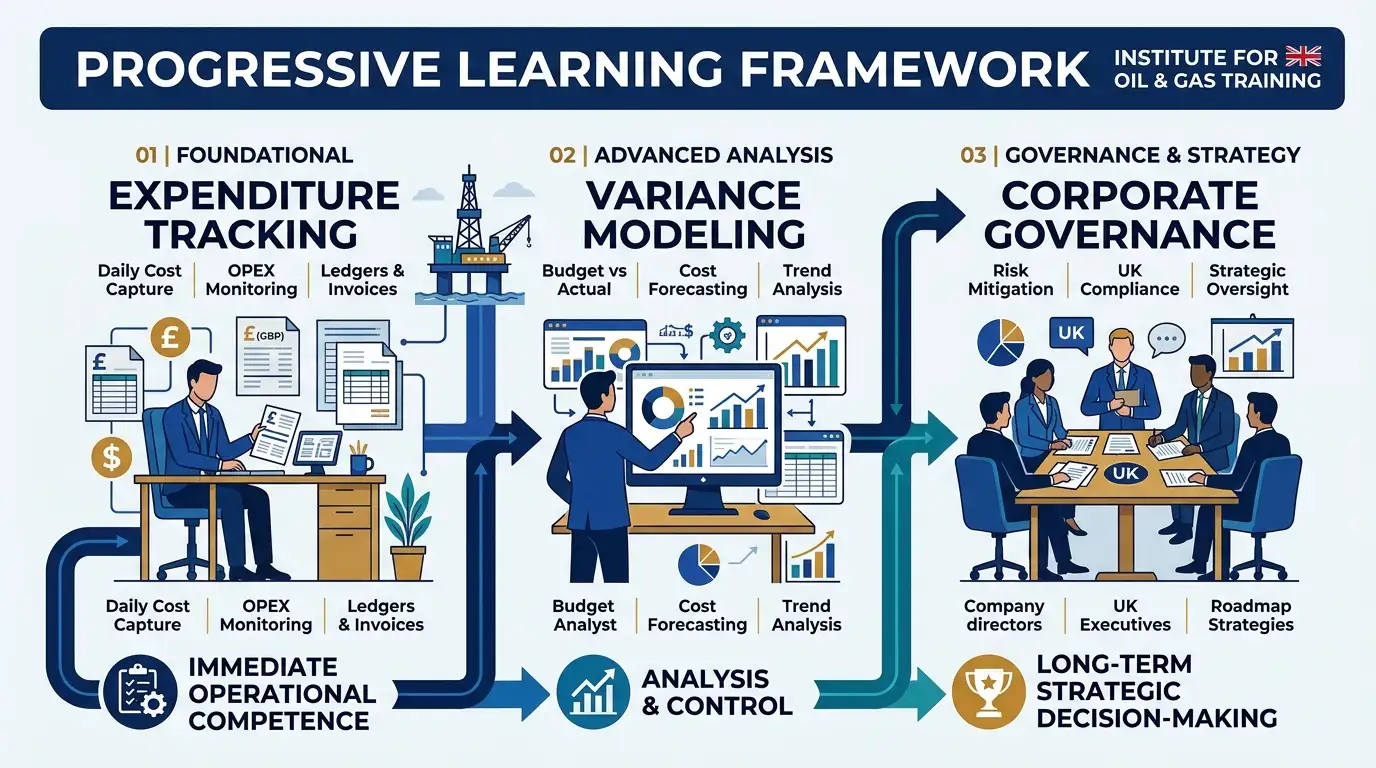
The curriculum employs a progressive learning framework moving from foundational expenditure tracking to complex variance modeling and governance. This structural design by Institute For Oil & Gas Training ensures participants build immediate operational competence alongside long-term strategic decision-making skills.
Curriculum Architecture Logic
Learning effectiveness depends on systematic skill accumulation. The structure begins with baseline accounting principles and advances directly into complex variance decomposition models.
Foundational Measurement: Establishing clear baselines for budget allocations, work breakdown structures, and commitment logging.
Analytical Decomposition: Isolating underlying drivers behind financial drift using price, volume, and efficiency calculations.
Control Mechanism Design: Setting operational thresholds, formalizing variance commentary, and building automated triggers.
Strategic Execution: Structuring formal corrective action plans and presenting financial reconciliations to executive stakeholders.
Operational Alignment
Energy sector projects demand specialized analytical tools that account for market volatility, long lead times, and regulatory compliance requirements. Generic corporate finance courses fail to capture these specific operational nuances.
The course structure integrates real-world operational variables directly into classroom exercises. Participants work with multi-currency budgets, joint-venture accounting constraints, and complex engineering procurement frameworks.
By grounding theoretical concepts in realistic scenarios, the Institute For Oil & Gas Training ensures immediate post-training applicability. To review the diagnostic procedures required to isolate root causes of overruns, consult our guide on How to Identify and Analyse Budget Deviations Through Cost Variance Analysis.
What Will Participants Learn in the Course?
Participants gain comprehensive mastery over variance analysis, cost tracking mechanisms, financial commentary, and corrective execution strategies. The course equips professionals to calculate efficiency variance, manage favorable and adverse variance, and present structured financial assessments to leadership.
Detailed Curriculum Breakdown
Module | Core Subject Matter | Practical Skill Deliverables |
Module 1: Cost Control Foundations | Cost baselines, work breakdown structures, commitment tracking systems. | Constructing commitment tracking registers and accrual frameworks. |
Module 2: Variance Decomposition | Math models for budget versus actual variance, price/volume split. | Calculating price, volume, and efficiency variances. |
Module 3: Reporting Governance | Accrual versus spend reporting, variance investigation thresholds. | Establishing threshold triggers and standardized commentary formats. |
Module 4: Remediation Strategy | Root cause analysis, corrective action plans, executive presentations. | Formulating actionable, cost-neutral remediation strategies. |
Key Competencies Delivered
Precision Variance Decomposition: Master the mathematical separation of price and volume variance to isolate market rate shifts from consumption inefficiencies.
Efficiency Evaluation: Calculate efficiency variance across labor, equipment, and material consumption to identify site-level productivity bottlenecks.
Advanced Accrual Alignment: Implement standardized accrual versus spend reporting protocols that align accounting records with actual physical progress.
Standardised Variance Commentary: Write professional variance commentary that clearly explains root causes, operational impacts, and financial forecasts.
Corrective Action Protocol: Construct robust corrective action plans that restore project expenditures to original baseline approvals.
How Is the Course Delivered?
The course is delivered through interactive classroom workshops, live online sessions, onsite corporate cohorts, and hybrid learning formats. The Institute For Oil & Gas Training utilizes practical scenario simulations, real-world case studies, and instructor-led analytical exercises to ensure deep skill retention.
Flexible Delivery Formats
To accommodate diverse corporate schedules and geographic locations, training options are structured across multiple delivery pathways.
In-Person Executive Workshops: Intensive 3 to 5-day immersive classroom sessions hosted at regional training centers.
Live Virtual Classroom: Interactive online modules delivered over 2 to 4 weeks with live instructor access and virtual collaboration tools.
Onsite Corporate Cohorts: Customized programs delivered directly at client facilities, tailored to organizational procedures.
Hybrid Learning Models: Combined self-paced digital modules with live application workshops for maximum scheduling flexibility.
Assessment Methods and Skill Verification
The program emphasizes practical competence over passive attendance. Skill mastery is evaluated through rigorous, practical assessment methodologies.
Diagnostic Baseline Assessment: Evaluates initial participant knowledge regarding cost concepts, formulas, and reporting metrics.
Real-Time Calculation Exercises: Individual and group mathematical problem-solving covering favorable and adverse variance calculations.
Simulated Budget Audit: Participants analyze a complex, multi-million pound project dataset to identify unrecorded commitments and misallocated costs.
Executive Capstone Project: Candidates draft and present a formal variance commentary and corrective action plan based on a live operational scenario.
The Institute For Oil & Gas Training validates all successful completions through a formal credentialing process, confirming verified practical competence.
What Results Can Be Expected Post-Training?
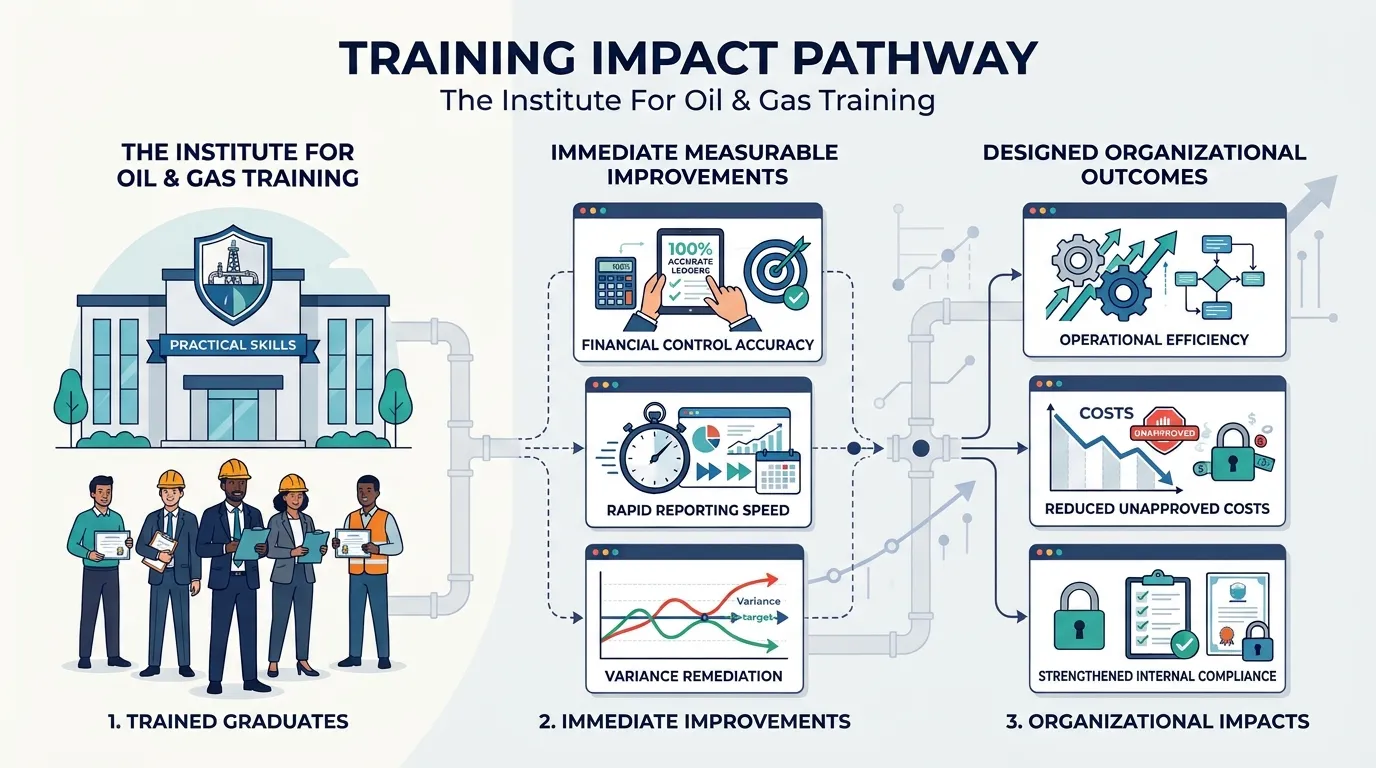
Graduates demonstrate immediate measurable improvements in financial control accuracy, reporting speed, and variance remediation effectiveness. The Institute For Oil & Gas Training designs outcomes to enhance operational efficiency, reduce unapproved cost growth, and strengthen internal compliance.
Individual Professional Impact
Equipping project personnel with structured analytical tools directly enhances their individual role performance and operational authority within project teams.
Enhanced Analytical Capability: Professionals rapidly isolate complex cost overrun drivers, moving beyond basic ledger reviews.
Executive-Level Communication: Managers draft clear variance commentary that provides actionable intelligence to senior leadership.
Proactive Risk Mitigation: Personnel identify early financial drift triggers before budget limits are breached.
Cross-Functional Authority: Engineers and operational leads bridge the gap between site activities and corporate financial requirements.
Corporate and Organizational ROI
For human resource departments, training leaders, and project directors, sending personnel to this course yields tangible structural returns across project portfolios.
Reduction in Unapproved Overruns: Establishing formal variance investigation thresholds prevents scope creep and unauthorized commitments.
Standardised Financial Reporting: HR teams build consistent competencies across regional offices, streamlining talent management.
Improved Accrual Precision: Accurate accrual versus spend reporting eliminates month-end accounting surprises for executive management.
Optimised Capital Allocation: Early identification of favorable and adverse variance allows management to reallocate capital effectively.
How Does Enrollment Work?
Enrollment involves a streamlined candidate evaluation process to confirm professional background suitability before course placement. The Institute For Oil & Gas Training maintains strict eligibility standards to ensure high-level peer interaction and collaborative learning.
Candidate Eligibility Criteria
The curriculum is engineered for mid-to-senior professionals who manage, monitor, or approve project expenditures.
Target Roles: Cost Engineers, Project Controls Managers, Finance Analysts, Operations Supervisors, Commercial Managers, and Procurement Lead Specialists.
Experience Requirements: Minimum 2–3 years of active involvement in project management, operational budgeting, or corporate cost control environments.
Prerequisite Knowledge: Basic familiarity with enterprise accounting concepts, project scheduling principles, and spreadsheet calculation models.
Enrollment and Application Workflow
Application Submission: Candidates submit their professional credentials and role details through the official course portal.
Profile Evaluation: The admissions team reviews candidate experience to verify alignment with course prerequisites and cohort standards.
Format Selection: Accepted applicants select their preferred training modality, schedule, and location preferences.
Pre-Course Preparation: Confirmed participants receive preparatory reading materials and diagnostic tools from the Institute For Oil & Gas Training prior to session commencement.
To secure your place in an upcoming cohort and transform your organization's financial control capabilities, enroll in this program today.
Frequently Asked Questions
What does oil and gas budgeting and cost control involve?
Oil and gas budgeting and cost control involves forecasting capital expenditures, establishing operational cost baselines, and monitoring real-time project spend against financial targets. Through structured frameworks provided by Institute For Oil & Gas Training, professionals learn to manage variance thresholds, evaluate accruals, and control resource allocation across upstream, midstream, and downstream operations. This ensures project profitability and prevents severe financial drift during complex energy developments.
Why is variance analysis critical in petroleum financial management?
Variance analysis isolates the underlying drivers of financial drift by separating price shifts from volume and consumption rate changes. Applying standard variance models enables project managers to distinguish between temporary market rate fluctuations and site-level operational inefficiencies. Institute For Oil & Gas Training equips teams with systematic methodologies to establish clear investigation thresholds and implement timely corrective action plans.
Who should undertake training in oil and gas petroleum budgeting & cost control?
This specialized instruction is designed for project controls managers, cost engineers, finance analysts, procurement leaders, and operational heads within the energy sector. Institute For Oil & Gas Training tailors the curriculum for professionals responsible for approving commitments, managing project cash flows, and delivering executive financial reporting. Candidates gain direct, actionable skills to enhance governance and standardise expenditure tracking across corporate units.
How does cost control differ between upstream and downstream energy operations?
Upstream cost control focuses primarily on high-risk capital expenditure, exploration uncertainty, and variable joint-venture billing structures. Conversely, downstream cost control targets operational expenditure, refinery yield efficiency, supply chain logistics, and maintenance downtime minimization. Institute For Oil & Gas Training covers analytical tracking frameworks suited to both capital-intensive field development and high-throughput processing environments.
How do commitment tracking and accrual reporting prevent project overruns?
Commitment tracking logs purchase orders and contracts at the point of obligation, giving early visibility of spend before invoices arrive. Accrual reporting aligns actual physical work performed on site with recorded accounting periods rather than lagging cash payments. Institute For Oil & Gas Training teaches professionals to integrate these techniques into routine budget variance reporting to eliminate unexpected cost inflation.
Related training courses
Budgeting & Forecasting for the Annual Budget Cycle Training Course
- Specialisation
- Oil & Gas Petroleum Budgeting & Cost Control
- Duration
- 5 days · 15 CPD hours
Cost Control & Variance Analysis Using Cost Coding Training Course
- Specialisation
- Oil & Gas Petroleum Budgeting & Cost Control
- Duration
- 5 days · 15 CPD hours
Cost Control for Field Development Projects: Overrun Prevention Training Course
- Specialisation
- Oil & Gas Petroleum Budgeting & Cost Control
- Duration
- 5 days · 15 CPD hours
More articles

How to Identify and Analyse Budget Deviations Through Cost Variance Analysis
Learn how to analyse budget deviations with cost variance analysis. Evaluate tracking methods, variances, and training for financial control.
Read article →
Why Cost Variance Analysis Matters in Oil and Gas Budget Control
Learn how cost variance analysis prevents budget overruns in oil and gas projects. Discover key frameworks, execution steps, and measurable ROI.
Read article →
Budgeting and Forecasting Rolling and Zero Based Techniques Training by Institute For Oil & Gas Training
Evaluate syllabus, delivery format, and workplace outcomes for the Budgeting and Forecasting Rolling and Zero Based Techniques Training course.
Read article →