
Petroleum operations require strict financial discipline across exploration, development, production, and decommissioning phases. Classifying expenditure correctly determines how costs flow through financial statements, directly impacting tax liabilities, joint venture audits, and operating margins. Upstream, midstream, and downstream assets present unique operational scenarios where the boundary between capital costs and operational expenses shifts rapidly. Misclassifying these expenditures distorts financial reporting and leads to severe regulatory non-compliance during joint interest billing audits.
Establishing accurate financial boundaries begins with understanding the core driver behind expenditure separation in asset-heavy industries. Operational teams must understand why CAPEX and OPEX classification matters in oil and gas finance before they evaluate specific field costs or implement project tracking systems. Misalignment between engineering units and finance departments routinely leads to improper capitalization of routine repairs or premature expensing of major asset enhancements. Establishing standardized internal accounting policies ensures consistent treatment across all operational sites, asset classes, and regional divisions.
What Is the Operational Difference Between CAPEX and OPEX in Oil and Gas?
The primary difference lies in whether an expenditure creates long-term asset value or maintains current operational capability. Capital expenditures acquire, upgrade, or extend the physical life of upstream assets, whereas operating expenditures cover routine day-to-day costs required to sustain continuous hydrocarbon production.
Petroleum operations involve massive capital allocations that dictate corporate liquidity and balance sheet strength over multi-year horizons. Accurately applying the capital expenditure definition requires verifying that a physical asset generates measurable economic benefits beyond the current accounting period. Upstream projects involve seismic acquisition, exploratory drilling, platform installation, and facility commissioning. These expenditures build the long-term producing foundation of the enterprise, requiring capitalization on the balance sheet followed by systematic depreciation, depletion, or amortization over the asset’s productive lifespan.
Operating costs represent the recurring financial friction of running petroleum assets daily. A rigorous operating expenditure definition encompasses continuous expenses such as field labor, fuel, consumables, surface lease rentals, routine maintenance, and administrative support. Operating expenses flow directly to the profit and loss statement within the accounting period incurred. Misallocating these expenses artificially inflates short-term earnings or conceals ongoing operational inefficiencies from senior management and joint venture partners.
Financial control teams must establish precise criteria to separate asset creation from operational preservation across field operations. Unclear accounting definitions create friction between asset managers aiming to minimize operating budgets and corporate accountants enforcing statutory compliance. Standardizing financial terminology across operational units prevents compliance failures during internal reviews and external joint venture audits.
How Do Capitalisation Criteria and Expensing Thresholds Govern Field Expenditure?
Capitalisation criteria require expenditures to enhance asset capacity, increase recovery efficiency, or extend operational lifespan beyond original design specifications. Expensing thresholds establish financial limits below which valid capital items are recorded immediately as operating costs to maintain accounting efficiency.
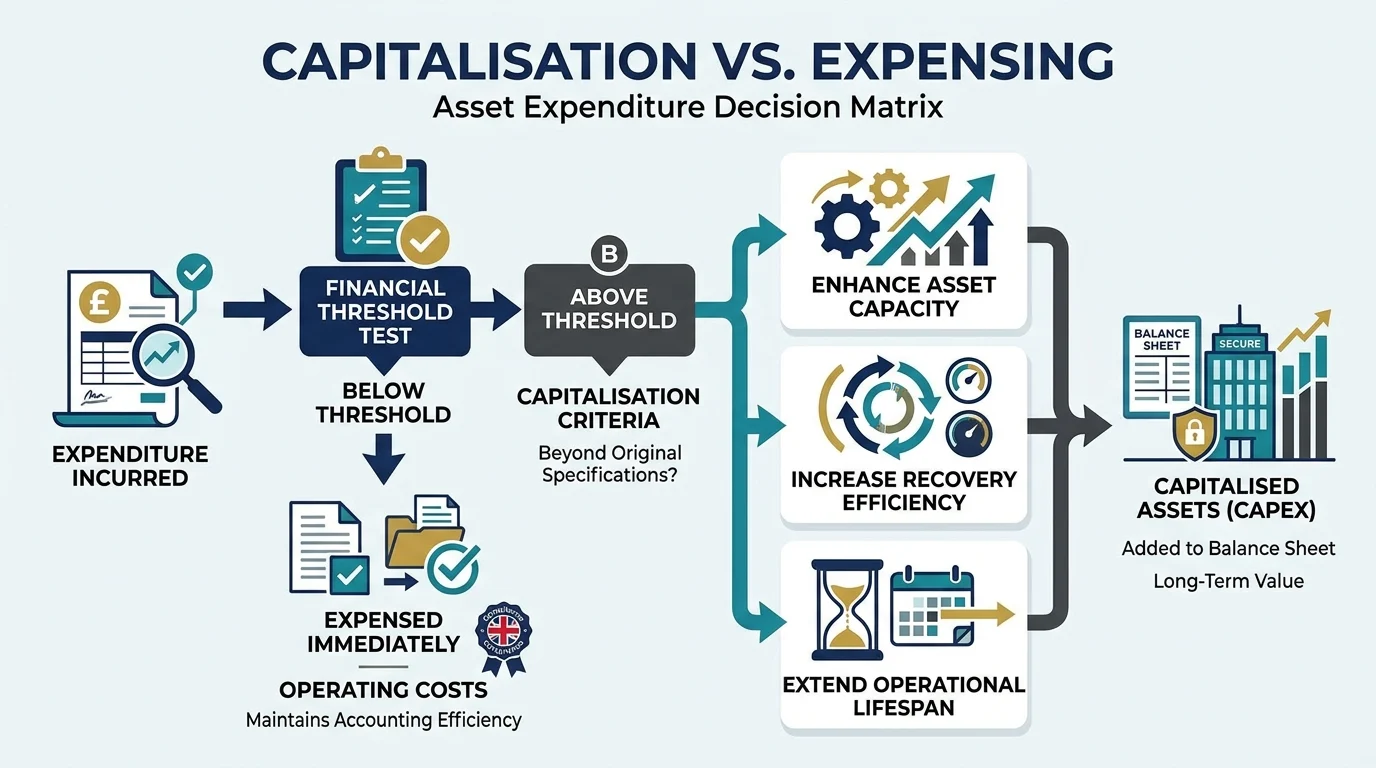
Applying capitalization standards in field environments requires clear quantitative and qualitative benchmarks. Financial controllers evaluate whether an physical intervention alters the underlying asset's baseline capabilities. Capitalization occurs when an investment significantly improves the production volume, safety threshold, or operational longevity of a platform, processing facility, or pipeline network. Without measurable performance improvements, field spending fails basic capitalization tests and must default to operational expenses.
Expensing thresholds provide pragmatic rules that keep corporate accounting systems from tracking trivial physical items over extended timeframes. Field operations consume hundreds of low-value physical components daily, including valves, minor instrumentation, and replacement piping segments. Establishing strict financial thresholds ensures that items under designated monetary cutoffs are expensed immediately, regardless of their theoretical physical lifespan.
Corporate finance teams publish policy manuals detailing specific thresholds based on project scope, facility type, and operational risk. The following structure illustrates how petroleum companies categorize field spending across capital and operational accounts:
Expenditure Category | Financial Objective | Accounting Treatment | Primary Operational Trigger |
Greenfield Development | Construct new production infrastructure | Capitalised (CAPEX) | Asset creation and facility installation |
Brownfield Expansion | Increase plant processing capacity | Capitalised (CAPEX) | Facility modification and throughput enhancement |
Major Turnaround | Restore original operating efficiency | Split (CAPEX/OPEX) | Component replacement and structural overhaul |
Routine Field Maintenance | Preserve continuous daily operations | Expensed (OPEX) | Minor repairs, fluid flushes, and inspections |
Well Workover (Repair) | Fix downhole mechanical failures | Expensed (OPEX) | Tubing repairs, pump swaps, and cleanouts |
Well Workover (Re-entry) | Access new producing reservoirs | Capitalised (CAPEX) | Perforating new zones and sidetracking |
Field engineers and accounting personnel must collaborate continuously to verify that daily purchase requisitions align with corporate guidelines. Inconsistent application of capitalization cutoffs distorts operational cost tracking, creates friction during partner billing, and weakens budget forecasting accuracy.
How Do Petroleum Operators Classify Maintenance Versus Enhancement Projects?
Maintenance preserves an asset's original operating condition and design performance capacity without extending its baseline life. Enhancement projects modify existing infrastructure to increase throughput efficiency, improve processing quality, expand storage capacity, or extend total operational lifespan beyond original engineering estimates.
Differentiating maintenance from enhancement represents one of the most complex tasks in oil and gas financial management. Routine field maintenance restores worn or damaged components to their original functional state. Repairing a leak in a process line, replacing worn pump seals, and repainting offshore jackets maintain current asset integrity. These actions prevent premature physical degradation, making them pure operating expenses that must be recognized immediately in current operating budgets.
Enhancements alter the functional specification of existing petroleum infrastructure to deliver superior economic outcomes. Replacing a standard separator with a higher-capacity unit or upgrading offshore power generation to lower emissions constitutes a capital enhancement. These modifications require formal capital budgeting, detailed engineering justifications, and long-term depreciation schedules to track their incremental financial contribution correctly across operating periods.
Evaluating project scopes requires applying a systematic evaluation model to prevent incorrect balance sheet treatment. Financial control teams utilize structured decision frameworks to evaluate operational spending before releasing project funds:
Evaluation Phase | Decision Criterion | Capital (CAPEX) Treatment | Operational (OPEX) Treatment |
Asset Capability Test | Does intervention increase production capacity? | Yes - Capitalise full modification cost | No - Evaluate under maintenance criteria |
Betterment Test | Does replacement exceed original technical spec? | Yes - Capitalise incremental upgrade value | No - Expense as like-for-like replacement |
Lifespan Test | Does work extend asset life beyond baseline? | Yes - Capitalise overhaul expenditure | No - Expense as routine preservation |
Financial Threshold | Does total spending exceed policy limits? | Yes - Capitalise if technical tests pass | No - Expense under materiality rules |
Operational teams must apply these evaluation phases consistently before issuing purchase orders or allocating project codes. Systematic classification protects operating margins, preserves balance sheet integrity, and ensures full compliance during complex joint venture audits.
What Rules Govern Workover and Turnaround Classification in Upstream Assets?
Workovers and turnarounds are classified by evaluating whether intervention work restores original production capacity or opens new hydrocarbon reserves. Downhole repairs and routine plant overhauls are expensed, while zone re-entries, sidetracks, and major structural enhancements are capitalised.
Upstream workovers cover a wide spectrum of downhole interventions designed to address mechanical failures or declining flow rates. Routine workover activities—such as replacing failed rod pumps, clearing sand blockages, or repairing damaged tubing—simply restore the well to its baseline operating capability. These activities represent operational maintenance. Conversely, workovers that involve sidetracking into new formation targets, deepening the wellbore, or re-completing in previously untapped pay zones create new productive value, requiring capital treatment.
Major facility turnarounds present significant accounting challenges due to the simultaneous execution of maintenance, safety inspections, and plant upgrades. Turnaround activities that focus on cleaning vessels, replacing worn valves, inspecting heat exchangers, and certifying relief systems fall under operational expenses. These tasks preserve existing operating integrity and meet regulatory safety mandates without altering the plant's structural capacity or design parameters.
When turnarounds incorporate major structural modifications, the associated expenditures must be separated using clear accounting rules. Capitalizing turnaround costs requires isolating the precise labor, materials, and contractor expenses tied to capacity expansion or technological upgrades. Facilities teams must track turnaround expenditures using discrete job orders to ensure that maintenance costs flow to current operating accounts while betterment projects are capitalized onto fixed asset registers.
How Does the Betterment Test Determine Useful Life Extension for Capitalization?
The betterment test evaluates whether an physical investment enhances an asset's technical capability, efficiency, or operational lifespan beyond its original design specs. Passing the betterment test requires documented engineering proof of increased asset utility or extended operational longevity.
Applying the betterment test prevents arbitrary capitalization of routine operational repairs. Financial controllers examine whether an asset modification delivers a structural increase in physical capacity, processing speed, or overall operational life. If an intervention merely restores an asset to its original operational state after normal wear and tear, it fails the betterment test and must be expensed as an operating cost.
Engineering documentation plays a critical role in supporting capitalization decisions under betterment rules. Project teams must provide empirical baseline data demonstrating the asset's performance before and after the modification. Upgrading an offshore compressor to process gas at higher working pressures passes the betterment test because it increases overall field output beyond historical limits. Replacing that same compressor with an identical unit after an operational failure fails the test, requiring operational expensing.
Extending useful life requires demonstrating that an investment delays asset retirement or decommissioning dates. Re-jacketing offshore platforms, structural hull reinforcements on floating production vessels, and major pipeline re-coatings extend operational utility across future accounting periods. Capitalizing these expenditures requires updating corporate fixed asset registers and adjusting depreciation schedules to reflect the extended productive life of the underlying infrastructure.
How Should Organizations Structure Classification Policy Documentation for Audit Readiness?
Classification policy documentation must define explicit accounting rules, financial thresholds, project coding structures, and operational sign-off workflows. Clear documentation ensures consistent financial reporting, streamlines joint venture audits, and eliminates costly tax compliance disputes.
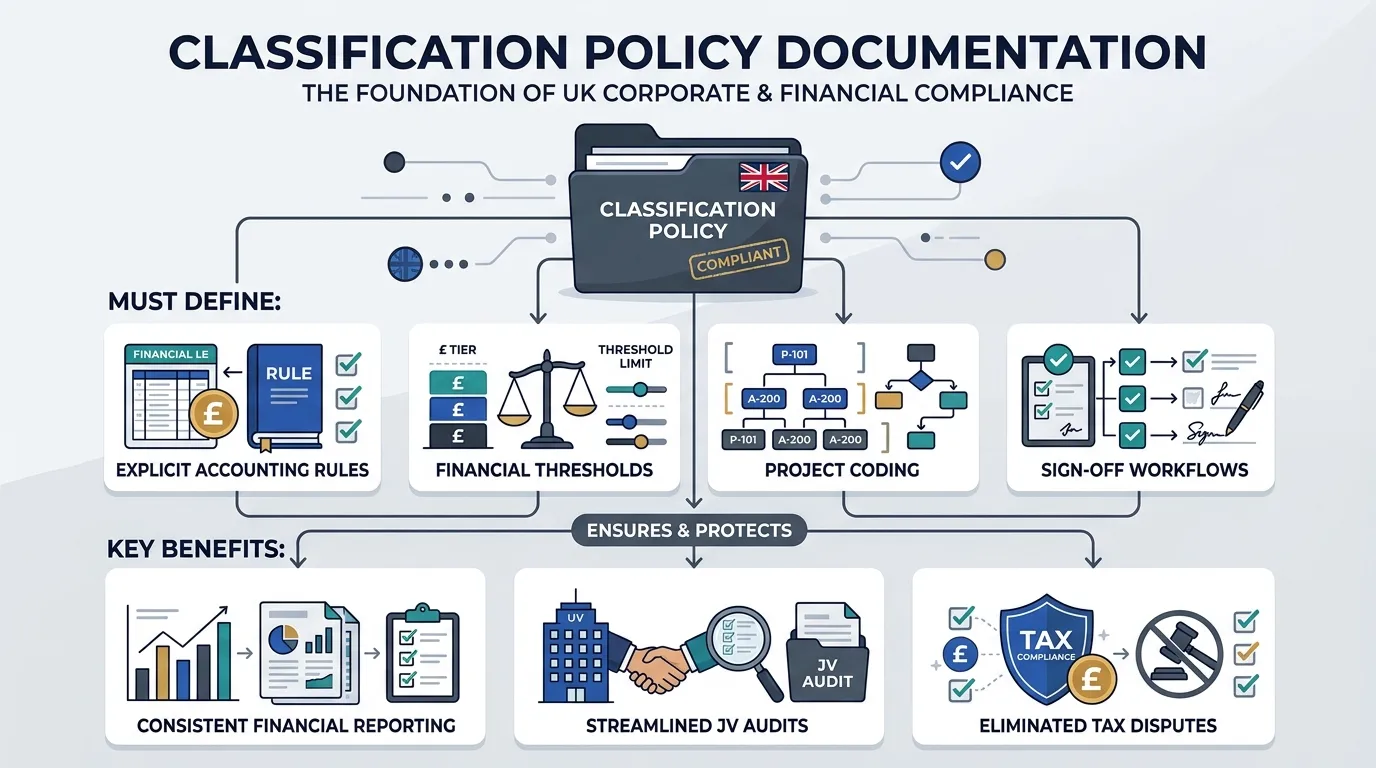
Developing robust classification policy documentation requires close coordination between corporate finance, legal teams, and field operations managers. Policy manuals must detail precise rules for every operational asset class, from seismic surveys to abandonment activities. Clear guidelines eliminate ambiguity, ensuring that engineers, procurement specialists, and financial analysts categorize purchase requisitions consistently across all operating assets.
Policy documentation must incorporate explicit sign-off matrices to enforce operational accountability. High-value field interventions require joint authorization from technical asset managers and corporate controllers before project codes are issued. Documenting these approval pathways creates a clear audit trail that supports financial statement assertions and protects the organization during complex joint interest billing audits.
Maintaining audit readiness requires regular reviews and updates of policy manuals to reflect changing regulatory standards and evolving operational models. Clear classification policies reduce financial compliance risks, streamline partner reconciliations, and ensure that workforce execution aligns with corporate governance frameworks.
How Do Corporate Training Approaches Build Classification Competency Across Teams?
Structured corporate training builds shared financial literacy across engineering, procurement, and accounting units. Effective learning delivery models combine practical field case studies, regulatory compliance frameworks, and real-world project exercises to eliminate operational misclassification risks.
Workforce skill gaps between field operations and corporate finance represent a major source of financial reporting risk. Field engineers often make procurement decisions without understanding the downstream accounting consequences of their choices. Conversely, finance professionals frequently lack the technical field knowledge needed to evaluate whether a complex turnaround scope represents routine maintenance or a capital asset betterment. Implementing targeted professional development programs bridges this operational gap across business units.
HR leaders and department heads must evaluate various training frameworks to determine the most effective delivery mechanism for their operational teams. Training models vary significantly in their delivery structure, time requirements, and practical application value:
Training Delivery Model | Core Structural Focus | Operational Strengths | Implementation Challenges |
External Academic Seminars | Theoretical accounting standards and regulatory rules | High conceptual rigor and exposure to industry standards | Low contextual relevance to specific field operations |
Self-Paced eLearning | Basic terminology and introductory policy guidelines | Scalable delivery and minimal operational disruption | Limited hands-on practice with complex field scenarios |
Customized Corporate Training | Specialized field scenarios, joint venture rules, and company policy | High contextual relevance and immediate operational ROI | Requires dedicated team scheduling and corporate commitment |
Corporate training programs focused on petroleum financial rules deliver immediate operational returns by reducing post-audit adjustments and partner billing disputes. Dedicated learning paths ensure that cross-functional teams apply capitalization rules accurately across every phase of asset development.
Organizations seeking to eliminate field misclassification risks should enroll key operational, procurement, and accounting personnel in the specialized CAPEX vs OPEX Classification & Decision Rules Training Course. Equipping cross-functional teams with practical decision frameworks ensures consistent policy execution, protects operating margins, and maintains full compliance during complex joint venture audits.
Selecting practical learning programs equips operational managers with the tools needed to evaluate complex field scenarios accurately. Enrolling cross-functional teams in structured CAPEX vs OPEX Classification and Decision Rules Training by Institute For Oil & Gas Training ensures that engineering, procurement, and finance personnel adopt unified accounting standards across all operational sites. Organizations that prioritize financial skills development achieve superior compliance rates, streamlined audit cycles, and optimal balance sheet management across their entire petroleum asset portfolio.
Frequently Asked Questions
What is Oil & Gas Petroleum Budgeting & Cost Control training?
Oil & Gas Petroleum Budgeting & Cost Control training is a specialized professional development program designed for energy sector personnel. Delivered by the Institute For Oil & Gas Training, this course covers capital expenditure (CAPEX) and operating expenditure (OPEX) management, variance analysis, and financial forecasting for upstream, midstream, and downstream operations. It equips managers and finance teams with practical tools to monitor expenditures, manage project cash flows, and maintain financial discipline across complex petroleum operations.
Why is petroleum budgeting and cost management important in the energy sector?
Volatile crude prices, high capital intensity, and strict joint venture operational requirements make rigorous cost governance essential for energy companies. Effective petroleum budgeting and cost control ensures that exploration and production projects remain commercially viable while minimizing budget overruns. Through training from the Institute For Oil & Gas Training, professionals learn to align operational milestones with strategic financial planning to protect operating margins and drive long-term profitability.
Who should attend an Oil & Gas Petroleum Budgeting & Cost Control course?
This course is designed for finance professionals, joint venture accounting staff, asset managers, project engineers, and HR leaders responsible for workforce upskilling in energy organizations. Participants gain actionable insights into petroleum cost accounting, field expenditure tracking, and economic evaluation frameworks. Training provided by the Institute For Oil & Gas Training bridges the gap between field engineering activities and corporate financial control, fostering cross-functional alignment.
What key topics are covered in a petroleum budgeting and cost control program?
The curriculum focuses on cash flow forecasting, authorization for expenditure (AFE) tracking, field cost estimation techniques, and financial risk mitigation in petroleum projects. Key modules also explore cost recovery mechanisms, joint interest billing practices, and variance reporting frameworks tailored to oil and gas asset lifecycles. Programs delivered by the Institute For Oil & Gas Training combine practical industry case studies with standardized financial reporting frameworks to maximize learning outcomes.
How does Oil & Gas Petroleum Budgeting & Cost Control training improve project performance?
By providing technical teams and managers with structured cost-tracking methodologies, training eliminates budget creep and enhances decision-making accuracy during asset development. Professionals learn to detect financial variances early, optimize resource allocation, and implement effective cost reduction strategies without compromising operational safety. Organizations that invest in Oil & Gas Petroleum Budgeting & Cost Control through the Institute For Oil & Gas Training achieve improved audit compliance, clearer joint venture transparency, and stronger project return on investment.
Related training courses
Budgeting & Forecasting: Rolling & Zero-Based Techniques Training Course
- Specialisation
- Oil & Gas Petroleum Budgeting & Cost Control
- Duration
- 5 days · 15 CPD hours
Cost Control & Variance Analysis for Budget Deviations Training Course
- Specialisation
- Oil & Gas Petroleum Budgeting & Cost Control
- Duration
- 5 days · 15 CPD hours
Budget Planning and Cost Optimisation Training Course
- Specialisation
- Oil & Gas Petroleum Budgeting & Cost Control
- Duration
- 5 days · 15 CPD hours
More articles

CAPEX vs OPEX Impact on Cost Recovery Training by Institute For Oil & Gas Training
Evaluate the CAPEX vs OPEX Impact on Cost Recovery Training by Institute For Oil & Gas Training. Learn modules, structure, outcomes, and enrollment details.
Read article →
How to Assess the Impact of CAPEX and OPEX Classification on Petroleum Cost Recovery
Learn how to assess CAPEX and OPEX classification in petroleum cost recovery. Evaluate audit risks, cash flow effects, and joint venture compliance.
Read article →
Why CAPEX and OPEX Classification Affects Cost Recovery in Oil and Gas
Learn how CAPEX and OPEX classification dictates cost recovery mechanisms, cash flow velocity, and regulatory compliance in upstream petroleum accounting.
Read article →