
CAPEX and OPEX classification establishes the foundational financial framework that dictates capital structure, tax liabilities, earnings before interest, taxes, depreciation, and amortization (EBITDA), and regulatory compliance across upstream, midstream, and downstream petroleum assets.
Capital expenditure (CAPEX) represents long-term investments in physical assets that yield economic benefits beyond a single accounting period. Operating expenditure (OPEX) covers day-to-day operational expenses incurred to maintain asset function. In capital-intensive sectors like oil and gas, misclassifying these costs distorts financial reporting, creates non-compliance risks under International Financial Reporting Standards (IFRS) and Generally Accepted Accounting Principles (GAAP), and misleads equity investors regarding operational efficiency.
Organizations face major financial exposure when project teams lack clear accounting boundaries. Misallocating major maintenance to CAPEX artificially inflates short-term earnings, while overly conservative expensing of asset enhancements suppresses profitability metrics. Finance professionals, project engineers, asset managers, and commercial teams require unified cross-functional understanding to ensure every dollar aligns with corporate governance frameworks and tax regulatory guidelines.
Understanding Capital Expenditure in Petroleum Assets
The capital expenditure definition encompasses funds used by a petroleum enterprise to acquire, upgrade, and maintain physical assets such as exploration wells, offshore platforms, processing facilities, and pipelines.
Petroleum operations require strict adherence to capitalisation criteria to determine whether expenditures qualify for asset recognition on the balance sheet. Expenditures must generate future economic benefits and possess costs that management can measure reliably.
Exploration and Appraisal Costs: Capitalised upon successful discovery of commercially viable reserves under IFRS 6.
Field Development Infrastructure: Initial construction costs for production facilities, subsea manifolds, and export pipelines.
Asset Betterments: Modifications that expand plant capacity by at least 15% or reduce operating costs permanently.
Defining Operating Expenditure in Daily Field Operations
The operating expenditure definition refers to operational expenses incurred during daily business operations to keep production assets running at design capacity without expanding their capability.
OPEX directly impacts the income statement within the current financial period. Operational expenses include lease operating expenses (LOE), routine inspections, minor repairs, field personnel salaries, and utility consumption across processing plants.
Establishing precise expensing thresholds prevents low-value purchases from creating unnecessary administrative work on fixed asset registers. Items falling below predefined financial values (e.g., equipment purchases under £50,000) are charged immediately as operational expenses regardless of their useful life.
How Do Skill Gaps in Financial Classification Impact Corporate Performance?
Unaligned engineering and financial teams trigger severe audit penalties, inflated operational budgets, distorted project net present value (NPV) estimates, and misreported corporate earnings that erode investor confidence and reduce free cash flow efficiency.
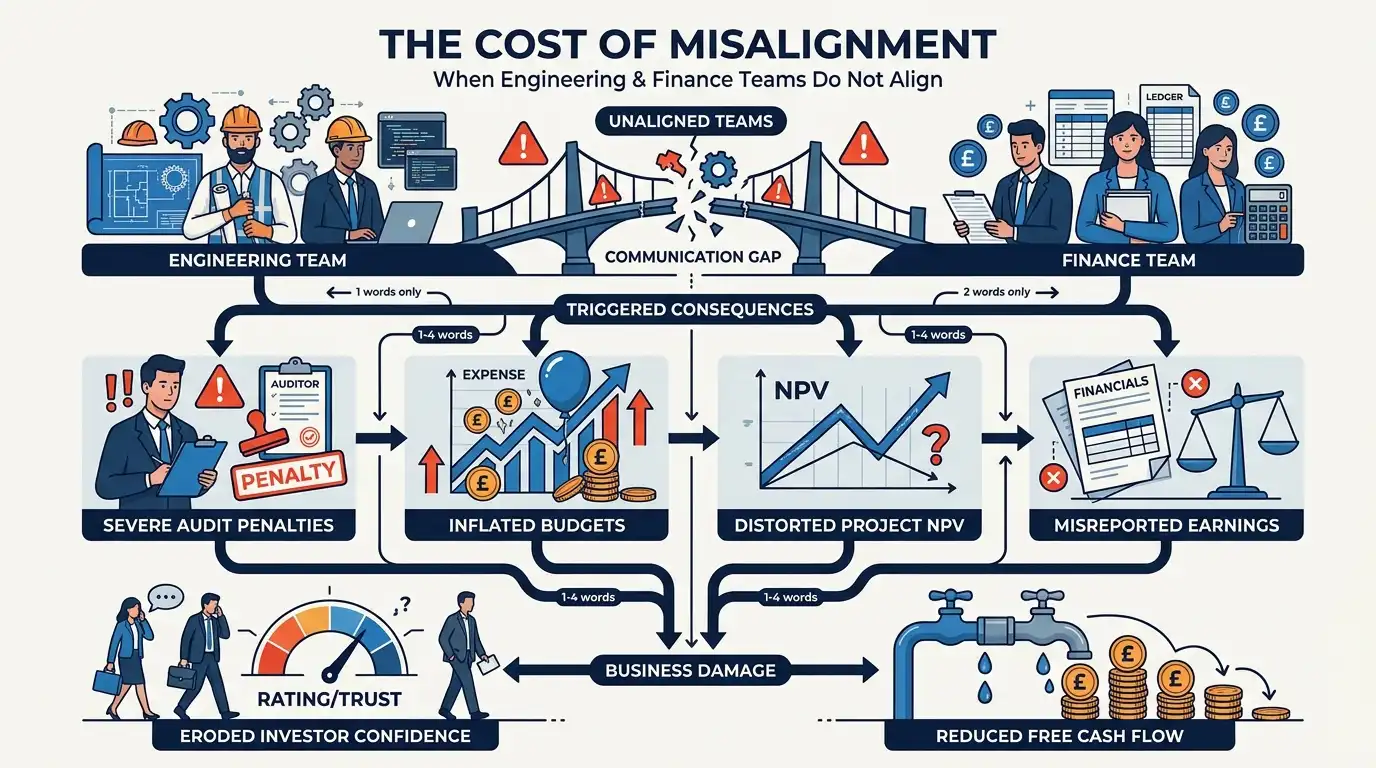
Skill gaps emerge when operational staff make purchasing and work-order decisions without understanding financial governance. Engineers focused on asset reliability frequently label major overhauls as routine maintenance, while procurement teams misapply accounting codes during purchase order creation. This disconnect creates financial restatements, delayed audits, and inaccurate asset valuations.
Cross-functional friction increases when operations and finance operate in silos. Financial analysts rely on field documentation to categorize expenses correctly. When field reports lack precise scope descriptions, financial controllers default to conservative expensing, which depresses reported net income and distorts key performance indicators (KPIs).
Financial Misclassification and Regulatory Consequences
Incorrected expenditure entries expose oil and gas operators to substantial legal and tax risks. Regulatory bodies, including tax authorities and securities regulators, review accounting practices to identify tax evasion or earnings manipulation.
Classification Error | Operational Trigger | Financial Impact | Regulatory Risk |
Capitalising Routine Maintenance | Tagging annual pump servicing as plant upgrade | Artificially inflates short-term earnings and balance sheet assets | High risk of financial restatements and SEC/FCA penalties |
Expensing Major Upgrades | Charging platform expansion to daily operating budget | Suppresses net income; reduces short-term tax liability incorrectly | Tax audit exposure, interest charges, and under-reporting fines |
Misallocating Turnaround Costs | Aggregating repairs and enhancements in one work order | Distorts EBITDA; invalidates depreciation schedules | Non-compliance with IAS 16 and IFRS accounting standards |
Workplace efficiency drops when finance teams spend hundreds of hours manually auditing job tickets to correct input errors. Establishing clear competencies reduces auditing delays, speeds up month-end closes, and ensures tax reporting remains accurate across international jurisdictions.
How Is CAPEX and OPEX Governance Training Delivered in Corporate Environments?
Corporate training uses structured, step-by-step methodologies combining financial policy workshops, real-world petroleum case studies, cross-departmental alignment sessions, and practical work-order classification simulations to build long-term operational competence.
Effective corporate learning programs bridge the gap between technical operations and financial governance. Organizations implement multi-stage learning initiatives that target multi-disciplinary cohorts, including project directors, petroleum engineers, cost controllers, and accounting personnel.
1.Pre-Assessment and Policy Benchmarking:Duration: 1-2 Weeks.
Instructors evaluate team skill gaps by reviewing past work orders and auditing current accounting practices. This baseline assessment identifies common classification errors, cross-departmental miscommunications, and policy gaps specific to the operator's asset portfolio.
2.Structured Workshop Delivery:Duration: 3-5 Days (Intense Classroom / Hybrid).
Learners examine core principles governing the capitalisation criteria, betterment tests, useful life extension, and expensing thresholds. Content focuses on international standards including IAS 16 (Property, Plant and Equipment) and IFRS 6 (Exploration for and Evaluation of Mineral Resources).
3.Simulation and Case-Based Application:Duration: Ongoing Interactive Modules.
Participants work through actual field scenarios, evaluating complex offshore turnarounds, workover programs, and platform modifications. Cross-functional teams analyze real job scopes, determine correct cost split ratios, and defend their financial decisions against governance standards.
4.Post-Training Governance Integration:Duration: 4 Weeks Post-Course.
Organizations update their standard operating procedures (SOPs) and integrate decision trees directly into Enterprise Resource Planning (ERP) software like SAP or Oracle. Teams complete post-training evaluations to confirm skill retention and process compliance.
To master practical application rules across complex petroleum operations, finance and operational managers must master specific accounting frameworks. Understanding how to evaluate turnarounds, asset modifications, and routine servicing requires direct training on real-world operational scopes. Professionals seeking to master these decision workflows rely on structured learning solutions such as the CAPEX vs OPEX Classification & Decision Rules Training Course to build cross-functional governance across asset teams.
What Key Components and Decision Frameworks Govern Expenditure Classification?
The classification framework relies on four core technical criteria: the betterment test, useful life extension evaluations, strict accounting boundary policies, and standardized classification policy documentation.
Determining whether an expenditure is capitalised or expensed requires clear technical criteria. Organizations rely on structured decision trees to analyze maintenance activities, major overhauls, and asset modifications uniformly across all operational divisions.
Applying the Betterment Test in Asset Upgrades
The betterment test determines whether an expenditure enhances an asset's baseline performance capacity or simply restores original operating performance.
To qualify as a betterment under standard financial guidelines, the modification must meet at least one of these criteria:
Production Volume Enhancement: Increases throughput capacity beyond original design specifications (e.g., upgrading a separator to handle 120,000 barrels per day up from 100,000).
Operating Cost Reduction: Permanently lowers operating costs through technological upgrades (e.g., converting diesel power systems to solar-hybrid arrays).
Product Quality Improvement: Enables the processing facility to handle heavier crude or reduce sulfur content to access higher-margin markets.
Expenditures that fail the betterment test are classified as routine maintenance and charged directly as OPEX, even if the financial outlay is substantial.
Evaluating Maintenance Versus Enhancement Activities
The boundary between maintenance versus enhancement activities often becomes blurred during major engineering events. Clear definitions prevent misclassification during reporting periods.
Routine Maintenance: Scheduled servicing, component replacements like-for-like, rust treatment, and safety valve recalibrations. These actions sustain original design capability and represent OPEX.
Asset Enhancements: Installing advanced telemetry systems, retrofitting compressor units with high-efficiency turbines, or structural modifications to accommodate deeper drilling equipment. These initiatives qualify as CAPEX.
Workover and Turnaround Classification Standards
Field operations involve workovers and major platform turnarounds that mix maintenance tasks with capital improvements. Clear accounting rules must be applied to split these costs correctly.
The workover and turnaround classification methodology dictates how companies account for major facility shutdowns. Turnarounds involve hundreds of individual work packages executed over a compressed timeframe.
Engineers and accountants must break down turnaround work packages item by item:
Component Replacement (OPEX): Replacing worn valve internals or heat exchanger tube bundles with identical specifications.
Asset Life Extension (CAPEX): Complete structural re-lining of processing vessels that adds 8 years of operational lifespan beyond the original asset retirement schedule.
Well Workovers: Re-completing an existing well in a new producing formation is capitalised, whereas sidetracking to clear a blocked hole without opening new reserves is expensed.
Useful Life Extension Criteria
Expenditures that extend useful life beyond the original asset lifecycle plan qualify for capitalisation. If an onshore processing plant has a designated 20-year lifespan and a £15 million overhaul extends its operational utility by another 7 years, the overhaul cost is capitalised. The cost is then depreciated over the extended 7-year timeframe.
Organizations document these guidelines in comprehensive classification policy documentation. This policy serves as the official corporate governance manual, providing clear definitions, dollar thresholds, and approval chains for engineering and finance teams.
How Do Organizations Implement Financial Classification Rules Across Departments?
Successful implementation requires embedding financial decision trees into Enterprise Resource Planning (ERP) software, updating standard operating procedures, training cross-functional teams, and conducting quarterly expenditure reviews.
Implementing robust cost-classification policies demands structural changes across operational workflows. Organizations that rely on manual reviews or ambiguous spreadsheets experience high error rates and audit findings. Modern enterprise execution integrates accounting rules directly into project management and procurement systems.
Cross-functional alignment ensures that project management, operations, procurement, and accounting teams apply identical rules when creating work orders, issuing purchase requisitions, and approving invoices.
Detailed procedures for applying accounting standards across live field projects are outlined in specialized operational guides. Professionals seeking deep step-by-step frameworks can review How to Apply CAPEX and OPEX Classification Rules in Petroleum Operations to establish compliant field-level expenditure procedures.
ERP Integration and Automated Governance
Standardizing expenditure classification requires configuring enterprise systems like SAP, Oracle, or Maximo to enforce financial governance at the point of data entry.
Work Breakdown Structure (WBS) Tagging: Requires project managers to select pre-approved financial categories before creating a project budget line item.
Mandatory Scope Description Fields: Disallows vague purchase order descriptions like "refurbishment work" in favor of structured scope selections (e.g., "like-for-like replacement" vs "capacity expansion").
Automated Approval Routing: Automatically routes purchase requisitions exceeding specific expensing thresholds to corporate accounting for validation.
Updating operational software prevents misclassifications before money is spent, eliminating time-consuming retroactive accounting entries.
What Measurable Outcomes and Business Benefits Does Proper Classification Produce?
Accurate expenditure classification improves EBITDA accuracy by 15-25%, reduces audit adjustment times by 40%, optimizes corporate tax liabilities, increases project ROI visibility, and strengthens overall capital allocation strategy.
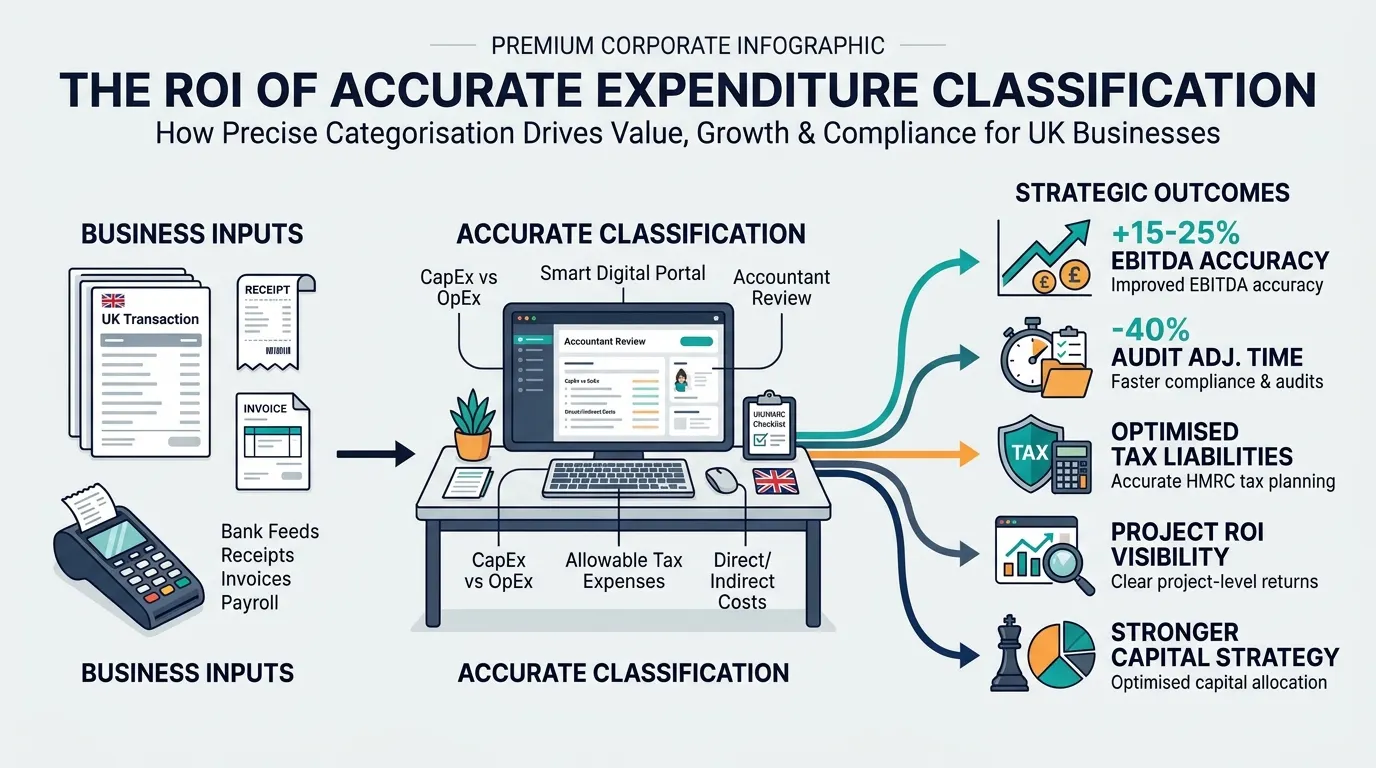
Disciplined CAPEX and OPEX classification delivers direct financial and operational benefits across oil and gas enterprises. Companies that establish clear classification governance eliminate financial restatements, optimize cash flows, and improve investor trust.
Financial KPIs and Operational Impact
Proper governance transforms financial visibility, ensuring that capital is deployed efficiently across exploration, production, and refining assets.
Accurate EBITDA and Operating Margin Reporting: Prevents artificial inflation or suppression of operating earnings, providing true performance visibility to executive leadership and external investors.
Optimized Tax Liabilities: Ensures that operational expenses are deducted immediately to lower current tax liability where legally permitted, while capital assets are systematically depreciated over their actual useful life under tax codes.
Enhanced Return on Capital Employed (ROCE): Ensures that balance sheet capital accurately reflects productive assets, enabling more reliable evaluation of capital efficiency across business units.
Streamlined Audit Processes: Eliminates end-of-year accounting disputes between field engineers and external auditors, reducing audit completion timelines and professional fees.
Organizational Benefits Across Key Corporate Departments
Applying rigorous cost classification rules strengthens operations across multiple departments:
Executive Leadership and Boards: Gain confidence in financial reports, risk management, and long-term capital allocation plans.
Finance and Treasury Teams: Maintain reliable cash flow forecasts, lower compliance risks, and optimize corporate borrowing structures.
Engineering and Operations Teams: Gain clear guidelines for project budgeting, eliminating approval bottlenecks for major maintenance and platform modifications.
Commercial and Procurement Units: Issue contracts with clear financial terms, simplifying invoice reconciliations and vendor management.
What Are the Common Misconceptions and Challenges in Expenditure Governance?
Common failure points include treating cost classification as a finance-only task, relying on generic off-the-shelf accounting rules, assuming all high-cost projects are CAPEX, and failing to update financial policy documentation as operating assets age.
Organizations frequently struggle with recurring misconceptions that undermine financial governance and distort project metrics across operational units.
Misconception 1: "Cost Classification Is Exclusively a Finance Responsibility"
Financial controllers do not manage field operations or write work packages. Over 80% of cost classification errors originate at the operational level when engineers write ambiguous job descriptions on work orders. Training operational managers to understand accounting implications solves classification errors at the source.
Misconception 2: "High-Dollar Projects Are Automatically CAPEX"
The size of an expenditure does not determine its financial classification. A £20 million emergency repair that replaces damaged subsea piping with identical components is an operating expense (OPEX) because it merely restores baseline performance. Conversely, a £200,000 modification that permanently increases processing capacity is capitalised (CAPEX). Classification is governed by economic intent and capability enhancements, not total project cost.
Misconception 3: "Off-the-Shelf Accounting Rules Fit Petroleum Operations"
Generic corporate finance rules fail to address the complexities of upstream oil and gas operations. Petroleum assets require specific policies covering joint venture billing, farm-in agreements, turnaround allocations, and production-sharing contract (PSC) cost-recovery rules. Customizing financial classification guidelines to match industry realities is essential for compliance.
Misconception 4: "Classification Policies Do Not Need Regular Updating"
Operating environments, tax laws, and accounting standards change over time. Operating assets experience performance degradation, requiring management to adjust depreciation schedules and useful life assumptions. Organizations must review their classification policy documentation annually to align internal practices with evolving regulatory standards and corporate strategy.
Building strong cross-functional competence in expenditure classification ensures that capital is deployed effectively, financial reporting remains fully compliant, and operational assets deliver sustainable economic returns across their lifecycle.
Frequently Asked Questions
What is included in an Oil & Gas Petroleum Budgeting & Cost Control course?
An Oil & Gas Petroleum Budgeting & Cost Control course delivered by the Institute For Oil & Gas Training covers capital expenditure (CAPEX) and operating expenditure (OPEX) management, variance analysis, project cash flow forecasting, and financial risk mitigation. Participants learn how to construct realistic field budgets, track operational costs against targets, and apply cost-control methodologies across upstream, midstream, and downstream assets.
Who should attend petroleum budgeting and cost control training?
This training is designed for project engineers, finance professionals, cost controllers, asset managers, and operations leaders working within the energy sector. Professionals looking to enhance their commercial acumen benefit from learning how to align engineering decisions with corporate financial governance through the Institute For Oil & Gas Training.
How does cost control training improve project profitability in petroleum operations?
Effective Oil & Gas Petroleum Budgeting & Cost Control training provides operational teams with practical tools to monitor expenditure real-time, detect cost overruns early, and eliminate budget waste. By establishing strict financial reporting standards, organizations trained by the Institute For Oil & Gas Training protect project margins and optimize return on capital employed (ROCE).
Why is cost control critical in upstream oil and gas projects?
Upstream developments involve high capital intensity, long payback periods, and volatile commodity pricing, making financial precision essential. Structured Oil & Gas Petroleum Budgeting & Cost Control instruction ensures field teams effectively distinguish between capitalised asset enhancements and operating expenses, reducing tax exposure and financial reporting errors for oil and gas enterprises.
What learning formats are available for oil and gas financial management training?
The Institute For Oil & Gas Training offers flexible learning formats, including interactive live workshops, tailored in-house corporate programs, and online modular courses. These practical programs incorporate real-world petroleum case studies and financial modeling exercises to ensure immediate application in corporate operating environments.
Related training courses
CAPEX vs OPEX Impact on Cost Recovery Training Course
- Specialisation
- Oil & Gas Petroleum Budgeting & Cost Control
- Duration
- 5 days · 15 CPD hours
Budgeting & Forecasting: Rolling & Zero-Based Techniques Training Course
- Specialisation
- Oil & Gas Petroleum Budgeting & Cost Control
- Duration
- 5 days · 15 CPD hours
Budget Planning and Cost Optimisation Training Course
- Specialisation
- Oil & Gas Petroleum Budgeting & Cost Control
- Duration
- 5 days · 15 CPD hours
More articles

CAPEX vs OPEX Impact on Cost Recovery Training by Institute For Oil & Gas Training
Evaluate the CAPEX vs OPEX Impact on Cost Recovery Training by Institute For Oil & Gas Training. Learn modules, structure, outcomes, and enrollment details.
Read article →
How to Assess the Impact of CAPEX and OPEX Classification on Petroleum Cost Recovery
Learn how to assess CAPEX and OPEX classification in petroleum cost recovery. Evaluate audit risks, cash flow effects, and joint venture compliance.
Read article →
Why CAPEX and OPEX Classification Affects Cost Recovery in Oil and Gas
Learn how CAPEX and OPEX classification dictates cost recovery mechanisms, cash flow velocity, and regulatory compliance in upstream petroleum accounting.
Read article →