

Contract obligation management is the systematic framework of identifying, extracting, executing, and monitoring legal, operational, and financial commitments within energy agreements. It ensures organizational alignment, eliminates non-compliance risks, protects capital investments, and standardizes workforce execution across multi-billion-pound capital asset project lifecycles.
In the oil and gas sector, a single joint operating agreement or engineering, procurement, and construction contract contains thousands of actionable commitments. These commitments govern health, safety, environmental mandates, local content requirements, delivery milestones, payment schedules, and performance guarantees. When project teams fail to track these clauses, organizations incur severe financial penalties, operational delays, and reputation loss. Contract obligation management shifts legal agreements from static paper documents into active operational workflows. It links contractual parameters directly to daily site execution, engineering deliverables, and supply chain activities.
From a workforce development and enterprise perspective, contract obligation management serves as a critical competency for project managers, commercial leads, engineers, and procurement specialists. Organizations that lack structured competence in this discipline experience margin erosion of up to 9% on major capital projects. Operationalizing contractual obligations requires cross-functional alignment between legal, finance, engineering, and site operations teams. Commercial success depends on transforming legal prose into clear, traceable deliverables with designated owners, explicit timelines, and measurable performance standards across every project phase.
Why Do Oil and Gas Organizations Face Severe Obligation Compliance Failures?
Energy organizations fail at contract compliance because functional teams operate in silos, contract handovers lack systematic structure, operational teams lack legal literacy, and companies rely on manual spreadsheets rather than standardized compliance monitoring frameworks and centralized obligation registers across complex project environments.
The transition from contract award to project execution represents the primary point of commercial failure in capital energy projects. Legal and business development teams negotiate complex terms over months, yet handover protocols to execution teams remain ad hoc and unstructured. Project managers and site engineers receive contracts spanning hundreds of pages without clear summaries of their specific operational duties. Consequently, technical personnel make daily field decisions that inadvertently breach notice requirements, miss relief clause deadlines, or trigger liquidated damages provisions.
Manual processes exacerbate these operational blind spots. Relying on disconnected spreadsheets across disparate engineering departments leads to outdated information, broken audit trails, and unmonitored risk exposure. Furthermore, key terms tracking often focuses solely on primary deadlines like final completion dates, while completely overlooking secondary obligations such as submittal approvals, joint venture audit windows, and statutory reporting duties. Without structured training programs that establish contract owner accountability, staff members view compliance as a legal department function rather than an operational duty integrated into their daily routine.
Compliance Risk Factor | Operational Mechanism | Enterprise Impact |
Unstructured Handovers | Legal terms remain uninterpreted for technical execution staff | Unintentional breach of operational terms and notice windows |
Siloed Management | Engineering, legal, and finance track data independently | Duplicate efforts, missed submittals, and unrecorded variations |
Manual Tracking | Spreadsheets lack automated alerts and audit logs | Data corruption, missed milestones, and lost revenue recovery |
Low Contract Literacy | Field staff lack understanding of breach and remedy terms | Inability to issue timely force majeure or variation notices |
How Does Obligation Extraction and Mapping Work in Workforce Development?
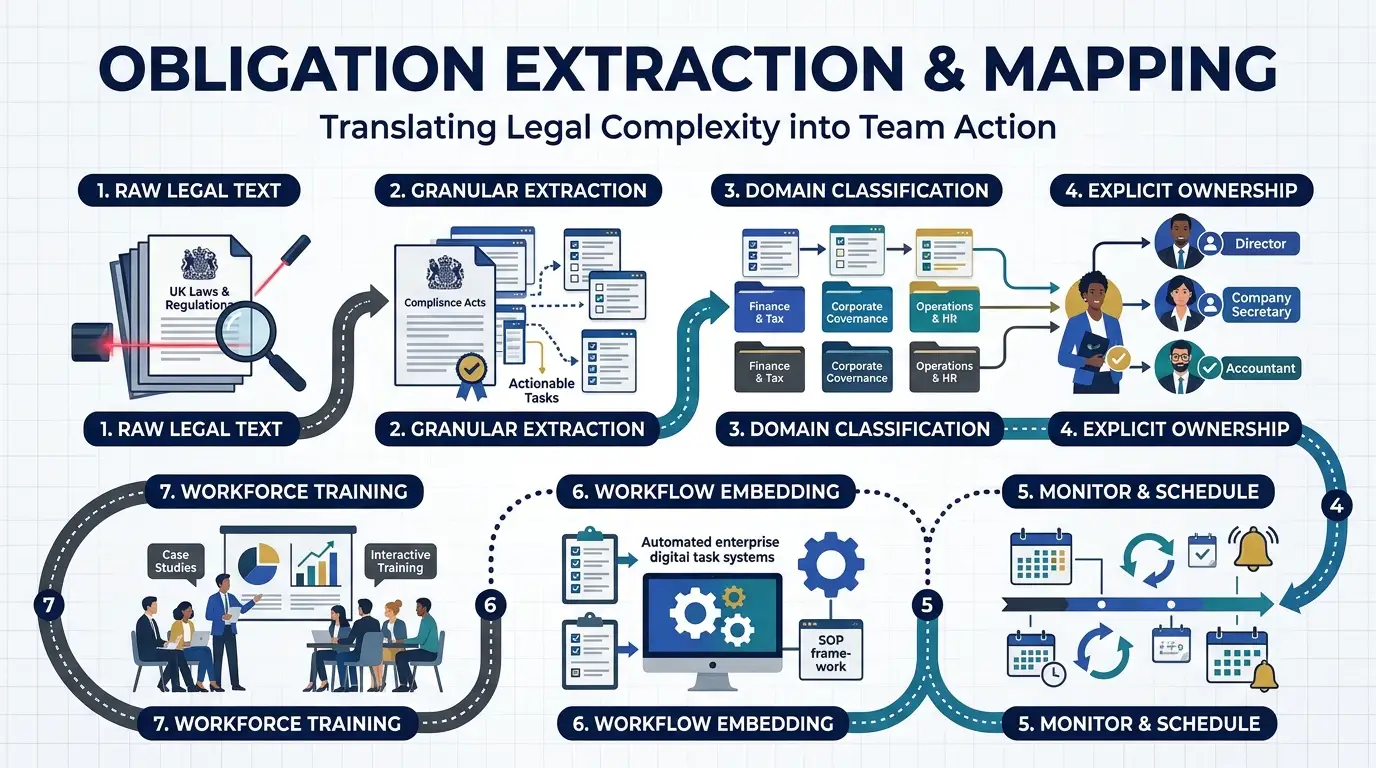
Obligation extraction and mapping works by breaking down legal text into granular, actionable tasks, classifying them by operational domain, assigning explicit ownership, establishing monitoring schedules, and embedding these parameters into standardized corporate workflows through practical, case-based workforce training methodologies.
Phase 1: Contract Analysis and Decomposition
Workforce development begins by teaching teams to systematically review complex agreements, including Joint Operating Agreements, Production Sharing Contracts, and Engineering, Procurement, Construction, and Commissioning contracts. Participants learn to isolate mandatory action verbs, conditional triggers, passive commitments, and explicit deadlines embedded within dense legal prose across major operational domains like logistics, HSE, and procurement.
Phase 2: Metadata Classification and Extraction
Teams apply structured taxonomies to categorize every identified commitment into a operational matrix. Learners map each item by type, governing clause, trigger event, risk level, and required proof of completion. This step ensures that technical commitments, financial milestones, and administrative notices receive structured metadata tags for seamless database integration and ongoing verification.
Phase 3: Creating the Contract Obligation Register
Participants transform extracted data into a centralized contract obligation register. The training guides professionals to define explicit inputs, required documentation, verification standards, and reporting cadences for every row. This establishes a single source of truth that links legal requirements directly to project scheduling software and enterprise resource planning systems.
Phase 4: Workflow Mapping and Assignment
Learners establish explicit contract owner accountability by linking every mapped item to specific organizational roles rather than general departments. Training modules demonstrate how to embed these tasks into daily field workflows, ensuring project engineers, commercial managers, and quality inspectors receive automated triggers before critical operational windows close.
What Essential Components Make Up an Effective Compliance Monitoring Framework?
An effective compliance monitoring framework comprises a centralized obligation register, clear accountability matrices, standardized extraction protocols, automated tracking technologies, structured verification procedures, and continuous audit mechanisms that collectively guarantee total visibility over all contractual commitments across project lifecycles.
A robust enterprise framework relies on precise architectural components to eliminate operational risk:
Obligation Extraction and Mapping Guidelines: Standardized procedures for converting contract text into structured data points across all business units.
Centralized Contract Obligation Register: A secure database tracking every commitment, due date, responsible party, and compliance status in real time.
Accountability Matrix (RACI): Clear designations defining who is Responsible, Accountable, Consulted, and Informed for every clause in the agreement.
Key Terms Tracking Engine: Automated systems that monitor critical milestones, notice requirements, deliverable schedules, and financial thresholds.
Breach and Remedy Protocols: Clear operational procedures that define exact escalation paths when a delivery failure or contractual breach occurs.
Audit and Verification Artifacts: Standardized templates for collecting physical, digital, and financial evidence to prove compliance to partners, auditors, and regulators.
To deploy these components successfully across capital asset projects, organizations must upskill their workforce through targeted professional development. Teams require formal training to master extraction techniques, operate monitoring software, and enforce accountability across cross-functional groups.
When evaluating organizational readiness and structuring internal capability programs, leadership teams evaluate training solutions such as the Contract Compliance: Obligation Extraction & Monitoring Training Course to build standardized operational competencies across engineering, commercial, and legal divisions.
How Do Enterprise Organisations Implement Contract Obligation Management Programs?
Organisations implement contract obligation management programs by establishing corporate governance policies, integrating specialized technology platforms, conducting diagnostic skill audits, executing targeted multi-modal training interventions, and embedding continuous audit cycles across all project management office workflows.
Enterprise implementation begins with a thorough audit of existing commercial processes and workforce capabilities. Leadership teams evaluate how current projects handle handover protocols, notice management, and risk identification. This diagnostic phase identifies systemic capability gaps, such as engineers misinterpreting variation clauses or procurement officers missing submittal timelines. Organizations then establish standardized corporate guidelines that mandate obligation tracking for all contracts valued above designated financial thresholds, such as £1,000,000.
Following policy definition, organizations execute comprehensive workforce capability programs. Training delivery formats combine structured workshops, online learning modules, and hybrid simulation sessions. Learning interventions utilize case-based learning, where professionals analyze real-world energy contracts, perform live obligation extraction, and populate enterprise registers under expert supervision. Simulation exercises force participants to navigate complex breach and remedy provisions, draft legally sound notices under tight time constraints, and resolve simulated joint venture disputes.
Implementation integrates these skills directly into corporate technology infrastructure. Teams configure enterprise resource planning systems and project management tools to reflect the obligation register. Contract compliance metrics become standard agenda items during monthly project reviews, while internal audit teams conduct quarterly verification checks. This integration ensures that commercial discipline becomes a continuous operational habit rather than an afterthought triggered by legal disputes.
What Specific Metrics Measure the Impact of Contract Management Training?
Organizations measure training impact through specific quantitative metrics, including percentage reduction in missed notice deadlines, percentage decrease in unrecoverable variation claims, accelerated milestone delivery times, reduced legal dispute costs, and improved employee retention rates among commercial project staff.
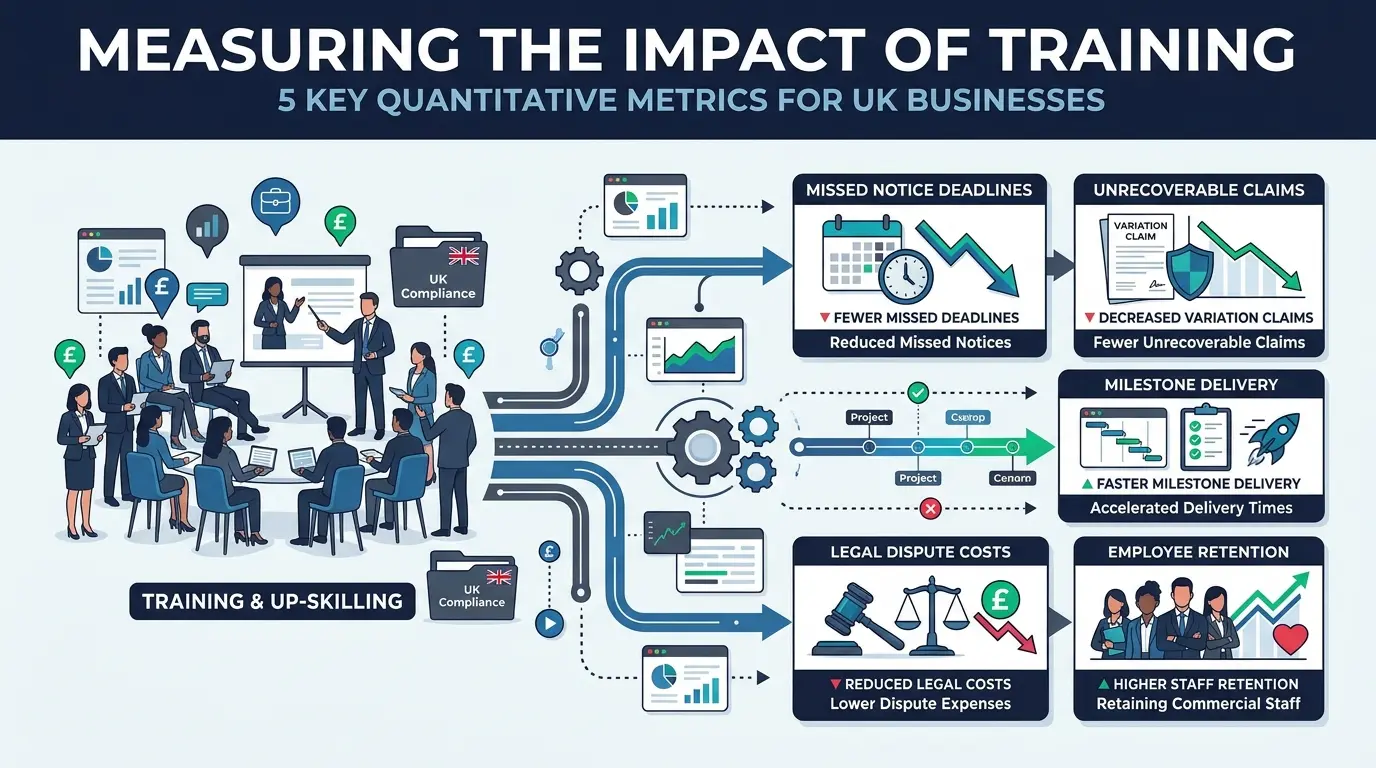
To evaluate return on investment, learning and development leaders track precise Key Performance Indicators across four primary domains:
Commercial Risk Reduction: Measuring the financial value of avoided liquidated damages, penalties, and uncollected variation claims across active project portfolios.
Operational Efficiency: Tracking the speed of obligation identification, reducing contract review times from 14 days down to 48 hours post-negotiation.
Compliance Accuracy Rate: Calculating the percentage of contractual deliverables submitted and accepted on or before the legal deadline, targeting 98% compliance.
Workforce Capability Metrics: Assessing pre- and post-training competency scores in legal literacy, extraction precision, and risk identification across project management cohorts.
Beyond immediate financial metrics, contract obligation management training drives long-term organizational transformation. Standardized workflows reduce operational friction between legal specialists and site engineers, fostering a culture of collaborative accountability. Employees operating with clear process clarity experience lower stress levels, leading to a 15% increase in workforce retention across commercial project management divisions within 12 months of program completion.
What Common Misconceptions Disrupt Obligation Compliance Delivery?
Common misconceptions include believing contract management is strictly a legal department duty, assuming enterprise software eliminates the need for workforce training, viewing obligation tracking as administrative overhead, and assuming standard project management methodologies automatically cover contractual compliance requirements.
The most damaging misconception in capital-intensive industries like energy, construction, and manufacturing is that contract compliance belongs exclusively to the legal department. Legal counsel structures agreements and manages formal litigation; they do not oversee day-to-day equipment inspections, submittal logs, or site-level notice windows. When operational teams delegate obligation tracking to legal counsel, field decisions occur in a commercial vacuum, leading to unrecorded variations and waived rights.
Another prevalent myth is that implementing Contract Lifecycle Management software automatically solves compliance challenges. Technology platforms are merely empty containers; they require skilled professionals capable of accurately extracting subtle, conditional obligations from unstructured text. Without comprehensive training in obligation extraction and mapping, organizations populate expensive software platforms with incomplete or inaccurate data, creating a false sense of security while operational exposure remains completely unmitigated.
Finally, enterprise leaders often assume that standard project management certifications adequately prepare staff for contract execution. General project management methodologies focus on schedule network diagrams, resource allocation, and general team management. They rarely cover the precise legal mechanics of breach and remedy provisions, joint venture auditing constraints, or formal notice requirements. Specialized workforce development programs bridge this gap by teaching professionals how to navigate the legal frameworks that govern modern commercial projects.
Frequently Asked Questions
What are the main types of oil and gas petroleum contracts?
The primary contract types in the energy sector include Production Sharing Contracts (PSCs), Joint Operating Agreements (JOAs), Concession Agreements, and Service Contracts. Each agreement dictates how exploration risks, operational responsibilities, revenues, and tax liabilities are distributed between host governments and international oil companies. Institute For Oil & Gas Training provides comprehensive professional instruction covering the legal frameworks, fiscal terms, and operational obligations inherent to each contract model.
Why is specialized training in oil and gas petroleum contracts important for energy professionals?
Petroleum agreements involve complex legal, financial, and technical terms where misinterpretation can lead to severe regulatory penalties, contractual disputes, or financial losses. Specialized training equips commercial managers, legal teams, and project leads with the skills to extract obligations, monitor compliance, and manage risk across the asset lifecycle. Professional courses from Institute For Oil & Gas Training ensure workforce alignment with international industry standards and operational best practices.
What key skills are required to manage oil and gas petroleum contracts effectively?
Effective contract management requires legal literacy, obligation extraction expertise, compliance monitoring, dispute resolution knowledge, and commercial risk analysis. Professionals must also master financial modeling for fiscal terms, joint venture auditing procedures, and notice requirement protocols. Institute For Oil & Gas Training develops these core competencies through practical, case-based learning designed for modern corporate energy environments.
How do organizations implement compliance frameworks for petroleum agreements?
Organizations establish contract compliance by creating centralized obligation registers, assigning explicit role-based accountability, and embedding automated milestone tracking into project management workflows. Cross-functional alignment between legal, procurement, and technical execution teams ensures that operational field decisions comply with contractual terms. Institute For Oil & Gas Training assists companies in structuring these operational frameworks through practical workforce development programs.
What role do Joint Operating Agreements play in oil and gas operations?
Joint Operating Agreements (JOAs) govern the working relationship, cost-sharing ratios, voting rights, and operational duties among consortium partners in an exploration or production block. They define the authority of the designated operator while protecting the commercial interests of non-operating financial partners. Standardized training on oil & gas petroleum contracts at Institute For Oil & Gas Training helps project leaders navigate JOA negotiations, default provisions, and joint interest accounting protocols.
Related training courses
Contract Compliance: Obligation Extraction & Monitoring Training Course
- Specialisation
- Oil & Gas Petroleum Contracts
- Duration
- 5 days · 13 CPD hours
Contract Compliance Across JOAs, PSCs & HGAs Training Course
- Specialisation
- Oil & Gas Petroleum Contracts
- Duration
- 5 days · 15 CPD hours
Contract Strategy, Risk and Negotiation Training Course
- Specialisation
- Oil & Gas Petroleum Contracts
- Duration
- 5 days · 15 CPD hours
More articles

Contract Compliance Across JOAs PSCs and HGAs Training by Institute For Oil & Gas Training
Evaluate the Contract Compliance Across JOAs PSCs and HGAs Training by Institute For Oil & Gas Training for oil and gas compliance management.
Read article →
How to Monitor and Manage Contractual Compliance Across JOAs PSCs and HGAs
Learn how to evaluate monitoring frameworks, audit protocols, and governance models for JOA, PSC, and HGA contractual compliance.
Read article →
Why Contract Compliance Is Challenging Across JOAs PSCs and HGAs
Learn why managing compliance across JOAs PSCs and HGAs challenges energy sector teams and how corporate training builds risk mitigation skills.
Read article →