

Three way matching in joint venture accounting is the control verification process that reconciles purchase orders, receiving documentation, and vendor invoices before payment. It guarantees that operating expenditures qualify for joint venture chargeability, preventing audit exceptions and joint venture write-offs.
In petroleum joint ventures, chargeability determines whether an operating expense is billable to non-operating partners under Joint Operating Agreements (JOAs) and Accounting Procedures (COPAS or local standards). Organizations lose millions annually when accounting teams process invoices without confirming that ordered items match delivered goods and final billings. Three way matching establishes strict financial discipline across multi-partner joint ventures, ensuring that every billed dollar aligns with approved Work Programs and Budgets (WP&B).
Corporate Joint Venture (JV) operations involve complex financial structures where the operating partner manages procurement on behalf of non-operating partners. Unverified costs create severe partner disputes during joint venture audits. Implementing robust verification frameworks ensures that operating expenses fulfill supporting documentation standards required by international oil and gas joint ventures.
Without systematic verification, companies risk internal control failures, delayed joint venture cash calls, and severe revenue leakage. Workforce training in invoice verification equips finance, procurement, and joint venture accounting teams with the methodologies required to maintain continuous chargeability validation across all operational phases.
Why Is Three Way Matching Essential for Corporate Risk Management and Audit Readiness?
Three way matching eliminates unrecoverable joint venture costs by catching billing errors, unauthorized purchases, and quantity discrepancies before payment execution. It builds audit ready records that satisfy non-operating partner reviews, regulatory compliance, and joint venture joint audit requirements.
Non-operating partners routinely conduct joint venture audits 24 to 36 months after operational activities take place. When operators present invoices lacking receiving logs or purchase authorization, non-operators issue formal audit exceptions, demanding full refunds or cost disallowances. Organizations that implement automated three way matching achieve 100% chargeable cost validation prior to posting expenses to the joint venture billing ledger.
The operational risk landscape increases when joint venture operations expand into deepwater drilling, subsea engineering, or major pipeline construction. Shared assets require precise cost distribution across joint venture partners. Training procurement and finance professionals on cost recovery evidence requirements eliminates discrepancies between physical field receipts and joint venture joint account billings.
Operational Risk Area | Consequence of Weak Controls | Outcome of Three Way Matching |
Partner Audits | Cost disallowances and financial penalties | Audit ready invoice files and zero partner exceptions |
Cash Flow Management | Delayed partner reimbursements and cash call disputes | Accelerated billing cycles and predictable cash inflow |
Procurement Integrity | Duplicate payments and overbilling by suppliers | Automated detection of line-item mismatches |
Tax Compliance | Non-compliance with VAT and withholding tax on invoices | Verified tax withholdings and clean statutory audits |
Proper control environments prevent cost allocation disputes, maintaining commercial trust between operating and non-operating joint venture partners.
How Does the Three Way Matching Process Function Step by Step in Modern Organizations?
The three way matching process functions through sequential verification across purchase orders, receiving reports, and vendor invoices. It validates prices, quantities, terms, and authority levels before joint venture accounting teams code and disburse funds to suppliers.
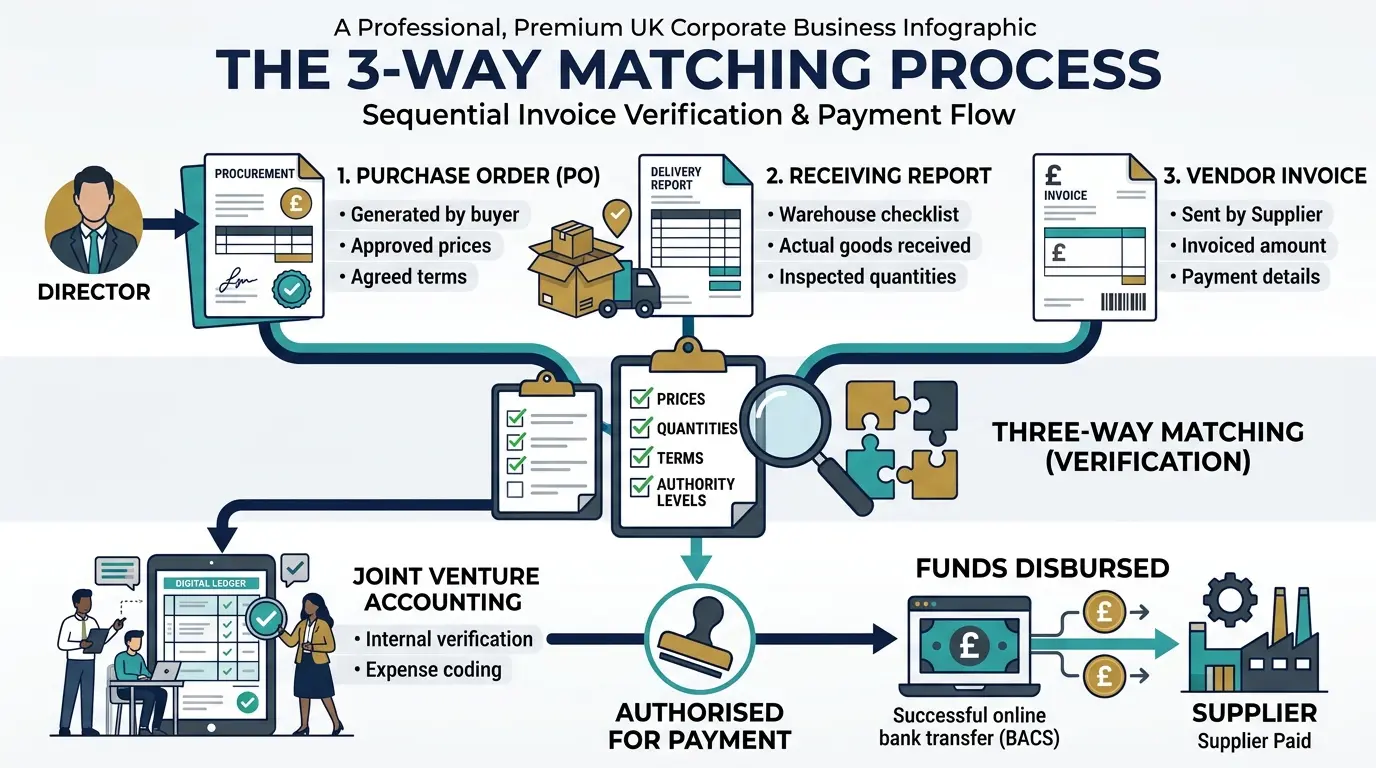
Step 1: Purchase Order Generation and Approval
Procurement teams issue an official Purchase Order (PO) based on approved joint venture budgets. The PO defines line-item descriptions, agreed unit prices, delivery schedules, and assigned joint venture cost centers. Authorized signers validate the commitment against the active Work Program and Budget.
Step 2: Receiving Documentation and Field Verification
Upon physical receipt of equipment, materials, or services at remote operating sites, field personnel generate a Goods Receiving Note (GRN) or Service Entry Sheet (SES). Field teams verify physical counts, inspect technical specifications, and document material arrivals. This step establishes non-negotiable backup documentation for partners to prove physical delivery.
Step 3: Invoice Receipt and Line-Item Reconciliation
The accounts payable team receives the vendor invoice and initiates the matching procedure. Accounts payable systems align three distinct data points:
Unit price and total value on the vendor invoice against the original Purchase Order.
Quantity and specifications on the invoice against the validated Goods Receiving Note.
Cost allocation codes on the invoice against the joint venture agreement chargeability criteria.
Step 4: Exception Handling and Discrepancy Resolution
If price variations exceed predefined tolerance thresholds (e.g., 0.5%), system controls place an automated hold on the invoice. Finance teams investigate whether the discrepancy stems from price inflation, partial shipments, or unauthorized scope adjustments.
Step 5: Chargeability Authorization and Joint Account Posting
Once reconciled, accounts payable personnel confirm invoice coding accuracy, apply correct tax treatments, and transfer the expense to the joint venture billing engine. The operating company successfully issues cash calls to non-operating partners backed by verified documentation.
What Key Components and Skills Are Required for Effective Invoice Verification Training?
Effective invoice verification training combines core competencies in joint venture accounting rules, digital ERP matching tools, tax compliance, and document control frameworks. It develops technical skills to systematically audit complex vendor billings.
Professional development in joint venture financial controls covers technical, analytical, and system-oriented modules designed for modern energy sector finance teams.
1. Joint Operating Agreement (JOA) Chargeability Frameworks
Workforce participants learn international accounting standards, including COPAS, AIPN, and regional joint venture guidelines. Training covers direct charges, indirect overhead allocations, non-chargeable administrative expenses, and partner approval thresholds.
2. Digital Matching Systems and ERP Automation
L&D programs build hands-on skills in enterprise systems like SAP S/4HANA, Oracle ERP Cloud, and specialized joint venture accounting software. Learners practice configuring automated matching tolerances, managing electronic workflows, and resolving system-flagged exceptions.
3. Shared Cost and Multi-Partner Allocation Rules
Corporate operations frequently run joint facilities serving multiple production fields or exploration blocks. Professionals master the allocation of shared invoices using volumetric, throughput, or fixed-percentage methods without violating joint venture contracts.
4. Tax Compliance and Statutory Withholding Verification
Cross-border joint ventures involve intricate tax structures. Training ensures accounting personnel accurately compute VAT and withholding tax on invoices, preventing joint venture tax penalties and double taxation risks.
To gain structural competence in deploying these systems, professionals complete the 3-Way Matching & Invoice Verification for JV Chargeability Training Course, which provides real-world case simulations and audit execution practice.
What Specific Corporate Use Cases Benefit Most From Joint Venture Matching Controls?
Corporate teams in oil and gas exploration, offshore drilling, EPC construction, and pipeline operations rely on three way matching. It protects high-capital projects where shared expenditures require transparent, error-free joint account documentation.
Offshore Drilling and Field Development Projects
Offshore exploration projects involve high daily expenditures (e.g., rig day-rates exceeding 300,000 USD). Marine logisticians and offshore rig accountants use three way matching to reconcile daily progress logs, marine vessel charters, and equipment rentals before billing non-operating partners.
Jointly Owned Infrastructure and Midstream Pipelines
Shared processing terminals and pipeline networks serve multiple joint venture groups. Accounting teams apply systematic verification to split maintenance, power generation, and operational expenses among participants based on real-time SCADA throughput data.
Engineering, Procurement, and Construction (EPC) Contracts
Capital-intensive EPC megaprojects feature thousands of supplier line items. Implementing robust matching controls ensures that engineering change orders, material deliveries, and progress milestones correlate directly with contractual pricing structures.
Cross-Border Joint Ventures in Emerging Markets
Operations across multinational boundaries must reconcile local currency invoices with international billing units (USD or EUR). Three way matching protects organizations against exchange rate miscalculations, unauthorized local vendor surcharges, and improper tax withholdings.
What Are the Organizational Benefits and Measurable Outcomes of Workforce Upskilling?
Workforce upskilling in invoice matching delivers measurable corporate benefits, including a 95% reduction in audit disallowances, accelerated partner cash recoveries, 40% faster invoice processing times, and full compliance with joint venture accounting standards.
Investing in structured corporate training produces quantitative returns across financial, operational, and audit performance metrics.
Financial Protection and Revenue Retention
Preventing unchargeable expenses protects corporate margins. Organizations eliminate structural revenue leakage by verifying that every dollar spent matches contractual entitlements before requesting partner reimbursement.
Enhanced Partner Trust and Commercial Governance
Transparent accounting practices strengthen commercial relationships between operators and non-operators. Flawless billing cycles eliminate audit friction, facilitating faster approvals for future Work Programs and Budgets.
Operational Efficiency and Process Standardisation
Structured training standardizes accounts payable routines across regional business units. Standardized document flows eliminate manual rework, reduce paper-based tracking, and streamline end-of-month financial closures.
How Should HR Leaders and L&D Professionals Implement Joint Venture Accounting Training?
HR and L&D leaders implement joint venture accounting training by assessing workforce skills, selecting practical blended delivery formats, integrating real-world project data, and evaluating performance metrics through post-training financial audits.
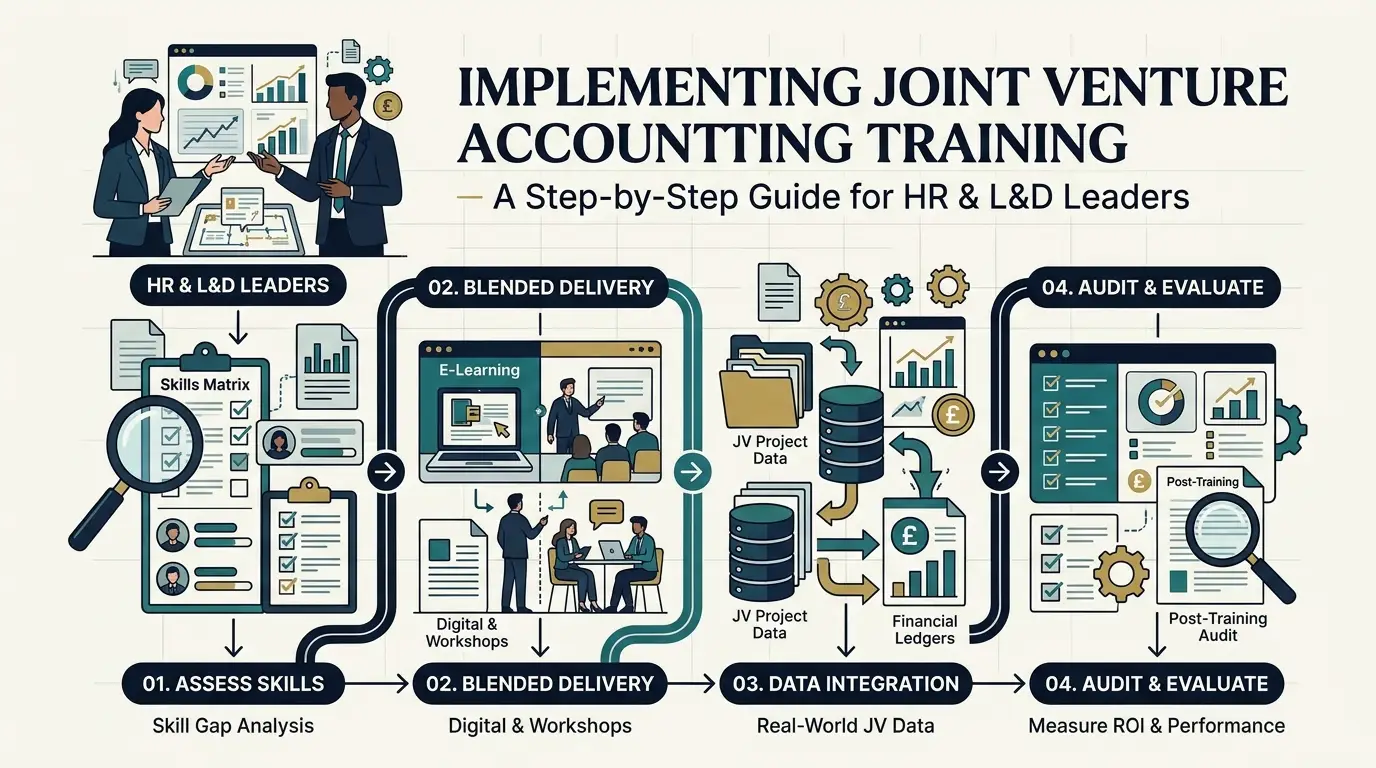
Executing a successful workforce transformation program requires a structured corporate learning strategy tailored to corporate finance and procurement objectives.
Phase 1: Skill Gap Analysis and Audience Mapping
Identify knowledge deficits across accounts payable teams, joint venture accountants, project managers, and field procurement personnel. Determine specific operational friction points, such as high partner audit queries or long invoice approval cycles.
Phase 2: Curriculum Customization and Methodology Selection
Design training modules that incorporate actual company documentation, such as local JOAs, custom ERP workflows, and typical vendor contracts. Modern learning frameworks utilize:
Case-Based Learning: Analyzing real-life joint venture audit disputes and cost recovery failures.
ERP System Simulations: Practicing interactive matching routines in simulated SAP or Oracle sandbox environments.
Role-Play Scenarios: Simulating partner audit negotiations and vendor dispute resolutions.
HR managers evaluating structural implementation frameworks often review How to Validate Invoices and Ensure Accurate JV Chargeability Through Three Way Matching to align internal learning paths with corporate governance objectives.
Phase 3: Delivery Execution Across Business Units
Deploy training through flexible, modern formats to accommodate site-based and corporate staff:
Interactive Workshops: 3-day intensive sessions for senior joint venture accountants and audit leads.
Blended E-Learning Modules: Self-paced micro-learning modules covering basic matching rules and invoice coding integrity.
Cohort-Based Training: Hybrid learning tracks pairing corporate finance professionals with field operations managers.
Phase 4: Post-Training Evaluation and Continuous Assessment
Measure learning impact by tracking key operational performance indicators 60, 90, and 180 days post-training. Evaluate metrics such as invoice processing velocity, error rate reductions, and partner audit clearance speed.
What Common Misconceptions Cause Joint Venture Matching Programs to Fail?
Matching programs fail when organizations view invoice verification as a simple accounts payable clerk task rather than an enterprise-wide risk management strategy, or when companies rely on static classroom training without hands-on system practice.
Misconception 1: "Automated ERP Systems Eliminate the Need for Human Skill"
Many executive teams assume buying advanced enterprise software resolves matching errors automatically. However, software relies on correct manual input, accurate tax selection, and proper joint venture coding. Without trained staff, automated systems flag false positives or let miscoded charges pass through unnoticed.
Misconception 2: "Three Way Matching Is Solely an Accounts Payable Function"
Treating invoice verification as an isolated accounting task causes operational failure. Field engineers, logistics coordinators, and procurement specialists generate the POs and GRNs that feed the matching engine. Comprehensive training must bridge the gap between technical site operations and corporate financial controls.
Misconception 3: "Generic Accounting Courses Are Sufficient for Joint Venture Operations"
Standard corporate accounting courses do not address the unique chargeability rules, COPAS guidelines, or non-operator audit rights present in international joint operating agreements. Customized, industry-specific training is required to master joint venture chargeability validation.
Frequently Asked Questions
What is oil and gas petroleum procurement?
Oil and gas petroleum procurement is the strategic process of sourcing, purchasing, and managing materials, equipment, and services required for upstream, midstream, and downstream energy operations. The Institute For Oil & Gas Training provides specialised professional development programs that equip supply chain personnel with essential skills in vendor management, contract negotiation, and material tracking. Effective oil & gas petroleum procurement ensures seamless operational continuity, strict regulatory compliance, and cost efficiency across complex energy projects.
How does supply chain management differ in the petroleum industry?
Petroleum supply chain management differs from general procurement due to high operational risks, volatile market pricing, complex international logistics, and strict health, safety, and environmental (HSE) standards. Professional training from the Institute For Oil & Gas Training focuses on mitigating supply chain disruptions and managing high-capital contracts in remote operating environments. Mastering oil & gas petroleum procurement requires deep technical knowledge of specialized field equipment, joint venture accounting rules, and global trade regulations.
What are the key stages of the petroleum procurement process?
The primary stages of oil & gas petroleum procurement include demand identification, technical vendor pre-qualification, tendering, contract negotiation, purchase order issuance, and expediting field deliveries. The Institute For Oil & Gas Training trains industry professionals to execute structured sourcing strategies, implement three-way matching invoice controls, and conduct rigorous supplier audits. Each stage requires robust inventory oversight and compliance tracking to prevent operational downtime and budget overruns.
Why is vendor quality management crucial in oil and gas procurement?
Vendor quality management is vital because sub-standard equipment or delayed material deliveries can lead to hazardous offshore incidents, environmental non-compliance, and costly non-productive time. Courses offered by the Institute For Oil & Gas Training teach procurement managers how to evaluate vendor capabilities, monitor key performance indicators, and enforce Quality Assurance and Quality Control (QA/QC) benchmarks. Standardised supplier evaluations ensure that all acquired assets meet international petroleum engineering specifications.
How can organisations improve cost management in petroleum procurement?
Organisations improve procurement cost management by adopting automated e-procurement systems, leveraging bulk purchasing contracts, and applying rigorous joint venture chargeability validation rules. Professional development programs delivered by the Institute For Oil & Gas Training help finance and supply chain teams eliminate billing errors, capture early payment discounts, and streamline inventory holding costs. Optimising oil & gas petroleum procurement workflows directly protects corporate capital expenditure and enhances overall project profit margins.
Related training courses
Procure-to-Pay (P2P) End-to-End Process for Oil & Gas Training Course
- Specialisation
- Oil & Gas Petroleum Procurement
- Duration
- 5 days · 15 CPD hours
Vendor Management & Local Content Requirements: Onboarding Training Course
- Specialisation
- Oil & Gas Petroleum Procurement
- Duration
- 5 days · 15 CPD hours
Financial Evaluation of Suppliers & Contractors: Credit Assessment Training Course
- Specialisation
- Oil & Gas Petroleum Procurement
- Duration
- 5 days · 15 CPD hours
More articles

Vendor Management and Local Content Requirements Onboarding Training by Institute For Oil & Gas Training
Enroll in the Vendor Management and Local Content Requirements Onboarding Training by Institute For Oil & Gas Training. Master procurement compliance.
Read article →
How to Evaluate Vendor Onboarding Processes and Local Content Requirements in Oil and Gas
Learn how to evaluate vendor onboarding processes and local content requirements in oil and gas to reduce supply chain risk and maintain compliance.
Read article →
Why Effective Vendor Onboarding Matters in Oil and Gas Procurement
Discover why vendor onboarding drives supply chain compliance, risk mitigation, and local content success in oil and gas procurement.
Read article →