
In oil and gas joint ventures, operating companies handle substantial capital expenditures that must be billed back to non-operating partners. Financial integrity depends entirely on verifying that every invoiced expense reflects real work performed, at the agreed contract rates, for the benefit of the joint account. Failing to establish rigorous verification mechanisms creates friction between joint venture partners, triggers costly audit exceptions, and leads to unrecoverable cash leaks.
To protect the joint account, operators deploy structured verification controls to cross-reference purchasing documentation before authorization. Understanding Why Three Way Matching Is Important for Joint Venture Chargeability provides the foundation for establishing sound accounting controls that meet joint operating agreement (JOA) requirements. By implementing systematic verification processes, joint venture accounting teams maintain clear cost visibility and protect revenue integrity across complex operational ecosystems.
How Does Three Way Matching Prevent Joint Venture Billing Discrepancies?
Three way matching prevents joint venture billing discrepancies by reconciling the purchase order, the receiving report, and the vendor invoice before payment authorization. This triangular verification guarantees that the joint account pays only for ordered, delivered, and contractually priced goods or services.
Joint venture operations rely heavily on third-party contractors for drilling, maintenance, logistics, and engineering support. Without rigorous cross-referencing, third-party invoices often include line-item pricing deviations, duplicated field tickets, or unauthorized scope changes. When an operator processes an unverified invoice, non-operating partners bear unauthorized costs, which leads to disputes during joint venture audits.
Executing a proper match requires verifying three primary records. First, the purchase order establishes the authorized scope, pre-agreed unit pricing, and commercial conditions. Second, the receiving report or field ticket confirms physical receipt, quantity accuracy, and operational sign-off by onsite personnel. Third, the vendor invoice details the final financial claim. Reconciling these three artifacts ensures absolute invoice coding accuracy prior to general ledger posting.
Discrepancies appear frequently in high-volume operating environments where field modifications occur daily. Discrepancies include rate mismatches between master service agreements and invoice rates, quantity variations between field delivery receipts and billing statements, and misplaced tax calculations. Three way matching creates an immediate hold mechanism when discrepancies exceed tolerance thresholds, preventing incorrect disbursements before joint account allocations take place.
Organisations must enforce supporting documentation standards across all procurement channels. Every voucher requires linked proof of authorization, delivery evidence, and mathematical verification. Maintaining these standards ensures that every dollar charged to the joint account rests upon verifiable operational events rather than unvalidated vendor submissions.
Matching Stage | Key Artifacts Required | Core Verification Focus | Common Discrepancy Risk |
Stage 1: Authorization | Purchase Order, Master Service Agreement | Approved unit rates, scope of work, budget code alignment | Unapproved rate increases, wrong joint account coding |
Stage 2: Delivery Verification | Receiving Report, Material Receipt Ticket, Timesheets | Actual quantities delivered, operational sign-off, date verification | Overstated quantities, missing field sign-offs, double-counted hours |
Stage 3: Financial Settlement | Vendor Invoice, Tax Certificates | Mathematical accuracy, tax splits, line-item matching against PO and RR | Unapplied discounts, duplicate invoice numbers, improper tax treatments |
What Documentation Is Required to Support Joint Venture Chargeability?
Joint venture chargeability requires comprehensive supporting documentation, including purchase orders, signed field delivery receipts, approved vendor invoices, joint account allocation schedules, and tax compliance certificates. These records substantiate that every expense directly benefits the joint venture under governing agreements.
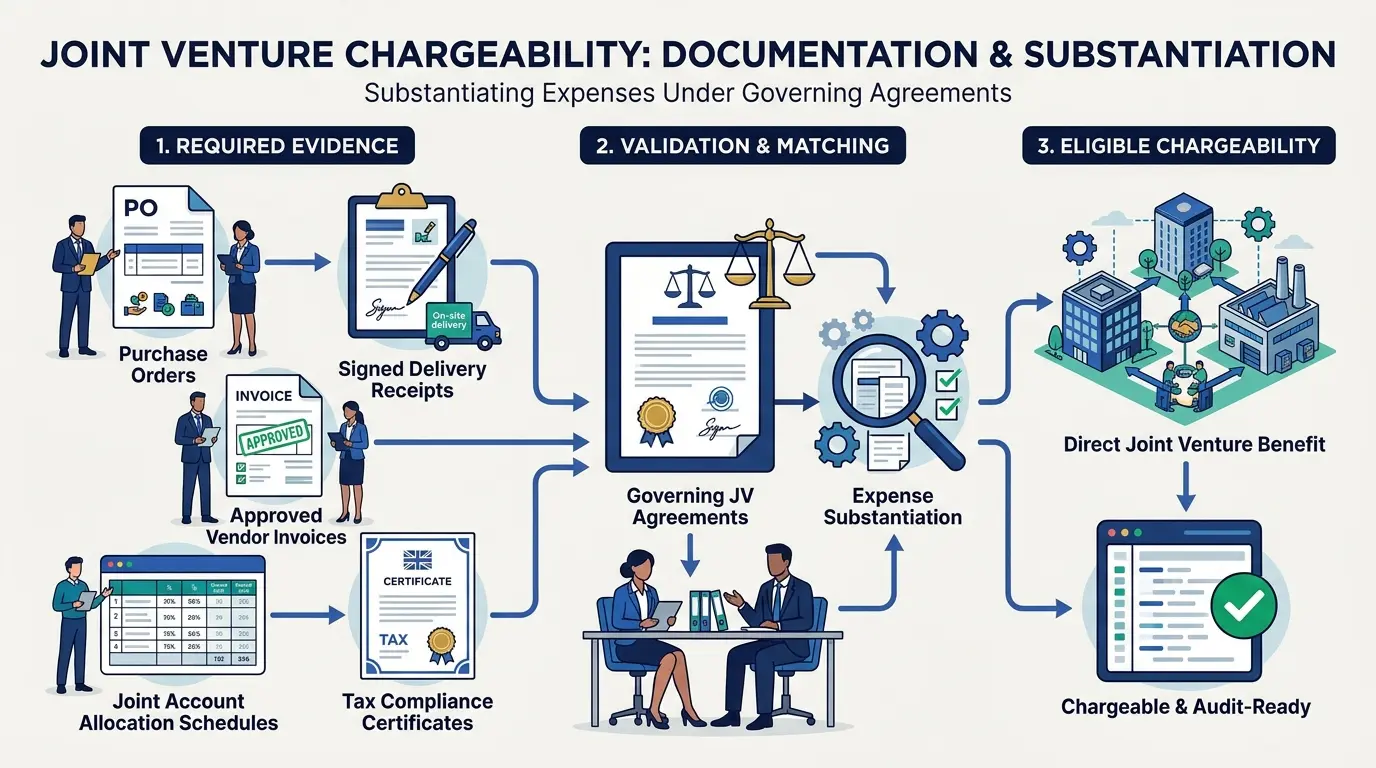
Governing contracts such as Accounting Procedures attached to Joint Operating Agreements explicitly define allowable costs. Operators cannot simply assert that an expense relates to joint operations; they must present clear cost recovery evidence requirements during financial review cycles. Missing or incomplete documentation results in immediate audit disallowance, forcing the operator to absorb the cost fully.
Primary records must demonstrate an unbroken chain of authorization and operational delivery. For material purchases, the package must contain the original requisition, approved purchase order, bill of lading, physical receiving slip, and the original invoice. For service contracts, documentation must include signed daily work reports, contractor timesheets, inspection certificates, and final completion acceptance forms.
Complex operational scenarios require specialized backup documentation. In multi-well campaigns or shared facilities, operators frequently process bulk purchases or shared equipment rentals. Supporting these claims requires explicit allocation schedules showing the exact usage metrics, engineering basis, or volume splits applied across participating property blocks.
Approved Purchase Orders detailing unit pricing, currency, and line-item scope.
Signed Material Receiving Reports or Field Delivery Receipts validating physical receipt.
Certified Contractor Timesheets and Daily Work Reports showing supervisor approval.
Joint Account Allocation Sheets defining the exact distribution methodology across partners.
Tax invoices detailing valid VAT and withholding tax on invoices to support tax credit claims.
Compiling backup documentation for partners must occur during initial invoice processing rather than reactively during an audit. Modern joint venture accounting systems link digitized source documents directly to the general ledger transaction block. This digital linkage allows non-operating partners to inspect supporting evidence during monthly cash call reconciliations, building trust and reducing formal audit exceptions.
How Do You Ensure Invoice Allocation and Tax Compliance for Shared Costs?
Ensure correct invoice allocation and tax compliance by applying contractual allocation keys, verifying joint operating agreement percentage shares, and isolating eligible tax components. This structured control prevents cross-subsidization between assets while guaranteeing full compliance with statutory tax withholding and reporting laws.
Shared operational costs represent one of the highest risk areas in joint venture accounting. Operators frequently utilize centralized logistics hubs, shared supply vessels, or regional engineering teams across multiple production blocks. Billing these shared expenditures to the correct joint account requires systematic allocation rules based on clear operational drivers such as direct labor hours, machine usage time, or production volumes.
The allocation of shared invoices must follow the exact formulas negotiated within the Joint Operating Agreement. Applying an arbitrary allocation percentage or failing to update allocation keys when ownership structures change leads to serious compliance breaches. Joint venture accountants must audit allocation runs monthly to confirm that shared vendor invoices align precisely with active joint venture participating interests.
Tax treatment adds another layer of complexity to invoice verification. Energy sector operations operate under strict statutory regimes involving Value Added Tax (VAT), Goods and Services Tax (GST), and corporate Withholding Tax (WHT). Joint venture billing systems must segregate recoverable indirect taxes from the core operational cost base billed to partners.
Improper tax handling directly inflates joint venture operating costs. If an operator fails to validate tax registration numbers or misapplies withholding tax deductions on cross-border service invoices, the joint account incurs non-recoverable tax exposures. Financial teams must verify that vendor invoices conform strictly to local statutory tax formats while ensuring that net recoverable taxes are routed to dedicated tax clearing accounts rather than partner billing statements.
How Does Three Way Matching Prepare Organizations for Joint Venture Audits?
Three way matching prepares organizations for joint venture audits by establishing a verifiable trail of authorized expenditures backed by complete source documents. This systematic verification prevents audit exceptions, eliminates unrecoverable disallowances, and ensures rapid resolution of partner inquiries.
Non-operating partners reserve the contractual right to audit the operator’s financial records, typically within a two-to-three-year window following the close of an accounting year. Audits focus heavily on high-value procurement, joint facility allocations, and vendor compliance. When auditors discover invoices lacking purchase authorization or delivery proof, they issue formal audit exceptions requesting full credits back to the joint account.
Establishing audit ready invoice files requires creating complete financial dossiers for every general ledger posting. A fully audit-ready file contains the approved purchase order, material receipt, vendor invoice, payment voucher, and tax compliance record bound together digitally or physically. Maintaining complete records eliminates long research cycles when external audit teams perform sample testing on joint account expenses.
The financial impact of poor verification manifests directly in audit disallowances. If an operator pays an vendor invoice without verifying line-item contract rates and later cannot produce the underlying field ticket, non-operating partners will refuse the charge. The operator must then absorb 100 percent of that unverified cost, converting a shared joint venture expense into a direct corporate loss.
Continuous matching controls serve as a live self-audit mechanism. By detecting rate errors, duplicate billings, and missing delivery confirmations prior to payment, accounting teams correct errors while vendor leverage remains high. Once a vendor receives payment, recovering overbillings becomes exceptionally difficult, often requiring lengthy commercial negotiations or legal disputes.
How Do Financial Teams Evaluate Training Options for Joint Venture Invoice Control?
Financial teams evaluate training options by assessing curriculum alignment with industry accounting standards, operational practicality, delivery formats, and measurable error-reduction capability. Effective training must bridge the gap between theoretical joint venture accounting rules and practical invoice verification workflows.
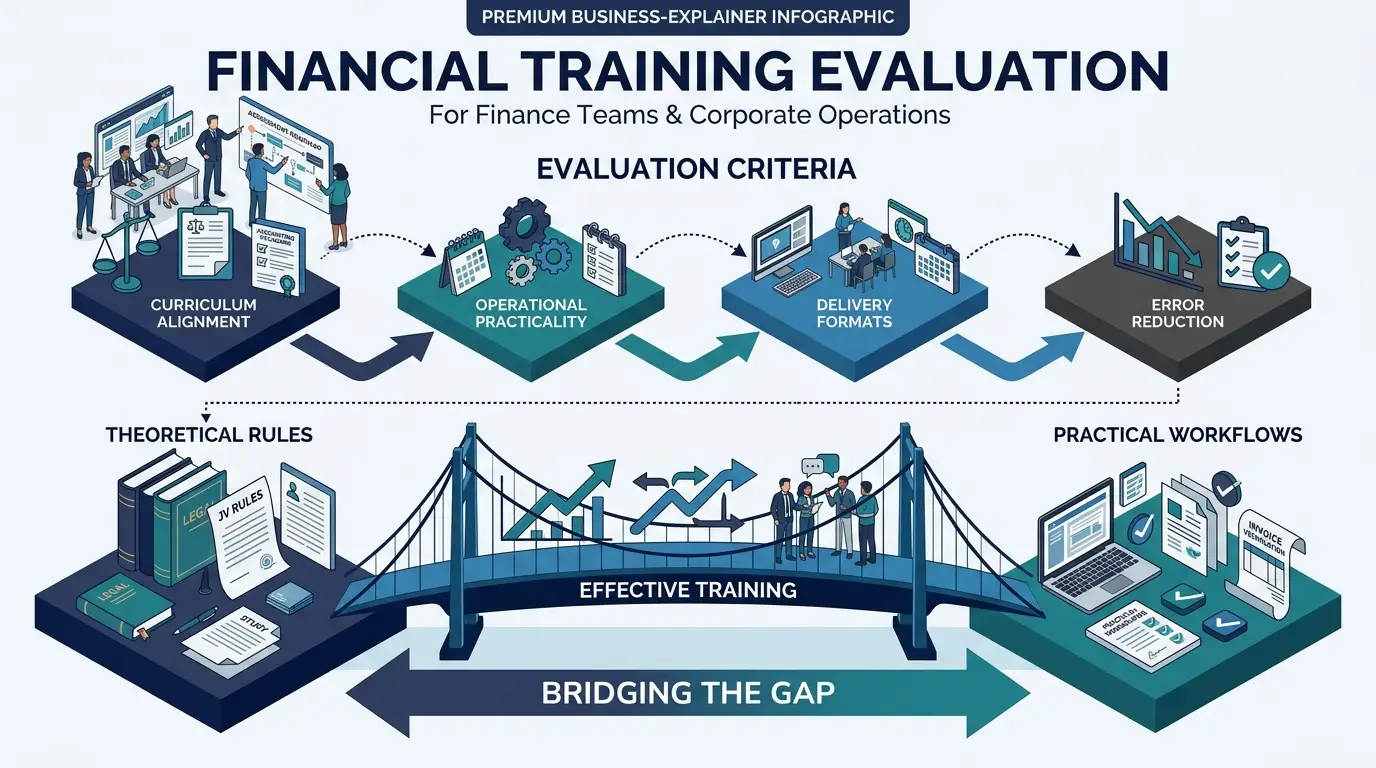
Building an audit-ready finance function requires continuous capability development across procurement, accounts payable, and joint venture accounting teams. When evaluating professional development solutions, HR directors and finance managers must select training frameworks that address the specific operational realities of energy sector joint ventures rather than generic accounting procedures.
Organizations select between several learning delivery models based on team size, geographical distribution, and immediate operational priorities. Selecting the right approach requires evaluating structured criteria across content depth, practical application, and enterprise performance impact.
Evaluation Metric | In-House Customized Workshops | External Professional Seminars | Self-Paced Digital Courses |
Operational Relevance | High; uses company JOAs, MSAs, and live invoice samples | Moderate; covers standard industry frameworks | Low to Moderate; generic accounting concepts |
Skill Transfer Speed | Immediate; teams work directly on company workflows | Moderate; requires post-course application | Slow; limited interactive feedback |
Audit Prevention Impact | High; targets specific historical audit gaps | Moderate; builds general compliance awareness | Low; limited practical enforcement |
Scalability & Cost | Optimal for teams of 8+ professionals | Best for individual skill development | Highly scalable; low cost per head |
Corporate learning programs must deliver immediate operational returns by reducing processing cycle times and eliminating joint venture audit exceptions. Specialized courses, such as the Three Way Matching and Invoice Verification for JV Chargeability Training by Institute For Oil & Gas Training, focus specifically on building practical skills in matching logic, contract interpretation, and joint account compliance.
When selecting a professional development partner, decision-makers must prioritize practical application over passive instruction. Finance personnel must practice reviewing complex, multi-currency invoices, identifying line-item pricing deviations against real-world master service agreements, and constructing defensible joint account allocation files.
Competency Area | Essential Learning Objective | Business Outcome |
Contractual Verification | Cross-referencing MSA rate cards against line-item vendor charges | Prevents rate overcharges and unapproved fee additions |
Documentary Alignment | Matching purchase orders, receiving slips, and invoices | Eliminates payments for undelivered goods or incomplete services |
Tax Integration | Isolating recoverable VAT/GST and applying correct Withholding Tax | Prevents non-recoverable tax leakages on partner billings |
Audit Preparation | Assembling complete, indexed audit packages per JOA standards | Reduces partner audit disallowances and speeds up query resolution |
Implementing a structured 3-Way Matching & Invoice Verification for JV Chargeability Training Course establishes a standardized compliance framework across the finance, procurement, and joint venture departments. Standardizing these controls minimizes human error, strengthens partner trust, and protects corporate capital across all joint operating ventures.
Frequently Asked Questions
What is Oil & Gas Petroleum Procurement and why is it critical?
Oil & Gas Petroleum Procurement is the strategic acquisition of equipment, services, and raw materials essential for upstream, midstream, and downstream operations. At the Institute For Oil & Gas Training, this discipline focuses on navigating complex international supply chains, managing vendor risks, and maintaining compliance with stringent energy sector regulations. Effective procurement ensures operational continuity, minimizes project delays, and controls capital expenditure in high-stakes energy ventures.
What are the core components of an Oil & Gas Petroleum Procurement training course?
Training in Oil & Gas Petroleum Procurement delivered by the Institute For Oil & Gas Training covers strategic sourcing, category management, contract drafting, and supplier relationship management. Learners master risk mitigation techniques, cost estimation frameworks, and joint venture accounting rules such as three-way matching. Additionally, courses emphasize sustainable sourcing practices and local content compliance across global petroleum operations.
How does specialized procurement training improve supply chain efficiency in the energy sector?
Specialized Oil & Gas Petroleum Procurement training equips teams with industry-specific market intelligence, contract negotiation frameworks, and inventory control strategies. Professionals trained at the Institute For Oil & Gas Training learn to streamline procurement lifecycles, mitigate geopolitical supply disruptions, and optimize material lead times. This directly reduces non-productive time (NPT) and prevents costly revenue leakage across complex petroleum projects.
Who should enroll in Oil & Gas Petroleum Procurement courses?
Oil & Gas Petroleum Procurement programs at the Institute For Oil & Gas Training are designed for supply chain managers, commercial buyers, project engineers, contracts officers, and finance professionals in the energy industry. It is equally valuable for corporate HR teams seeking to upskill personnel handling high-value petroleum contracts and vendor negotiations. The practical, business-aligned curriculum caters to both developing practitioners and experienced energy executives.
How does effective petroleum procurement management reduce joint venture and audit risks?
Robust Oil & Gas Petroleum Procurement protocols enforce rigorous document reconciliation, transparent bidding procedures, and clear contract rate cards across joint operating agreements. By implementing frameworks taught by the Institute For Oil & Gas Training, organizations establish verifiable audit trails and accurate chargeability checks. This prevents unauthorized cost allocations, mitigates vendor billing disputes, and ensures full audit readiness for partner reconciliations.
Related training courses
3-Way Matching & Invoice Verification for Day-Rate Contracts Training Course
- Specialisation
- Oil & Gas Petroleum Procurement
- Duration
- 5 days · 15 CPD hours
Vendor Management & Local Content Requirements: Onboarding Training Course
- Specialisation
- Oil & Gas Petroleum Procurement
- Duration
- 5 days · 15 CPD hours
Financial Evaluation of Suppliers & Contractors: Tender Evaluation Training Course
- Specialisation
- Oil & Gas Petroleum Procurement
- Duration
- 5 days · 15 CPD hours
More articles

Vendor Management and Local Content Requirements Onboarding Training by Institute For Oil & Gas Training
Enroll in the Vendor Management and Local Content Requirements Onboarding Training by Institute For Oil & Gas Training. Master procurement compliance.
Read article →
How to Evaluate Vendor Onboarding Processes and Local Content Requirements in Oil and Gas
Learn how to evaluate vendor onboarding processes and local content requirements in oil and gas to reduce supply chain risk and maintain compliance.
Read article →
Why Effective Vendor Onboarding Matters in Oil and Gas Procurement
Discover why vendor onboarding drives supply chain compliance, risk mitigation, and local content success in oil and gas procurement.
Read article →