

Managing cash call and AFE overruns in petroleum projects is a financial governance discipline that controls joint venture expenditures, ensures compliance with operating agreements, prevents unbudgeted capital calls, and aligns joint operating partners on project cost controls.
Petroleum exploration and production operations operate under complex Joint Operating Agreements (JOAs). These legal frameworks dictate how operating and non-operating partners share capital requirements and risk. The Authorisation for Expenditure (AFE) serves as the legally binding budget baseline for specific field activities such as drilling operations, seismic acquisition, and facility upgrades. When field operations encounter unexpected reservoir pressures, equipment failure, or market inflation, costs exceed initial estimates. An AFE overrun occurs when actual expenditure surpasses approved baseline figures beyond contractually agreed variance thresholds, which usually trigger mandatory partner notifications or formal amendments.
From a workforce capability perspective, managing cash call and AFE overruns is not merely an accounting function. It is a cross-functional operational skill combining petroleum engineering, joint venture accounting, contract law, and project management. Corporate training in this discipline closes structural knowledge gaps between technical execution teams and commercial managers. Uncoordinated field decisions directly cause financial friction between partners. When drilling engineers modify well designs without evaluating partner voting rights or financial thresholds, organisations face cash flow disruption, delayed cash call remittances, and potential legal disputes. Structured professional development builds systematic cost-tracking workflows across exploration, production, and finance departments.
How Do Cash Call and AFE Overrun Failures Impact Corporate Performance?
Uncontrolled cash call and AFE overruns trigger severe partner disputes, erode project returns, disrupt corporate liquidity, create non-consent penalties, and degrade joint venture trust across upstream oil and gas operating consortia.
Upstream petroleum projects require capital commitments ranging from 10 million USD to over 1 billion USD per field development phase. Joint venture partners base their annual capital allocation plans on approved work programme and budget submissions. When an operator fails to monitor real-time field expenditures, actual project spending rapidly exceeds baseline allocations. This triggers immediate cash flow deficits for all joint venture members. Operating companies must issue emergency cash calls to cover operational expenditures. Non-operating partners faced with unexpected multi-million dollar capital requests frequently audit project accounts, withhold funding, or initiate formal dispute resolution processes.
Operational cost overruns create severe corporate complications through non-consent and sole risk provisions embedded in joint operating agreements. If an operator incurs expenditures exceeding agreed variance limits without securing prior partner consent, non-operating partners hold the legal right to refuse payment. The operating company must then absorb 100% of the financial overrun while non-operating partners retain rights to future production revenues under specific contractual clauses. Repeated governance failures reduce project internal rates of return (IRR) by 15% to 40%, damage corporate reputation, and limit an operator's ability to secure future joint venture farm-in agreements across energy sectors like offshore drilling, subsea installation, and refining operations.
How Do Organisations Train Teams to Control AFE and Work Program Budgets?
Organisations train teams using structured corporate learning pathways, case-based workshops, real-time simulation exercises, and cross-departmental alignment programs that bridge technical engineering decisions with joint venture financial management.
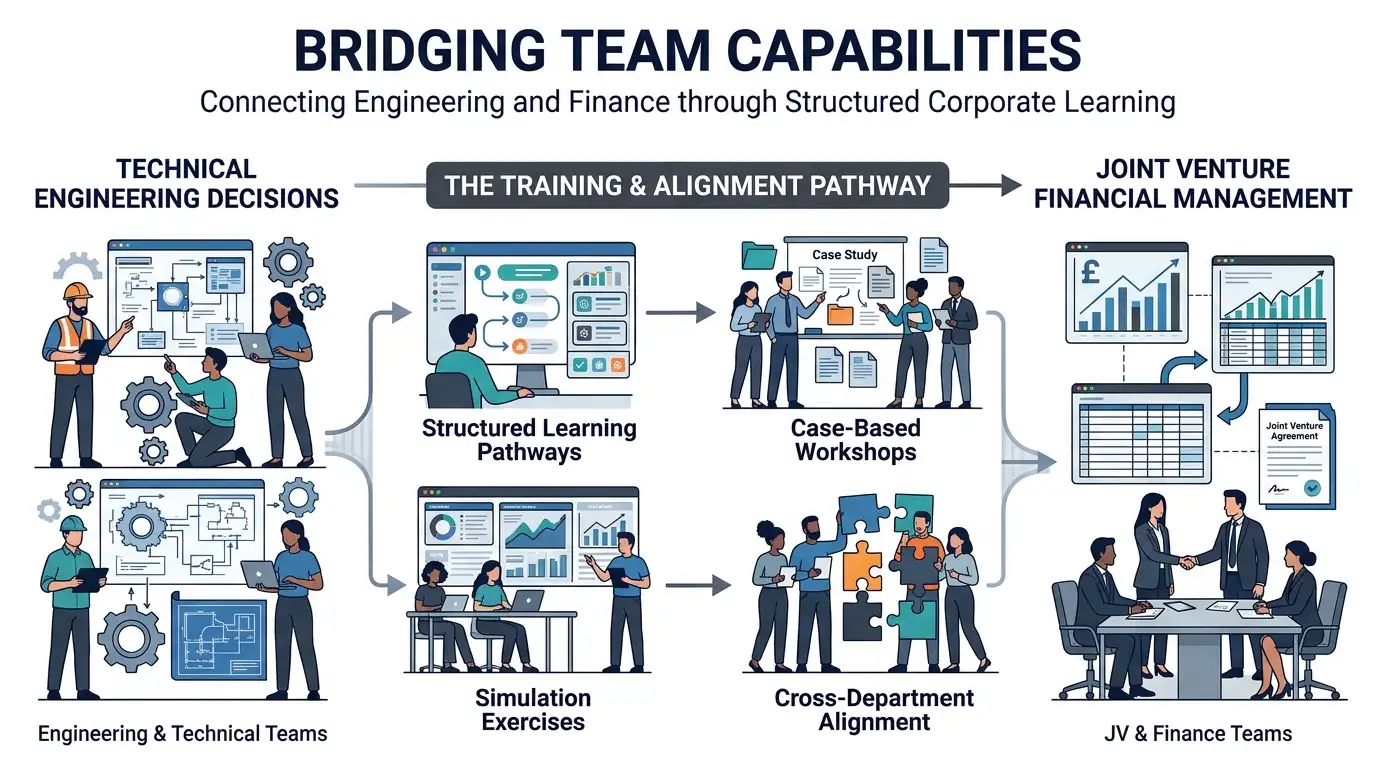
Effective corporate training programs follow a macro-to-micro learning framework designed for cross-functional industry cohorts. The training process begins with a diagnostic evaluation of organizational skill gaps across asset management, joint venture accounting, and project delivery teams. Program design incorporates 3-day intensive executive workshops, 6-week online interactive modules, or blended corporate learning structures tailored to working professionals. Participant cohorts work directly with realistic petroleum asset datasets, examining actual Joint Operating Agreements, Accounting Procedures, and Work Programme and Budget (WP&B) schedules to understand the legal mechanics of joint venture governance.
Learning execution relies heavily on experiential methodologies rather than passive lectures. Teams analyze historical project case studies involving cost overruns in deepwater drilling, land acquisition, and production facility construction. Through practical simulations, drilling engineers, finance officers, and commercial managers practice authorising expenditure proposals, tracking variance indicators, and drafting formal partner notifications. Participants calculate AFE approval thresholds under tight time constraints, evaluate partner voting rights under varying ownership percentages, and model the financial consequences of non-consent declarations. Role-playing exercises force technical leads to defend cost adjustments before simulated partner operating committees, embedding commercial discipline into daily engineering workflows.
Organisations evaluating operational learning frameworks often review specialized professional curricula, such as the Cash Calls, AFEs & Work Program/Budget Control: Overruns Training Course, to standardise joint venture control procedures across international business units. Training evaluation measures immediate post-course knowledge retention alongside 90-day workplace application audits. These assessments evaluate how effectively asset teams apply standardized variance controls, manage partner approvals, and execute formal close-out procedures on active capital projects.
What Core Components Are Required in Cash Call and AFE Governance Training?
AFE governance training requires instruction in authorisation for expenditure preparation, approval threshold mechanics, partner voting rules, supplementary AFE workflows, overrun approvals, close-out audits, and sole risk provisions.
A comprehensive corporate training framework covers nine core financial and operational control mechanisms:
Authorisation for Expenditure Preparation: Standardized methodologies for building accurate cost estimates using Work Breakdown Structures (WBS), risk contingency factors, and clear scope descriptions for operational activities.
AFE Approval Thresholds: Contractual variance limits (typically 10% or 100,000 USD above original baseline) that dictate when an operator must seek formal partner re-approval.
Partner Voting and Consent: Voting mechanisms, minimum ownership percentage requirements, and response timelines specified in JOAs for approving operational expenditures.
Supplementary AFE: Procedural rules for drafting, submitting, and securing partner authorization for additional funds when project scopes expand or unexpected operational difficulties arise.
AFE Overrun Approval: Administrative workflows for emergency spending authorisations, field change orders, and retroactive partner approvals during active operations.
AFE Close-Out: Post-operational financial audits, reconciliation of actual spending against approved budgets, asset capitalisation, and final partner cost settlements.
Work Programme and Budget Submission: Annual submission structures required by host governments and non-operating partners to approve upcoming field exploration and production activities.
Budget Variance Approval Limits: Matrix of internal corporate delegation of authority (DOA) limits controlling which management tiers approve cost adjustments.
Non-Consent and Sole Risk Provisions: Legal and financial rules governing project operations when one or more partners elect not to participate in proposed field activities.
What Are the Key Organizational Benefits of Standardized Budget Control Training?
Standardized budget control training reduces unapproved project overruns, improves cash flow forecasting accuracy, protects joint venture partner relationships, accelerates audit resolutions, and secures project profitability.
Corporate workforce development delivers measurable benefits across multiple enterprise performance dimensions:
Financial Control and Risk Mitigation: Standardized expenditure workflows prevent unbudgeted cost expansions, protecting corporate liquidity reserves across capital-intensive projects in oil, gas, and renewable energy sectors.
Partner Alignment and Conflict Reduction: Transparent financial reporting builds trust among joint venture consortia, eliminating costly partner disputes and legal arbitrations related to unapproved spending.
Cross-Functional Team Efficiency: Shared commercial literacy across engineering, procurement, legal, and financial departments streamlines internal approval cycles by 30% to 50%.
Regulatory and Audit Compliance: Rigorous close-out protocols and audit-ready project records reduce external joint venture audit exceptions and avoid financial penalties.
Optimized Asset Capitalization: Timely financial reconciliation ensures accurate fixed-asset recording, optimizing corporate tax management and depreciation schedules.
Which Enterprise Teams Require Training in Cash Call and AFE Management?
Petroleum engineering leads, joint venture accountants, asset managers, procurement directors, legal advisors, and corporate decision-makers require structured training in cash call and AFE management.
Organizational application spans multiple operational units across capital-intensive sectors like upstream exploration, midstream pipeline transportation, downstream refining, and offshore construction:
Asset Managers and Project Directors: Leaders managing multi-partner fields require deep understanding of JOA mechanics, work program approvals, and budget variance controls to protect asset cash flows.
Drilling, Subsea, and Facilities Engineers: Technical leads designing operational scopes must understand how daily field modifications directly impact AFE approval limits and partner voting rights.
Joint Venture and Project Accountants: Financial professionals managing cash calls, monthly partner billings, expenditure reconciliations, and close-out statements require precise knowledge of joint interest accounting principles.
Commercial and Legal Specialists: Negotiators crafting JOAs, farm-in agreements, and sole-risk clauses need operational insight to structure realistic contractual threshold limits.
Supply Chain and Procurement Managers: Buyers negotiating high-value service contracts, rig leases, and equipment procurement must align purchasing timelines with partner approval cycles.
What Common Problems and Misconceptions Undermine AFE Training ROI?
Common problems include treating AFE control as a back-office accounting task, using static lecture formats, failing to involve technical teams, relying on generic finance courses, and ignoring joint venture legal realities.
Organisations frequently encounter structural pitfalls when implementing financial governance training programs:
The Accounting-Only Fallacy: Assuming cost control rests entirely within finance departments. Over 80% of project cost overruns stem from field-level engineering decisions made by technical personnel who lack commercial training.
Generic Corporate Finance Curricula: Utilizing standard financial management courses that lack upstream oil and gas context. Generic finance training omits critical joint venture mechanics like cash calls, JOA voting rules, and sole risk provisions.
Theoretical Lecture Delivery: Relying on passive classroom lectures without practical exercises. Professional development requires scenario-based learning using real joint interest billings and field change requests.
Isolation from Internal Delegation of Authority (DOA): Training teams on generic financial concepts without integrating the organization's specific internal approval matrices and partner operating agreements.
Lack of Post-Training Measurement: Failing to evaluate learning transfer through workforce KPIs, such as reduced billing dispute turnaround times, lower joint venture audit exceptions, and zero unauthorized overruns.
How Do Organisations Implement an Enterprise-Wide AFE and Budget Control Strategy?
Organisations implement budget control strategies by conducting capability audits, establishing cross-functional learning programs, standardizing financial governance tools, and linking learning outcomes to operational performance metrics.
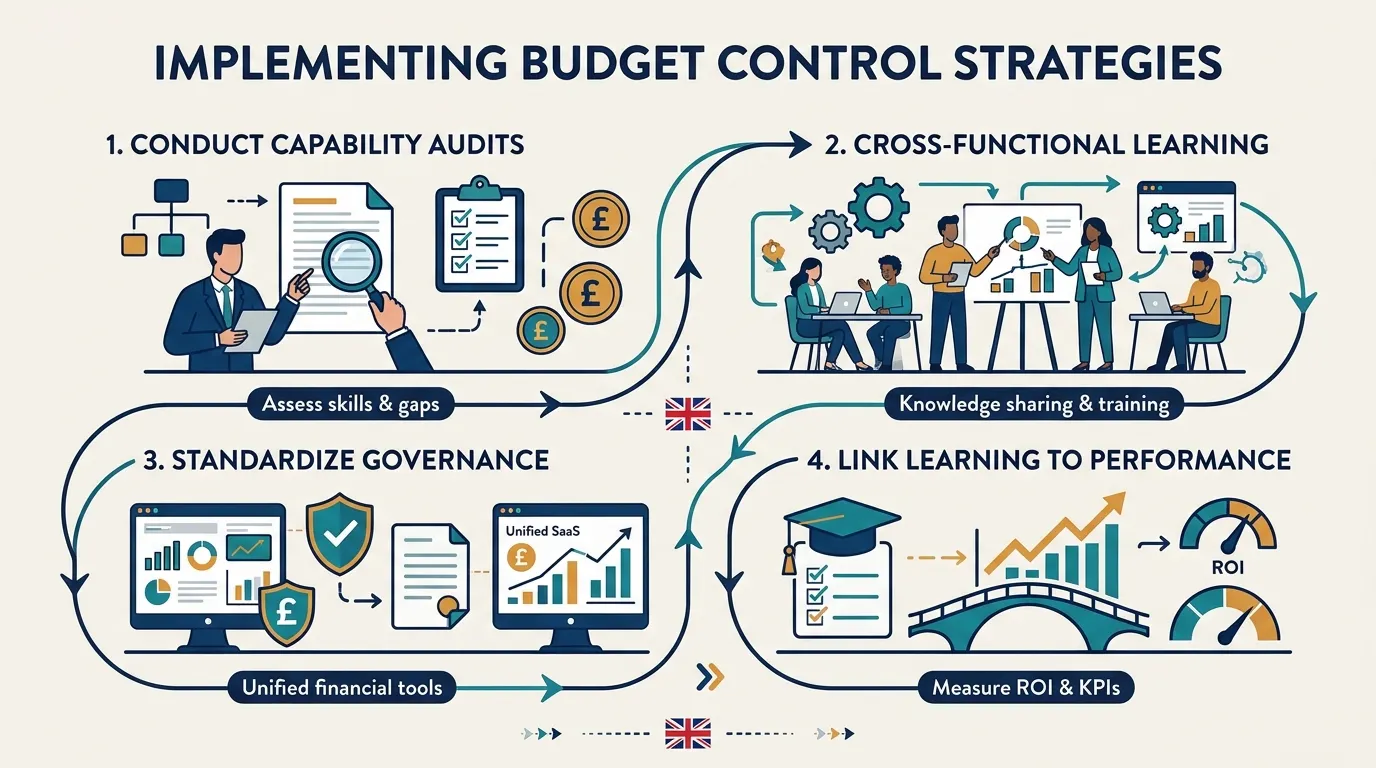
Successful implementation follows a four-phase enterprise rollout model:
Phase 1: Capability Gap Assessment and Policy Alignment
The organisation evaluates current project performance data, joint venture audit exceptions, and cash call dispute logs. Leadership aligns internal Delegation of Authority (DOA) frameworks with standard Joint Operating Agreement (JOA) requirements across active asset portfolios.
Phase 2: Curriculum Design and Cohort Selection
L&D professionals structure role-tailored learning pathways. Multi-disciplinary cohorts containing drilling engineers, joint venture accountants, procurement officers, and asset leads are assembled to mirror real-world project teams.
Phase 3: Applied Training Delivery
Teams complete practical learning programs. Participants analyze asset datasets, simulate partner voting processes, practice drafting supplementary AFEs, and resolve complex cost overrun scenarios under operational time constraints.
Understanding the mechanics of variance control allows project teams to evaluate operational solutions effectively. Detailed guidance on implementing monitoring systems can be found in How to Monitor and Control Cash Call AFE and Work Program Budget Overruns, which provides operational frameworks for field-level tracking.
Phase 4: Operational Integration and ROI Tracking
Organisations deploy standard AFE monitoring templates, automated cash call tracking tools, and close-out checklists across operational units. Human resources and line managers monitor performance metrics over 6 to 12 months, tracking reduction in partner billing disputes, faster AFE close-out times, and overall project margin protection.
Frequently Asked Questions
What is Oil & Gas Petroleum Budgeting & Cost Control?
Oil & Gas Petroleum Budgeting & Cost Control is a financial governance framework used by upstream, midstream, and downstream energy companies to manage capital expenditures, operating budgets, and joint venture cash calls. Through practical programs from Institute For Oil & Gas Training, professionals master Authorisation for Expenditure (AFE) drafting, cost variance monitoring, and financial compliance under Joint Operating Agreements.
Why is AFE control important in petroleum project management?
Authorisation for Expenditure (AFE) control prevents unbudgeted project overruns and establishes legally binding budget baselines among joint venture operating partners. Training provided by Institute For Oil & Gas Training equips asset managers and engineers with standard variance tracking workflows to manage supplementary AFEs, partner voting rules, and financial delegation limits.
Who should attend an Oil & Gas Petroleum Budgeting & Cost Control course?
This training targets petroleum engineers, joint venture accountants, asset managers, commercial advisors, procurement leads, and finance directors responsible for capital allocation and expenditure management. Programs at Institute For Oil & Gas Training bridge the gap between technical field decisions and joint interest accounting rules to protect enterprise liquidity.
How do cash calls work in upstream petroleum operations?
Cash calls are formal financial requests issued by an operating company to non-operating partners to cover upcoming operational expenses based on an approved Work Programme and Budget (WP&B). Mastering this process via Institute For Oil & Gas Training ensures accurate monthly billing schedules, eliminates partner funding disputes, and maintains joint venture cash flow alignment.
What measurable outcomes does cost control training provide for energy companies?
Standardised cost control education reduces billing dispute turnaround times, lowers joint venture audit exceptions, and prevents unapproved capital spending. By completing Oil & Gas Petroleum Budgeting & Cost Control courses with Institute For Oil & Gas Training, organisations streamline internal approval cycles, protect project internal rates of return (IRR), and ensure compliance with sole risk provisions.
Related training courses
CAPEX vs OPEX Impact on Cost Recovery Training Course
- Specialisation
- Oil & Gas Petroleum Budgeting & Cost Control
- Duration
- 5 days · 15 CPD hours
Cost Control for Field Development Projects: Cost Baselines Training Course
- Specialisation
- Oil & Gas Petroleum Budgeting & Cost Control
- Duration
- 5 days · 15 CPD hours
Cash Calls, AFEs & Work Program/Budget Control: Preparation Training Course
- Specialisation
- Oil & Gas Petroleum Budgeting & Cost Control
- Duration
- 5 days · 15 CPD hours
More articles

Budget Planning and Cost Optimisation Training by Institute For Oil & Gas Training
Master petroleum operating budgets, CAPEX, and OPEX management through the professional training course offered by the Institute For Oil & Gas Training.
Read article →
How to Identify Cost Saving Opportunities and Optimise Petroleum Operating Budgets
Discover proven methods to identify cost-saving opportunities, optimize OPEX and CAPEX, and improve financial forecasting in petroleum operations.
Read article →
Why Budget Planning and Cost Optimisation Matter in Oil and Gas Operations
Discover why budget planning and cost optimisation matter in oil and gas operations. Learn how structured training improves financial control and OPEX.
Read article →