
Joint venture operations in the oil and gas sector require continuous financial oversight across multiple operational partners. Effective management of cash calls, Authorisations for Expenditure (AFEs), and annual Work Programs and Budgets (WPB) prevents capital erosion and protects project margins. Operators must establish clear operational controls to track commitments against approved financial baselines.
Understanding the root causes of financial variance allows non-operators and joint venture asset managers to mitigate risk early. For a foundational analysis of why these financial variances occur and their impact on asset performance, review Why Managing Cash Call and AFE Overruns Matters in Petroleum Projects. Implementing robust tracking mechanisms reduces billing disputes, maintains joint operating agreement compliance, and ensures cash calls remain aligned with actual field operations.
What Causes Cash Call and AFE Budget Overruns in Petroleum Operations?
Cash call and AFE budget overruns stem from scope changes, supply chain inflation, poor cost tracking, delayed joint venture partner approvals, and inaccurate initial baseline estimates. Operators lose financial control when commitment tracking systems fail to reflect real-time field expenditures.
Petroleum ventures operate under dynamic conditions where subsurface technical challenges directly impact operational timelines. Initial cost estimates frequently fail to capture compounding market factors, such as rig rate fluctuations, specialized equipment availability, and logistical bottlenecks in remote locations. When joint venture management teams rely on historical baseline metrics without updating cost assumptions for real-time market inflation, budget baselines fail within the first quarter of execution.
Scope creep represents another structural cause of financial variance. Drilling engineers and production teams often encounter unpredicted geological formations requiring remedial workovers, side-tracks, or heavier mud weights. If field personnel execute these technical adjustments without initiating a formal change management process, expenditure accumulates rapidly before management identifies the trend.
Communication delays between upstream operating assets and corporate accounting departments further exacerbate tracking errors. Non-operator partners receive monthly cash calls that reflect cash outflow rather than accrued liabilities or signed purchase orders. This lag between commitment creation and cash disbursement hides overruns until the project reaches critical financial thresholds. Without an integrated commitment accounting framework, joint venture managers face unexpected cash calls late in the operational cycle.
Internal governance gaps also compound these challenges. Organizations often lack clear operational procedures for matching joint interest billings (JIB) against original AFE line items. When project teams fail to enforce standardized line-item cost coding, field expenses drift into incorrect cost pools. This masks specific budget breaches and complicates subsequent joint venture audits.
How Do Operators Structure AFE Preparation and Approval Thresholds?
Operators structure AFE preparation by categorizing expenses into capital, operating, and plug-and-abandonment categories while establishing tiered authorization levels. Approval thresholds define specific monetary and percentage limits where project managers must seek joint venture partner consent before incurring costs.
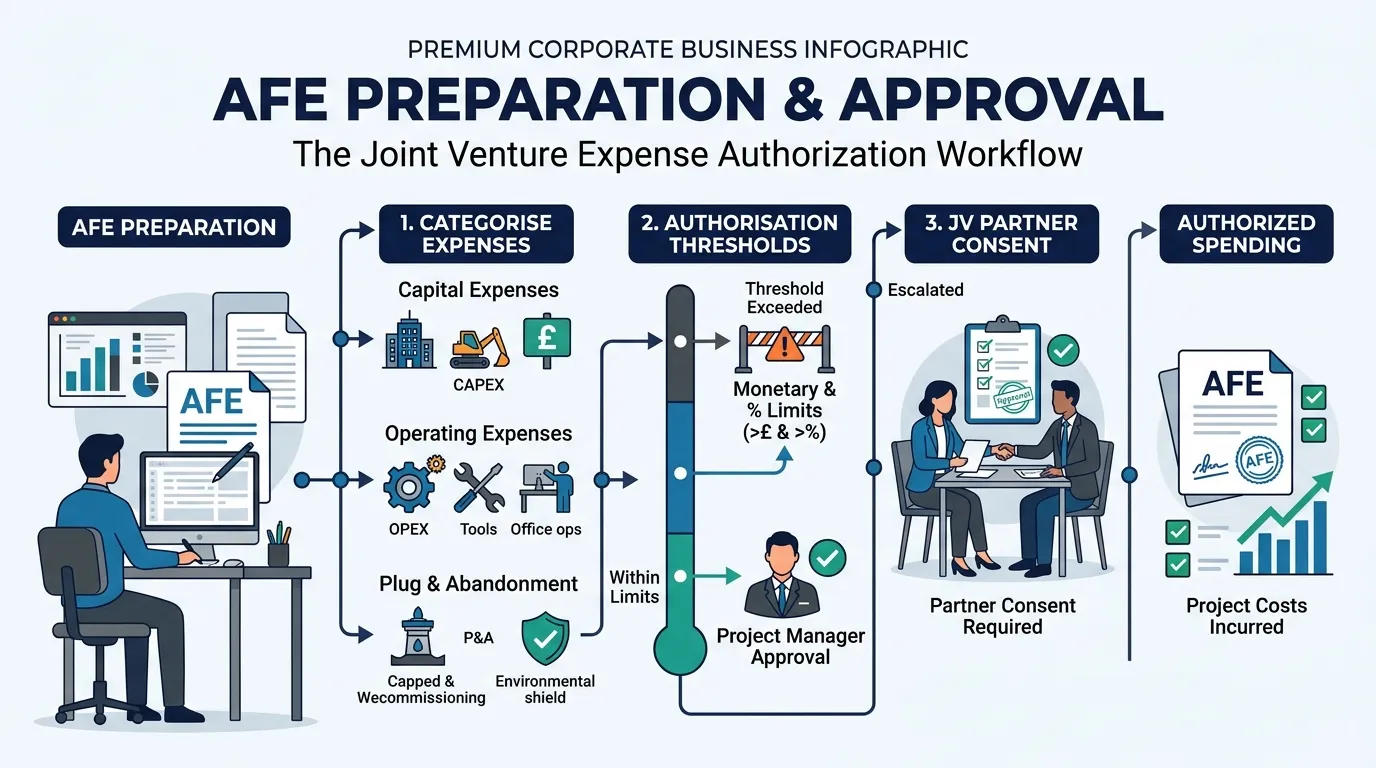
The authorisation for expenditure preparation process begins with accurate line-item estimation based on detailed engineering designs and current market rates. Engineers and commercial teams break down anticipated expenses into distinct categories, separating tangible equipment costs from intangible service rates. Standardized cost coding ensures every line item maps directly to the overarching work program.
Internal approval hierarchies dictate which authority levels can authorize specific financial commitments. A standard authorization matrix establishes distinct operational tiers:
Authority Level | Financial Limit (USD) | Variance Tolerance Threshold | Required Approvers |
Field Operations Manager | Up to $100,000 | 0% Line Item / 5% Total | Operations Lead, Project Engineer |
Asset General Manager | $100,001 – $500,000 | 5% Line Item / 5% Total | Finance Lead, Asset Director |
Corporate Executive Committee | $500,001 – $2,000,000 | 10% Line Item / 8% Total | CFO, VP Upstream Operations |
Joint Venture Operating Committee | Exceeding $2,000,000 or JOA Limit | Requires Supplementary AFE | All Voting Joint Venture Partners |
Once internal authorization is complete, the operator submits the document for partner evaluation. The Joint Operating Agreement (JOA) dictates the specific AFE approval thresholds that govern non-operator voting rights. Typically, JOAs require formal partner consent for any project exceeding a predefined expenditure baseline, such as $500,000 or $1,000,000.
If projected costs exceed the initial estimate during execution, operators must enforce strict budget variance approval limits. Minor cost variances within an agreed percentage, often 10% of total AFE value, receive automatic authorization under standard JOA terms. However, variances exceeding this threshold require immediate notification to partners and formal approval prior to incurring additional liabilities.
Establishing clear definitions for operational scope changes prevents informal expansion of project baselines. The approval structure must distinguish between expected inflationary increases and explicit alterations to technical specifications. Enforcing these boundaries protects all joint venture participants from unapproved capital exposure.
What Controls Prevent Work Program and Budget (WPB) Variance?
Preventing Work Program and Budget variance requires real-time commitment tracking, strict cost-center segregation, periodic variance reporting, and proactive change management. Organizations must reconcile ongoing field commitments against original budget baselines on a weekly basis.
A successful control framework aligns physical operational milestones with monetary disbursements. Asset managers monitor financial progress using Earned Value Management (EVM), comparing actual cost of work performed against scheduled budget targets. This approach flags negative performance trends before they result in actual cash overruns.
The process begins during the initial work programme and budget submission, where teams establish baseline milestones, operational timelines, and monthly expenditure curves. Approving this document commits partners to funding specific activities over a 12-month period. Clear activity breakdowns prevent operational leads from reallocating funds between distinct capital projects without partner approval.
To maintain control during execution, management must deploy five core processes:
Commitment-Based Accounting: Record financial obligations at the time purchase orders are signed rather than waiting for supplier invoices.
Weekly Variance Audits: Compare actual-plus-committed costs against the phased monthly WPB baseline to identify early drift.
Formal Change Order Workflows: Require written operational and financial justification before field teams alter technical specifications.
Line-Item Lockouts: Prevent operational leads from shifting unused funds from one project category to cover overruns in another.
Standardized Reconciliations: Monthly matching of joint interest billings with operational progress reports to ensure accurate billing.
Enforcing these procedures requires integration between financial accounting software and field management software. Field supervisors must update progress logs daily, allowing financial analysts to calculate accrued liabilities accurately. When actual costs approach internal control limits, automated alerts notify asset managers to take corrective action.
Early variance detection provides project leaders with options to optimize remaining operations. If drilling operations encounter costly delays, management can adjust downstream completion schedules to keep total asset expenditure within authorized parameters.
How Are Partner Voting, Non-Consent, and Sole Risk Provisions Handled?
Partner voting rights, non-consent mechanisms, and sole risk provisions are governed by the Joint Operating Agreement. These contractual terms dictate how partners approve operations, opt out of specific projects, or independently fund operations when consensus fails.
Decision-making in joint petroleum operations relies on defined voting interest thresholds. Major capital projects usually require approval from partners holding a combined working interest percentage between 60% and 80%, depending on JOA terms. Once a project receives formal approval through partner voting and consent, all consenting partners are legally bound to fund their proportional shares via periodic cash calls.
When individual partners choose not to participate in a proposed operational activity, non-consent and sole risk provisions govern the path forward:
Non-Consent Operations: Allow a partner to decline participation in specific discretionary operations, such as deepening an existing well or conducting optional testing. Consenting partners absorb the non-consenting party's financial share. In return, consenting partners receive the non-consenting party's share of production from that specific operation until they recover their investment plus a contractual penalty (often 200% to 500%).
Sole Risk Operations: Permit a single partner or a minority group to execute an operation that failed to pass the general voting threshold. The sole risk group bears 100% of the financial risk and operational liability. If the operation succeeds, the non-participating partners can buy back into the operation by paying specified premium penalties outlined in the JOA.
Managing these provisions requires precise accounting separation. Financial teams must maintain distinct cost centers for sole risk activities to ensure non-participating partners are not billed for unapproved expenses. Failure to isolate these costs leads to joint venture default notices and legal disputes.
When cash call defaults occur, the operator must enforce contractual remedies promptly. JOAs typically grant operators the right to charge interest on unpaid cash calls, seize the defaulting partner's share of production, or force a forfeiture of their working interest if default remains uncured after a standard notice period.
How to Process Supplementary AFEs and Complete AFE Close-Out?
Processing a supplementary AFE requires documenting cost variances, providing technical justifications, and obtaining partner consent before spending exceeds authorized thresholds. Completing an AFE close-out involves finalizing payments, auditing accounts, and distributing final joint interest billings.
When unforeseen field challenges drive costs beyond the initial variance allowance, operators must issue a supplementary AFE immediately. This document details the original budget, current expenditures, projected final cost, and specific engineering or commercial reasons for the increase. Operators cannot use a supplementary AFE to cover broad scope changes without partner consent; the document must justify cost escalation within the originally approved project scope.
The process for managing supplementary AFEs and close-outs follows a structured sequence:
Variance Identification: Field engineering flags impending overrun when actual-plus-committed costs reach 90% of approved AFE baseline.
Technical & Financial Review: Project team prepares a supplementary request detailing root causes, revised cost projections, and mitigation plans.
Partner Submission: Operator formally distributes the supplementary AFE to all joint venture participants, initiating the standard JOA voting window.
Approval Execution: Upon securing required partner approval percentages, the revised cost ceiling becomes the new operational baseline.
Physical Operations Completion: Field activities conclude, and the operator ensures all physical equipment and vendor services are fully demobilized.
Financial Reconciliation: Accounting verifies all invoices, clears open purchase orders, resolves disputed charges, and calculates final line-item variances.
Formal AFE Close-Out: The operator issues a final AFE close-out report to partners, summarizing total performance against budget and closing the cost center to future charges.
Timely close-out limits an asset's exposure to late vendor billings and accounting errors. JOAs generally require operators to close out AFEs within 60 to 180 days after completing physical operations. This structured close ensures project accounts are finalized for joint venture auditing.
Regular close-outs yield data that improves future cost estimation. Analyzing variance history across multiple wells or facility upgrades allows commercial teams to refine baseline assumptions in subsequent work program submissions.
Evaluating Corporate Learning Approaches for Joint Venture Financial Control
Organizations managing complex joint venture portfolios evaluate multiple learning delivery frameworks to build financial capability across asset teams. Choosing the right training approach ensures operational managers, finance professionals, and joint venture auditors possess aligned skills for controlling project costs.
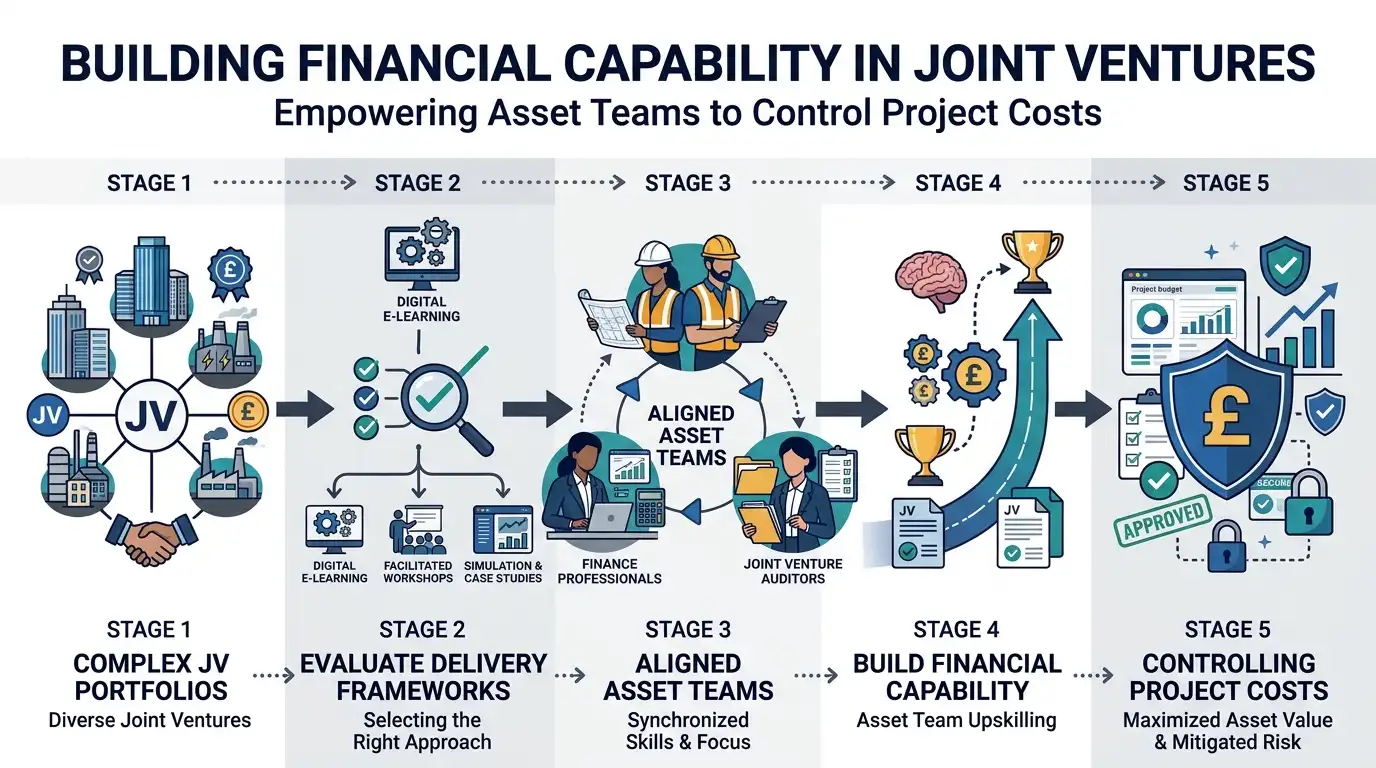
Organizations select from three primary workforce development approaches:
In-House Peer Mentoring
This informal approach relies on senior joint venture accountants and asset managers to transfer knowledge to junior staff during daily operations. While highly context-specific, it lacks standardized evaluation metrics and often perpetuates legacy tracking errors across business units.
Generic Corporate E-Learning Modules
Broad financial management courses provide scalable access to fundamental accounting principles. However, these programs rarely cover specialized petroleum industry structures such as non-consent provisions, cash call mechanics, or standard JOA language, limiting their practical value for joint venture teams.
Practical Industry-Driven Training Programs
External programs tailored to oil and gas financial management combine JOA legal frameworks with practical cost-control techniques. Teams evaluate these solutions based on their alignment with real-world operational scenarios, joint venture compliance rules, and measurable business performance outcomes.
Organizations looking to establish structured financial control capabilities often choose specialized courses such as the Cash Calls, AFEs & Work Program/Budget Control: Overruns Training Course. Structured development programs equip multidisciplinary teams with actionable skills to monitor cash commitments, structure approval thresholds, and negotiate partner disputes effectively.
Learning Delivery Metric | In-House Peer Mentoring | Generic E-Learning | Specialized Industry Training |
Operational Relevance | High (Internal focus) | Low (General finance) | High (Oil & Gas specific) |
Time-to-Competency | 12–18 Months | 6–12 Months | 1–3 Months |
JOA Alignment | Variable | None | Complete |
Cross-Functional Impact | Low (Siloed knowledge) | Low (Self-paced) | High (Aligned asset teams) |
Implementation Cost | Hidden (Loss of senior time) | Low (Per-user license) | Moderate (Structured program) |
When evaluating training frameworks, human resources and operational leaders must measure potential ROI against the cost of financial variances. Preventing a single unapproved budget overrun or billing dispute yields cost savings far exceeding the investment in structured professional development. Upward mobility in financial control requires asset management teams to share a standardized understanding of AFE lifecycle governance.
Building organizational competency in cash call management protects corporate capital, streamlines partner relationships, and ensures compliance across all operating assets.
Frequently Asked Questions
What is oil and gas petroleum budgeting and cost control?
Oil & Gas Petroleum Budgeting & Cost Control is the management process of planning, tracking, and regulating capital expenditure (CAPEX) and operational expenditure (OPEX) in energy assets. The Institute For Oil & Gas Training provides structured frameworks to ensure joint venture cash calls, Authorisations for Expenditure (AFEs), and annual work programs remain within approved financial limits. This practice prevents budget overruns, resolves partner billing disputes, and aligns operational execution with measurable business targets.
How do operators manage AFE overruns in petroleum projects?
Operators manage AFE overruns by establishing commitment-based accounting systems, monitoring real-time field expenditure, and setting strict approval variance thresholds under Joint Operating Agreements (JOA). If costs approach or exceed authorized limits, project teams must issue a supplementary AFE to justify variances and obtain partner consent. Organizations utilizing Oil & Gas Petroleum Budgeting & Cost Control methodologies from the Institute For Oil & Gas Training reduce financial risk through proactive variance tracking and structured audit controls.
What is the role of cash calls in joint venture petroleum operations?
Cash calls serve as the primary mechanism for operators to request capital contributions from non-operating partners to cover upcoming operational expenses and field commitments. These requests are derived from approved work programs and AFEs to maintain continuous project cash flow. Through specialized Oil & Gas Petroleum Budgeting & Cost Control training from the Institute For Oil & Gas Training, asset managers learn to validate cash call calculations against joint interest billings to eliminate billing discrepancies.
Why is cost control critical for upstream oil and gas assets?
Cost control is critical for upstream operations because fluctuating commodity prices, complex supply chains, and unexpected geological factors can quickly escalate exploration and production expenses. Effective cost management ensures projects retain profitability, maintain regulatory compliance, and safeguard joint venture capital assets. Implementing professional Oil & Gas Petroleum Budgeting & Cost Control frameworks from the Institute For Oil & Gas Training enables exploration teams to maintain financial discipline throughout the asset lifecycle.
What skills are taught in an Oil & Gas Petroleum Budgeting & Cost Control course?
An Oil & Gas Petroleum Budgeting & Cost Control course equips finance, engineering, and asset management professionals with the tools to structure AFEs, manage work program variances, and navigate complex JOA voting rules. Participants trained by the Institute For Oil & Gas Training master techniques for sole risk provisions, earned value management, commitment tracking, and formal AFE close-out procedures. These competencies help petroleum companies protect operating margins and improve performance reporting across corporate assets.
Related training courses
CAPEX vs OPEX Classification & Decision Rules Training Course
- Specialisation
- Oil & Gas Petroleum Budgeting & Cost Control
- Duration
- 5 days · 13 CPD hours
Cost Control & Variance Analysis Using Cost Coding Training Course
- Specialisation
- Oil & Gas Petroleum Budgeting & Cost Control
- Duration
- 5 days · 15 CPD hours
Budget Management and Management Control in the Oil & Gas Industry
- Specialisation
- Oil & Gas Petroleum Budgeting & Cost Control
- Duration
- 5 days · 15 CPD hours
More articles

Budget Planning and Cost Optimisation Training by Institute For Oil & Gas Training
Master petroleum operating budgets, CAPEX, and OPEX management through the professional training course offered by the Institute For Oil & Gas Training.
Read article →
How to Identify Cost Saving Opportunities and Optimise Petroleum Operating Budgets
Discover proven methods to identify cost-saving opportunities, optimize OPEX and CAPEX, and improve financial forecasting in petroleum operations.
Read article →
Why Budget Planning and Cost Optimisation Matter in Oil and Gas Operations
Discover why budget planning and cost optimisation matter in oil and gas operations. Learn how structured training improves financial control and OPEX.
Read article →