

Managing the end-to-end procure-to-pay process in oil and gas operations requires strict alignment between operational demand, inventory governance, and financial settlement. Upstream, midstream, and downstream assets depend on uninterrupted supply chains where process bottlenecks directly create costly operational downtime.
Establishing structural efficiency across complex supply chains demands an understanding of Why Procure to Pay Processes Matter in Oil and Gas Procurement. Operational teams must govern every transactional phase to mitigate fraud, prevent leakage, and eliminate costly inventory hold-ups across offshore and onshore facilities.
What Are the Core Stages of the End to End Procure to Pay Process?
The core stages of the end-to-end procure-to-pay process comprise demand identification, requisition authorization, sourcing, purchase order creation, goods or service receipt verification, invoice matching, and final payment execution. Each stage establishes operational controls to ensure complete financial and transactional integrity.
Demand Generation and Purchase Requisition
The procurement cycle begins when an operational unit identifies a need for materials, spare parts, or technical services. The user generates a purchase requisition within the Enterprise Resource Planning (ERP) platform. This document outlines technical specifications, required delivery timelines, work breakdown structure (WBS) codes, and estimated costs. Accurate data input at this stage prevents downstream discrepancies during financial reconciliation.
Requisition Approval Workflow
Once created, the request routes through a predefined requisition approval workflow. Approval hierarchies rely on strict financial delegation of authority (DoA) limits. Line managers, budget holders, and technical specialists review the requisition to verify operational necessity and budget availability. Automated routing prevents unauthorized commitments while keeping audit trails fully transparent.
Sourcing and Purchase Order Creation
Following approval, the procurement team evaluates existing framework agreements or initiates strategic sourcing for non-contracted items. Officers execute purchase order creation to transform approved requisitions into legally binding contracts. The purchase order (PO) defines item descriptions, agreed pricing, delivery terms (Incoterms), and payment schedules. Sending the PO to the vendor locks in the commercial terms.
Receipt Verification via Goods Receipt Note and Service Entry Sheet
Upon physical delivery of tangible goods to a warehouse or field location, material handlers inspect the items and issue a goods receipt note (GRN). For technical or operational services, line supervisors verify work completion by issuing a service entry sheet (SES). These receipts confirm that delivered goods and executed services match the quality and quantity specified in the original PO.
Invoice Processing and 3-Way Matching
The finance department receives the vendor invoice and initiates invoice processing. Automated ERP systems run a 3-way match comparing the PO, the GRN or SES, and the vendor invoice. Matching line items, unit prices, and quantities validates the claim. Discrepancies trigger exception workflows that isolate discrepancies for manual resolution.
Settlement and Payment Run
The final phase involves scheduling and executing payment based on agreed credit terms (such as Net 30 or Net 60). Finance teams consolidate approved invoices into a systematic payment run. Treasury executes bank transfers, clears open liabilities, and sends remittance advices to vendors, completing the operational procurement lifecycle.
How Do Catalogue and Non-Catalogue Buying Differ in Energy Operations?
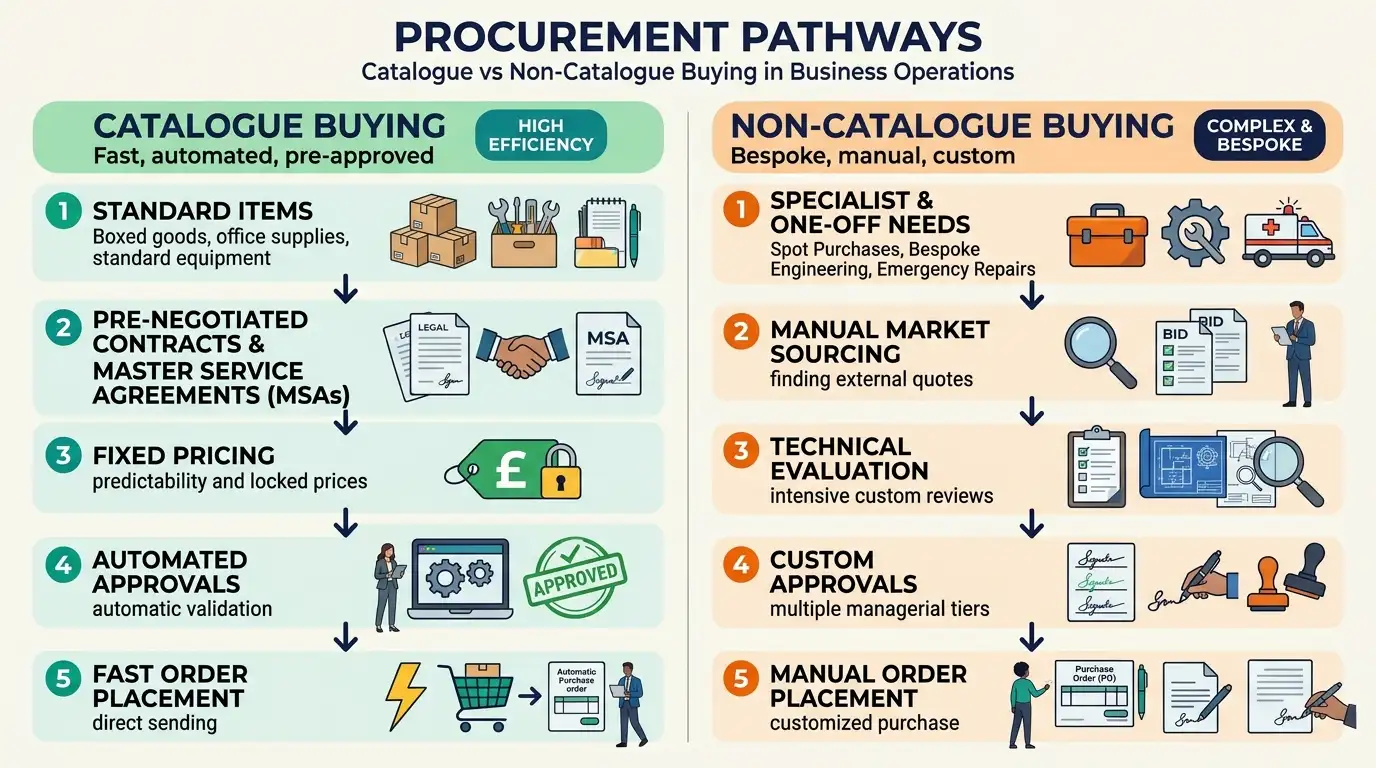
Catalogue buying uses pre-negotiated contracts and master service agreements for standard items, ensuring fixed pricing and automated approvals. Non-catalogue buying addresses spot purchases, bespoke engineering, and emergency repairs, requiring custom approvals, manual market sourcing, and intensive technical evaluation before order placement.
Framework Agreements and Catalogue Buying
Catalogue and non-catalogue buying represent distinct operational pathways in energy supply chains. Catalogue buying relies on digital punch-out catalogues linked directly to framework agreements and Master Service Agreements (MSAs). High-volume, standardized maintenance items—such as fast-moving pipe fittings, standard valves, personal protective equipment (PPE), and routine consumables—exist within pre-approved electronic catalogues.
Buyers select predefined line items with pre-negotiated pricing and established delivery terms. This setup automates approval thresholds, drastically reduces purchasing friction, and maintains tight control over operational budgets.
Non-Catalogue Procurement and Ad-Hoc Purchasing
Non-catalogue buying addresses unique, high-value, or specialized operational requirements. Examples include custom-engineered drilling bits, emergency turbine repairs, specialized subsea equipment, and niche environmental consulting services. Because these items lack pre-negotiated master contracts, requisitioners must enter detailed technical specifications manually.
Procurement teams must execute ad-hoc market assessments, issue Requests for Quotation (RFQs), evaluate technical bids, and negotiate contract terms before issuing a purchase order. This extra governance adds time to the procurement cycle but protects against commercial and operational risks.
What Factors Impact Procurement Cycle Time in Oil and Gas Supply Chains?
Procurement cycle time is driven by requisition accuracy, authorization threshold complexity, vendor responsiveness, logistics lead times, and manual invoice clearance. Incomplete technical specifications, fragmented approval chains, and recurring 3-way matching exceptions create severe operational delays across upstream and downstream operations.
Requisition Quality and Spec Clarity
Incomplete or inaccurate line-item specifications force procurement officers to return requisitions to field engineers for clarification. Re-work loops add days or weeks to the front end of the procurement cycle. Establishing clear material master databases and mandatory specification fields eliminates initial processing delays.
Financial Authority Thresholds and Routing Bottlenecks
Excessively complex approval hierarchies stall critical requisitions. When approval workflows require sequential signatures from multiple executives for routine low-value items, procurement velocity drops. Organizations optimize throughput by establishing realistic delegation of authority thresholds and enabling mobile approval capabilities.
Vendor Integration and Commercial Responsiveness
The speed of vendor confirmation, order processing, and shipping notification directly governs overall cycle duration. Integrated supplier portals allow vendors to receive POs, confirm delivery dates, and submit digital advance shipping notices instantly, cutting transaction time significantly compared to manual email communications.
Invoice Matching Discrepancies and Exception Resolution
Inconsistent pricing between purchase orders, goods receipts, and vendor invoices creates massive processing backlogs. When invoice validation fails, accounts payable teams must manually investigate pricing variances, missing service entry sheets, or quantity mismatches. Resolving these exceptions stalls supplier payments and consumes extensive administrative resources.
How Can Organizations Maximize Spend Under Management in Energy Assets?
Organizations maximize spend under management by consolidating fragmented purchasing into enterprise framework agreements, enforcing e-procurement platform adoption, eliminating off-contract maverick spend, and integrating real-time analytics to audit material category compliance across all operating units and asset facilities.
Eliminating Maverick Spend
Spend under management measures the proportion of enterprise expenditure actively controlled, negotiated, and audited by professional procurement teams. Uncontrolled or "maverick" spending occurs when field units purchase goods outside established procurement channels and contracts. Maverick buying leads to higher unit prices, unvetted supplier risks, non-standard material usage, and loss of volume rebates.
Consolidating Category Management
Structuring procurement operations around clear spending categories allows teams to aggregate purchasing volumes across multiple field assets. Aggregating demand for commodity groups—such as line pipes, OCTG (Oil Country Tubular Goods), chemicals, and logistics services—gives organizations strong leverage during contract negotiations.
Enforcing E-Procurement System Compliance
Restricting non-PO purchases ensures that operational units execute purchases through enterprise e-procurement portals. System rules enforce automated policy compliance, direct users toward preferred vendors, and flag non-compliant requisitions before commercial commitments occur.
Utilizing Advanced Analytics and Spend Visibility
Integrating analytics tools into the ERP architecture gives procurement leadership real-time visibility into spending trends across business units. Clear visibility helps teams identify uncontracted expenditure categories, evaluate vendor performance, optimize payment terms, and capture cost-saving opportunities systematically.
Which Training Framework Best Improves P2P Operational Competency?
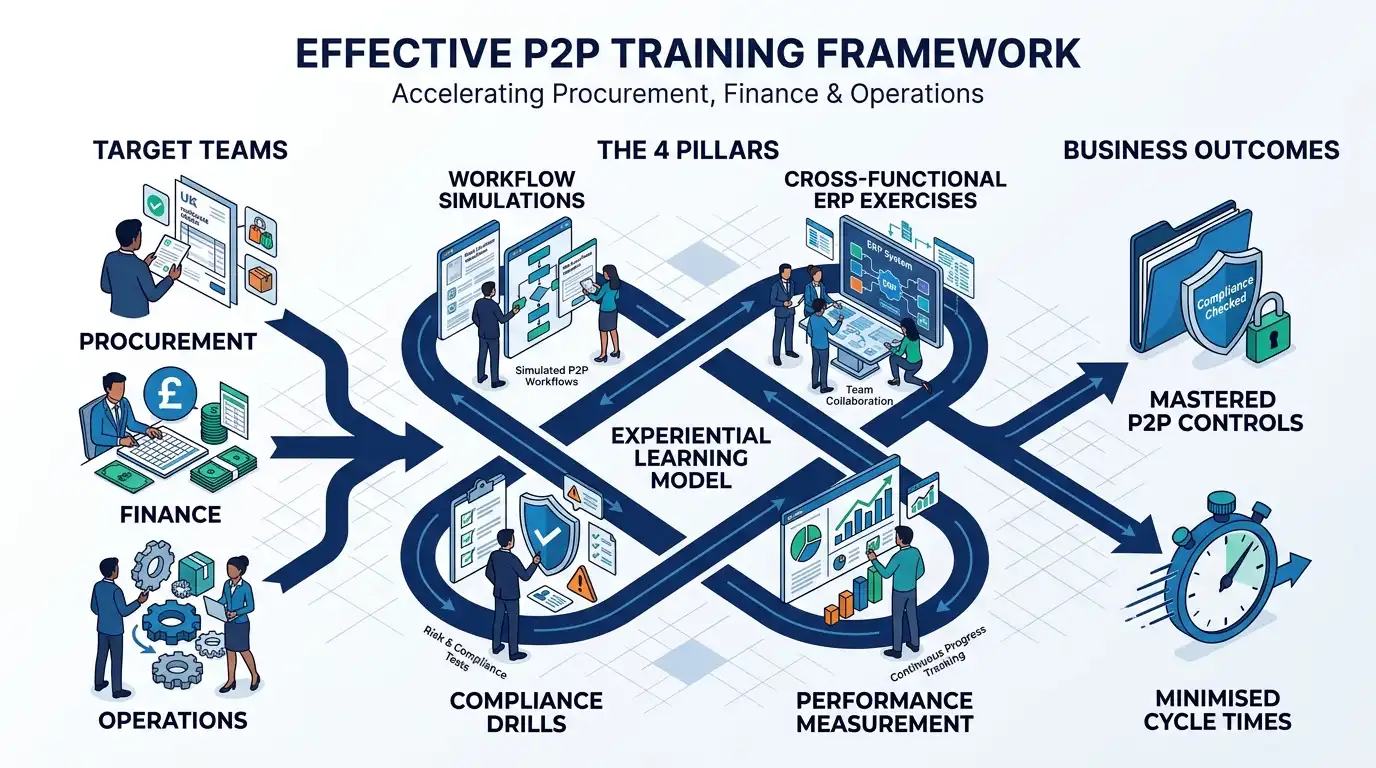
The most effective training framework combines practical workflow simulations, cross-functional ERP exercises, compliance scenario drills, and continuous performance measurement. Experiential learning models ensure procurement, finance, and operations personnel master technical P2P controls and minimize operational cycle times efficiently.
Evaluating Workforce Competency Gaps
Procurement transformation fails without a competent, trained workforce. Field engineers, buyers, and financial controllers often operate in organizational silos, leading to errors during requisition creation, goods receipt processing, and invoice matching. Addressing skill gaps requires structured workforce development focused on end-to-end process integration.
Implementing targeted professional development programs, such as the Procure to Pay End to End Process Training for Oil and Gas Professionals by Institute For Oil & Gas Training, ensures cross-functional alignment and improves overall process efficiency.
Organizations evaluating professional learning solutions can explore structured options through the [Procure-to-Pay (P2P) End-to-End Process for Oil & Gas Training Course](Procure-to-Pay (P2P) End-to-End Process for Oil & Gas Training Course) to build institutional capabilities.
Learning Delivery Models Comparison
Selecting the right educational model depends on organizational structure, workforce distribution, and operational urgency.
Training Delivery Model | Primary Focus & Methodology | Operational Advantages | Implementation Challenges | Ideal Business Context |
Instructor-Led Corporate Workshops | Intensive, expert-guided practical sessions focusing on industry workflows and regulatory compliance. | High engagement, real-time feedback, tailored to company-specific ERP rules and DoA frameworks. | Requires dedicated staff time off-site or scheduled downtime for operational personnel. | Enterprise capability building and major procurement system transformations. |
Interactive Digital & E-Learning Modules | Self-paced digital modules covering foundational P2P rules, nomenclature, and basic ERP entry. | Highly scalable, low cost per participant, accessible across remote offshore assets. | Lower completion rates; lacks customized, hands-on problem-solving for complex exceptions. | Onboarding new hires and broad compliance refresher training across global teams. |
On-the-Job Mentorship & Shadowing | Informal, peer-to-peer knowledge transfer during daily operational execution. | Zero formal training cost, immediate real-world context on live operational transactions. | Inconsistent quality, risks perpetuating existing inefficient work habits across teams. | Small operational sites with low turnover and basic purchasing structures. |
Decision Framework for Training Selection
HR leadership and procurement directors should apply a structured framework when selecting training solutions to bridge skill gaps across their workforce.
Evaluation Criterion | Low Capability / High Risk | Target Standard / High Capability | Strategic Business Value |
ERP Workflow Mastery | Frequent requisition errors and improper WBS coding. | Error-free requisition creation and accurate material master selection. | Prevents order re-work loops and downstream invoice holds. |
Cross-Functional Visibility | Siloed operations with poor communication between finance and supply chain. | Clear understanding of how field actions impact cash flow and financial audits. | Accelerates 3-way matching and improves vendor relationships. |
Exception Handling Skills | Manual exception resolution taking weeks per invoice discrepancy. | Rapid identification and clearance of GRN/SES and PO line mismatches. | Cuts procurement cycle time and avoids late payment penalties. |
Policy & DoA Compliance | Unintentional policy violations and unvetted emergency ordering. | Strict adherence to financial thresholds and sourcing guidelines. | Protects asset integrity and eliminates unvetted maverick spend. |
Measuring ROI and Performance Impact
The business value of procurement training reflects directly in operational Key Performance Indicators (KPIs). Organizations measuring program success track four core metrics post-training:
Procurement Cycle Time Reduction: Faster processing from initial requisition to PO issuance.
Decrease in 3-Way Match Exceptions: Lower error rates across POs, GRNs/SESs, and invoices.
Increase in Spend Under Management: Higher policy compliance and reduced maverick buying.
Lower Cost per Transaction: Efficient administrative workflows across procurement and finance teams.
Investments in structured workforce learning yield measurable financial returns by reducing operational downtime, optimizing inventory levels, and improving working capital management across energy operations.
Frequently Asked Questions
What is oil and gas petroleum procurement?
Oil & Gas Petroleum Procurement is the strategic process of acquiring equipment, raw materials, technical services, and logistics necessary for upstream, midstream, and downstream operations. It encompasses supplier selection, contract negotiation, inventory governance, and risk mitigation to maintain uninterrupted supply chains. Training through the Institute For Oil & Gas Training equips industry professionals with the frameworks required to streamline procurement cycles and control operational expenditure.
Why is specialized procurement training essential in the energy sector?
Petroleum supply chains face unique challenges, including strict safety compliance, volatile market pricing, complex international logistics, and high equipment costs. Specialized procurement courses from the Institute For Oil & Gas Training provide teams with technical knowledge in contract management, strategic sourcing, and delegation of authority rules. This targeted training minimizes supply chain disruptions, reduces maverick spend, and aligns purchasing activities with operational safety standards.
How does the procure-to-pay (P2P) process work in petroleum operations?
The end-to-end procure-to-pay cycle begins with purchase requisition creation and approval, followed by purchase order execution, goods or service receipt verification, and final invoice settlement. In oil and gas assets, accurate three-way matching between purchase orders, material receipt notes, and vendor invoices prevents costly financial leakage. The Institute For Oil & Gas Training delivers practical modules on managing Oil & Gas Petroleum Procurement workflows to reduce transaction times and eliminate inventory bottlenecks.
How do oil and gas companies optimize spend under management?
Energy organizations optimize spend under management by consolidating purchasing demand into enterprise framework agreements, enforcing electronic procurement adoption, and eliminating off-contract buying. Implementing real-time spend analytics allows procurement managers to audit category compliance and leverage volume discounting. Through the Institute For Oil & Gas Training, supply chain personnel learn how to design robust commercial strategies for effective Oil & Gas Petroleum Procurement.
What key skills are required for oil and gas procurement professionals?
Procurement specialists require a balance of commercial negotiation techniques, vendor risk management capabilities, market analysis, and enterprise resource planning (ERP) system proficiency. Understanding specialized contract structures, such as Master Service Agreements and Incoterms, is critical for international energy assets. The Institute For Oil & Gas Training offers tailored corporate programs focused on building these high-demand competencies for sustainable workplace execution.
Related training courses
Vendor Management & Local Content Requirements: Onboarding Training Course
- Specialisation
- Oil & Gas Petroleum Procurement
- Duration
- 5 days · 15 CPD hours
Vendor Management & Local Content Requirements: ICV Compliance Training Course
- Specialisation
- Oil & Gas Petroleum Procurement
- Duration
- 5 days · 15 CPD hours
Financial Evaluation of Suppliers & Contractors: Credit Assessment Training Course
- Specialisation
- Oil & Gas Petroleum Procurement
- Duration
- 5 days · 15 CPD hours
More articles

Procure to Pay Controls and Automation Workflow Design Training by Institute For Oil & Gas Training
Master P2P workflow design, automation, and internal controls with Institute For Oil & Gas Training. Enroll now for measurable operational gains.
Read article →
How to Design Procure to Pay Workflows with Effective Controls and Automation
Learn how to design Procure to Pay workflows featuring robust internal controls and automation to eliminate procurement inefficiencies and financial risk.
Read article →
Why Procure to Pay Controls and Automation Are Essential for Procurement Efficiency
Discover how procure to pay controls and automation streamline workflows, mitigate risk, and boost corporate procurement efficiency.
Read article →