
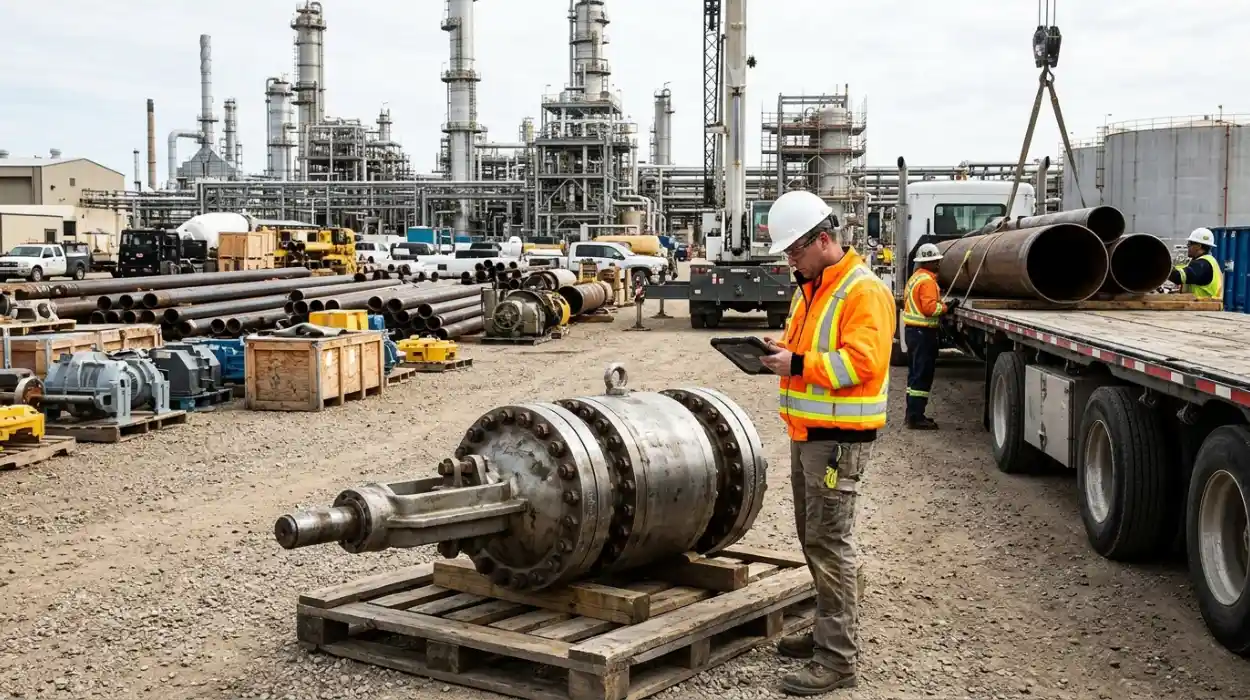
The Procure to Pay process in oil and gas procurement is an end-to-end operational framework that integrates purchasing workflows, vendor management, inventory tracking, service validation, and financial settlement into a single, compliant system to control operational expenditure.
In upstream, midstream, and downstream operations, Procure to Pay (P2P) functions as the core operational mechanism for capital allocation and material management. Oil and gas enterprises manage multi-billion-pound exploration and production budgets across remote assets, offshore rigs, and complex refining facilities. Without a structured P2P workflow, organisations suffer from maverick spending, delayed maintenance turnarounds, high inventory holding costs, and contractual non-compliance.
Procure to Pay spans the full lifecycle of expenditure. It connects operational requisitions from field engineers directly to corporate finance teams. The workflow ensures every pound spent aligns with pre-approved contracts, safety regulations, and joint venture auditing standards. In high-risk operational environments, P2P efficiency directly prevents costly equipment downtime, logistics bottlenecks, and supplier disputes.
How Does the Procure to Pay Cycle Work in Enterprise Operations?
The Procure to Pay cycle functions by enforcing continuous transactional checks across operational demand identification, formal vendor engagement, physical or technical delivery verification, invoice reconciliation, and structured financial disbursement through enterprise resource planning systems.
The operational process starts when field personnel identify a material requirement or specialized technical service. Employees submit a formal purchase requisition, specifying exact technical specifications, required delivery dates, and cost center allocations. System logic routes the requisition through a pre-configured requisition approval workflow based on monetary thresholds, departmental budgets, and delegation-of-authority matrices.
Once approved, the procurement system executes purchase order creation, converting the verified request into a legally binding contract sent to the selected supplier. Procurement strategies separate transactions into catalogue and non-catalogue buying. Enterprise catalogues cover recurring, standardized items like safety equipment, pipe fittings, and standard valves. Non-catalogue buying manages custom engineering components, drill bits, and specialized offshore subsea tools requiring technical evaluations.
Upon physical arrival at offshore platforms or onshore yards, warehouse staff inspect items and generate a goods receipt note. For ongoing offshore technical services, site supervisors validate completed contractor hours and milestones by issuing a service entry sheet. Finance teams process vendor bills through automated 3-way matching, comparing the invoice against the original purchase order and the verified receiving document. After successful reconciliation, the accounting system queues the transaction for the scheduled payment run.
What Core Components Define a Modern P2P Framework?
A modern Procure to Pay framework comprises standardized requisition protocols, delegated approval hierarchies, automated commercial order generation, rigorous receipt validation, digital invoice matching engines, and data analytics dashboards driving spend under management.
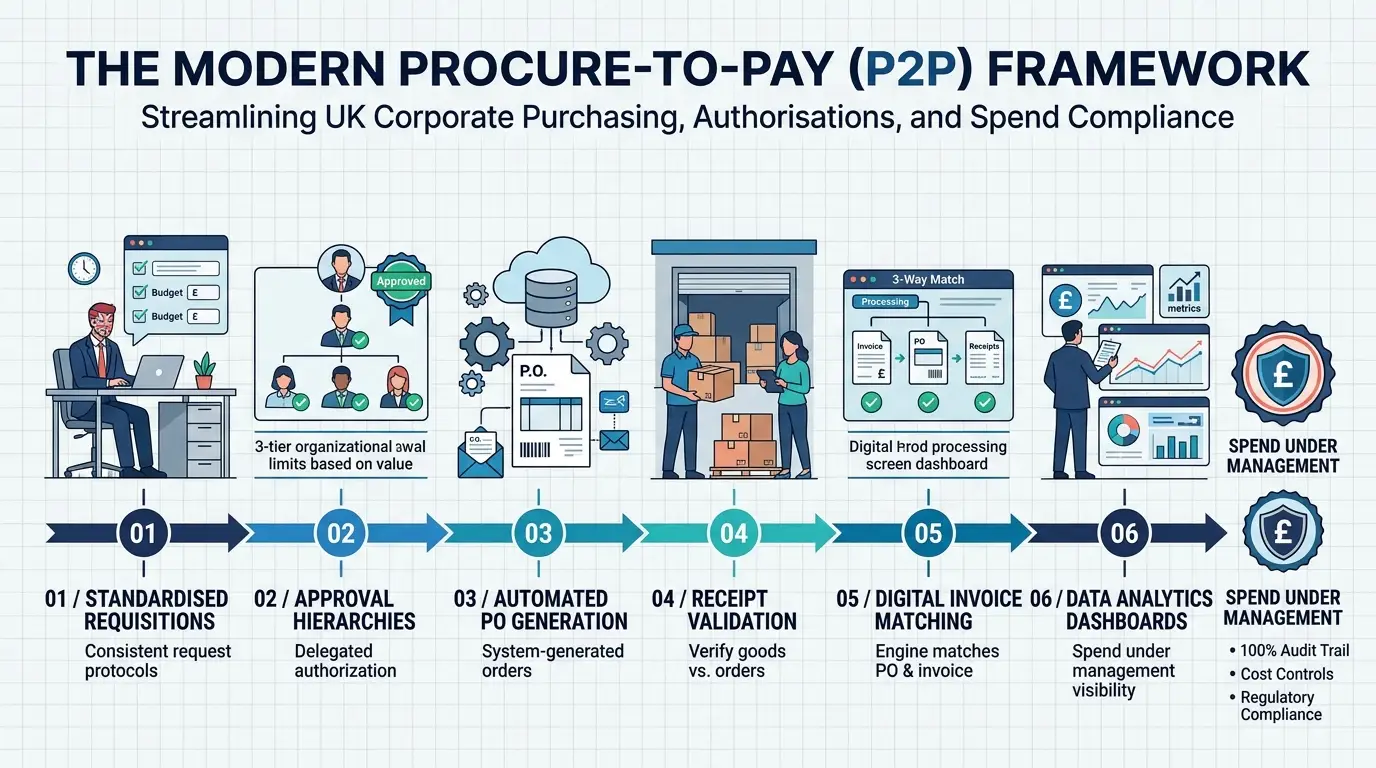
Oil and gas supply chains rely on specific operational components to ensure structural integrity across high-volume transactions:
Requisition Protocols: Standardized digital forms that capture technical specifications, unit of measure, financial cost centers, project codes, and safety compliance certificates before purchasing activity starts.
Approval Hierarchies: Multi-tiered rules embedded in software systems that govern authorization levels according to delegation of authority policies across management ranks.
Master Service Agreements and Catalogues: Pre-negotiated commercial agreements integrated into digital purchasing portals to stream repeat purchases at contracted pricing structures.
Verification Mechanisms: Formal operational records including the goods receipt note for physical supplies and the service entry sheet for technical contractor execution.
Financial Reconciliation Engines: Digital invoice processing architectures designed to automatically execute 3-way matching between purchase orders, receipt logs, and vendor invoices.
Spend Analytics Modules: Analytical tracking tools that calculate spend under management to identify unmanaged tail spend, contract leaks, and supplier performance metrics.
How Do Enterprise Skill Gaps Impact P2P Execution?
Enterprise skill gaps in Procure to Pay execution cause costly operational delays, high error rates in service verification, maverick spend, extended procurement cycle times, and severe joint venture audit non-compliance risks across exploration projects.
Energy sector procurement environments present complex technical demands. When workforce capabilities lack depth in enterprise software utilization, legal contracting terms, or accounting principles, structural breakdowns occur across operational sites:
Incorrect Requisition Coding: Field engineers select incorrect general ledger accounts or work breakdown structure codes, forcing finance teams to manually rework orders and delaying material dispatch.
Inaccurate Service Validation: Site managers approve a service entry sheet without verifying contractor rate sheets against signed Master Service Agreements, causing overbillings.
Manual Workarounds and Maverick Buying: Teams bypass formal catalogue and non-catalogue buying rules to expedite deliveries, reducing visibility over corporate expenditure.
Extended Procurement Cycle Time: Lack of training on software systems leads to stalled approval queues, increasing total procurement cycle time from 5 days to 22 days.
Vendor Friction and Payment Delays: Errors during initial invoice processing trigger system exceptions, creating invoice backlogs, supplier credit holds, and operational project standstills.
What Strategic Benefits Does an Optimized P2P Process Produce?
An optimized Procure to Pay process reduces operating expenses, minimizes supply chain disruption risks, enforces regulatory compliance, optimizes cash flow management, and provides complete transactional transparency for internal audit teams.
Enterprise-wide P2P optimization delivers measurable advantages across energy sector supply chains:
Operational Metric | Standard Environment | Optimized P2P Environment | Strategic Impact |
Procurement Cycle Time | 18–25 Business Days | 3–5 Business Days | Faster turnaround for critical offshore spares |
Spend Under Management | 55% – 65% | 85% – 95% | Elimination of unmanaged tail spend and leakage |
Straight-Through Invoice Processing | 30% – 40% | 80% – 90% | Lower administrative costs per processed invoice |
Contractual Compliance | 60% Coverage | 95%+ Coverage | Eradication of price variance and illegal surcharges |
Maverick Spend Ratio | 20% – 35% Total Spend | Under 3% Total Spend | Total control over operational capital allocation |
Organizations achieving high P2P maturity eliminate administrative duplication across engineering, logistics, and finance departments. Clean data capture allows commercial teams to negotiate volume discounts with key suppliers based on accurate historical purchasing volumes.
How Do Organizations Implement P2P Workforce Development Programs?
Organizations implement Procure to Pay workforce development through structured skills gap assessments, blended learning pathways, practical ERP system simulations, role-based technical workshops, and continuous post-training competency evaluations.
Workforce enablement requires an organized implementation roadmap to transition employees from legacy habits to standardized, compliant execution.
Competency Mapping: L&D professionals assess current proficiency levels across supply chain planners, field engineers, warehouse supervisors, and accounts payable specialists.
Curriculum Alignment: Subject matter experts design practical learning modules focused on realistic energy industry scenarios, such as emergency drilling platform requisitions or complex offshore vessel charter invoicing.
Delivery via Blended Learning: Training teams combine instructor-led interactive workshops with self-paced digital learning modules to accommodate shift rotations across onshore offices and remote field locations.
Hands-on ERP Simulations: Learners practice executing real transactions inside sandbox software environments, performing purchase order creation, processing a goods receipt note, and resolving mismatched invoice exceptions.
Post-Training Competency Testing: Organizations evaluate skill retention through practical scenarios, measuring student accuracy in approving requisitions and validating technical service entries.
When evaluating external educational resources to structure internal skill-building initiatives, corporate decision-makers frequently review specialized curriculum paths such as the Procure-to-Pay (P2P) End-to-End Process for Oil & Gas Training Course to standardize operational workflows across multi-disciplinary teams.
Which Operational Teams Require P2P Training?
Procure to Pay training targets cross-functional operational teams, including supply chain specialists, site engineers, warehouse administrators, accounts payable staff, category managers, and department heads holding budget approval authority.
Workforce development programs must address the unique functional responsibilities of distinct corporate roles:
Field Engineers and Asset Managers: Require precise knowledge of requisition submission, cost-center coding, and non-catalogue item specification to prevent delays in maintenance schedules.
Logistics and Materials Personnel: Need practical mastery of material inspection protocols and system entry procedures to process a goods receipt note accurately upon cargo delivery.
Contract Engineers and Site Supervisors: Focus on technical verification frameworks to inspect contractor milestones and sign off on a service entry sheet without commercial leakage.
Accounts Payable Teams: Must build advanced capabilities in exception handling, automated matching rules, tax compliance, and executing an efficient payment run.
Procurement and Category Leaders: Require analytical skills to interpret procurement data, monitor spend under management, manage supplier performance, and compress overall procurement cycle time.
As organizations scale operational training, learning managers often transition from introductory concepts to detailed procedural guides. To explore exact operational techniques, teams reference guides on How to Manage the End to End Procure to Pay Process in Oil and Gas Operations to establish uniform operational standard operating procedures across all production facilities.
What Common Misconceptions Disrupt P2P Training Success?
Common misconceptions that disrupt Procure to Pay training success include treating P2P purely as an IT software update, training departments in isolated silos, assuming single static workshops build long-term competence, and neglecting practical operational context.
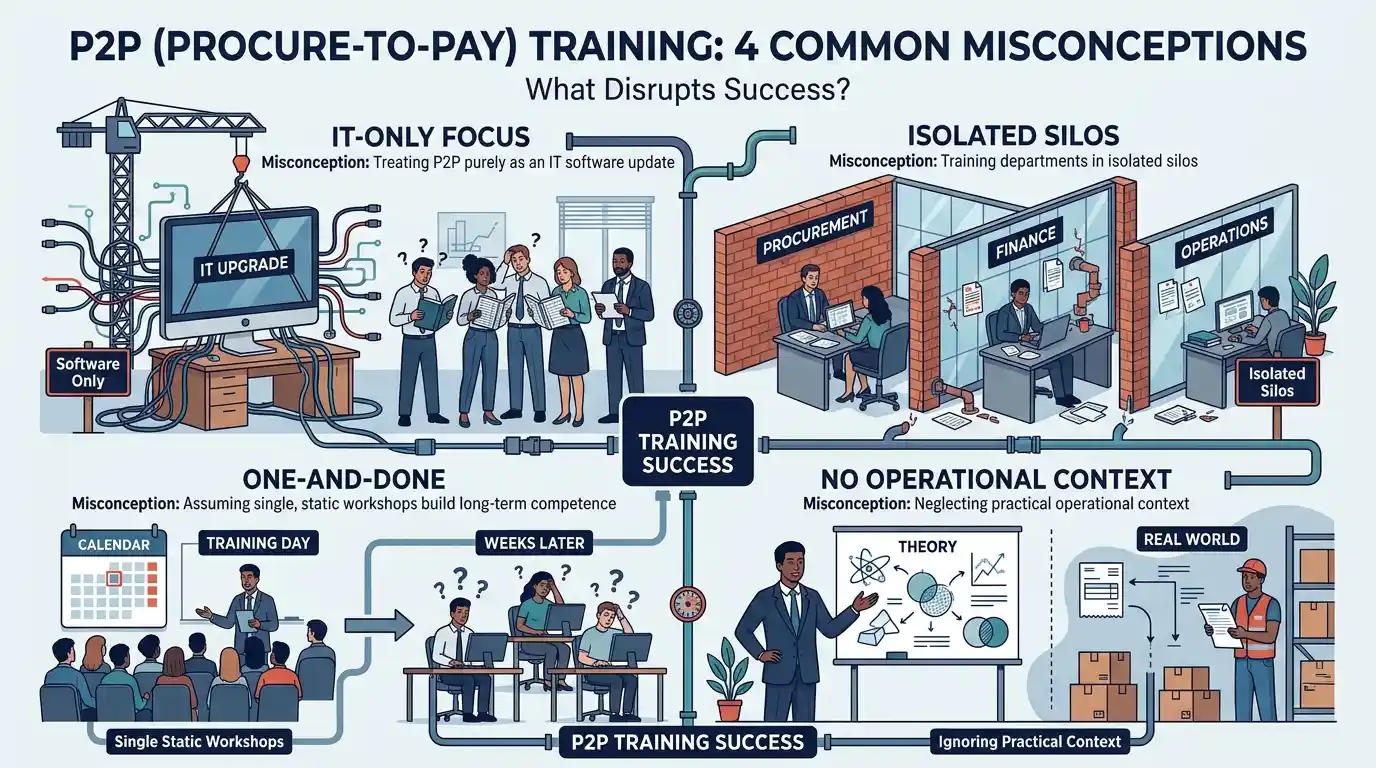
Enterprise learning programs fail to generate measurable return on investment when leadership teams succumb to structural misunderstandings:
Viewing P2P as an IT System Issue: Assuming that installing ERP software automatically changes operational behavior without targeted human skill development.
Isolated Departmental Training: Teaching procurement, operations, and finance in separate sessions prevents employees from understanding how their input errors create downstream disruptions for other teams.
One-Time Event Fallacy: Treating workforce training as a single orientation event rather than an ongoing development framework with continuous learning reinforcement.
Generic ERP Instruction: Utilizing generic software training manuals that lack oil and gas context, such as drilling rig terminology, Joint Operating Agreements, or hazardous material logistics rules.
Ignoring Outcome Metrics: Measuring success by course completion rates rather than evaluating real operational KPIs like invoice exception reductions or compressed cycle times.
What Measurable Outcomes Prove P2P Training ROI?
Measurable outcomes proving Procure to Pay training ROI include a 40% to 60% reduction in cycle times, a 70% decrease in invoice processing errors, higher spend under management, reduced maverick purchasing, and lower transaction processing costs.
L&D professionals and corporate decision-makers justify professional development investments by measuring concrete performance improvements post-training:
Procurement Cycle Time Compression: Standardized requisitioning and automated approval routing eliminate administrative delays, moving purchase requests to vendor dispatch faster.
Reduction in Invoice Exceptions: Training accounts payable and field personnel on precise 3-way matching reduces manual invoice holds, preventing late payment penalties and vendor disputes.
Increased Spend Under Management: Educated managers route purchases through authorized corporate contracts and catalogues, capturing volume discounts and controlling tail spend.
Eradication of Duplicate Payments: Structured system validation workflows ensure invoices map to verified receipt logs, stopping duplicate disbursements.
Enhanced Audit Compliance: Full traceability across requisitions, approvals, purchase orders, goods receipts, and payments ensures 100% compliance during joint venture and regulatory financial audits.
Frequently Asked Questions
What is included in an Oil & Gas Petroleum Procurement training course?
An Oil & Gas Petroleum Procurement course from the Institute For Oil & Gas Training covers the complete end-to-end purchasing cycle, including purchase requisitions, vendor selection, contract negotiation, inventory management, and compliance auditing. Participants master critical operational skills such as managing service entry sheets, purchase order creation, and 3-way invoice matching. This structured learning enables energy sector professionals to streamline supply chain operations, reduce operational expenditure, and mitigate project risk.
Why is specialized procurement training essential for oil and gas operations?
Energy sector supply chains involve high-value transactions, stringent safety regulations, and complex joint venture agreements that general purchasing courses fail to address. Through practical training with the Institute For Oil & Gas Training, supply chain and finance teams gain hands-on experience in managing tail spend, optimizing procurement cycle times, and enforcing corporate delegation of authority. This specialized knowledge directly prevents supply chain delays, maverick spending, and contractual non-compliance in field operations.
How does Oil & Gas Petroleum Procurement training improve supply chain efficiency?
Training equips employees with standardized workflows for catalogue and non-catalogue buying, goods receipt validation, and automated invoice processing within enterprise systems. By standardizing these operational procedures, the Institute For Oil & Gas Training helps energy companies increase spend under management while reducing manual invoice processing errors and administrative cycle times. Consequently, organizations achieve lower inventory holding costs and maintain seamless continuous production cycles.
Who should undertake Oil & Gas Petroleum Procurement training?
This professional development program is designed for supply chain specialists, procurement managers, field engineers, warehouse administrators, and accounts payable professionals operating within the energy industry. The Institute For Oil & Gas Training tailors curriculum pathways to ensure cross-functional teams build a unified understanding of commercial contracts, vendor management, and financial reconciliation. Decision-makers and budget holders also benefit by acquiring strategic oversight to enforce governance across capital expenditure projects.
What are the main benefits of optimizing the Procure-to-Pay (P2P) cycle in energy procurement?
Optimizing the P2P cycle reduces total procurement cycle time, minimizes invoice exception backlogs, and maximizes contract compliance across remote operational assets. With practical guidance from the Institute For Oil & Gas Training, organizations strengthen vendor relationships, eliminate duplicate disbursements, and establish complete audit trail transparency for joint venture partners. These operational improvements deliver measurable financial returns while safeguarding critical exploration and production schedules.
Related training courses
Procure-to-Pay (P2P) End-to-End Process for Oil & Gas Training Course
- Specialisation
- Oil & Gas Petroleum Procurement
- Duration
- 5 days · 15 CPD hours
Procure-to-Pay (P2P) Controls & Automation: Workflow Design Training Course
- Specialisation
- Oil & Gas Petroleum Procurement
- Duration
- 5 days · 15 CPD hours
Vendor Management & Local Content Requirements: ICV Compliance Training Course
- Specialisation
- Oil & Gas Petroleum Procurement
- Duration
- 5 days · 15 CPD hours
More articles

Procure to Pay Controls and Automation Workflow Design Training by Institute For Oil & Gas Training
Master P2P workflow design, automation, and internal controls with Institute For Oil & Gas Training. Enroll now for measurable operational gains.
Read article →
How to Design Procure to Pay Workflows with Effective Controls and Automation
Learn how to design Procure to Pay workflows featuring robust internal controls and automation to eliminate procurement inefficiencies and financial risk.
Read article →
Why Procure to Pay Controls and Automation Are Essential for Procurement Efficiency
Discover how procure to pay controls and automation streamline workflows, mitigate risk, and boost corporate procurement efficiency.
Read article →