

Procure to pay controls and automation integrate software, standardized approval hierarchies, and transactional policies to streamline corporate purchasing, eliminate manual data entry, reduce financial leakage, and give leadership complete visibility over organization-wide expenditure from requisition through to final payment processing.
Procure to Pay (P2P) represents the end-to-end operational cycle through which an organization identifies material requirements, selects suppliers, issues purchase orders, receives goods or services, and settles vendor invoices. In corporate environments, manual P2P operations create severe operational friction. Paper-based purchase orders, physical invoice handling, and uncoordinated approval chains lead to processing delays, missed early payment discounts, high operational costs, and elevated risks of fraud or duplicate payments.
Modern enterprise P2P systems replace disjointed manual touchpoints with centralized digital workflows. These systems embed internal controls directly into purchasing applications. Systemic enforcement of compliance frameworks—such as mandatory purchase order (PO) generation prior to order placement—ensures that every expenditure reflects verified corporate budgets and pre-approved authorization limits.
From an organizational development perspective, implementing P2P controls requires targeted workforce training. Technology adoption fails when staff lack operational understanding of compliance rules, software interfaces, or financial audit trails. Procurement officers, accounts payable (AP) specialists, department managers, and finance professionals require structured upskilling to operate automated platforms, resolve invoice exceptions, and evaluate vendor performance metrics effectively.
How Do Procure to Pay Workflows Function in Corporate Environments?
Procure to pay workflows execute sequential operations using automated business logic to validate requisitions, dispatch purchase orders to vendors, confirm goods receipt, perform automated three-way matching, and schedule payments according to pre-configured corporate treasury guidelines and contract terms.
The corporate P2P execution cycle follows five core stages:
Purchase Requisition and Approval: An employee identifies a business need and submits a digital requisition via the centralized Enterprise Resource Planning (ERP) platform. The system checks available department budgets and routes the request through automated approval chains based on established delegation of authority thresholds.
Purchase Order Issuance: Once authorized, the platform converts the requisition into an official PO. The system dispatches this document to the vendor through a supplier self-service portal, locking in pricing, item specifications, and delivery schedules.
Goods Receipt and Verification: Upon physical delivery, receiving staff log a Goods Received Note (GRN) in the system. This record confirms quantity, item quality, and acceptance dates.
Automated Invoice Capture and Matching: Vendors submit electronic invoices. Systems featuring optical character recognition capture ingest invoice header and line-item data without human intervention. The platform executes an automated three-way match, comparing invoice data against the original PO and the GRN.
Payment Processing and Reconciliation: Validated invoices enter the payment queue. The treasury team executes batch payments on maturity dates, capturing available supplier discounts and updating payables ageing and DPO (Days Sales Outstanding) dashboards in real time.
When data discrepancies occur during matching, automated rules route the file to specialized AP staff for invoice exception management. Upstream workforce training ensures that operational teams diagnose whether errors stem from vendor price inflation, quantity mismatches, or incorrect tax codes without halting manufacturing or service delivery.
What Key Components Make Up an Effective P2P Control Framework?
An effective P2P control framework combines strict governance policies, digital validation tools, unified software architecture, clear authorization hierarchies, automated matching algorithms, and comprehensive workforce training programs designed to align operational behavior with corporate financial targets.
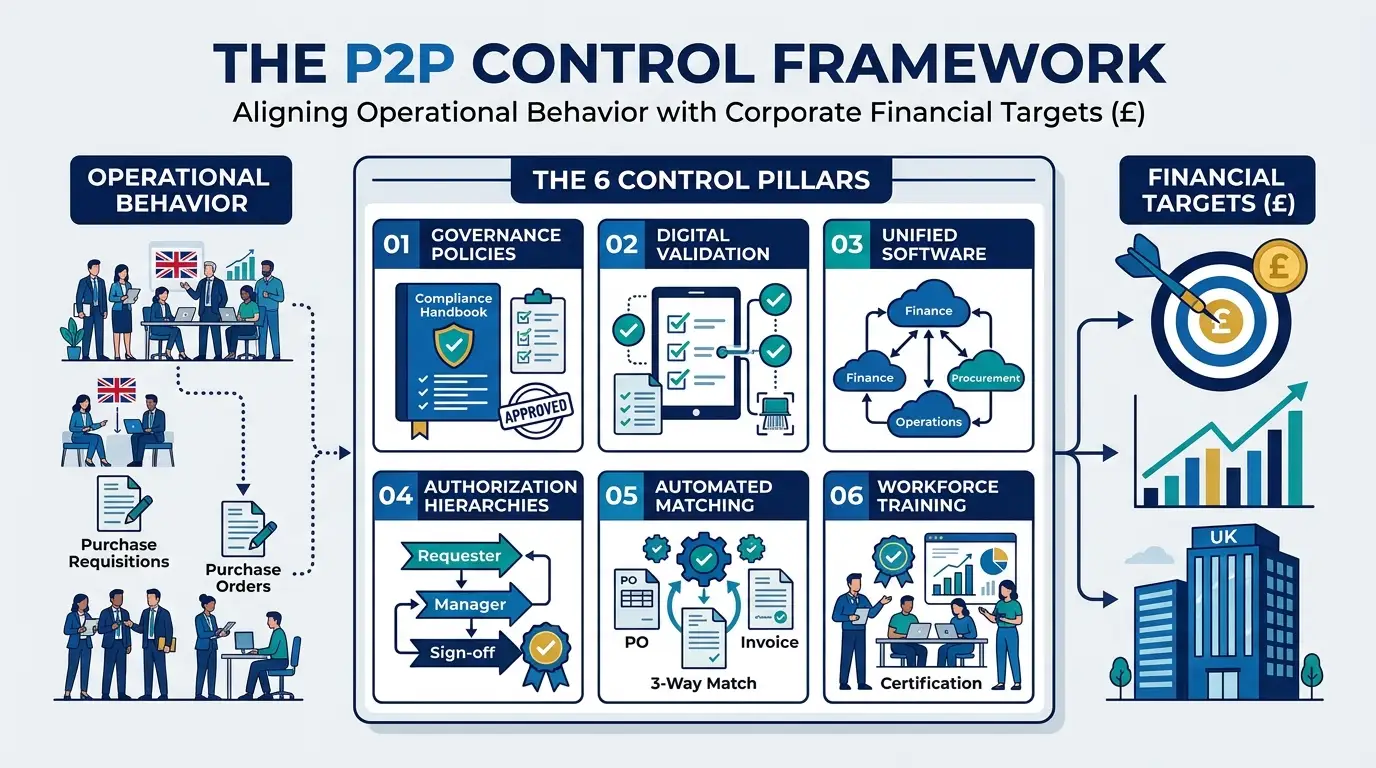
A robust enterprise procurement system depends on four distinct structural components:
1. Governance Policies
Delegation of Authority Thresholds: Rules that define spend limits for each organizational level. A manager approves transactions up to £10,000, while directorship authorization triggers for amounts exceeding £50,000.
No PO No Pay Policy: Mandatory financial rules directing accounts payable teams to reject any supplier invoice lacking an approved purchase order number.
Segregation of Duties: Governance frameworks ensuring no single employee holds authority to initiate requisitions, approve orders, log receipt of goods, and disburse vendor funds.
2. Automation and Digital Tools
Optical Character Recognition (OCR) Capture: Advanced software tools that extract text data from scanned paper or electronic PDF invoices, converting raw data into digital ERP fields.
Supplier Self-Service Portals: Secure external platforms where vendors upload invoices directly, view payment schedules, track order statuses, and update corporate information.
Automated Exception Handling Engines: Rule-based routing systems that flag price variations outside strict percentage tolerances (such as a 2% variance limit) and notify procurement managers automatically.
3. Analytics and Reporting Dashboards
Real-time metrics tracking vendor delivery performance, system processing times, contract compliance rates, and cash management figures like early payment discount capture percentages.
4. Continuous Competency Development
Structured training interventions including interactive ERP simulation exercises, process auditing workshops, and case-based studies on fraud detection. Employees practice identifying irregular billing patterns, resolving system exceptions, and utilizing vendor communication tools safely.
Why Is Professional Development Critical for P2P Implementation Success?
Professional development equips multi-departmental teams with the operational capabilities, regulatory knowledge, and analytical skills necessary to operate automated procurement systems, eliminate manual workarounds, adhere to compliance frameworks, and maintain financial audit integrity across the enterprise.
Enterprise software investments fail to produce targeted ROI when organizations treat system implementations as purely technical upgrades rather than organizational change initiatives. When enterprise software deploys without parallel workforce training, employees construct informal workarounds. Staff purchase supplies outside approved vendor contracts, create retrospective purchase orders to bypass approval gates, or approve unverified invoice exceptions to clear backlogs.
Targeted corporate learning programs address systematic employee skill gaps:
Procurement Specialists: Require advanced capabilities in negotiating contract pricing tiers, analyzing supplier performance analytics, and managing vendor compliance via digital portals.
Accounts Payable Specialists: Require technical expertise in configuring OCR capture rules, resolving complex three-way matching errors, and executing duplicate payment prevention audits.
Department Managers: Need practical training on evaluating budget availability, reviewing line-item requisitions, and applying delegation of authority rules consistently.
Structured training delivery methodologies ensure high knowledge retention. Case-based learning environments allow AP teams to review real-world historical invoice fraud attempts. Simulated ERP sandbox environments enable department heads to practice routing complex requisitions safely. Blended learning programs—combining live expert-led interactive workshops with self-paced digital reference modules—ensure operational continuity across global, multi-site business operations.
How Do Organizations Implement Procure to Pay Controls Step by Step?
Organizations implement P2P controls by assessing current process maturity, standardizing approval policies, configuring integrated digital procurement platforms, conducting targeted role-based workforce training, executing pilot deployments, and continually evaluating performance against key performance metrics.
Successful corporate deployment follows a structured five-phase roadmap:
Phase 1: Diagnostic Assessment and Process Mapping
Consultants and internal L&D teams evaluate existing purchasing workflows across all business units. Audit teams identify process bottlenecks, rogue spending patterns, manual data entry volumes, and policy compliance gaps across departments.
Phase 2: Policy Standardization and System Configuration
Leadership defines standard operating procedures across the enterprise. System administrators build corporate policies into the software architecture, setting strict delegation of authority limits, enforcing mandatory PO rules, and configuring accounts payable automation parameters for 3-way matching tolerances.
Phase 3: Role-Based Workforce Capability Building
Before full system go-live, staff participate in mandatory training programs tailored to specific organizational functions:
Purchasing officers master supplier onboarding and contract management modules.
Finance teams practice handling edge-case scenarios, such as split-shipment invoice processing or currency conversion adjustments.
Team leaders learn how to conduct requisitions within platform parameters.
To master how to design procure to pay workflows with effective controls and automation, organizations often utilize specialized learning programs like the Procure-to-Pay (P2P) Controls & Automation: Workflow Design Training Course to ensure their teams possess the exact technical and operational frameworks required for seamless execution.
Phase 4: Phased Rollout and Pilot Deployment
The organization deploys the automated workflow within a single business unit or geographical region. L&D facilitators monitor user activity, track software navigation accuracy, address user friction, and refine approval routing rules based on real-world pilot feedback.
Phase 5: Enterprise Scaling and Optimization
The platform expands across all remaining corporate locations, departments, and subsidiaries. Executive leadership reviews real-time operational dashboards to track metrics such as average cycle time per purchase order, percentage of automated invoice matches, and captured early payment discounts.
What Common Misconceptions Impair P2P Automation Projects?
Common misconceptions include believing that software alone fixes bad procurement processes, assuming automation removes the need for human oversight, treating training as a one-time onboarding event, and assuming that P2P controls only benefit the finance department.
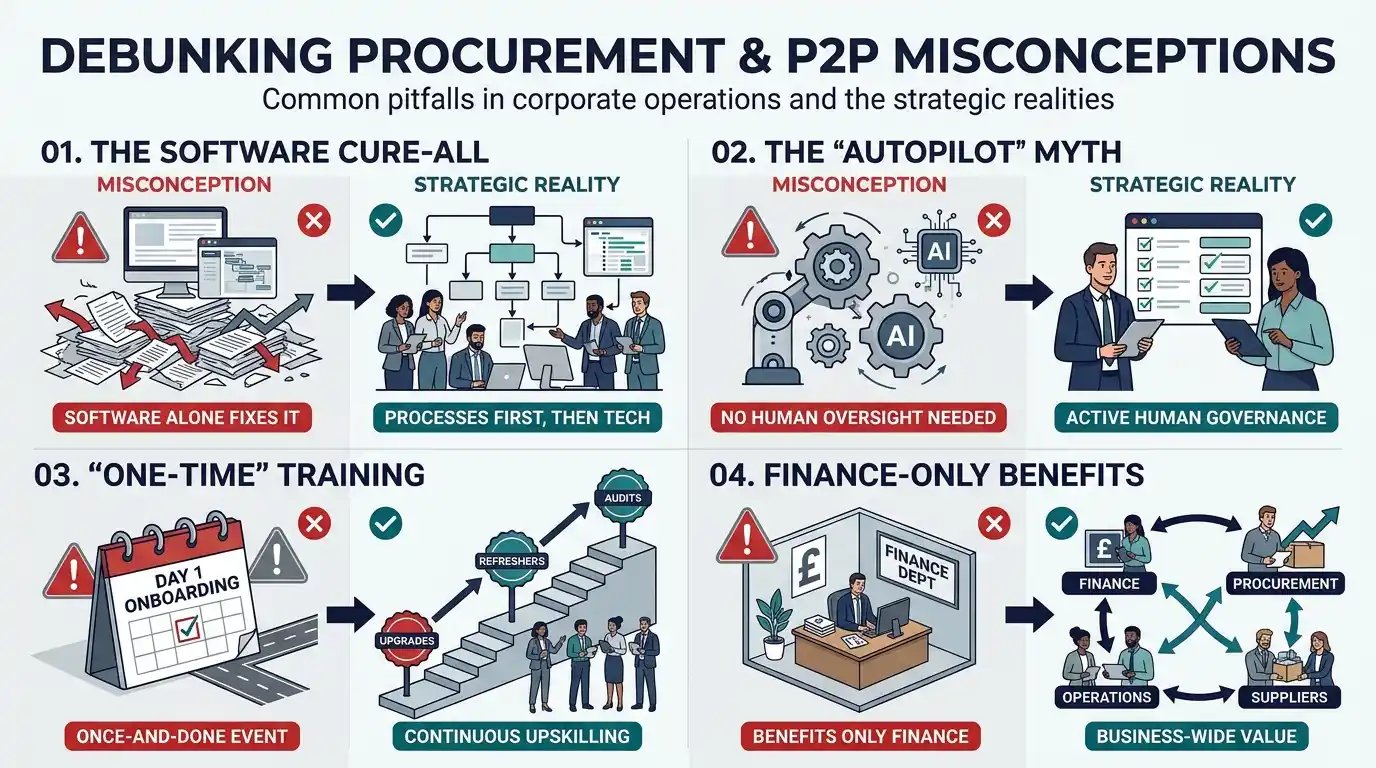
"Software automatically fixes broken business processes." Digitizing an unstandardized, inefficient procurement workflow simply accelerates the generation of operational errors. Organizations must streamline approval steps, standardize taxonomy, and establish clear policies before applying digital software layers.
"Automation eliminates the need for human procurement capability." Automating manual tasks like data entry does not eliminate human responsibility. It shifts workforce requirements toward higher-value capabilities like strategic vendor negotiation, complex data analytics, supply chain risk mitigation, and exception resolution.
"P2P automation only concerns the accounting and finance department." P2P operations impact every operational department that buys goods or utilizes vendor services. When non-finance staff fail to understand procurement timelines or requisition procedures, corporate supply chains experience disruptions, vendor relationships deteriorate, and operational project schedules slip.
"Training is a one-time software walkthrough at software go-live." One-off software demonstrations produce poor skill retention. Effective workforce capability development requires continuous learning, role-specific simulations, post-implementation refresher workshops, and structured competency evaluations to adapt to system updates and employee turnover.
What Measurable Financial and Operational Outcomes Does P2P Control Produce?
P2P controls and targeted training yield measurable outcomes, including a 70% reduction in invoice processing costs, 80% faster purchase order cycle times, complete elimination of duplicate payments, higher early payment discount capture, and improved working capital management.
Structured P2P automation coupled with workforce capability building delivers clear performance gains:
1. Direct Processing Cost Reduction
Manual invoice handling costs organizations between £12 and £15 per invoice due to labor, physical paper routing, storage, and error correction. Automated OCR capture combined with three-way matching reduces processing costs to under £3 per invoice. For an enterprise processing 50,000 invoices per year, this translates to annual savings exceeding £500,000.
2. Accelerated Purchase Order and Invoice Cycle Times
Legacy approval routing takes 7 to 10 days per purchase order. Automated notification engines and pre-configured authorization rules reduce cycle times to less than 24 hours. Faster order placement prevents material shortages in industries like manufacturing, construction, and oil and gas operations.
3. Complete Financial Error Mitigation
Advanced duplicate payment prevention algorithms compare invoice numbers, payment amounts, vendor tax IDs, and billing dates across historical databases. Eliminating duplicate disburse and overpayments preserves thousands of pounds in working capital that previously required manual audit recovery.
4. Working Capital Optimization
With full visibility over payables ageing and DPO, corporate treasury teams precisely schedule vendor payments. Organizations systematically capture 2% early payment discounts offered by suppliers without compromising operational liquidity or running late payment penalties.
5. Full Audit Trail Compliance and Governance
Automated platforms maintain unalterable digital logs tracking every requisition submitter, line-item approver, receiving log entry, and invoice modification. Internal and external financial audits transition from disruptive months-long sampling processes to straightforward system data exports, ensuring strict regulatory compliance across all business units.
Frequently Asked Questions
What is oil and gas petroleum procurement?
Oil & Gas Petroleum Procurement is the strategic process of sourcing, purchasing, and managing materials, equipment, and specialized services required for upstream, midstream, and downstream energy operations. The Institute For Oil & Gas Training provides professional workforce development to help personnel master supply chain management, contract negotiations, and compliance standards within the energy sector.
Why is specialized procurement training important in the oil and gas sector?
The energy industry operates under high market volatility, strict safety regulations, and complex international supply chains. Specialized training from the Institute For Oil & Gas Training equips procurement professionals with the skills needed to mitigate operational risks, optimize spend, and maintain vendor compliance across complex energy projects.
How does procurement in petroleum differ from standard corporate procurement?
Petroleum procurement involves highly technical engineering specifications, stringent quality assurance requirements, complex global logistics, and rigorous environmental compliance standards. The Institute For Oil & Gas Training structures its curriculum to address these unique operational challenges, including managing critical equipment sourcing and joint-venture contracts.
What are the key skills required for petroleum procurement professionals?
Essential competencies include strategic vendor sourcing, contract management, cost engineering, risk assessment, and inventory control. Through programs at the Institute For Oil & Gas Training, professionals develop practical expertise in evaluating market dynamics, managing vendor performance, and implementing sustainable supply chain strategies.
How do procurement controls improve operational efficiency in the energy industry?
Robust procurement controls prevent budget overruns, eliminate vendor delays, ensure regulatory compliance, and mitigate supply chain disruptions across offshore and onshore assets. The Institute For Oil & Gas Training teaches structured frameworks that align procurement workflows with overarching strategic and operational safety targets.
Related training courses
Procure-to-Pay (P2P) for Remote & Offshore Operations Training Course
- Specialisation
- Oil & Gas Petroleum Procurement
- Duration
- 5 days · 15 CPD hours
3-Way Matching & Invoice Verification for Day-Rate Contracts Training Course
- Specialisation
- Oil & Gas Petroleum Procurement
- Duration
- 5 days · 15 CPD hours
Financial Evaluation of Suppliers & Contractors: Tender Evaluation Training Course
- Specialisation
- Oil & Gas Petroleum Procurement
- Duration
- 5 days · 15 CPD hours
More articles

Procure to Pay Controls and Automation Workflow Design Training by Institute For Oil & Gas Training
Master P2P workflow design, automation, and internal controls with Institute For Oil & Gas Training. Enroll now for measurable operational gains.
Read article →
How to Design Procure to Pay Workflows with Effective Controls and Automation
Learn how to design Procure to Pay workflows featuring robust internal controls and automation to eliminate procurement inefficiencies and financial risk.
Read article →
Procure to Pay End to End Process Training for Oil and Gas Professionals by Institute For Oil & Gas Training
Evaluate the Procure-to-Pay End-to-End Process for Oil & Gas Training Course by Institute For Oil & Gas Training. Learn modules, structure, and outcomes.
Read article →