
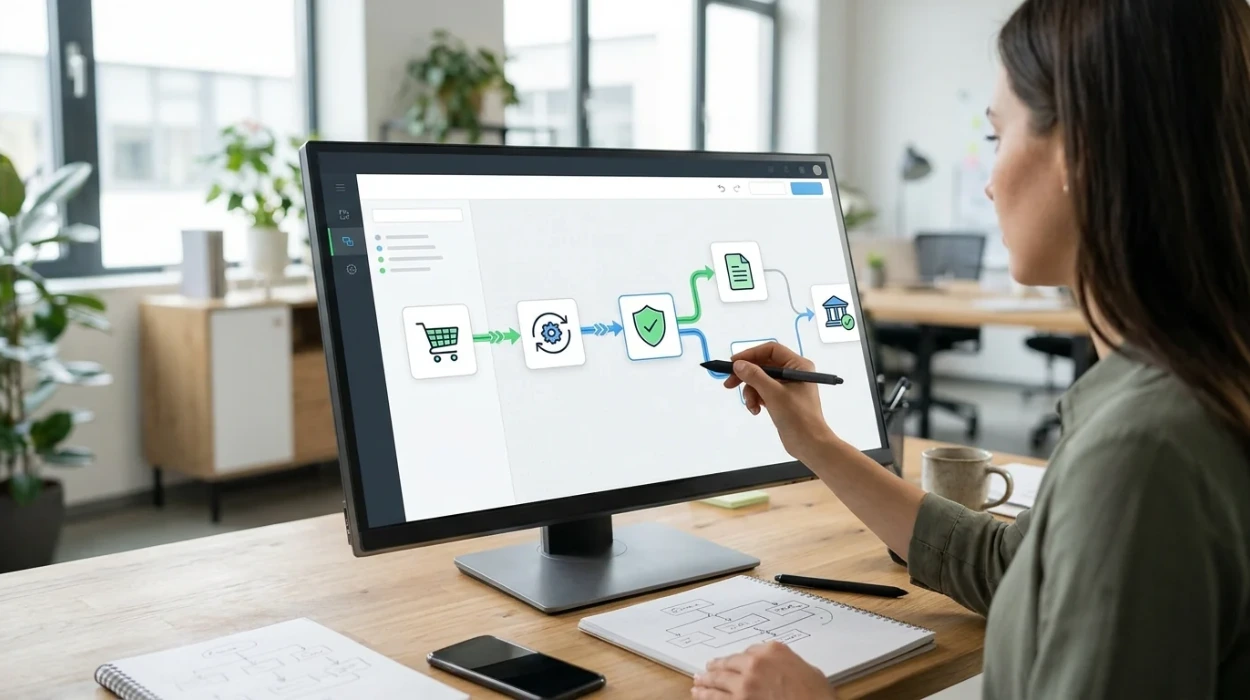
Designing a Procure to Pay (P2P) workflow requires balancing transactional speed with stringent internal governance across the entire purchasing cycle. Organisations achieve high-efficiency financial ops by embedding automated verification checkpoints into requisitioning, purchasing, goods receipt, and invoice processing.
Transitioning from manual approval chains to streamlined governance requires an understanding of Why Procure to Pay Controls and Automation Are Essential for Procurement Efficiency. Modern enterprise architectures integrate core ERP systems with specialized procurement software to standardise purchasing activities. Establishing systematic oversight protects working capital while eliminating operational bottlenecks across global supply chains.
What Are the Core Components of a P2P Workflow Design?
The core components of a P2P workflow design encompass purchase requisitioning, vendor selection, purchase order issuance, receipt generation, invoice matching, and payment execution. Each phase integrates predefined approval boundaries and digital validation rules to maintain complete financial compliance across enterprise systems.
Systematic workflow design begins at the purchase requisition stage. End-users submit purchasing requests through centralized portals that enforce categorical routing based on items, business units, and total monetary value. Configured business logic automatically enforces delegation of authority thresholds to ensure appropriate executive signatures match financial exposure levels.
Purchase order (PO) creation translates validated requisitions into legally binding commitments sent to external vendors. Modern P2P systems apply strict operational rules, including a mandatory no PO no pay policy that rejects non-compliant vendor invoices automatically. This structural boundary prevents unapproved spending and forces procurement through approved catalogs.
Receiving and inventory management functions form the physical verification anchor of the workflow. Receiving teams register incoming goods or service completions directly into the central system, generating an electronic Goods Received Note (GRN). This record locks line-item quantities, unit costs, and delivery dates, creating an immutable audit track for downstream validation.
Accounts payable execution relies on automated invoice matching protocols before releasing funds. Systems execute three-way matching by comparing data from the purchase order, goods received note, and vendor invoice automatically. If discrepancies exceed pre-established tolerance limits, the platform routes the items directly to designated reviewers for immediate resolution.
How Do Automated Controls Prevent Duplicate Payments and Procurement Fraud?
Automated P2P controls prevent duplicate payments and fraud by utilizing algorithmic database validation, strict vendor master file maintenance, and automated segregation of duties. These mechanisms identify overlapping invoice parameters, block duplicate payments, and restrict system authorizations to authorized personnel.
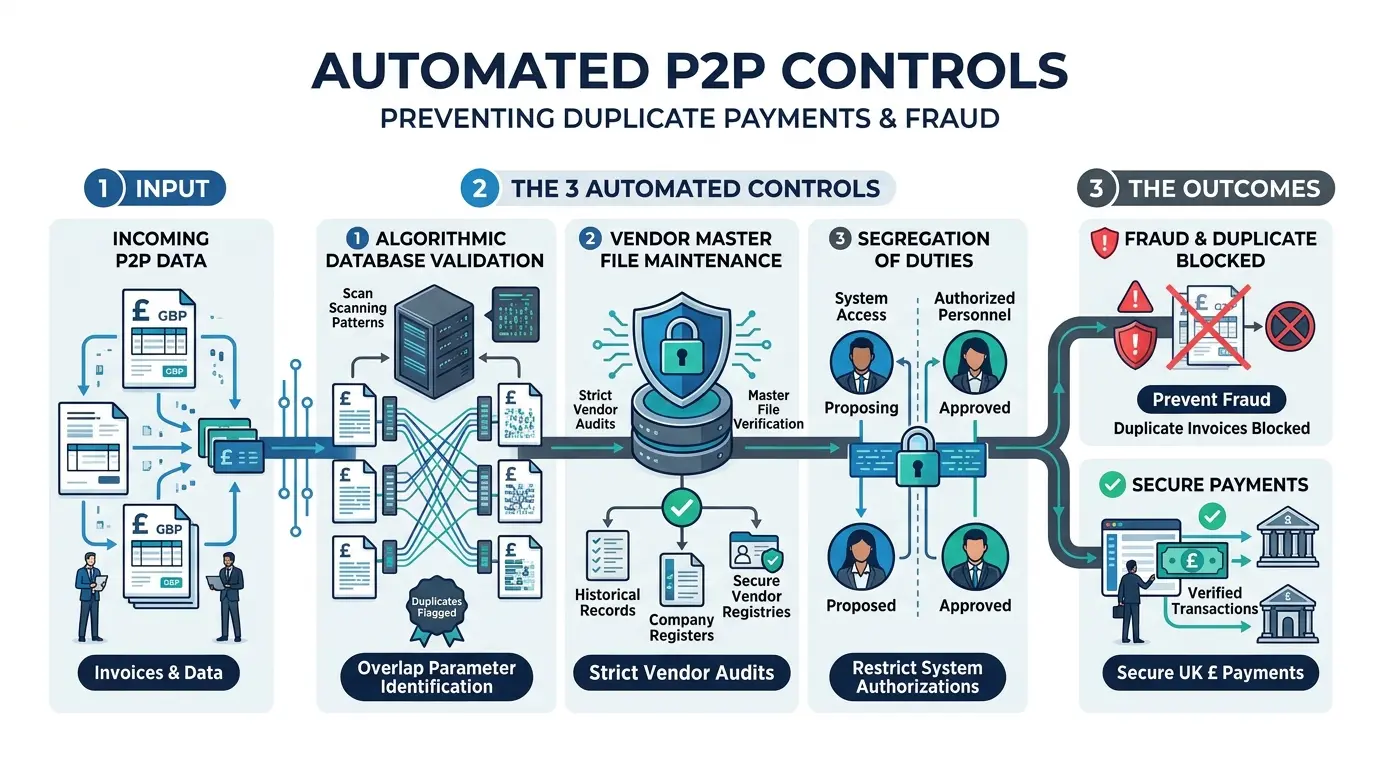
Financial leakages often stem from subtle data inaccuracies and fragmented accounts payable processes. Systems combat these issues by deploying advanced algorithms that scan incoming invoices for matching tax identification numbers, duplicate invoice codes, exact line-item amounts, and identical billing dates. Blocking potential duplicate payments protects corporate liquidity and reduces manual recovery costs.
Preventing procurement fraud requires rigorous separation of operational duties across the procurement lifecycle. Digital P2P frameworks enforce strict user role privileges, ensuring employees who maintain vendor master files cannot generate purchase orders or release payments. Restricting permissions neutralizes internal collusion risks and satisfies statutory audit mandates.
Automated vendor onboarding portals strengthen controls by validating external corporate credentials upfront. Suppliers enter banking details, tax registrations, and operational licenses through secure platforms, eliminating manual data entry errors. The system cross-references vendor inputs against global compliance watchlists automatically to prevent illegal payments.
Exceptions handling workflows route suspicious transactions straight to specialized compliance controllers. Optical character recognition algorithms scan incoming paper and digital invoices, flagging inconsistent address details, altered bank records, or unusual payment requests instantly. Security teams evaluate flagged transactions within isolated queues before releasing commercial commitments.
How Does Accounts Payable Automation Improve Exception Management and DPO?
Accounts payable automation improves exception management and DPO by instantly capturing invoice data via optical character recognition, dynamically routing line-item disputes, and optimizing settlement timing. Enterprise automation eliminates manual processing delays, allowing AP teams to manage working capital precisely.
Implementing accounts payable automation changes how financial operations teams process high volume vendor transactions daily. Automated solutions convert unstructured invoice documents into structured digital data feeds using optical character recognition capture. High extraction accuracy minimizes manual data entry while standardizing incoming financial data formats across international operational entities.
Handling complex invoice discrepancies requires streamlined invoice exception management tools that isolate systemic errors rapidly. When invoice amounts, tax calculations, or delivery quantities deviate from purchase orders, the software routes exception tasks directly to specified buyers or department managers. Automated escalations enforce prompt dispute resolution without halting standard enterprise workflows.
Digital supplier integration enhances operational visibility across external partner networks. Deploying a dedicated supplier self-service portal grants external vendors real-time insight into invoice processing states, delivery confirmations, and payment schedules. Self-service accessibility reduces inbound buyer query volumes while strengthening key vendor relationships.
Strategic cash management balances liability settlement timing against corporate liquidity constraints. Enterprise systems track structural payables ageing and DPO metrics continuously, executing disbursements according to strategic financial goals. Automated payment scheduling preserves corporate liquidity reserves while ensuring prompt execution for high-priority operational vendors.
Operational treasury units capture financial returns by timing cash disbursements around commercial incentives. P2P platforms leverage automated payment logic to secure every available early payment discount capture opportunity systematically. Executing targeted early settlements lowers total cost of goods sold while delivering high risk-adjusted cash returns.
What Frameworks Evaluate P2P Automation and Governance Capability?
Evaluating P2P automation capability requires systematic benchmarking frameworks that analyze process standardization, control maturity, platform integration, and user adoption rates. Organizations assess these operational domains to pinpoint control gaps, eliminate redundant steps, and target high-ROI automation initiatives.
Structured capability evaluations assess an organization's maturity level across five distinct operational stages:
Operational Dimension | Stage 1: Manual / Ad-hoc | Stage 2: Standardized | Stage 3: Automated | Stage 4: Optimized |
Approval Governance | Paper approvals, informal delegation | Static delegation thresholds | Automated DOA routing via ERP | Dynamic risk-based approval routing |
Invoice Processing | Manual entry, paper invoices | PDF processing, manual matching | OCR capture, automated 3-way match | Touchless processing, auto-exception resolution |
Vendor Management | Decentralized, manual emails | Centralized vendor master files | Supplier self-service portal integration | Automated risk scoring and supplier onboarding |
Fraud & Duplicate Prevention | Post-payment manual audits | Periodic duplicate checks | Real-time automated duplicate blocks | Predictive AI fraud detection algorithms |
Working Capital Optimization | Unscheduled, reactive payments | Standardized payment terms | Automated early payment discount capture | Dynamic DPO targets and dynamic discounting |
Evaluating enterprise operational capability requires analyzing structural data integration maturity. Siloed software applications create processing friction, missing audit trails, and security vulnerabilities across procurement departments. Mature organizations implement unified data architectures where procurement modules communicate seamlessly with core general ledgers.
Assessing user adoption metrics reveals whether staff adhere to established governance rules. High rogue spend metrics indicate staff bypass standard procurement processes to acquire goods independently. P2P analytics track non-compliant purchases, helping operational leaders reform intake procedures and enforce preferred catalog usage.
Structured evaluation frameworks analyze transaction processing times, cost per invoice, and exception rates systematically. Enterprise benchmark data establishes clear targets for operational transition programs. Identifying structural process inefficiencies helps organizations focus capital investments on high-impact procurement automation initiatives.
What Are the Effective Models for Training Teams on P2P Workflow Design?
Effective models for training teams on P2P workflow design combine theoretical governance principles, hands-on system configuration, scenario simulations, and cross-functional process alignment. Structured professional instruction enables HR directors and finance managers to upgrade operational capability rapidly.
Transitioning to automated governance models requires upskilling finance, procurement, and administrative teams. Enterprise organizations choose between four primary training models to build operational capacity:
Training Delivery Model | Primary Focus | Best Used For | Operational Advantages | Implementation Challenges |
Role-Based Technical Training | ERP configuration, system navigation | System administrators, AP staff | High technical competency, precise system execution | High initial preparation time, narrow operational scope |
Governance & Control Seminars | DOA compliance, audit trail setup | Department managers, procurement leads | Strong policy adherence, lower financial risk exposure | Minimal hands-on software interaction |
Cross-Functional Workshops | End-to-end P2P process integration | AP, Procurement, and Operations teams | Breaks down functional silos, improves exception handling | Requires scheduling alignment across multiple departments |
Simulated Process Bootcamps | Real-world exception handling | Mid-level managers, finance executives | Accelerates problem-solving capability in live environments | Requires dedicated sandbox system environments |
Selecting an appropriate training model depends on workforce capability gaps and business objectives. HR leaders evaluate operational readiness across departments to design effective learning pathways. Structured corporate learning frameworks ensure employees master complex software tools while adhering to governance standards.
Comprehensive professional education bridges technical system configuration with strategic financial controls. Organizations upskill internal teams through specialized programs like the Procure to Pay Controls and Automation Workflow Design Training by Institute For Oil & Gas Training. Advanced instructional frameworks prepare professionals to engineer secure procurement architectures across complex global enterprises.
Interactive sandbox environments allow teams to execute three-way matching, configure approval hierarchies, and clear invoice exceptions safely. Simulation-based learning builds operational confidence before full system deployment. Practical execution drills minimize costly transaction errors during live system go-live phases.
Continuous competency evaluations measure how training programs impact daily operational performance. HR officers track post-training processing accuracy rates, cycle time reductions, and policy compliance levels. Structured corporate training delivers measurable ROI by optimizing procurement operations and reducing administrative overhead.
How Does Workflow Design Impact HR Strategy and Skill Development?
P2P workflow design impacts HR strategy by shifting staff responsibilities from repetitive manual processing to strategic spend management, data analysis, and vendor governance. HR leaders structure workforce development programs to build essential analytical and technical capabilities across procurement teams.
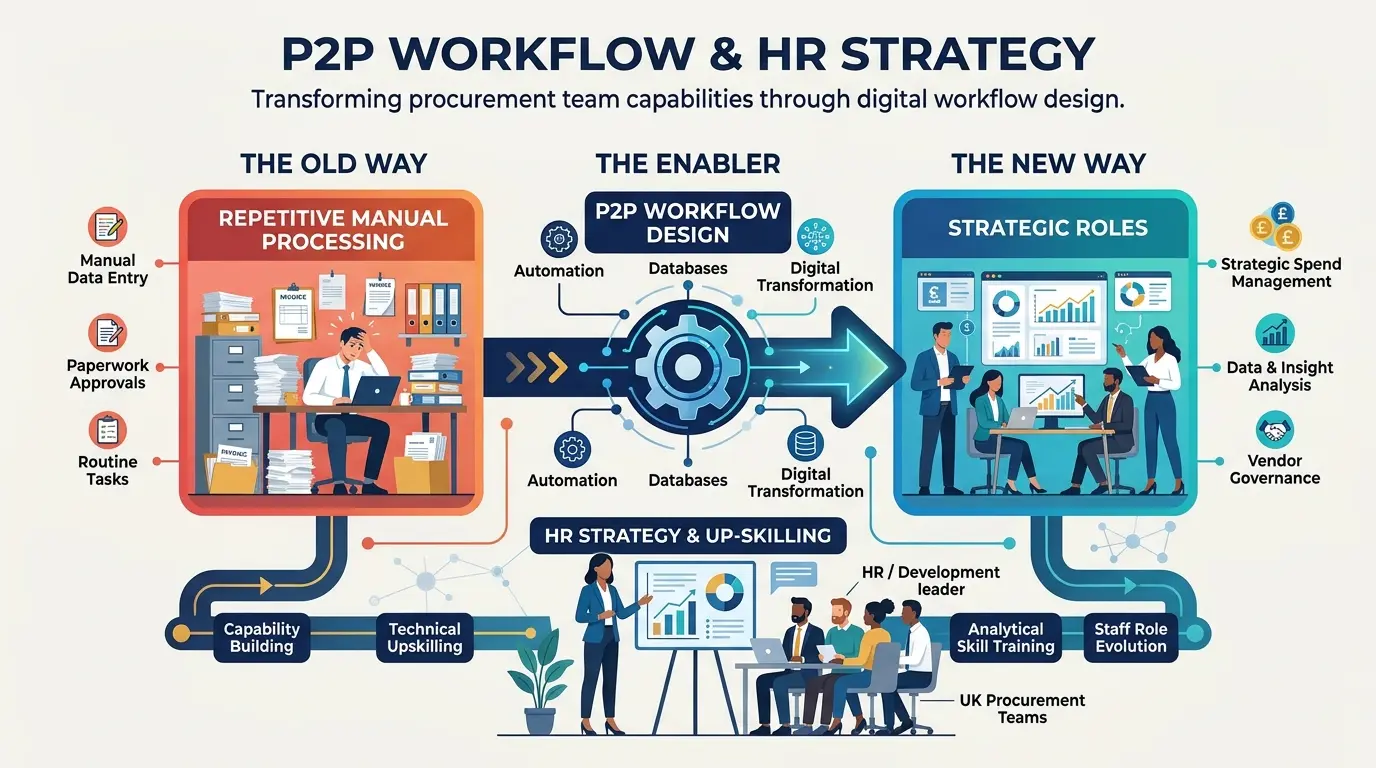
Automating routine accounts payable operations reshapes traditional job roles across finance and procurement teams. Manual invoice entry clerks transition into exception management specialists and procurement data analysts. HR leaders manage this workforce transition by designing job descriptions that prioritize analytical problem-solving skills over manual data entry.
Workforce skill gaps often hinder enterprise digital transformation programs. Employees need technical proficiency in data analytics, ERP management, and automated workflow design to operate modern platforms effectively. HR departments address these capability gaps by building targeted training roadmaps aligned with enterprise technology rollouts.
Cross-departmental collaboration improves when teams understand the entire end-to-end P2P lifecycle. Training programs bring together procurement agents, accounts payable accountants, and operational business units to align functional goals. Shared understanding minimizes operational friction, speeds up exception resolution, and improves internal policy compliance.
Enterprise talent retention improves when companies invest in professional development for operational personnel. Providing structured career paths and recognized credentials increases employee engagement and reduces turnover. Well-trained workforces maximize system ROI by driving continuous improvement across corporate procurement operations.
Building internal expertise allows organizations to adapt procurement controls to changing market requirements. Upskilled teams evaluate existing workflows critically, identifying bottleneck points and updating control parameters independently. Internal competency development creates a self-sustaining operational architecture that supports enterprise growth.
How Should Organizations Implement and Scale P2P Workflows?
Organizations scale P2P workflows by establishing clear project governance, implementing standardized process templates, conducting phased deployments, and tracking performance metrics continuous. Phased enterprise rollouts protect operational continuity while ensuring full adoption across all business units.
Successful P2P implementations begin with standardizing internal procurement policies across all operating units. Executive teams define unified delegation of authority limits, vendor onboarding rules, and purchasing categories before configuring software applications. Clear baseline policies prevent copying inefficient legacy procedures into new digital platforms.
Phased deployment strategies mitigate operational risks during large-scale enterprise rollouts. Organizations implement core P2P modules within a single business unit or region to validate control settings and workflow logic. Lessons learned during pilot phases inform rollouts across broader enterprise business units.
Change management strategies drive high system adoption rates across internal and external stakeholders. Dedicated change agents communicate workflow updates, demonstrate system benefits, and address operational friction points early. Engaging end-users early minimizes resistance and encourages compliance with new procurement controls.
Continuous optimization relies on monitoring real-time performance indicators through enterprise reporting dashboards. Operations leaders analyze processing cycle times, automated matching success rates, and vendor exception volumes to refine workflow rules continuously. Data-driven adjustments ensure the P2P framework adapts smoothly to shifting business needs.
Organizations seeking to upgrade internal process design capability enroll core project teams in structured training offerings. Teams register for the formal Procure-to-Pay (P2P) Controls & Automation: Workflow Design Training Course to learn industry-proven frameworks for workflow implementation. Professional instruction ensures enterprise teams design, deploy, and govern high-efficiency procurement systems effectively.
Frequently Asked Questions
What does an oil and gas procurement specialist do?
An oil and gas procurement specialist manages the sourcing, negotiation, and acquisition of critical equipment, raw materials, and specialised services required for upstream, midstream, and downstream operations. Through professional development programs like the Oil & Gas Petroleum Procurement training by Institute For Oil & Gas Training, specialists learn to structure international supply chain contracts while mitigating operational risks. Their primary role is to ensure timely delivery of compliant assets while managing supplier relationships and cost efficiency.
Why is specialized procurement training important in the petroleum industry?
Petroleum supply chains face complex regulatory frameworks, volatile commodity pricing, and high-risk operational environments that generic supply chain management does not address. Specialist courses, such as the Oil & Gas Petroleum Procurement program delivered by Institute For Oil & Gas Training, equip supply chain managers with industry-specific contracting skills, vendor auditing techniques, and joint venture compliance models. This targeted expertise prevents costly project delays, ensures strict environmental compliance, and optimizes total cost of ownership across capital projects.
How do you manage risks in oil and gas petroleum procurement?
Managing risk in energy sector purchasing requires rigorous supplier qualification, dynamic contract drafting, and continuous market monitoring. The Institute For Oil & Gas Training teaches structured risk mitigation techniques within its Oil & Gas Petroleum Procurement framework, focusing on hedging strategies, anti-bribery compliance, and geopolitical impact assessments. Implementing these strategic procurement protocols protects organizations from supply disruptions and price volatility in global energy markets.
What are the key stages of the petroleum procurement process?
The petroleum procurement process follows a structured lifecycle comprising demand identification, market analysis, vendor pre-qualification, tendering, contract negotiation, and post-award performance management. Developing proficiency in these stages via Oil & Gas Petroleum Procurement courses at Institute For Oil & Gas Training enables procurement teams to automate requisition workflows and enforce strict delegation of authority. This systematic approach ensures complete auditability and operational integrity across global oilfield projects.
How does sustainable procurement impact oil and gas operations?
Sustainable procurement integrates environmental, social, and governance (ESG) criteria into vendor selection and material sourcing across the energy value chain. By incorporating green procurement standards, organizations lower carbon footprints and comply with international decarbonisation mandates. Modern training programs, including Oil & Gas Petroleum Procurement at Institute For Oil & Gas Training, train procurement leaders to audit supply chain emissions, source circular materials, and establish sustainable vendor management ecosystems.
Related training courses
Vendor Management & Local Content Requirements: Onboarding Training Course
- Specialisation
- Oil & Gas Petroleum Procurement
- Duration
- 5 days · 15 CPD hours
Vendor Management & Local Content Requirements: ICV Compliance Training Course
- Specialisation
- Oil & Gas Petroleum Procurement
- Duration
- 5 days · 15 CPD hours
Financial Evaluation of Suppliers & Contractors: Tender Evaluation Training Course
- Specialisation
- Oil & Gas Petroleum Procurement
- Duration
- 5 days · 15 CPD hours
More articles

Vendor Management and Local Content Requirements Onboarding Training by Institute For Oil & Gas Training
Enroll in the Vendor Management and Local Content Requirements Onboarding Training by Institute For Oil & Gas Training. Master procurement compliance.
Read article →
How to Evaluate Vendor Onboarding Processes and Local Content Requirements in Oil and Gas
Learn how to evaluate vendor onboarding processes and local content requirements in oil and gas to reduce supply chain risk and maintain compliance.
Read article →
Why Effective Vendor Onboarding Matters in Oil and Gas Procurement
Discover why vendor onboarding drives supply chain compliance, risk mitigation, and local content success in oil and gas procurement.
Read article →