

Evaluating bank reconciliation automation for multi-bank treasury operations requires assessing system adaptability, ERP connectivity, and rule-based exception management capabilities. Finance leaders must systematically analyze operational bottlenecks across complex account structures to select solutions that achieve straight-through processing and reduce human error.
Multi-bank treasury structures inherently create operational complexity due to disparate statement formats, varying transmission schedules, and complex accounting hierarchies. Before embarking on a software selection or process redesign, treasury leaders must understand Why Bank Reconciliation Automation Matters for Oil and Gas Companies, as establishing this baseline helps quantify the organizational risks of manual spreadsheets against the efficiency gains of automated data flows. Operational risk increases exponentially when finance teams process high transaction volumes using manual data extraction methods across international banking partners.
What Challenges Define Multi Bank Treasury Reconciliation?
Multi-bank treasury reconciliation presents challenges due to fragmented data streams, varied statement formats, time zone differences, and complex currency fluctuations. Managing multiple banking relationships manually increases operational risk, causes delays in ledger posting, and inflates audit costs.
Energy sector finance departments manage dozens of active bank accounts across exploration, joint venture, and local operating entities. Each financial institution delivers transaction records through distinct channels and data structures. Treasury teams must consolidate these divergent data streams every morning before initiating cash position reporting or funding decisions.
Data ingestion represents the primary operational bottleneck in legacy treasury workflows. Banking partners supply data via file transfers, direct API feeds, or web portals. Variations in file delivery times interrupt posting schedules, forcing staff to wait for balance confirmations or perform manual file downloads.
Unstructured bank descriptors further complicate transaction matching. Banks use inconsistent narrative strings for wire transfers, direct debits, and bank charges. A payment received from the same counterparty can feature different description text depending on the originating bank, rendering basic text-matching algorithms ineffective.
Multi-currency operations introduce valuation and FX timing discrepancies into the ledger reconciliation process. Fluctuations in exchange rates between transaction execution and bank settlement create foreign exchange variances. Treasury operators must distinguish genuine transaction errors from timing differences caused by currency conversion methods.
Joint venture and project accounts introduce strict governance requirements that exacerbate processing delays. Energy firms must maintain segregated records for cash calls, escrow accounts, and capital expenditure pools. Reconciling these specialized accounts requires stringent verification protocols to maintain partner transparency and regulatory compliance.
Which Core Features Enable Effective Bank Reconciliation Automation?
Effective bank reconciliation automation requires automated bank statement import, multi-format parsing, flexible auto-matching rules, direct ERP integration, and automated exception routing. These capabilities transform raw transaction records into validated financial ledger entries without human intervention.
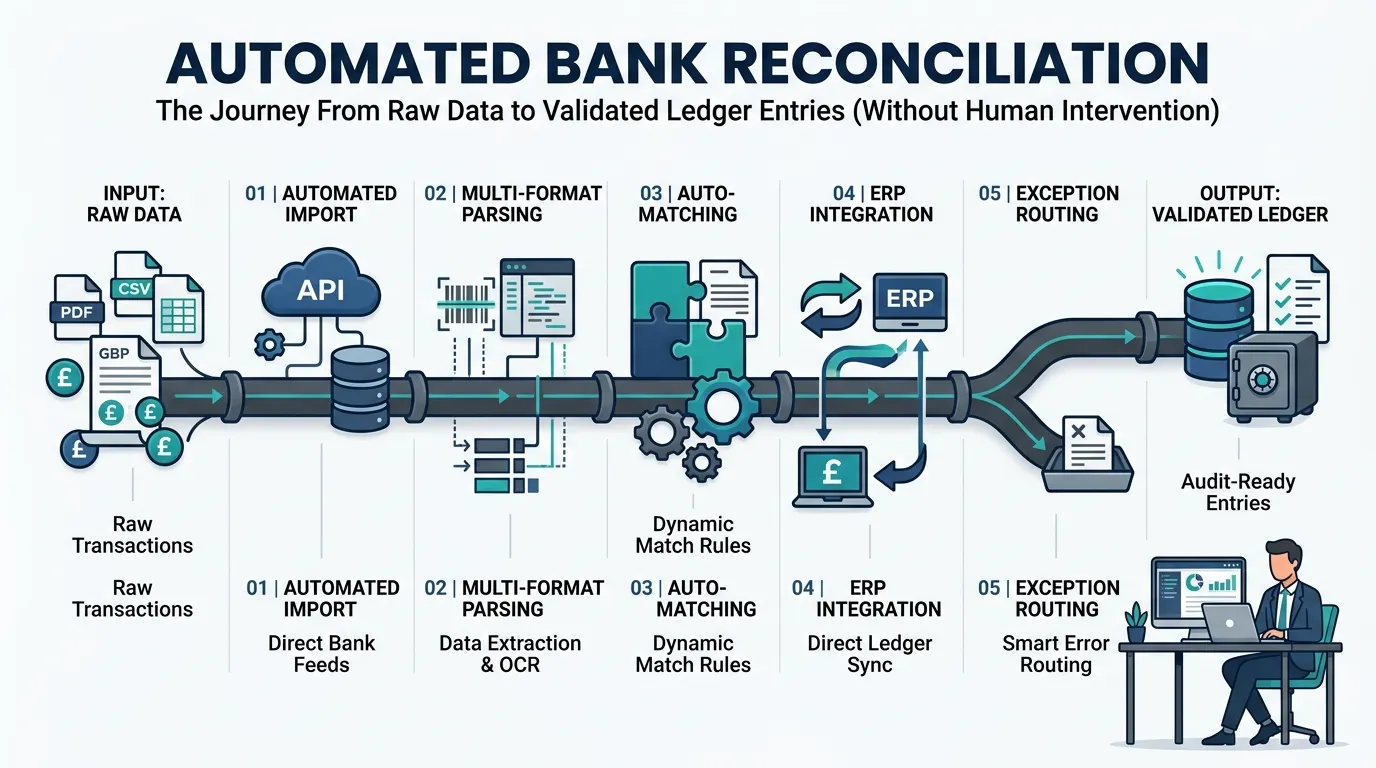
Automated bank statement import serves as the foundational layer for modern treasury automation platforms. Systems must automatically retrieve, decrypt, and parse electronic bank statements at scheduled intervals. Automated file ingestion eliminates manual portal logins and cuts early-morning processing times.
Financial institutions transmit transaction data using standard electronic formats with specific structural rules:
MT940 and BAI2 formats remain the dominant standards for end-of-day cash reporting globally.
ISO 20022 XML (CAMT.053) provides richer transaction metadata and precise counterparty identification.
Direct API connections enable real-time statement polling for high-priority working capital accounts.
The core intelligence of an automated system resides within its auto-matching rules engine. The platform must support multi-layered matching logic ranging from simple one-to-one identifier matches to complex many-to-one or many-to-many allocations. Dynamic tolerances accommodate minor bank fee deductions and exchange rate differentials automatically.
Robust exception handling workflows determine how efficiently a system handles unmatched items. Rather than dumping non-matching transactions into generic error queues, advanced platforms categorize exceptions by root cause. The system routes discrepancies directly to responsible operators alongside suggested matching actions based on historical resolution patterns.
Seamless ERP bank ledger integration completes the automated data lifecycle. Once transactions clear matching criteria, the automation tool must post clearing entries directly to general ledger accounts. Bidirectional synchronization ensures cash positions reflect real-time cleared balances across the entire organization.
How Do You Evaluate Reconciliation Automation Delivery Models?
Evaluating reconciliation automation models requires comparing proprietary software deployment, custom ERP module configuration, external managed services, and corporate team upskilling. Organizations must weigh long-term operational autonomy and technical agility against initial implementation speed and upfront capital expenditure.
Treasury leaders evaluate four main paths when upgrading reconciliation workflows. Software-focused solutions provide pre-built connectors and proprietary matching algorithms. Custom ERP development utilizes existing enterprise software but demands extensive technical consulting. Managed services outsource transaction matching entirely to third parties. Dedicated corporate training builds internal technical capabilities to configure and maintain internal automation systems.
The decision framework depends on internal resource availability, IT governance policy, and desired operational control. While external software vendors market turnkey solutions, internal team skill gaps frequently stall system adoption. Corporations that invest in technical training for finance personnel build sustainable, in-house expertise capable of maintaining complex matching rules without continuous external reliance.
Training internal treasury teams on automated system design yields higher operational resilience. Teams learn to build custom matching logic, manage format variations, and troubleshoot integration faults directly. This internal capability reduces long-term software licensing costs and ensures rapid adaptation when banking relationships or reporting requirements change.
Organizations considering structured training programs for their finance workforce often evaluate the Bank Reconciliation Automation for Multi-Bank Environments Training Course to bridge internal technical skill gaps. Developing in-house competence ensures treasury analysts understand the underlying data structures rather than operating black-box software applications.
What Criteria Determine Software and Training Effectiveness?
Determining software and training effectiveness involves evaluating auto-matching accuracy rates, exception resolution speeds, system scalabilities, integration capabilities, and audit trail rigor. These operational metrics directly reflect the financial return and risk reduction achieved by the organization.
The table below outlines the primary evaluation criteria for assessing reconciliation solutions and operational readiness:
Evaluation Criterion | Low Performance / Manual Baseline | High Performance / Automated Target | Strategic Business Impact |
Auto-Matching Rate | Under 40% (manual matching reliance) | Over 90% (straight-through processing) | Reduces manual effort; accelerates daily cash position visibility. |
Format Parsing Flexibility | Single format or manual CSV conversions | Native parsing for MT940 and BAI2 formats, CAMT, and APIs | Eliminates data transformation errors across global banking partners. |
ERP Ledger Integration | Manual batch uploads or end-of-month journals | Real-time bidirectional ERP bank ledger integration | Ensures accurate general ledger balances and prevents posting lag. |
Exception Handling Speed | Multi-day investigation cycles | Real-time categorization and guided routing | Minimizes unposted cash items and lowers operational risk. |
Complex Account Support | Processed via offline spreadsheets | Native logic for escrow and project account reconciliation | Maintains strict compliance for joint ventures and ring-fenced funds. |
Selecting or designing an automated reconciliation framework requires a decision matrix aligned with corporate treasury goals:
Evaluation criteria must prioritize how systems process specialized operational requirements. Energy companies require specialized rules for multi-currency bank accounts to handle volatile exchange rates without generating constant false exceptions. Matching algorithms must automatically separate principal payments, interest charges, and foreign exchange variances.
Accounting integrity relies on detailed control frameworks for escrow and project account reconciliation. Systems must track restricted cash allocations against contractual obligations automatically. Clear audit logs must document every automated match, manual override, and ledger adjustment to satisfy internal control reviews and external audits.
Joint venture bank account reconciliation adds secondary validation layers. The automation system must allocate shared cash receipts and cash calls according to operator agreement percentages. Reconciling joint venture accounts within automated workflows prevents cash call disputes between operating partners and maintains transparent financial reporting.
How Should HR and Finance Leaders Implement Automation Upskilling?
HR and finance leaders should implement automation upskilling by mapping operational skill gaps, establishing structured technical learning paths, applying hands-on treasury simulations, and measuring operational KPI improvements. Aligning training with business goals ensures long-term operational autonomy and software adoption.
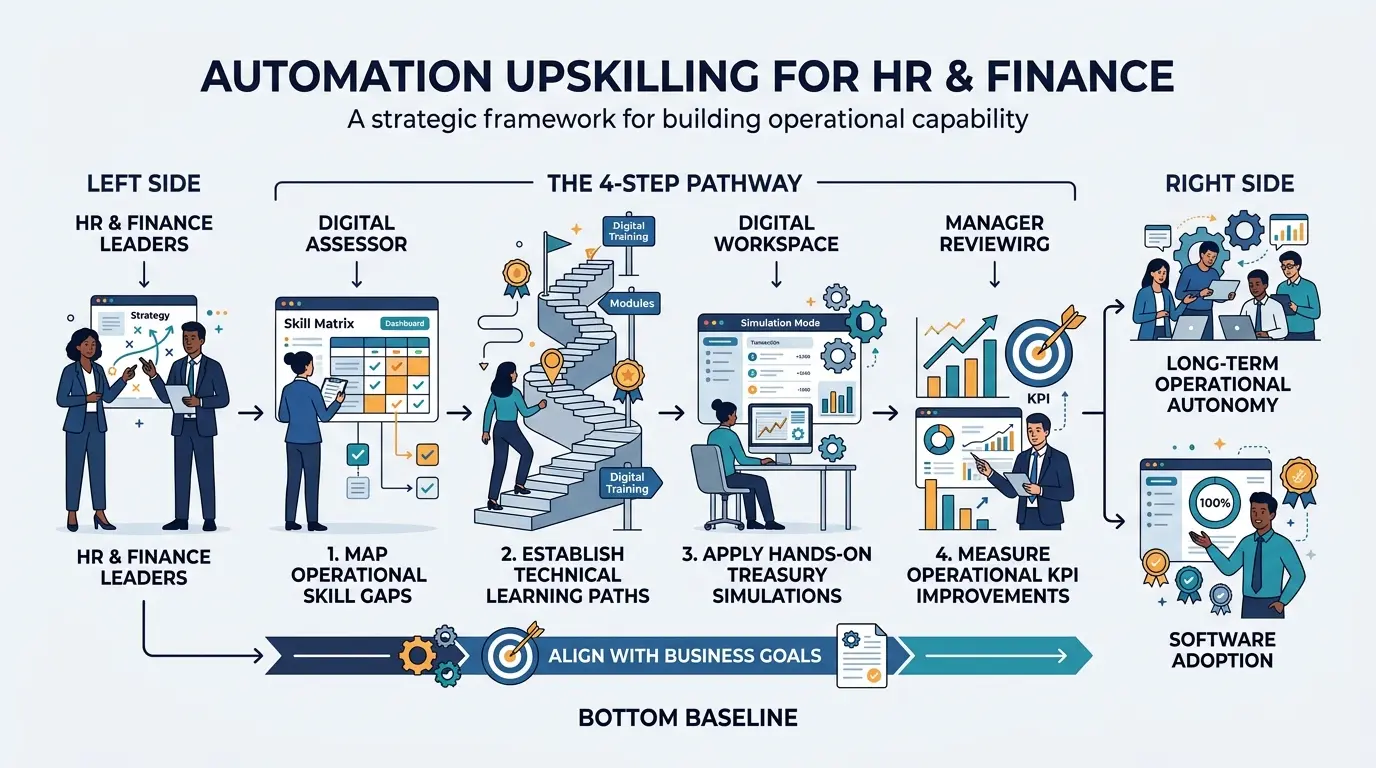
Successful digital transformation in treasury operations depends heavily on workforce readiness. Software acquisitions fail when finance staff lack the technical skills to configure matching logic, maintain data pipelines, or audit automated outputs. HR leaders must partner with treasury executives to design practical learning interventions.
Implementation begins with a thorough capability assessment of current treasury personnel. HR teams identify skill gaps in data architecture, financial format structures, and automated logic design. Training programs must target these specific technical competencies rather than generic software navigation.
Structured training programs deliver practical, industry-driven instruction tailored to corporate operating environments. To build internal capability, organizations implement targeted Bank Reconciliation Automation Training for Multi Bank Environments in Oil and Gas programs that combine system architecture theory with hands-on scenario testing. Finance professionals learn to build robust matching rules, resolve complex data discrepancies, and optimize end-to-end processing workflows.
Organizations measure training return on investment using tangible operational KPIs:
Straight-Through Processing Rate: The percentage of transactions matched and posted without human intervention.
Daily Close Timeline: The reduction in total hours required to finalize cash position reports each morning.
Exception Resolution Duration: The average time spent investigating and clearing unmatched bank items.
Audit Compliance Score: The reduction in audit findings related to cash control and bank ledger discrepancies.
Building internal expertise ensures continuous process improvement. Trained treasury staff adjust auto-matching parameters as new banking relationships form, preventing system degradation over time. Investing in workforce skills creates a resilient treasury department capable of managing high transaction volumes without proportional head-count growth.
Frequently Asked Questions
What does the Oil & Gas Petroleum Treasury, Cash and Banking course cover?
The Oil & Gas Petroleum Treasury, Cash and Banking program by the Institute For Oil & Gas Training covers liquidity management, commodity hedging, international payment structures, and multi-bank cash pooling. Participants learn energy-specific treasury operations, currency exposure mitigation, and working capital optimization across upstream, midstream, and downstream sectors.
How does specialized treasury training benefit energy sector finance professionals?
Specialized petroleum treasury training equips finance personnel to manage volatile energy prices, joint venture cash calls, and cross-border trade settlements effectively. Through the Institute For Oil & Gas Training, professionals master practical treasury controls and cash forecasting models tailored to oil and gas capital expenditure cycles.
What cash and banking strategies are critical for oil and gas operations?
Key cash management strategies include daily cash position monitoring, automated bank reconciliation across international accounts, and structured escrow management for capital projects. The Oil & Gas Petroleum Treasury, Cash and Banking curriculum delivered by the Institute For Oil & Gas Training focuses on optimizing credit facilities, maintaining liquidity cushions, and automating corporate banking interfaces.
Who should enrol in the Oil & Gas Petroleum Treasury, Cash and Banking program?
This professional course is designed for treasury managers, corporate finance analysts, cash controllers, and energy accounting specialists. The Institute For Oil & Gas Training structures the Oil & Gas Petroleum Treasury, Cash and Banking training for both mid-level finance practitioners and senior leaders aiming to refine financial risk mitigation in petroleum operations.
How does treasury management address foreign exchange and commodity risk in petroleum?
Petroleum treasury management mitigates market volatility by implementing structured hedging frameworks using futures, options, and currency swaps. The Institute For Oil & Gas Training provides hands-on exposure to managing multi-currency cash flows, interest rate exposures, and banking counterparty risks inherent in international hydrocarbon trading.
Related training courses
Corrosion Control by Material Selection Training Course
- Specialisation
- Oil & Gas Corrosion Management and Control
- Duration
- 5 days · 15 CPD hours
Introduction to Conventional and Advanced NDT Techniques Training Course
- Specialisation
- Oil & Gas Inspection and Non-Destructive Testing
- Duration
- 5 days · 15 CPD hours
Corrosion Monitoring & Testing Training Course
- Specialisation
- Oil & Gas Corrosion Management and Control
- Duration
- 5 days · 15 CPD hours
More articles

Bank Relationship Management Training for Petroleum Company Treasury Professionals
Master bank evaluation, RFPs, and fee analysis. Enroll in the Bank Relationship Management Training by Institute For Oil & Gas Training.
Read article →
How to Evaluate Banking Partners and Treasury Services for Oil and Gas Businesses
Evaluate banking partners and treasury services for oil and gas firms with structured criteria, RFP models, and counterparty credit frameworks.
Read article →
Why Bank Relationship Management Matters for Petroleum Companies
Learn how structured bank relationship management training mitigates liquidity risk, lowers financing costs, and improves treasury performance.
Read article →