

Corporate treasury operations in the energy sector encounter severe operational bottlenecks when balancing high-volume, multi-currency cash flows across fragmented banking networks. Finance professionals managing complex joint venture operations, project accounts, and cross-border energy transactions require targeted technical instruction to modernise manual reconciliation workflows and eliminate costly balance sheet discrepancies.
Understanding Why Bank Reconciliation Automation Matters for Oil and Gas Companies provides the essential operational baseline for identifying accounting inefficiencies across upstream, midstream, and downstream financial units.
What is the course and what problem does it solve?
The Bank Reconciliation Automation for Multi-Bank Environments Training Course is an intensive corporate training program designed by Institute For Oil & Gas Training to resolve operational delays, manual errors, and audit risks associated with multi-bank reconciliation in energy sector treasury operations.
Oil and gas corporations maintain highly fragmented banking structures. Treasury departments routinely oversee dozens of local and international accounts, each supporting distinct project phases, joint operating agreements, or escrow obligations. Legacy reconciliation workflows rely heavily on manual data extraction from bank portals, leading to persistent transaction backlogs, inflated labor costs, and heightened exposure to undetected operational errors.
This skill gap directly impacts financial governance. When cash visibility is delayed by inefficient balance sheet matching, finance teams struggle to execute accurate short-term cash forecasting, verify joint venture cash calls, or ensure compliance with strict regulatory reporting deadlines. The training provided by Institute For Oil & Gas Training systematically tackles these operational deficiencies by training personnel to build, configure, and manage automated reconciliation frameworks directly integrated with enterprise resource planning systems.
Why is this course structured in this practical sequence?
The curriculum follows a progressive skill-building architecture that transitions participants from foundational data protocol standardisation to advanced enterprise ledger integration, ensuring immediate, practical application within multi-bank oil and gas corporate treasury departments.
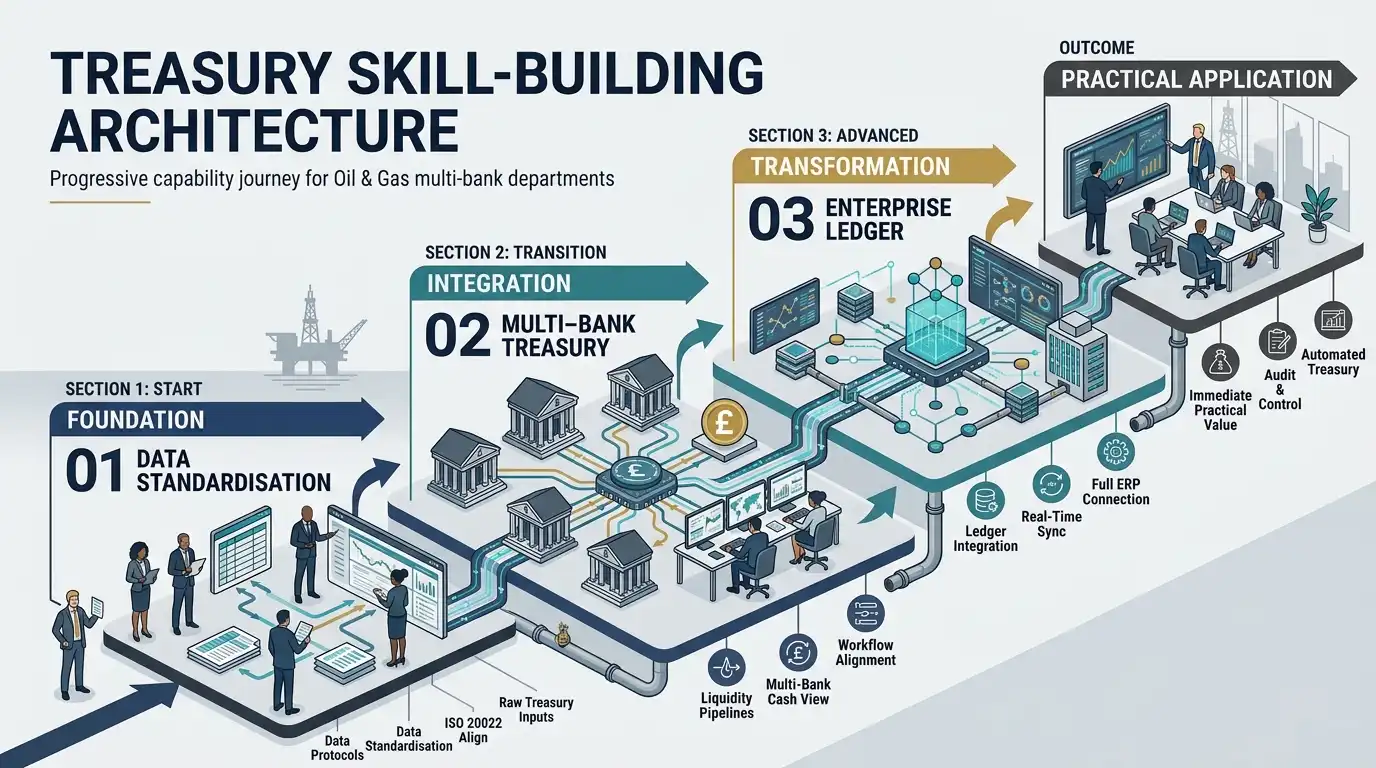
Effective automation requires a structured sequence of technical competencies. Finance professionals cannot configure reliable automated matching rules without first mastering the structural nuances of electronic statement formats. Consequently, Institute For Oil & Gas Training structured this program to build capability systematically, preventing technical gaps that often lead to failed automation projects.
Evaluating How to Evaluate Bank Reconciliation Automation for Multi Bank Treasury Operations reveals that successful implementation depends on aligning technical training with actual corporate systems architecture.
The course progression moves deliberately from data ingestion to governance:
Ingestion & Standardisation: Mastering file formats to eliminate manual data entry.
Logic & Matching Engines: Developing rules that handle multi-currency, variable-reference payments.
Exception Architecture: Constructing escalation paths for joint venture and escrow disputes.
Enterprise Integration: Synchronising bank feeds with ERP sub-ledgers for real-time reporting.
What will participants learn across the training modules?
Participants gain practical mastery over electronic statement formats, automated rule engine configuration, multi-currency balance clearing, exception resolution workflows, and enterprise ledger synchronization tailored specifically for energy sector treasury frameworks.
Module 1: Bank Statement Parsing and Data Ingestion
This module focuses on standardising incoming financial data streams from global banking partners.
Master electronic statement formats including SWIFT MT940, BAI2, and XML ISO 20022 formats.
Automate the secure import of daily bank statements across multiple international banking portals.
Configure data transformation pipelines to convert non-standard bank outputs into standardized ERP inputs.
Establish automated validation checks to identify missing statement files or corrupted transmission data instantly.
Module 2: Rule Engine Configuration and Auto-Matching Mechanics
Participants learn to design and implement precise matching logic tailored to complex energy transactions.
Construct multi-tiered auto-matching rules using exact, fuzzy, and conditional reference logic.
Set up automated clearing protocols for recurring utility, royalty, and vendor cash transactions.
Define custom tolerance thresholds for minor banking fee deductions and timing differences.
Reduce manual matching volume by establishing dynamic rule hierarchies based on historical transaction data.
Module 3: Multi-Currency and Complex Account Management
This section addresses the technical requirements of complex treasury structures typical in oil and gas operations.
Manage high-volume multi-currency bank accounts with automated exchange rate revaluation inputs.
Configure specialized reconciliation templates for escrow and project account reconciliation workflows.
Design dedicated matching protocols for joint venture bank account reconciliation and cash call tracking.
Standardise balance clearing across international subsidiaries operating under distinct tax regimes.
Module 4: Exception Handling and Workflow Governance
Participants learn to streamline discrepancy management without disrupting daily operational closing schedules.
Build automated exception routing workflows that assign unallocated items directly to responsible business units.
Implement structured audit trails for balance sheet adjustments, manual overrides, and dispute resolutions.
Establish standardized protocols for investigating timing differences and unidentified bank charges.
Create real-time exception dashboards to track open items by age, value, and operational department.
Module 5: ERP Integration and Audit Compliance
The final technical module connects bank automation directly to enterprise finance infrastructure.
Configure real-time ERP bank ledger integration for immediate sub-ledger posting and balance updates.
Align automated reconciliation outputs with internal financial controls and external audit requirements.
Generate automated end-of-month audit packages containing complete transaction histories and matching logs.
Establish continuous monitoring controls to detect potential payment anomalies or internal control breaches.
How is the training program delivered and evaluated?
The program offers flexible, specification-driven delivery options including interactive virtual classrooms, live instructor-led corporate workshops, hybrid models, and dedicated on-site corporate training sessions, evaluated through practical technical assessments.
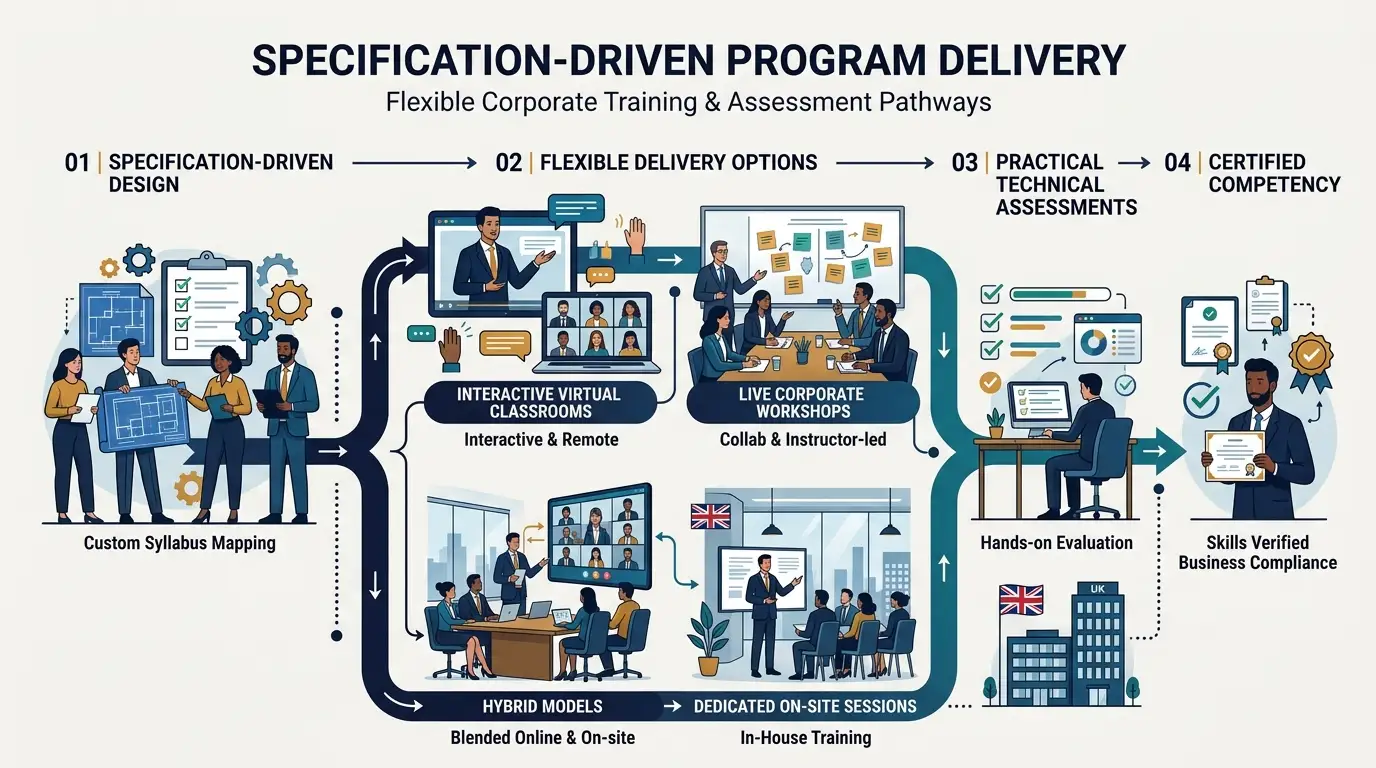
Institute For Oil & Gas Training provides versatile learning formats tailored to corporate requirements:
Live Virtual Classroom
Delivered via secure interactive platforms, this format allows geographically dispersed treasury teams to attend scheduled live modules together. Sessions combine instructor instruction with live system demonstrations.
On-Site Corporate Workshops
Designed for enterprise finance teams, on-site programs take place directly at corporate headquarters. Trainers adapt practical exercises to match the organization's actual banking environment and ERP setup.
Hybrid Delivery
Combines self-paced online technical preparation modules with live practical configuration workshops, allowing finance personnel to balance skill acquisition alongside daily operational responsibilities.
Participants undergo hands-on evaluation using simulated multi-bank datasets. Assessment relies on objective skill metrics:
Configuring a functional auto-matching engine from raw SWIFT MT940 datasets.
Setting up exception handling logic for joint venture payment discrepancies.
Executing an automated end-of-month closing sequence within target parameters.
What measurable corporate outcomes can organizations expect?
Organizations completing this program achieve immediate reductions in financial closing cycles, higher automated matching rates, lower operational overhead, and strengthened internal compliance controls across global treasury units.
The enterprise-focused programs delivered by Institute For Oil & Gas Training convert technical knowledge into measurable corporate performance metrics:
Accelerated Month-End Closing
Transitioning from manual statement entry to automated file processing dramatically shortens the time required to reconcile bank balances against enterprise sub-ledgers, enabling rapid monthly financial closes.
Enhanced Operational Efficiency
By raising auto-matching rates above 90%, treasury personnel spend significantly less time on manual data verification and focus their capacity on high-value cash management and financial analysis.
Risk Mitigation and Regulatory Compliance
Standardized auto-matching logic and automated exception tracking eliminate unrecorded transactions, minimize fraud risk, and provide external auditors with complete, verifiable transaction histories.
Improved Joint Venture Governance
Standardizing project account reconciliation ensures cash call variances are spotted and resolved quickly, preventing partner disputes and maintaining operational trust in joint ventures.
How does enrollment and corporate implementation work?
Enrollment involves an initial corporate treasury skills assessment, customized group scheduling, pre-course technical setup, and structured post-training execution support.
Target Audience and Prerequisites
This course is structured specifically for corporate finance personnel, including:
Treasury Managers and Financial Controllers overseeing multi-currency accounts.
Senior Accountants responsible for bank reconciliation and ledger integrity.
Finance Transformation Leads managing ERP integration projects.
Systems Analysts supporting financial software infrastructure.
Participants should possess a fundamental understanding of corporate accounting principles, standard banking operations, and basic enterprise software navigation.
Corporate Enrollment Process
Human Resources and finance department leads can enroll whole teams or select key personnel through a structured process managed by Institute For Oil & Gas Training:
Treasury Diagnostic: Evaluation of current banking formats, ERP setup, and operational pain points.
Curriculum Tailoring: Fine-tuning module focus areas to target organizational challenges.
Sandbox Setup: Preparing secure training environments populated with realistic transaction data.
Course Delivery: Completing live, virtual, or hybrid instruction sessions.
Post-Training Review: Detailed evaluation reports highlighting participant competency and readiness.
Organizations seeking to upgrade treasury operations and establish automated reconciliation workflows across multi-bank environments can apply for course access through the registration portal.
Frequently Asked Questions
What is oil and gas petroleum treasury management?
Oil and gas petroleum treasury management involves overseeing operational cash flows, managing foreign exchange risks, and maintaining liquidity across complex energy supply chains. Delivered by Institute For Oil & Gas Training, the Oil & Gas Petroleum Treasury, Cash and Banking course equips professionals with specialized frameworks to balance capital allocation, joint venture cash calls, and international trade financing. This technical discipline ensures energy corporations maintain solvency and streamline multi-bank treasury operations.
What are the main components of petroleum cash and banking operations?
The core components include automated bank statement processing, cash positioning, currency risk management, and joint venture account clearing. Institute For Oil & Gas Training structures its Oil & Gas Petroleum Treasury, Cash and Banking curriculum to address the integration of enterprise resource planning systems with global banking portals. Mastering these operational areas enables finance teams to minimize transaction fees, reduce manual reconciliation backlogs, and safeguard liquidity.
Why is treasury management unique in the oil and gas industry?
Petroleum treasury management must navigate extreme commodity price volatility, multi-currency international transactions, capital-intensive exploration projects, and complex joint operating agreements. Through the Oil & Gas Petroleum Treasury, Cash and Banking program at Institute For Oil & Gas Training, finance specialists learn to mitigate these sector-specific financial exposures. Specialized treasury controls are essential for coordinating cross-border cash pooling and managing escrow accounts for large-scale energy developments.
How does cash forecasting work in energy sector treasury operations?
Cash forecasting in the energy sector relies on aggregating production schedules, capital expenditure timelines, royalty obligations, and expected revenue from crude oil and natural gas sales. The Oil & Gas Petroleum Treasury, Cash and Banking training from Institute For Oil & Gas Training demonstrates how to build dynamic liquidity models that incorporate variable payment terms and fluctuating market prices. Accurate forecasting prevents liquidity shortfalls and optimizes working capital deployment across upstream and downstream divisions.
Who should undertake training in petroleum treasury and cash management?
This targeted training is designed for corporate treasurers, financial controllers, joint venture accountants, and finance managers operating within energy companies. The Oil & Gas Petroleum Treasury, Cash and Banking course provided by Institute For Oil & Gas Training provides the practical skills required to automate bank reconciliations, improve financial governance, and streamline corporate banking relationships. It benefits organizations seeking to enhance team performance and reduce operational risk across global finance units.
Related training courses
API 580 Risk Based Inspection Training Course
- Specialisation
- Oil & Gas Asset Integrity Management
- Duration
- 5 days · 15 CPD hours
Corrosion Control by Material Selection Training Course
- Specialisation
- Oil & Gas Corrosion Management and Control
- Duration
- 5 days · 15 CPD hours
Contract Strategy, Risk and Negotiation Training Course
- Specialisation
- Oil & Gas Petroleum Contracts
- Duration
- 5 days · 15 CPD hours
More articles

Bank Relationship Management Training for Petroleum Company Treasury Professionals
Master bank evaluation, RFPs, and fee analysis. Enroll in the Bank Relationship Management Training by Institute For Oil & Gas Training.
Read article →
How to Evaluate Banking Partners and Treasury Services for Oil and Gas Businesses
Evaluate banking partners and treasury services for oil and gas firms with structured criteria, RFP models, and counterparty credit frameworks.
Read article →
Why Bank Relationship Management Matters for Petroleum Companies
Learn how structured bank relationship management training mitigates liquidity risk, lowers financing costs, and improves treasury performance.
Read article →