

Bank relationship management is the strategic alignment of corporate treasury operations with financial institutions to secure credit facilities, optimize cash liquidity, lower transaction fees, and mitigate counterparty risks across volatile energy value chains.
In capital-intensive industries like upstream exploration, midstream transport, and downstream refining, capital structure directly dictates operational continuity. Energy corporations operate within tight margins and volatile commodity cycles, requiring constant access to multi-currency credit lines and complex treasury services. Strategic bank relationship management moves financial management away from transactional interactions into structured corporate governance.
Organisations build structured treasury capabilities to manage debt covenants, lower bank billing fees, and maintain uninterrupted working capital. Workforce competency in financial risk control prevents operational delays caused by restricted liquidity or delayed letters of credit.
When petroleum financial teams lack formal governance training, corporate entities face higher borrowing margins, operational friction, and overall financial underperformance.
How Do Enterprise Skill Gaps in Treasury Impact Petroleum Operations?
Skill gaps in enterprise treasury teams create cash flow bottlenecks, increase bank service fees by 15%, elevate counterparty default risks, and delay cross-border commodity settlements during major energy price shifts.
Petroleum corporations require financial professionals who possess specialized knowledge of complex banking structures, sovereign risk, and trade finance instruments.
Without targeted professional development, finance professionals struggle to navigate key operational frameworks:
Bank fee analysis and billing review: Unmonitored bank fee structures lead to significant cost leakage in international transfer fees, trade confirmation charges, and unused line commitments.
Counterparty credit assessment: Inadequate risk assessment exposes petroleum firms to financial distress when trading partners or issuing banks fail to fulfill financial commitments.
Know your customer onboarding: Poorly managed compliance processes create 60-day delays in bank account setup, stalling joint venture funding and operational timelines.
To solve these systemic skill deficiencies, enterprise learning programs focus on real-world execution across trade finance, debt negotiation, and cash pool management.
How Does a Structured Corporate Training Program Build Bank Relationship Competency?
Corporate training builds bank relationship competency through a 4-phase structured learning pathway involving pre-assessment, interactive workshops, real-world case simulations, and post-training performance tracking across key financial governance areas.
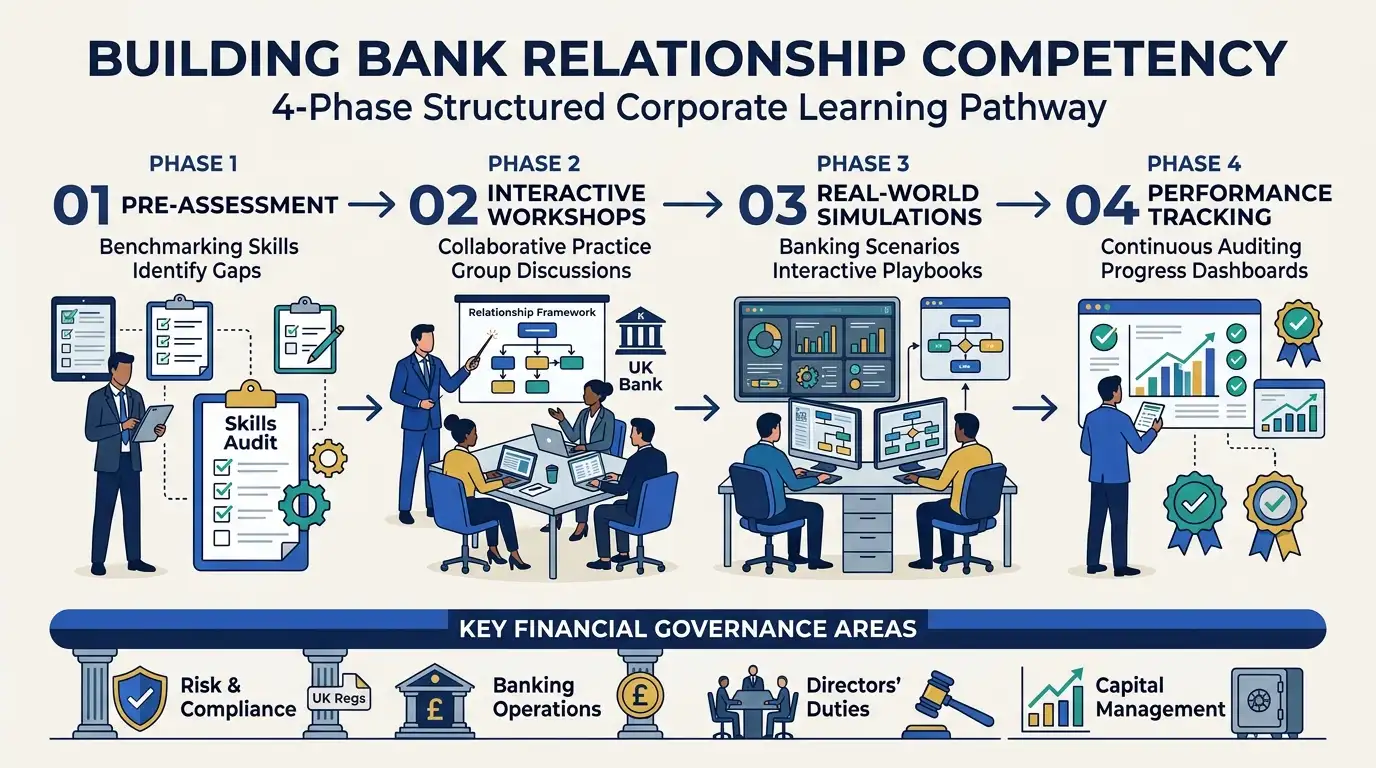
Building enterprise treasury capability requires moving beyond passive lecturing into structured, outcome-driven learning architectures. Modern workforce development follows a rigorous four-stage implementation methodology:
Phase 1: Diagnostic Assessment and Capability Mapping
Training begins by evaluating baseline competencies across finance managers, treasury analysts, and corporate accountants. Learning leaders audit current institutional workflows to identify inefficiencies in credit negotiations, account reconciliation, and risk monitoring.
Phase 2: Core Capability Delivery
Instruction is delivered through hybrid learning environments combining intensive 3-day instructor-led workshops with digital learning modules. Participants analyze core functional areas including wallet allocation strategy, liquidity aggregation, and sovereign risk management.
Phase 3: Applied Case Simulations and Role Play
Participants engage in practical exercises replicating real-world banking interactions. Learners practice negotiating credit margin spreads, conducting mock relationship review meetings, and resolving trade service disputes using actual market data from sectors like oil refining, natural gas distribution, and offshore drilling.
Phase 4: Post-Training Evaluation and On-the-Job Application
Post-course assessments measure skill application over 90 to 180 days. Corporate decision-makers track improvements in fee reconciliation speed, credit line negotiation outcomes, and compliance accuracy.
For organizations seeking to upskill their workforce in these specialized treasury capabilities, enrolling teams in the Bank Relationship Management for Petroleum Companies Training Course provides the practical framework required to optimize bank portfolios and mitigate counterparty exposure.
What Key Components Are Included in Bank Relationship Management Frameworks?
Key components include credit facility negotiation, wallet allocation models, bank service level agreements, counterparty risk analysis tools, automated fee audit systems, and formal review frameworks.
A comprehensive workforce development curriculum addresses both technical skills and strategic governance frameworks required by modern energy companies:
1. Bank Selection Criteria and RFP Design
Learning modules instruct teams on establishing objective bank selection criteria when issuing a request for proposal (RFP). Financial professionals learn to evaluate candidate banks based on global clearing capabilities, credit ratings, digital treasury platforms, and industry sector expertise.
2. Strategic Wallet Allocation
Participants master methods for allocating banking business across syndicated lending groups. Teams learn to balance credit commitments against profitable ancillary business, such as foreign exchange, trade finance, and cash management services, ensuring equitable partner compensation without overpaying.
3. Bank Service Level Agreement (SLA) Management
Training equips learners to construct, enforce, and audit a bank service level agreement. Participants define quantitative operational targets for payment processing times, letter of credit issuance speed, account opening timelines, and query resolution schedules.
4. Credit Line Negotiation Strategies
Learners master financial modeling and negotiation techniques required for credit line negotiation. Instruction covers debt covenant structuring, arrangement fee reduction, facility sizing, and securing commitment terms for reserve-based lending facilities.
How Do Enterprise Teams Implement Treasury Development Programs?
Organizations implement treasury development by conducting baseline skill assessments, customizing industry-specific learning modules, executing blended instruction, establishing governance metrics, and auditing post-training performance.
Successful organizational rollout requires structured alignment between Human Resources, Learning & Development leaders, and Chief Financial Officers.
Implementation follows five distinct steps across corporate structures:
Executive Sponsorship and Goal Setting: Corporate leadership defines clear performance objectives, such as reducing total bank fee expenditures by 10% or accelerating foreign exchange settlement speeds.
Curriculum Customization: Learning content is tailored to reflect the organization's current banking structure, debt profile, and operational regions across international markets.
Blended Delivery Execution: Staff undergo intensive learning sequences comprising 60% practical exercise time and 40% theoretical instruction.
Integration with Internal Controls: Training outcomes are integrated directly into standard operating procedures, policy manuals, and compliance guidelines.
Continuous Performance Auditing: Treasury leadership conducts quarterly reviews to verify that staff consistently apply updated fee audit techniques, credit evaluation models, and relationship management protocols.
Organizations evaluating their existing financial relationships and seeking to select optimal banking partners should review our comprehensive guide on how to evaluate banking partners and treasury services for oil and gas businesses to inform their strategic decision-making.
What Measurable Outcomes Does Bank Relationship Management Training Produce?
Structured training produces a 12% to 18% reduction in bank service fees, cuts trade transaction processing times by 35%, eliminates covenant compliance breaches, and improves treasury team productivity.
Investing in specialized capability development delivers clear, quantifiable return on investment across multiple operational domains:
Financial and Cost Outcomes
Direct Cost Reduction: Systematic bank fee analysis and billing review routinely identifies billing discrepancies, unearned service charges, and excess margin spreads, yielding direct cost savings.
Optimized Borrowing Costs: Effective wallet allocation and competitive RFP processes lower commitment fees and arrangement margins on syndicated credit lines.
Operational Efficiency Outcomes
Accelerated Execution: Standardized SLA monitoring reduces trade finance processing times, allowing faster clearance of import and export documentation for crude oil and refined product shipments.
Streamlined Onboarding: Mastering know your customer onboarding requirements eliminates administrative delays when establishing operational accounts in new geographic markets.
Risk Management and Governance Outcomes
Reduced Counterparty Risk: Rigorous counterparty credit assessment methodologies protect corporate assets from bank distress or default events in volatile financial environments.
Proactive Partner Governance: Structured relationship review meetings transform institutional banking interactions from reactive sales calls into transparent evaluations of service delivery and credit commitment.
What Common Misconceptions Limit the Effectiveness of Treasury Training?
Common misconceptions include viewing bank management as purely transactional, assuming generic finance courses cover energy treasury requirements, and treating banking relationships as static, unmanageable cost centers.
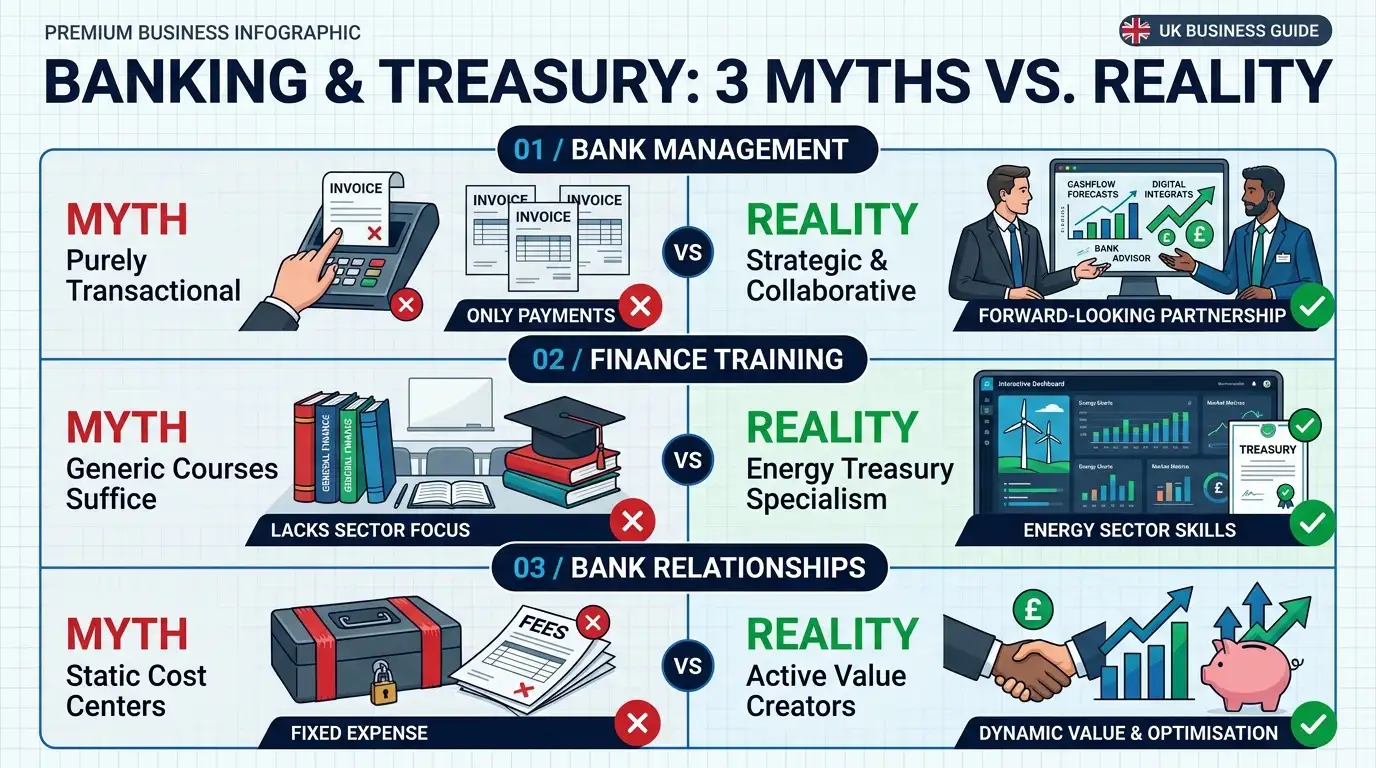
Organizations often fail to realize the full value of their banking networks due to several persistent operational myths:
Myth 1: Banking Fees and Services Are Non-Negotiable
Many business leaders assume bank fee schedules and credit margins are fixed market rates. In reality, systematic billing reviews and wallet allocation analyses regularly expose negotiable price variations across competing institutions.
Myth 2: Generic Financial Training Suits Energy Sector Needs
Standard corporate finance courses focus on basic accounting and generic corporate valuation. They omit specialized topics critical to capital-intensive energy firms, such as reserve-based credit facility negotiations, international trade letters of credit, and complex cross-border liquidity structures.
Myth 3: Relationship Reviews Are Informal Check-Ins
Unstructured meetings without performance metrics fail to hold financial institutions accountable. Effective corporate governance requires formal, data-driven relationship review meetings supported by clear SLA performance scorecards and wallet sharing metrics.
By addressing these misconceptions through structured professional development, petroleum corporations establish resilient corporate treasury operations capable of supporting long-term growth and volatile market stability.
Frequently Asked Questions
What is included in the Oil & Gas Petroleum Treasury, Cash and Banking training course?
The Oil & Gas Petroleum Treasury, Cash and Banking course delivered by the Institute For Oil & Gas Training covers capital structure optimization, credit facility negotiation, and cash liquidity management. Participants learn practical techniques for bank fee analysis, counterparty credit risk assessment, and service level agreement (SLA) auditing. The curriculum focuses on industry-specific frameworks designed to streamline cross-border trade finance and treasury operations.
How does treasury management training help oil and gas companies reduce financial risk?
Structured professional development equips treasury teams with formal methodologies to evaluate sovereign risk, mitigate FX exposure, and monitor counterparty default risks across complex energy supply chains. By mastering know your customer (KYC) onboarding and syndicated credit line negotiations, organizations maintain working capital stability during volatile commodity price cycles. The Institute For Oil & Gas Training provides practical tools to prevent compliance breaches and liquidity bottlenecks.
Who should attend the Oil & Gas Petroleum Treasury, Cash and Banking course?
This program is designed for finance managers, corporate treasury analysts, chief financial officers, and L&D professionals responsible for workforce development in capital-intensive energy sectors. It is equally valuable for team leaders seeking to improve wallet allocation models and bank relationship governance. Participants at the Institute For Oil & Gas Training gain practical skills tailored to upstream, midstream, and downstream corporate requirements.
How does bank relationship management lower operational costs for petroleum firms?
Effective bank relationship management enables corporate treasury departments to audit bank billing statements, eliminate unearned transaction fees, and optimize credit arrangement margins. Training staff to conduct structured bank fee reviews and issue formal requests for proposals (RFPs) directly reduces administrative overhead by 12% to 18%. The Institute For Oil & Gas Training teaches actionable strategies to ensure equitable wallet sharing and cost transparency.
What delivery formats are available for Institute For Oil & Gas Training treasury courses?
The Institute For Oil & Gas Training offers flexible delivery options, including intensive instructor-led corporate workshops, interactive online modules, and blended hybrid learning programs. Courses feature case-based simulations, debt restructuring exercises, and role-play scenarios tailored to real-world energy market environments. Organizations can also customize learning pathways to align with specific internal governance protocols and performance KPIs.
Related training courses
Pipeline Inspection and Integrity Assessment Training Course
- Specialisation
- Oil & Gas Pipeline Integrity and Inspection
- Duration
- 5 days · 15 CPD hours
Offshore Pipeline Inspection and Integrity Assessment Training Course
- Specialisation
- Oil & Gas Pipeline Integrity and Inspection
- Duration
- 5 days · 15 CPD hours
API RP 574 Inspection Practices for Piping System Components Training Course
- Specialisation
- Oil & Gas Inspection and Non-Destructive Testing
- Duration
- 5 days · 15 CPD hours
More articles

Bank Relationship Management Training for Petroleum Company Treasury Professionals
Master bank evaluation, RFPs, and fee analysis. Enroll in the Bank Relationship Management Training by Institute For Oil & Gas Training.
Read article →
How to Evaluate Banking Partners and Treasury Services for Oil and Gas Businesses
Evaluate banking partners and treasury services for oil and gas firms with structured criteria, RFP models, and counterparty credit frameworks.
Read article →
Hedging and Derivatives Governance and Policy Design Training for Oil and Gas Professionals
Master risk frameworks board limits and ISDA mandates. Enroll in Institute For Oil & Gas Training's BOFU hedging governance course today.
Read article →