

Selecting financial institutions to manage cash management, trade finance, and debt syndication requires a systematic evaluation framework. Oil and gas companies operate in high-volatility capital environments where cash visibility, cross-border settlement speeds, and credit availability directly dictate operational continuity. Evaluating prospective financial partners involves auditing transaction capabilities, counterparty exposure, and service-level commitments against specific energy-sector requirements.
Effective treasury operations depend on robust institutional alignment between energy firms and financial service providers. Understanding Why Bank Relationship Management Matters for Petroleum Companies provides the foundation for establishing resilient commercial banking partnerships. Treasury leaders must examine financial strength, liquidity support mechanisms, and fee structures systematically to determine which partners can handle volatile commodity cycles and capital-intensive upstream or downstream assets.
What Financial and Operational Criteria Define a Qualified Energy Banking Partner?
Qualified energy banking partners possess minimum single-A credit ratings, provide dedicated credit lines across commodity downturns, deliver real-time multi-currency treasury visibility, and offer seamless SWIFT integration for cross-border liquidity management without imposing excessive transaction friction or onboarding delays.
Primary bank selection criteria must focus on capital strength, technical capabilities, and energy market expertise. Evaluating a bank requires rigorous counterparty credit assessment to confirm the institution maintains sufficient balance-sheet strength during energy market troughs. Financial institutions with volatile credit ratings create unnecessary systemic risk for corporate treasury divisions managing large collateral obligations or letters of credit.
Technical infrastructure dictates daily treasury efficiency. Corporate treasurers must assess whether a financial institution supports automated host-to-host connectivity, API-driven bank reporting, and ISO 20022 message formats. Energy firms managing global supply chains require instant multi-currency clearing and automated zero-balance cash pooling across foreign subsidiaries to minimise idle cash balances.
Regulatory alignment and operational adaptability represent critical evaluation pillars. A partner bank must demonstrate streamlined know your customer onboarding processes to allow rapid establishment of new joint venture accounts or project SPVs. Complex corporate structures in the energy industry demand flexible onboarding protocols that prevent delays in capital deployment.
How Do Treasury Teams Structure a Request for Proposal for Banking Services?
Treasury teams structure banking requests for proposal by defining explicit volume projections, outlining technical interface requirements, demanding itemised fee schedules, mandating specific service level guarantees, and requiring comprehensive disclosures regarding credit commitment capabilities during volatile market cycles.
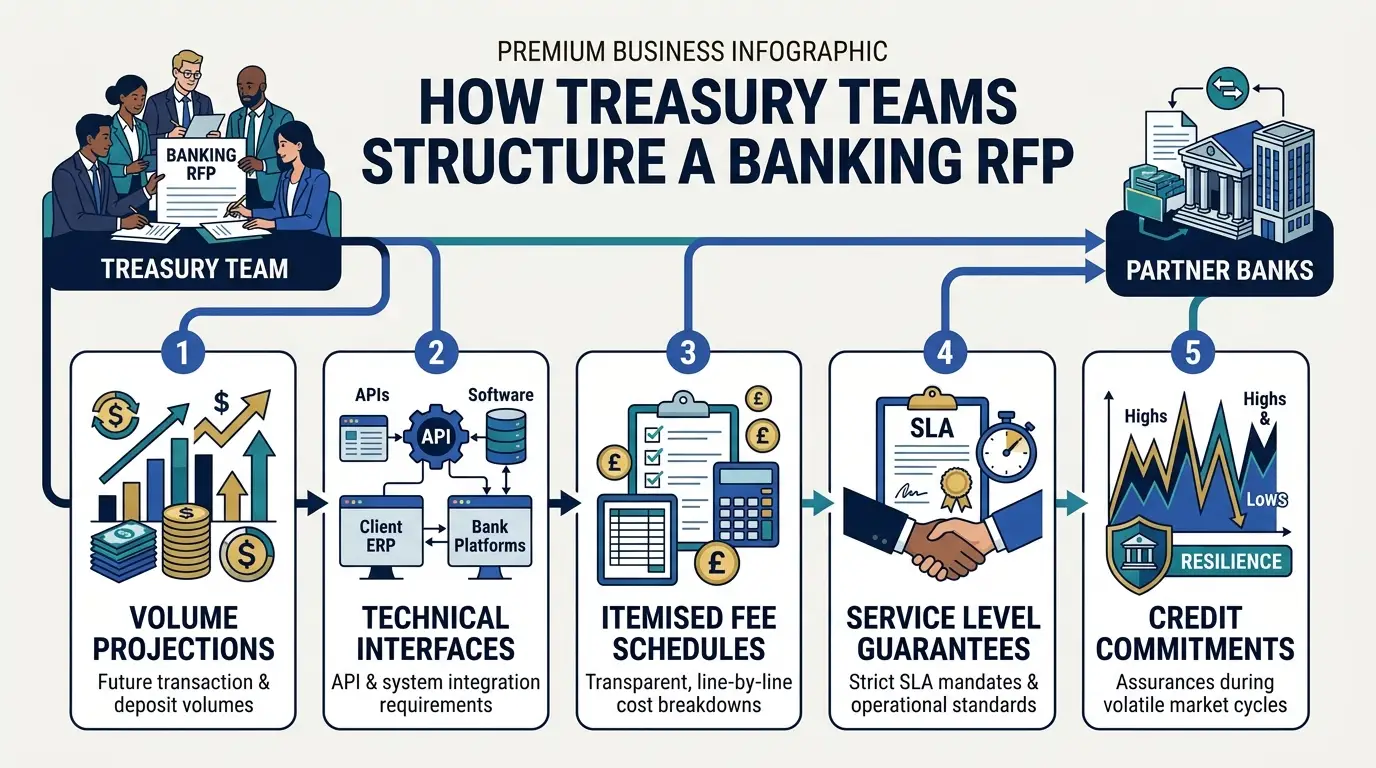
A request for proposal must capture detailed transactional baseline data to yield comparable, accurate bank bids. Energy companies must provide respondents with historical transaction volumes, foreign exchange turnover rates, trade finance instruments, and target account architectures. Unclear baseline data leads to standard pricing proposals that obscure true transaction costs.
The RFP design must force financial institutions to disclose all costs using standardized formats. Standardizing the fee response structure allows treasury teams to conduct an objective bank fee analysis and billing review using standard TWIST or EDI 822 electronic statements. Transparent fee comparisons prevent hidden charges in wire transfers, foreign exchange markups, and account maintenance overheads.
Contractual guarantees must form an explicit core of the RFP framework. The request for proposal must mandate clear metrics within the bank service level agreement, including processing cut-off times, account opening turnarounds, and resolution windows for failed payments. Establishing clear benchmarks during the RFP stage ensures contractual accountability before account migration begins.
How Should Oil and Gas Treasury Departments Allocate Wallet Share Across Multiple Banks?
Treasury departments allocate wallet share by distributing non-credit fee income to banks proportionate to their credit commitments, ensuring lead underwriters receive lucrative capital markets business while secondary banks maintain adequate transaction compensation.
Strategic wallet allocation balances risk mitigation with commercial relationship incentives. Oil and gas companies rely on syndicate banking models where credit facilities require participating institutions to hold substantial balance sheet exposure. Banks expect fee-generating business, such as trade finance, foreign exchange execution, and cash management services, to compensate for low-margin revolving credit facilities.
Treasury teams maintain precise wallet allocation models to track total fee streams paid across all banking partners. Tracking fee streams ensures that energy companies systematically reward financial institutions providing critical credit lines during downcycles. Mismanaging wallet distribution can cause key lending partners to exit syndicate facilities, reducing overall liquidity capacity.
Strategic treasury groups build long-term competency in capital structuring and bank relations through specialized programs like Bank Relationship Management for Petroleum Companies Training Course. Developing internal analytical capabilities enables finance teams to structure balanced wallet matrices that protect corporate credit availability while containing overall banking expenditures.
How Do Energy Companies Conduct Effective Bank Fee Analysis and Billing Review?
Energy companies conduct effective bank fee analysis by comparing monthly electronic bank billing statements against contractual pricing schedules, calculating earnings credit rates against idle balances, and auditing foreign exchange spread markups to identify unapproved pricing changes.
Regular billing reviews prevent cost creeping across corporate account structures. Financial institutions update service fees or alter transaction categories over time, leading to silent margin erosion if left unchecked. Corporate treasury teams use automated billing audit software to cross-reference contractual rate cards against incoming electronic fee files.
Evaluating the earnings credit rate applied to non-interest-bearing operating balances is vital. Energy firms maintain high cash reserves for working capital demands and project expenditures. Treasury teams must ensure earnings credits offset monthly service charges accurately based on prevailing short-term benchmark rates.
Foreign exchange execution costs require rigorous post-trade transaction cost analysis. Banks often embed hidden fees within execution spreads rather than charging explicit transaction fees. Auditing foreign exchange transactions against benchmark interbank rates at the exact millisecond of execution exposes hidden revenue extraction by partner institutions.
How Should Energy Treasury Teams Approach Credit Line Negotiation and Counterparty Exposure?
Treasury teams negotiate credit lines by securing flexible borrowing base formulas, establishing predictable covenant structures, limiting restricted cash mandates, and implementing daily counterparty exposure monitoring across all cash, derivative, and trade finance positions.
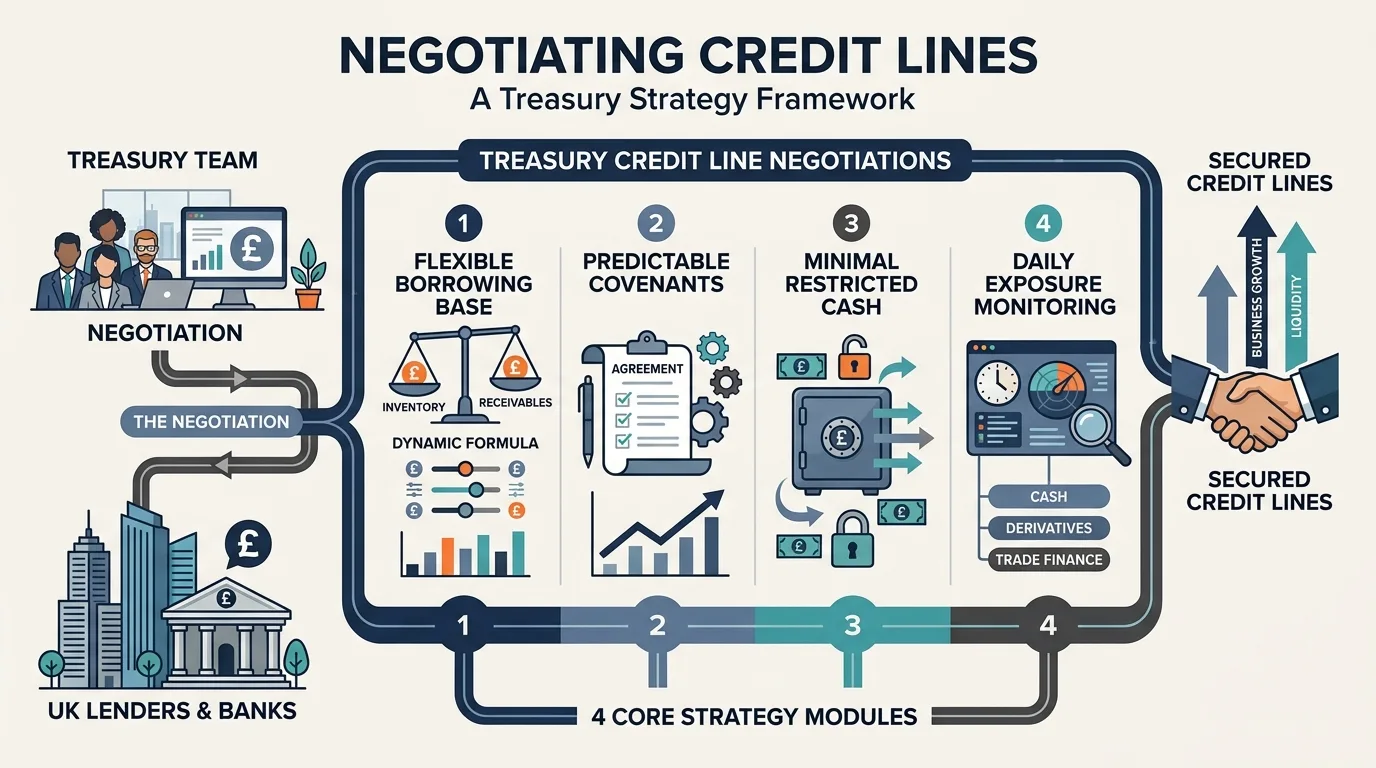
Borrowing base agreements must reflect the volatile valuation of underlying petroleum inventory and receivables. Credit line negotiation strategies should focus on maximizing advance rates for eligible hydrocarbon inventory while minimizing restrictive liquidity covenants. Securing flexible covenant thresholds prevents technical defaults caused by sudden commodity price movements.
Counterparty credit assessment protocols must operate dynamically rather than relying on annual financial reviews. Treasury departments aggregate total balance-sheet exposure to each financial partner daily, including cash deposits, mark-to-market derivative values, and outstanding trade commitments. Setting strict concentration limits per institution mitigates systemic risk during broader financial sector distress.
Negotiations must address collateralization mechanics for hedging portfolios. As commodity prices fluctuate, margin calls on derivative transactions can drain liquid cash reserves rapidly. Treasury teams negotiate parental guarantees, uncollateralized threshold levels, and diverse credit support annex frameworks to maintain corporate liquidity stability.
How Are Bank Relationship Review Meetings Structured to Drive Performance?
Bank relationship review meetings follow a structured agenda featuring scorecard evaluations, credit commitment reviews, operational error logs, and forward-looking business discussions to align service delivery with strategic corporate goals.
Formal relationship review meetings should occur at least twice a year with each key banking institution. These sessions transform ad-hoc operational interactions into structured strategic evaluations. Providing partner banks with quantitative scorecards before meetings establishes clear operational priorities and pinpoints performance gaps objectively.
Performance scorecards must evaluate both operational execution and credit support alignment. Operational metrics measure payment execution timeliness, account management responsiveness, and system uptime. Credit alignment metrics evaluate the bank’s consistency in holding committed lending allocations without introducing overly restrictive terms.
Structuring systematic review protocols requires targeted professional development for corporate finance teams. Completing structured learning programs such as Bank Relationship Management Training for Petroleum Company Treasury Professionals ensures treasury managers master objective bank evaluation techniques, fee audit mechanics, and negotiation strategies.
How Do Banking Partner Evaluation Approaches Compare Across Treasury Objectives?
Selecting an optimal banking evaluation framework depends on corporate priorities, asset complexity, and cross-border operational exposure. Treasury departments choose among structured evaluation methodologies to align banking capabilities with organizational risk tolerance and operational requirements.
Selecting the appropriate method requires evaluating operational priorities against available internal resource capacity.
How Should Treasury Leaders Select and Execute Their Banking Evaluation Framework?
Executing a banking partner evaluation framework requires a systematic, four-phase project plan to ensure smooth execution without disturbing daily treasury activities.
Phase 1: Baseline Internal Audit
Map all existing account structures, daily transaction volumes, foreign exchange flows, and credit lines. Collect twelve months of fee statements to establish an accurate cost baseline for future bid comparisons.
Phase 2: Structured RFP Execution
Issue standardized request for proposal documentation to qualified institutions. Mandate precise pricing schedules and enforce standardized electronic fee formats to ensure objective bid comparisons.
Phase 3: Wallet Allocation and Risk Alignment
Calculate total relationship revenue across all product lines. Rebalance wallet distribution to ensure credit-providing institutions receive adequate compensating non-credit business, maintaining systemic liquidity access.
Phase 4: SLA Finalization and Continuous Review
Draft enforceable service level agreements covering payment cut-offs, exception handling, and query response times. Establish automated monthly fee audit procedures and bi-annual relationship review meetings to maintain partner accountability over time.
Frequently Asked Questions
What does an Oil & Gas Petroleum Treasury, Cash and Banking program cover?
The Oil & Gas Petroleum Treasury, Cash and Banking program by the Institute For Oil & Gas Training covers essential financial operations tailored to the energy sector, including liquidity management, cash flow forecasting, working capital optimization, and credit risk mitigation. Participants learn how to navigate complex international banking relationships, manage multi-currency trade flows, and apply hedging strategies to buffer against commodity price volatility. The curriculum provides corporate finance teams with practical frameworks to maintain fiscal solvency across volatile market cycles.
How does treasury management in the oil and gas sector differ from other industries?
Petroleum treasury management involves navigating high capital intensity, cross-border trade settlements, complex joint-venture cash calls, and severe commodity price volatility. The Institute For Oil & Gas Training addresses these unique challenges through its specialized Oil & Gas Petroleum Treasury, Cash and Banking curriculum, emphasizing liquidity resilience and counterparty risk assessment. Energy companies require dynamic cash forecasting models and specialized commercial banking structures that standard corporate treasury frameworks rarely address.
Who should enrol in an Oil & Gas Petroleum Treasury, Cash and Banking course?
This training is designed for corporate treasurers, finance directors, cash managers, financial analysts, and commercial banking executives working within or supporting upstream, midstream, and downstream energy companies. Through the Institute For Oil & Gas Training, professionals enrolled in the Oil & Gas Petroleum Treasury, Cash and Banking program gain the specialized technical competencies needed to manage multi-jurisdictional financial operations effectively. It is also highly beneficial for finance professionals transitioning into the petroleum and energy finance space.
How does specialized treasury training improve corporate cash flow visibility?
Specialized training equips finance teams with advanced cash pooling techniques, automated bank reconciliation workflows, and standardized liquidity reporting structures across global subsidiaries. The Oil & Gas Petroleum Treasury, Cash and Banking course delivered by the Institute For Oil & Gas Training focuses on optimizing host-to-host banking connectivity and treasury management system integration. These operational enhancements eliminate idle cash balances, accelerate capital deployment, and provide real-time visibility across foreign currency accounts.
What value does bank relationship management add to petroleum treasury operations?
Effective bank relationship management ensures oil and gas businesses secure adequate bilateral credit facilities, flexible borrowing base terms, and competitive foreign exchange execution rates. The Institute For Oil & Gas Training integrates strategic bank evaluation frameworks into its Oil & Gas Petroleum Treasury, Cash and Banking modules, enabling treasury teams to structure balanced wallet allocations. This strategic alignment reduces transaction friction, optimizes fee structures, and secures crucial balance sheet support during industry downcycles.
Related training courses
Amine Gas Treating and Regeneration Operations Training Course
- Specialisation
- Oil & Gas Process Engineering and Operations
- Duration
- 5 days · 15 CPD hours
Pipeline Inspection and Integrity Assessment Training Course
- Specialisation
- Oil & Gas Pipeline Integrity and Inspection
- Duration
- 5 days · 15 CPD hours
Fiscal Disputes, Cost Recovery and Contract Resolution Training Course
- Specialisation
- Oil & Gas Petroleum Fiscal Regime
- Duration
- 5 days · 15 CPD hours
More articles

Bank Relationship Management Training for Petroleum Company Treasury Professionals
Master bank evaluation, RFPs, and fee analysis. Enroll in the Bank Relationship Management Training by Institute For Oil & Gas Training.
Read article →
Why Bank Relationship Management Matters for Petroleum Companies
Learn how structured bank relationship management training mitigates liquidity risk, lowers financing costs, and improves treasury performance.
Read article →
Hedging and Derivatives Governance and Policy Design Training for Oil and Gas Professionals
Master risk frameworks board limits and ISDA mandates. Enroll in Institute For Oil & Gas Training's BOFU hedging governance course today.
Read article →