

Bank reconciliation automation in oil and gas treasury operations is the digital transformation of matching internal ERP bank ledgers with external bank statements, eliminating manual data entry, reducing human error, and accelerating financial reporting across multi-currency corporate environments.
Bank reconciliation automation replaces manual spreadsheet matching with algorithmic rules engines. Oil and gas companies operate in high-volume, multi-bank environments that process millions of transactions daily across upstream, midstream, and downstream operations. Treasury teams handle complex financial structures like joint venture bank account reconciliation, escrow accounts, and multi-currency bank accounts. Manual processing creates severe bottlenecks during month-end financial closes. It exposes organizations to fraud, compliance breaches, and inaccuracies in cash visibility.
In corporate environments, automated bank reconciliation functions as a strategic control framework. Software ingests standard messaging protocols such as SWIFT MT940 and BAI2 formats directly into an enterprise resource planning (ERP) system. The automation platform applies auto-matching rules to pair cash inflows and outflows against open ledger items. It isolates discrepancies into an automated exception handling workflow for rapid investigation.
From an organizational perspective, transitioning to automated reconciliation requires upskilling finance professionals. Finance staff shift from low-value data entry roles to high-value analytical roles. Corporate training programs equip accounting and treasury personnel with technical skills to configure matching rules, resolve complex exceptions, and audit digital workflows.
Establishing automated reconciliation standards transforms treasury operations into a real-time risk management engine. Organizations achieve accurate daily cash positioning across international subsidiaries. They ensure strict regulatory compliance with financial bodies like the UK Financial Conduct Authority (FCA) and international accounting standards like IFRS 9.
Treasury Dimension | Manual Reconciliation | Automated Reconciliation |
Transaction Processing Speed | 50–100 transactions per hour per analyst | 10,000+ transactions per minute automatically |
Error Rate | 3%–5% manual input error rate | 0% algorithmic entry error rate |
Statement Standardisation | Manual conversion of physical/PDF statements | Automated parsing of MT940 and BAI2 formats |
Exception Resolution | Days spent tracing spreadsheet discrepancies | Real-time isolation via structured exception workflows |
Audit Visibility | Fragmented paper trails and local spreadsheets | Centralised, immutable ERP audit logs |
How Does Bank Reconciliation Automation Work in Corporate Learning and Workforce Implementation?
Bank reconciliation automation works in corporate environments through a structured four-stage implementation process that combines software deployment, ERP bank ledger integration, workflow standardization, and targeted technical training for enterprise treasury personnel.
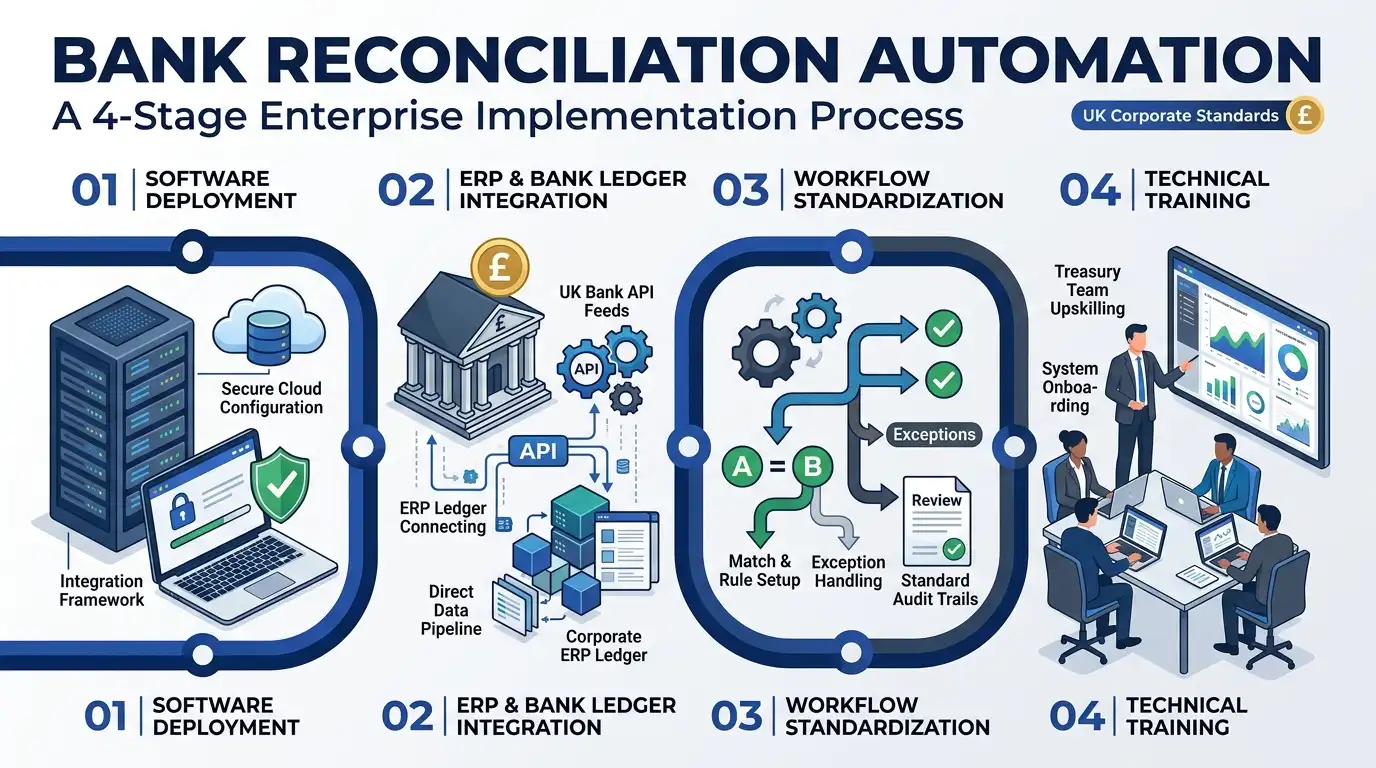
Stage 1: Process Assessment and Skill Gap Identification
Organizations audit existing bank statement import mechanisms, ledger structures, and manual reconciliation workflows. L&D leaders evaluate finance team competencies across systems like SAP, Oracle NetSuite, and Microsoft Dynamics 365. They identify critical skill gaps in digital treasury management, automated rule building, and data governance.
Stage 2: Technical System Integration and Rule Configuration
IT teams configure direct API or SFTP connections between global banking partners and central ERP systems. Systems ingest standardized data files using MT940 and BAI2 formats. Developers and senior treasury analysts build baseline auto-matching rules based on transaction references, value dates, precise amounts, and tolerance thresholds.
Stage 3: Workforce Up-Skilling and Applied Training
Organizations deliver targeted corporate learning programs to bridge operational gaps. Up-skilling relies on practical training formats such as hands-on workshops, interactive online modules, and hybrid learning models. Training relies on case-based learning and interactive software simulations.
Finance personnel practice managing high-volume data streams, overriding false positives, and routing un-matched items through exception handling protocols. Staff learn to manage complex accounts, including escrow and project account reconciliation and joint venture bank account reconciliation setups.
Stage 4: Operational Execution and Continuous Improvement
The organization shifts from manual matching to automated reconciliation execution. Treasury management continuously monitors performance metrics, targeting auto-match rates above 90%. System administrators refine auto-matching rules based on emerging transaction patterns, while trained analysts handle complex exceptions.
What Key Components and Skills Are Required to Master Bank Reconciliation Automation?
Mastering bank reconciliation automation requires a combination of technical knowledge in global financial messaging, proficiency in ERP bank ledger integration, expertise in auto-matching rule engine design, and advanced competencies in automated exception handling.
Technical Messaging Standards and Data Parsing
Treasury personnel must master standard financial formats. Understanding MT940 and BAI2 formats allows teams to verify that incoming bank statement import files parse correctly into ERP systems. Analysts learn to troubleshoot data transmission errors, character truncation, and formatting inconsistencies before data enters central matching ledgers.
ERP Bank Ledger Integration Architecture
Effective automation requires complete synchronization between external bank feeds and internal accounts. Professionals must understand how sub-ledgers post transactions into the main general ledger. Training covers real-time data flows, clearing account mechanics, and multi-currency bank accounts valuation under fluctuating foreign exchange rates.
Algorithmic Auto-Matching Engine Design
Treasury teams learn to construct, test, and optimize algorithmic auto-matching rules within enterprise systems. Key skills include setting up single-field and multi-field criteria, applying range and date tolerances, and building logic for one-to-one, one-to-many, and many-to-many transaction matching scenarios.
Exception Handling and Root-Cause Analysis Protocols
When automated matching engines isolate discrepancies, analysts must step in with rapid exception handling routines. Finance teams develop skills in diagnosing structural causes of un-matched items, resolving timing differences, identifying short payments, and identifying unauthorized bank charges or potential fraud.
How Do Enterprise Benefits Drive Organizational Performance and Financial Control?
Bank reconciliation automation drives enterprise performance by reducing month-end close cycles by 60%, eliminating manual error costs, improving corporate cash visibility, strengthening audit compliance, and optimizing resource allocation across finance departments.
Accelerated Month-End Closing Cycles
Manual reconciliation delays financial reporting for enterprise organizations. Implementing automated systems cuts bank reconciliation processing time from 10 business days down to 2 days per closing cycle. Rapid closes give C-suite executives faster access to verified financial records for strategic decision-making.
Operational Cost Reduction and Error Mitigation
Manual spreadsheet processing carries an estimated 3% to 5% operational error rate due to typos, duplicate entries, and incorrect line-item pairings. Automation reduces input errors to 0%. This eliminates costly retrospective accounting adjustments, administrative re-work, and audit penalties across multinational operating units.
Real-Time Cash Visibility Across Global Accounts
Energy companies operate complex account networks spread across multiple geographic jurisdictions. Automated processing updates ERP bank ledger positions every morning. Corporate treasurers gain instant visibility into consolidated cash balances across hundreds of multi-currency bank accounts, improving liquidity forecasting and capital allocation.
Enhanced Audit Compliance and Fraud Prevention
Automated reconciliation platforms maintain immutable digital audit trails for every transaction. The system logs who created, matched, reviewed, or adjusted each ledger entry. Enterprise software enforces segregation of duties, preventing unauthorized manual overrides and mitigating internal fraud risks across joint venture operations.
Where Is Bank Reconciliation Automation Applied Across Corporate Energy Functions?
Bank reconciliation automation is applied across joint venture management, upstream exploration projects, downstream retail and trading divisions, and corporate treasury management across global energy companies.
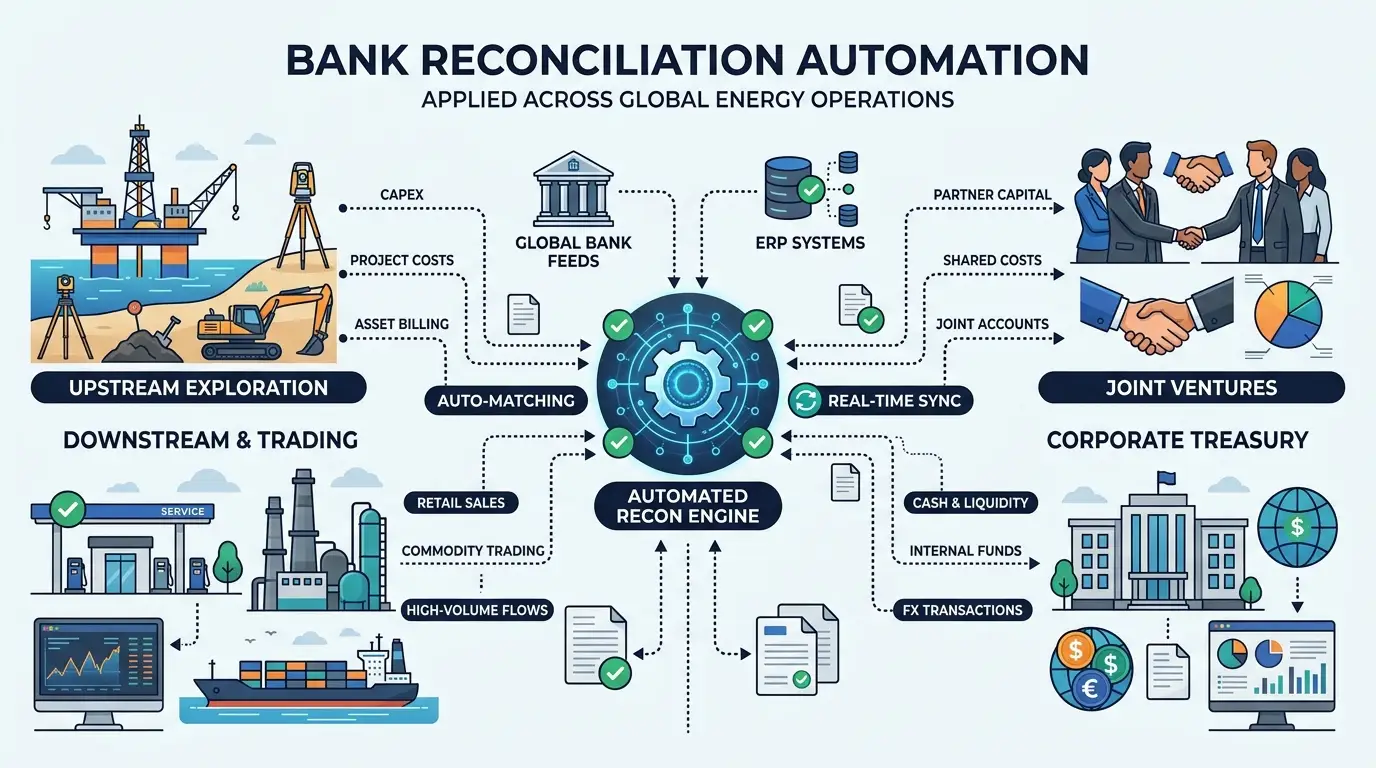
Joint Venture Operating Companies and Operator Accounts
Oil and gas extraction projects rely on joint ventures where an operator manages capital expenditures on behalf of non-operating partners. Teams apply automation to conduct joint venture bank account reconciliation to verify cash calls, trace vendor disbursements, and validate monthly billings with transparency.
Upstream Project Accounting and Escrow Management
Capital-intensive exploration projects use escrow structures to secure funding for field development, decommissioning liabilities, and equipment purchases. Specialized accounting teams use automated reconciliation platforms to execute escrow and project account reconciliation, ensuring balance integrity across dedicated accounts.
Downstream Refining, Retail, and Distribution Networks
Downstream operations process thousands of high-frequency consumer transactions daily across service station networks, fuel distribution hubs, and commercial supply contracts. Automated reconciliation ingests payment gateway reports, card processor feeds, and bank statements to match daily receipts against high-volume commercial ledgers.
Corporate Treasury and Global Currency Management
Centralized corporate treasury departments handle cross-border capital transfers, foreign exchange hedging, and intercompany debt service. Treasury operations use auto-matching rules and central bank statement import feeds to track cash movements, manage currency risks, and optimize liquidity across international subsidiaries.
What Common Problems and Misconceptions Impair Training Effectiveness and Project ROI?
Common problems that impair project ROI include relying on generic finance training, treating reconciliation automation purely as an IT project, neglecting structured change management, and failing to track post-implementation performance metrics.
Relying on Generic, Off-the-Shelf Accounting Courses
Generic accounting training fails to address the operational complexities of global energy companies. Generic programs omit specialized subjects like multi-currency bank accounts, joint venture cash calls, and complex SWIFT data file structures. Workforce development requires tailored programs built around actual business workflows.
Treating Reconciliation Automation as an IT Implementation Only
Organizations often assume software vendors or internal IT departments can deliver automation without deep involvement from finance teams. When finance personnel do not participate in designing matching logic and exception workflows, system adoption fails. Finance teams must own the business rules powering the matching engine.
Expecting Automation to Eliminate Human Oversight Entirely
A common misconception is that automation completely removes staff from the reconciliation process. Automated platforms handle repetitive matching, but complex discrepancies require human judgment. Organizations must upskill their staff to shift from data entry mechanics to root-cause investigation and exception resolution.
Failing to Measure Long-Term Learning ROI and System Metrics
Many corporate learning initiatives lack key performance metrics (KPIs) to evaluate success. Without measuring post-training metrics—such as percentage auto-match rates, time-to-resolve exceptions, and month-end close duration—management cannot evaluate training impact or verify return on investment.
Overcoming Skill Gaps with Targeted Education
Unlocking the full return on investment from automation software requires structured workforce development. Corporate learning programs build internal capabilities, ensuring employees can manage automated software confidently.
Organizations seeking to optimize multi-bank treasury workflows should evaluate structured professional development programs, such as the Bank Reconciliation Automation for Multi-Bank Environments Training Course. Structured training bridges technical skill gaps, equips personnel to build robust auto-matching rules, and turns bank reconciliation into a competitive advantage.
Frequently Asked Questions
What is oil and gas petroleum treasury, cash and banking management?
Oil and gas petroleum treasury, cash and banking management involves overseeing global liquidity, cash positioning, risk exposure, and joint venture cash calls within energy sector corporate finance. The Institute For Oil & Gas Training provides professional development in this discipline to help finance personnel manage multi-currency bank accounts, volatile commodity revenue, and capital expenditure workflows. Mastering these workflows ensures robust financial control and regulatory compliance across international oil and gas operations.
How does bank reconciliation automation benefit energy company treasury operations?
Bank reconciliation automation integrates external bank statement feeds with central enterprise resource planning (ERP) systems to match high-volume transactions automatically. This technology reduces month-end financial closing times, eliminates manual data entry errors, and provides real-time cash visibility across global subsidiaries. Through targeted programs at the Institute For Oil & Gas Training, treasury professionals learn to configure auto-matching rules and manage exception handling protocols for complex petroleum accounts.
What key skills are required for oil and gas cash and liquidity management?
Managing liquidity in the energy sector requires expertise in cash flow forecasting, foreign exchange hedging, working capital optimization, and global banking messaging formats like MT940 and BAI2. Finance teams must also understand joint venture accounting structures and escrow account governance to maintain financial stability. The Institute For Oil & Gas Training equips corporate treasury staff with these practical skills through hands-on case studies and industry-aligned training.
Why is joint venture bank account reconciliation critical in oil and gas finance?
Joint venture bank account reconciliation verifies that operating cash calls, vendor disbursements, and field development expenses align transparently with legal operating agreements. Because capital expenditures in upstream exploration involve multiple international partners, accurate reconciliation prevents billing disputes and audit non-compliance. Professional training from the Institute For Oil & Gas Training prepares treasury analysts to audit cash flows and resolve ledger discrepancies across joint venture structures.
How do finance teams implement automated bank statement imports in treasury systems?
Implementing automated bank statement imports requires establishing secure data connections between commercial banks and corporate ERP systems using standardized SWIFT MT940 or BAI2 electronic file formats. Treasury teams configure automated parsing logic to map incoming bank ledger entries directly to internal accounts. The Institute For Oil & Gas Training trains L&D cohorts and finance professionals on system integration, automated matching engine configuration, and exception management for seamless treasury operations.
Related training courses
Introduction to Conventional and Advanced NDT Techniques Training Course
- Specialisation
- Oil & Gas Inspection and Non-Destructive Testing
- Duration
- 5 days · 15 CPD hours
Acoustic Emission Testing Training Course
- Specialisation
- Oil & Gas Inspection and Non-Destructive Testing
- Duration
- 5 days · 15 CPD hours
Corrosion Monitoring & Testing Training Course
- Specialisation
- Oil & Gas Corrosion Management and Control
- Duration
- 5 days · 15 CPD hours
More articles

Bank Relationship Management Training for Petroleum Company Treasury Professionals
Master bank evaluation, RFPs, and fee analysis. Enroll in the Bank Relationship Management Training by Institute For Oil & Gas Training.
Read article →
How to Evaluate Banking Partners and Treasury Services for Oil and Gas Businesses
Evaluate banking partners and treasury services for oil and gas firms with structured criteria, RFP models, and counterparty credit frameworks.
Read article →
Why Bank Relationship Management Matters for Petroleum Companies
Learn how structured bank relationship management training mitigates liquidity risk, lowers financing costs, and improves treasury performance.
Read article →