

Petroleum treasury teams face severe operational risks due to misaligned credit facilities, unoptimized banking fees, and inefficient cash management structures across international jurisdictions. The Bank Relationship Management for Petroleum Companies Training Course by Institute For Oil & Gas Training addresses these challenges by equipping treasury managers with structured methodologies to evaluate banking partners, negotiate credit terms, enforce service level agreements, and streamline corporate onboarding procedures.
Managing corporate banking ties requires deep sector knowledge due to commodity price volatility and massive capital expenditure requirements. Understanding Why Bank Relationship Management Matters for Petroleum Companies helps organizations recognize that bank ties directly dictate capital liquidity, borrowing costs, and risk mitigation strategies across volatile energy markets.
What is the course and what problem does it solve?
This professional training program resolves critical skill gaps in petroleum treasury management by establishing standardized practices for banking partner evaluation, fee audits, credit line negotiations, and counterparty risk assessment, directly protecting corporate liquidity and reducing overall transactional costs across global operations
Petroleum enterprises operate under high capital intensity and complex international cash flows. Treasury professionals frequently struggle with opaque banking fee structures, suboptimal credit allocations, and protracted onboarding processes. These operational bottlenecks lead to uncalculated counterparty risks and excessive foreign exchange costs. Without structured banking protocols, finance teams fail to extract maximum value from banking relationships.
The Bank Relationship Management for Petroleum Companies Training Course solves these systemic workplace inefficiencies through structured training frameworks designed by Institute For Oil & Gas Training. The program addresses real-world treasury challenges by providing standardized templates for formal evaluation and governance. Participants transition from passive banking clients to proactive financial managers capable of auditing billing statements, managing risk exposure, and optimizing global liquidity structures.
Why is this course structured this way?
The curriculum follows a progressive pedagogical framework that moves systematically from fundamental banking infrastructure analysis to complex credit negotiations, contractual service level enforcement, and wallet share allocation strategies, ensuring immediate, measurable workplace application for energy sector treasury teams.
Curriculum structure directly influences retention and practical capability. Institute For Oil & Gas Training designed this course to mirror the lifecycle of corporate banking partnerships within the energy sector. Finance professionals must master baseline partner evaluations before attempting complex financial modeling or multilateral credit negotiations.
Learning progression relies on building analytical mastery step by step. Treasury officers begin by learning How to Evaluate Banking Partners and Treasury Services for Oil and Gas Businesses before advancing to negotiation strategies and fee review mechanisms. This logical flow ensures participants understand systemic risk before committing corporate capital to financial institution partners.
What will participants learn through this program?
Participants gain verifiable technical competencies in applying precise bank selection criteria, drafting competitive requests for proposals, conducting bank fee analysis and billing reviews, assessing counterparty credit risks, and conducting performance-driven bank relationship review meetings to optimize corporate wallet allocation.
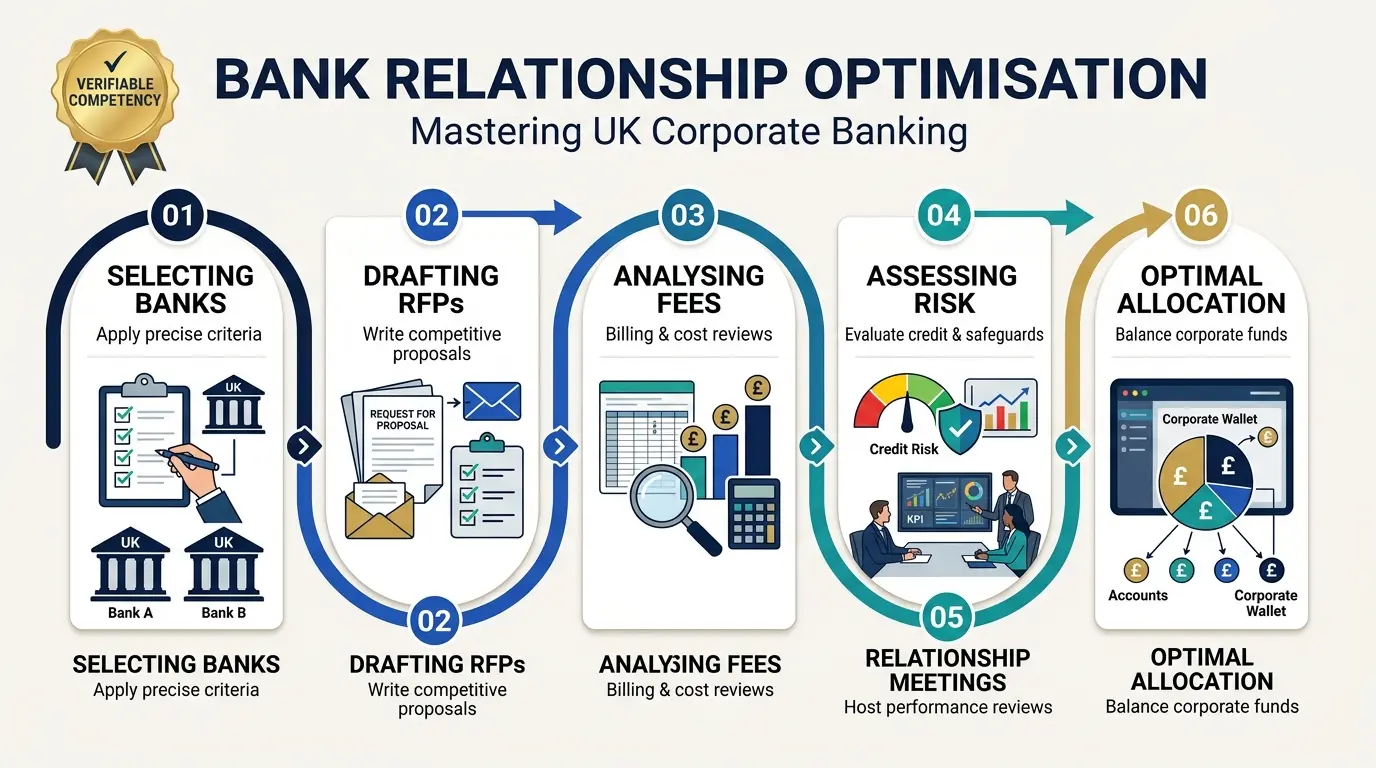
The syllabus is structured into five detailed modules designed to establish practical capabilities in corporate treasury operations.
Module 1: Banking Partner Evaluation & Selection Frameworks
Establishing empirical bank selection criteria tailored to upstream, midstream, and downstream operations.
Drafting comprehensive request for proposal (RFP) documentation for transactional banking, trade finance, and cash management.
Evaluating global versus regional banking capabilities regarding clearing networks and local liquidity needs.
Structuring clear criteria to balance primary and secondary banking relationships.
Module 2: Credit Facility Structuring & Counterparty Risk
Executing rigorous counterparty credit assessment frameworks to protect corporate cash reserves.
Techniques for credit line negotiation, including borrowing bases, covenants, and collateral requirements.
Managing letters of credit, bank guarantees, and performance bonds specific to petroleum trade finance.
Mitigating systemic exposure across financial institution counterparties through diversification models.
Module 3: Bank Fee Auditing & Cost Optimization
Conducting rigorous bank fee analysis and billing review using standardized formats.
Identifying hidden charges, non-compliant pricing, and float inefficiencies in cash concentration structures.
Benchmarking treasury service costs against prevailing energy market standards.
Implementing automated monthly fee audit workflows within corporate treasury systems.
Module 4: Treasury Governance & Service Quality Management
Drafting and enforcing a robust bank service level agreement (SLA) with clear performance metrics.
Accelerating know your customer onboarding processes through structured documentation templates.
Establishing governance frameworks for cross-border account administration and signature authorizations.
Resolving operational failures, payment delays, and clearing errors through formal escalation paths.
Module 5: Strategic Relationship Management & Wallet Allocation
Calculating equitable wallet allocation strategies to align business volumes with credit provision.
Structuring productive relationship review meetings using objective scorecards and performance data.
Managing multi-banking syndicates to secure long-term capital commitments for major projects.
Aligning banking strategies with corporate ESG guidelines and long-term corporate finance goals.
How is the course delivered and assessed?
Delivered through flexible interactive online sessions, intensive in-person workshops, or customized corporate onsite programs, training incorporates practical case studies, real-world treasury simulations, and rigorous practical assessments managed directly by expert instructor panels.
Institute For Oil & Gas Training offers flexible delivery models designed to fit corporate schedules without disrupting daily treasury workflows.
Instructional Methodology
Training delivery combines direct instruction with hands-on practice. Instructors present real energy sector treasury scenarios, requiring participants to solve actual operational challenges. Attendees analyze real billing statements, draft RFPs, and construct credit evaluation models using corporate datasets.
Assessment and Verification
Skill acquisition is systematically verified before certification. Participants complete practical assessments including:
A practical bank fee audit assignment using sample statement datasets.
A simulated request for proposal defense evaluated by industry experts.
A final capstone project centered on developing a complete corporate bank governance framework.
What measurable results can organizations expect?
Organizations achieve immediate financial returns through reduced banking fees, lowered credit facility costs, streamlined KYC onboarding cycles, enhanced counterparty risk controls, and optimized wallet share allocation across their global core banking groups.
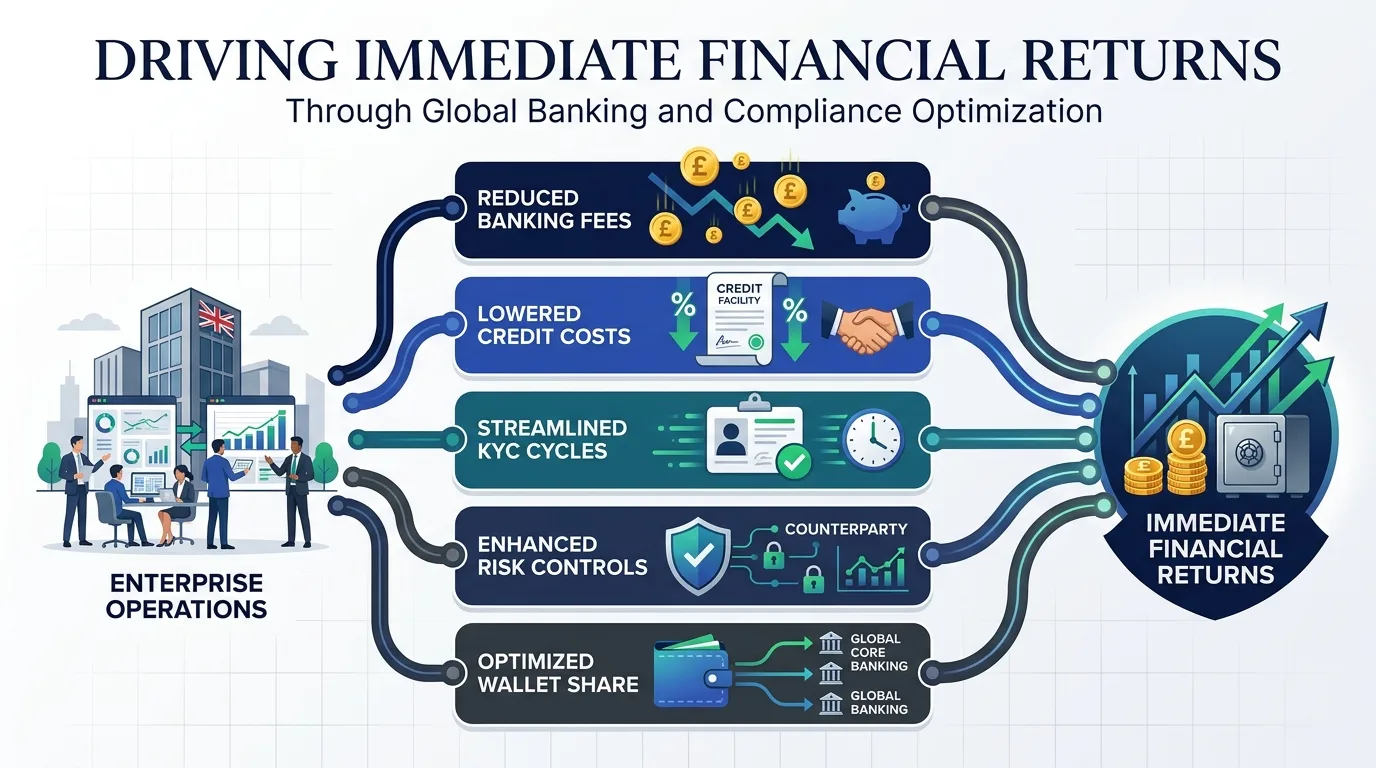
Investing in formal treasury development yields measurable operational improvements across corporate finance functions. HR leaders and Chief Financial Officers utilize this program to build resilient finance departments capable of protecting capital reserves.
HR and Organizational Impact
Human resources departments deploy this program to construct functional career pathways for finance talent. Standardizing treasury procedures reduces key-person dependency, simplifies team integration, and aligns corporate governance across regional business units.
Departmental Performance Enhancement
Treasury teams complete the program with ready-to-use operational tools. Organizations report immediate improvements in billing transparency, faster issue resolution via formal SLAs, and stronger negotiating leverage during credit renewals.
How does enrollment and completion work?
Enrollment involves a formal background assessment to confirm pre-requisite finance experience, followed by corporate seat allocation, module completion, practical assessment submission, and formal professional certification issuing.
Eligibility Criteria
This course is structured for corporate finance professionals, including:
Treasury Managers and Treasury Analysts
Chief Financial Officers and Finance Directors
Corporate Cash Managers and Risk Officers
Commercial Banking Relationship Managers seeking energy sector expertise
Candidates should possess at least two years of experience in corporate finance, financial accounting, or commercial banking operations.
Graduation Requirements
To receive the official certification from Institute For Oil & Gas Training, participants must attend at least 85% of live instruction hours, achieve a minimum passing grade of 75% on all practical assignments, and successfully complete the capstone project.
To equip your treasury team with key skills for managing financial partners, optimize fee structures, and secure critical credit facilities, submit your application today to enroll in this program.
Frequently Asked Questions
What is oil and gas petroleum treasury, cash and banking management?
Oil & Gas Petroleum Treasury, Cash and Banking involves managing an energy company’s liquidity, capital structure, bank relationships, and cash flows across global operations. Specialized programs delivered by the Institute For Oil & Gas Training focus on optimizing multi-currency cash pools, foreign exchange exposures, and joint-venture cash calls unique to the energy sector.
Why is specialized treasury and cash management critical for petroleum companies?
Petroleum operations involve extreme price volatility, capital-intensive projects, cross-border transactions, and complex joint venture agreements. Specialized training in Oil & Gas Petroleum Treasury, Cash and Banking enables finance teams to mitigate counterparty credit risks, minimize foreign exchange losses, and enforce effective bank service level agreements.
What key topics are covered in Oil & Gas Petroleum Treasury, Cash and Banking courses?
Training programs offered by the Institute For Oil & Gas Training cover cash flow forecasting for liftings, multi-bank reconciliation automation, bank fee auditing, and liquidity management. Participants also master credit line negotiations, commodity hedging policies, and cross-border payment structures tailored to upstream, midstream, and downstream activities.
How does bank relationship management impact energy sector cash liquidity?
Effective banking relationship management ensures petroleum companies secure reliable credit facilities, competitive transactional fees, and efficient clearing networks. Courses in Oil & Gas Petroleum Treasury, Cash and Banking teach professionals how to structure bank requests for proposals (RFPs), conduct billing audits, and allocate wallet share to maintain optimal financial flexibility.
Who should attend Oil & Gas Petroleum Treasury, Cash and Banking training programs?
These executive training programs are designed for corporate treasury managers, finance directors, cash analysts, and financial risk managers within energy enterprises. Professional development through the Institute For Oil & Gas Training equips finance professionals with actionable tools to enhance team performance and ensure regulatory compliance across global markets.
Related training courses
Amine Gas Treating and Regeneration Operations Training Course
- Specialisation
- Oil & Gas Process Engineering and Operations
- Duration
- 5 days · 15 CPD hours
Pipeline Inspection and Integrity Assessment Training Course
- Specialisation
- Oil & Gas Pipeline Integrity and Inspection
- Duration
- 5 days · 15 CPD hours
Offshore Pipeline Inspection and Integrity Assessment Training Course
- Specialisation
- Oil & Gas Pipeline Integrity and Inspection
- Duration
- 5 days · 15 CPD hours
More articles

How to Evaluate Banking Partners and Treasury Services for Oil and Gas Businesses
Evaluate banking partners and treasury services for oil and gas firms with structured criteria, RFP models, and counterparty credit frameworks.
Read article →
Why Bank Relationship Management Matters for Petroleum Companies
Learn how structured bank relationship management training mitigates liquidity risk, lowers financing costs, and improves treasury performance.
Read article →
Hedging and Derivatives Governance and Policy Design Training for Oil and Gas Professionals
Master risk frameworks board limits and ISDA mandates. Enroll in Institute For Oil & Gas Training's BOFU hedging governance course today.
Read article →