
Financial reporting under international standards requires precise accounting treatments for corporate assets, particularly in volatile commodity markets. Companies operating in the energy sector face unique operational risks that complicate impairment accounting. Grasping the foundational aspects of these asset valuations requires examining Why Expected Credit Loss Matters for Oil and Gas Financial Instruments. Energy firms deal with complex joint-venture agreements, heavy capital expenditures, and lengthy supply chains that expose their balance sheets to severe credit vulnerabilities. Traditional impairment models based solely on incurred losses proved inadequate during market downturns, prompting regulatory shifts toward forward-looking methodologies. Finance teams must navigate these accounting complexities without relying on outdated provisioning metrics.
What makes the business model assessment and SPPI test difficult for energy companies?
The business model assessment and SPPI test create compliance friction because energy assets involve complex joint operating agreements, long-term gas sales contracts, and embedded derivatives that frequently violate the solely payments of principal and interest criteria.
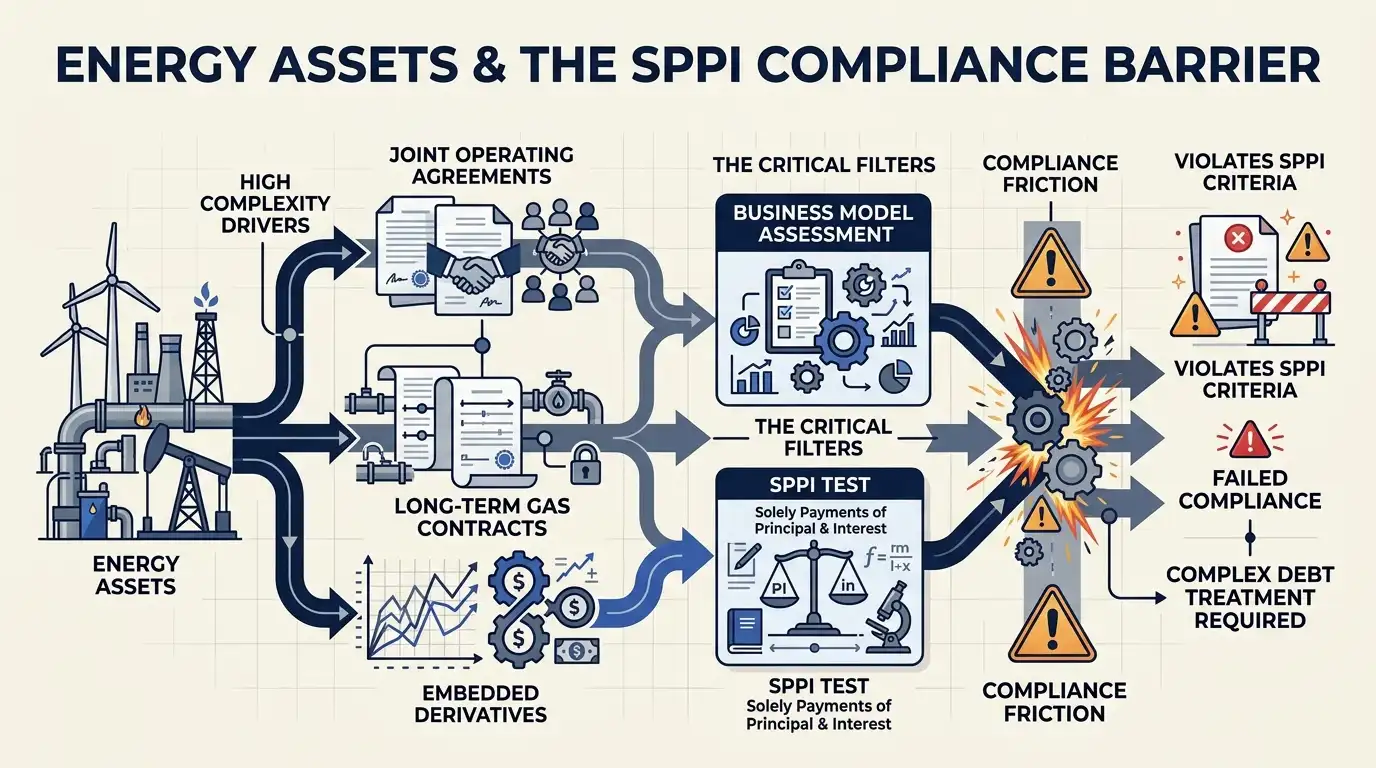
Energy firms manage diverse portfolios of financial assets alongside physical exploration and production assets. The initial classification phase under financial reporting rules requires evaluating whether an asset is held to collect contractual cash flows, sell financial assets, or both. Joint operating agreements often include cash-call mechanisms and cost-recovery clauses that obscure the fundamental nature of cash flows. When an energy company holds receivables from joint-venture partners, the contractual cash flows must represent strictly principal and interest. Embedded derivatives within long-term power purchase agreements or gas sales contracts alter cash flow characteristics. If these modifications introduce equity-like returns or commodity price exposure, the asset fails the solely payments of principal and interest test.
Failing this test forces organizations to classify instruments at fair value through profit or loss rather than amortised cost. Volatility spikes directly into the income statement, distorting operational earnings reports. Finance departments must evaluate contractual terms across all commercial agreements to prevent unexpected valuation swings. Workforce capability gaps often hinder this process, as accounting professionals require targeted development through the IFRS 9 – Financial Instruments: Expected Credit Loss Training Course to accurately parse complex joint-venture contracts. Without specialized analytical competencies, organizations misclassify financial instruments, leading to restatements and regulatory scrutiny.
How do companies measure lifetime expected credit losses for partner receivables and intercompany loans?
Companies measure lifetime expected credit losses for partner receivables and intercompany loans by constructing robust receivable provisioning matrices, incorporating macroeconomic forecasts, and applying probability-weighted scenarios that reflect severe industry downturns.
Measuring credit risk in the energy sector demands granular data collection across diverse counterparties. Partner receivables arise when non-operators fail to fund their share of drilling or facility maintenance costs. Intercompany loans between parent entities and special purpose vehicles in foreign jurisdictions carry distinct sovereign and transfer risks. Traditional historical loss rates fail to capture sudden shifts in commodity prices or geopolitical disruptions. Risk teams must establish a receivable provisioning matrix that categorises exposures by aging brackets and credit quality ratings. This matrix requires continuous calibration against forward-looking macroeconomic variables such as benchmark crude prices, rig counts, and global refining margins.
For intercompany loans, management must determine whether exposures are short-term or long-term to apply the correct staging criteria. Stage one requires a twelve-month credit loss allowance, while stage two and stage three mandate lifetime expected credit loss recognition following a significant increase in credit risk. Energy firms often struggle with data silos between operational field teams and corporate finance departments. Bridging this gap requires structured interventions, such as enrolling finance staff in specialized IFRS 9 Expected Credit Loss Training for Oil and Gas Financial Professionals programs to standardize impairment calculation methodologies across global subsidiaries. Organizations that streamline these internal workflows reduce audit friction and ensure defensible provisioning figures.
Why does fair value through profit or loss accounting complicate impairment reporting?
Fair value through profit or loss accounting complicates impairment reporting because market price fluctuations overshadow underlying credit risk adjustments, creating artificial earnings volatility that misrepresents true counterparty default probabilities.
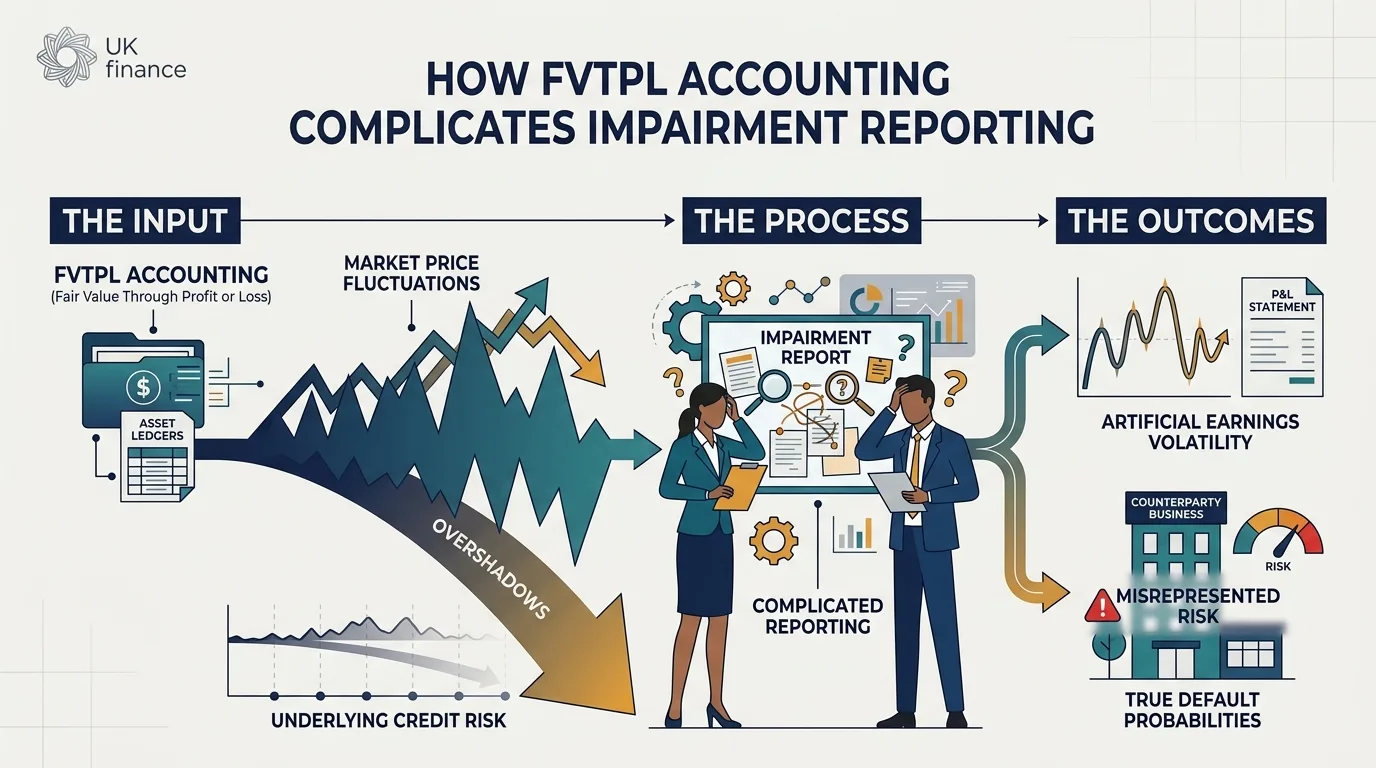
Financial assets that fail the cash flow characteristics test or are managed under a fair value business model bypass traditional impairment stages entirely. Instead of calculating expected credit losses through a multi-stage matrix, accountants must revalue these instruments at each reporting date. Commodity price swings, interest rate shifts, and liquidity discounts directly impact the carrying value. Consequently, an energy firm might report massive earnings losses due to market volatility rather than actual counterparty default events. Financial analysts struggle to separate operational performance from fair value accounting noise.
Mitigating this reporting ambiguity requires advanced valuation frameworks and rigorous sensitivity testing. Finance personnel must document the economic rationale behind valuation adjustments to satisfy external auditors. Corporate learning strategies must address this technical overlap between fair value measurement and credit risk management. Upskilling internal teams ensures that financial statements transparently communicate counterparty health without distorting capital allocation decisions.
Frequently Asked Questions
How does IFRS impact financial reporting in the oil and gas sector?
International Financial Reporting Standards dictate how energy firms account for complex transactions, including exploration assets, asset retirement obligations, and revenue recognition. Through specialized curricula like Oil and Gas Petroleum IFRS & Financial Reporting, the Institute For Oil & Gas Training helps finance teams align with global reporting mandates. Proper application ensures transparent disclosures across upstream, midstream, and downstream operations.
What are the main accounting challenges under petroleum IFRS standards?
Energy companies frequently encounter difficulties when evaluating joint-venture arrangements, measuring reserve valuations, and calculating expected credit losses on long-term receivables. The Institute For Oil & Gas Training addresses these complexities within its Oil and Gas Petroleum IFRS & Financial Reporting programs by focusing on sector-specific asset impairment rules. Accurate treatment prevents earnings volatility and minimizes compliance risks during external audits.
Why is specialized financial training important for energy accounting professionals?
Standard corporate accounting frameworks often fail to address the intricate commercial structures and production-sharing contracts unique to the petroleum industry. Programs dedicated to Oil and Gas Petroleum IFRS & Financial Reporting from the Institute For Oil & Gas Training bridge this capability gap by building technical proficiency. Upskilling finance personnel ensures reliable financial statements and improves strategic decision-making across corporate portfolios.
How do upstream activities influence petroleum financial reporting compliance?
Upstream exploration and evaluation expenditures require specialized accounting treatments under international standards to determine whether costs should be capitalised or expensed. The Institute For Oil & Gas Training covers these technical valuation mechanics extensively in its Oil and Gas Petroleum IFRS & Financial Reporting courses. Mastery of these rules allows accounting teams to accurately reflect reserve values and capital expenditures on the balance sheet.
What should organizations look for in an oil and gas IFRS training provider?
Effective learning providers must offer practical, industry-driven curricula that reflect current regulatory shifts and real-world commodity market conditions. The Institute For Oil & Gas Training delivers targeted Oil and Gas Petroleum IFRS & Financial Reporting sessions designed to match measurable business outcomes for corporate finance divisions. Organizations benefit from structured learning paths that directly enhance compliance accuracy and workforce capabilities.
Related training courses
Reliability Centered Maintenance (RCM) Training Course
- Specialisation
- Oil & Gas Reliability and Maintenance Management
- Duration
- 5 days · 15 CPD hours
Pipeline Integrity Management (API 1160/ASME B31.8) Training Course
- Specialisation
- Oil & Gas Pipeline Integrity and Inspection
- Duration
- 5 days · 15 CPD hours
Asset Integrity Management (ISO 55000/PAS 55) Training Course
- Specialisation
- Oil & Gas Asset Integrity Management
- Duration
- 5 days · 15 CPD hours
More articles

IFRS 9 Expected Credit Loss Training for Oil and Gas Financial Professionals
Master IFRS 9 expected credit loss models for oil and gas assets. Enhance compliance and valuation accuracy. Enroll in our specialized training course today.
Read article →
Why Expected Credit Loss Matters for Oil and Gas Financial Instruments
Discover how expected credit loss training closes skill gaps, improves financial reporting, and ensures IFRS 9 compliance in oil and gas companies.
Read article →
IFRS 16 Lease Charging and Modifications Training for Oil and Gas Joint Venture Professionals
Master IFRS 16 lease charging, JV cost allocation, and modifications with Institute For Oil & Gas Training. Enroll today.
Read article →