
Developing an accurate budget and robust forecast for the annual oil and gas budget cycle requires aligning technical operational data with macroeconomic variables. The process demands a structured approach to aggregate capital expenditure, operating costs, and revenue estimates across complex asset portfolios.
Uncertainty in global commodity markets, geopolitical shifts, and reservoir depletion rates make traditional static financial planning obsolete for energy firms. Understanding Why Annual Budgeting and Forecasting Matter in Oil and Gas Operations provides the underlying operational context necessary to build resilient models. Organizations must move beyond basic financial reporting toward integrated dynamic forecasting systems.
How Does the Oil and Gas Budget Cycle Function?
The oil and gas budget cycle functions as a structured multi-month framework that translates strategic corporate goals into operational expenditure, capital allocation, and volume targets. It establishes governance, timeline milestones, resource commitments, and performance benchmarks across upstream, midstream, and downstream assets.
The execution of an annual cycle relies on a clear timetable that aligns technical teams with financial controllers. Establishing a formal budget calendar and timetable ensures cross-functional readiness across departments. The typical planning timeline spans four to six months prior to the start of the fiscal year.
Upstream planning begins with technical evaluations of asset performance, decline curves, and workover schedules. Financial analysts translate these physical parameters into monetary values using standard corporate parameters.
Corporate headquarters sets macro parameters early in the cycle. Asset managers then populate operational templates with localized field data to ensure full coverage of planned activities.
What Are the Core Assumptions Required for Energy Forecasting?
Core assumptions for energy forecasting include price deck projections, production volume profiles, cost inflation indices, and operational downtime estimates. These metrics define the baseline cash flow projections and risk parameters across all exploration, development, and production assets.
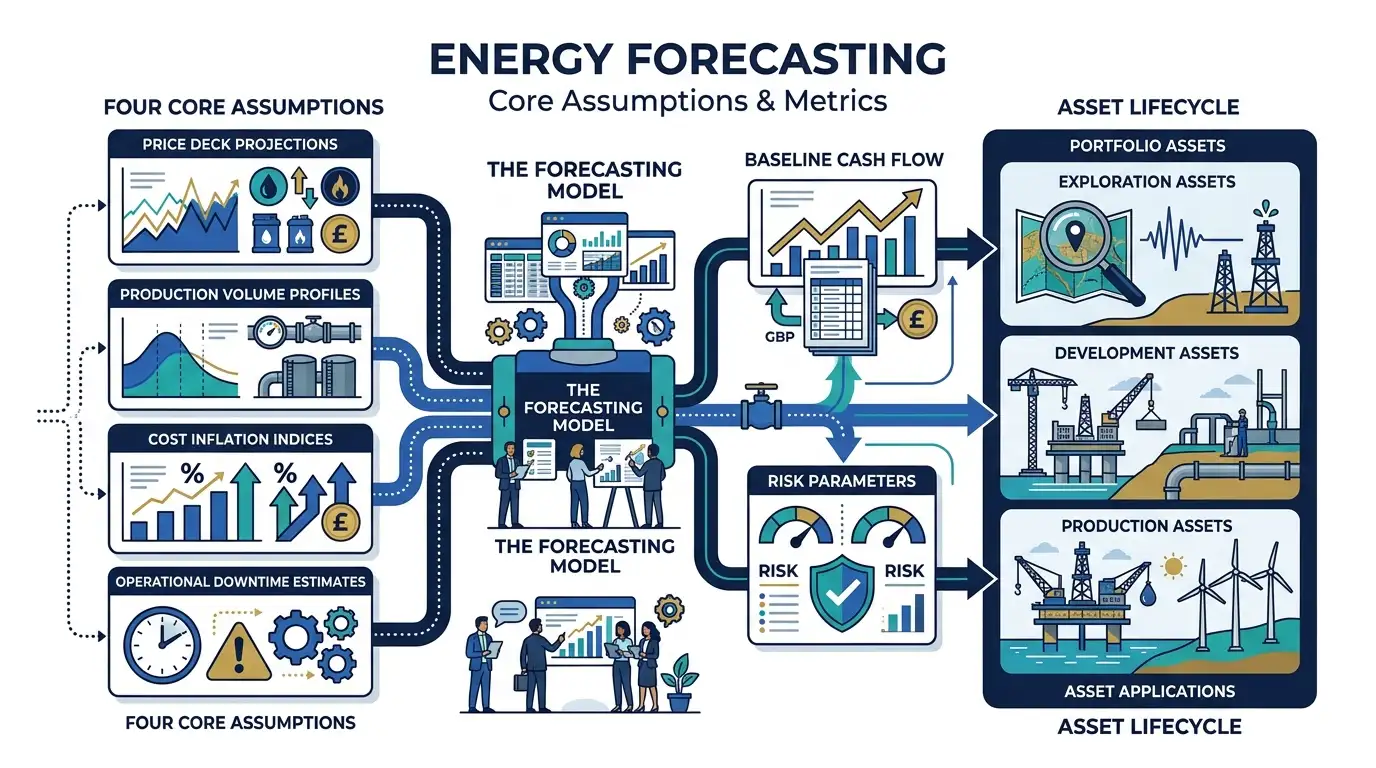
Pricedeck assumptions dictate top-line revenue expectations. Energy companies establish conservative, base, and aggressive oil and gas price scenarios to stress-test planned investments.
Production volume assumptions originate from reservoir engineering decline curves and well intervention schedules. Unplanned facility outages and maintenance turnaround times must be factored into net volume calculations.
Cost inflation assumptions account for supply chain price shifts across drilling services, steel casing, and field labor. Equipment leasing rates, energy costs for field processing, and transportation tariffs directly alter operating margins.
How Do Bottom-Up and Top-Down Budgeting Methods Compare?
Bottom-up budgeting builds financial estimates from asset-level operational data up to corporate levels, whereas top-down budgeting allocates financial targets from executive management down to field operations. Each methodology presents distinct trade-offs in accuracy, execution speed, ownership, and alignment.
Selecting the right budgeting approach impacts data quality, organizational buy-in, and administrative overhead. High-leverage energy organizations frequently blend both techniques to balance strategic discipline with operational reality.
Evaluation Attribute | Top-Down Budgeting | Bottom-Up Budgeting | Hybrid Iterative Approach |
Primary Data Origin | Executive leadership & strategic targets | Field engineering & operational units | Combined corporate targets & field inputs |
Preparation Speed | Fast (2 to 4 weeks) | Slow (8 to 12 weeks) | Moderate (6 to 8 weeks) |
Asset Level Accuracy | Low to moderate | High | High |
Field Buy-In & Ownership | Low | High | High |
Resource Overhead | Minimal finance team requirement | Heavy departmental labor load | Balanced cross-functional load |
Best Fit Scenario | Portfolio-level strategic shifts | Complex operational field planning | Standard annual corporate budget cycle |
Bottom-up and top-down budgeting processes must reconcile during the mid-stage of the planning cycle. Top-down direction prevents budget pad, while bottom-up detail grounds financial expectations in physical field capability.
How Is Budget Consolidation Executed Across Complex Energy Assets?
Budget consolidation aggregates localized financial and operational models from disparate business units, joint ventures, and geographical subsidiaries into a single unified financial model. It standardizes currency conversions, internal transfer pricing, joint-venture accounting, and tax structures.
Consolidating multi-asset portfolios requires robust data governance rules. Discrepancies in accounting treatments between operated and non-operated assets create significant reporting errors if unaddressed.
Field-level expenditures must be mapped into standardized corporate chart of accounts entries. Operating expense items like lease operating expenses, field overhead, and workover costs require consistent categorization.
Joint venture assets require precise working interest and net revenue interest calculations. Financial models must separate gross field expenditure from net corporate commitments to maintain cash flow accuracy.
How Should Organizations Conduct Budget Challenge and Review Sessions?
Budget challenge and review sessions evaluate the validity, efficiency, and alignment of operational submissions against strategic corporate milestones. These sessions scrutinize cost assumptions, project execution timelines, capital allocation, and risk mitigation strategies prior to final submission.
Effective review sessions operate as rigorous, objective audits rather than formal approvals. Cross-functional review committees examine key performance indicators and cost drivers for every asset.
Budget challenge and review sessions require budget holders to defend their operational line items with empirical data. Operational teams present technical justification for drilling campaigns, facility upgrades, and maintenance expenditure.
The evaluation panel tests financial models against downside market scenarios. Asset managers must demonstrate that proposed projects yield acceptable internal rates of return under low price deck conditions.
How Is Board Approval Secured and Managed?
Board approval is secured by presenting a finalized corporate budget package that details projected revenues, capital allocation strategies, debt coverage, and risk management policies. Final sign-off authorizes executive leadership to execute operational plans and commit corporate capital.
The formal presentation to the board of directors summarizes portfolio-level performance metrics. It highlights key capital expenditure projects, production growth targets, and free cash flow generation projections.
Board members evaluate the budget against broader corporate governance standards and shareholder return commitments. Liquidity metrics, leverage ratios, and dividend sustainability take priority during board evaluations.
Once approved, the annual budget serves as the baseline for operational authorization and performance monitoring. Any material deviation from approved expenditure levels requires formal management authorization.
How Does Budget Holder Accountability Drive Operational Execution?
Budget holder accountability enforces direct responsibility among department heads and asset managers for operating within approved financial parameters. It ties financial performance directly to management performance metrics, variance analysis routines, and corrective action protocols.
Clear ownership prevents cost overrun cascades across complex capital projects. Assigning direct accountability ensures continuous monitoring of actual costs against baseline estimates.
Establishing budget holder accountability requires real-time financial reporting systems. Asset managers must have immediate access to purchase order data, joint-interest billings, and field tickets.
Monthly variance analysis identifies cost trends before they disrupt quarterly forecasts. Department heads must document operational variances and submit actionable remediation plans when expenditures exceed baseline tolerances.
Which Training Approaches Build Modern Budgeting and Forecasting Competencies?
Training approaches for energy financial planning range from internal mentoring and traditional finance courses to specialized industry-focused practical workshops. Effective corporate programs combine technical petroleum economics with advanced financial modeling frameworks.
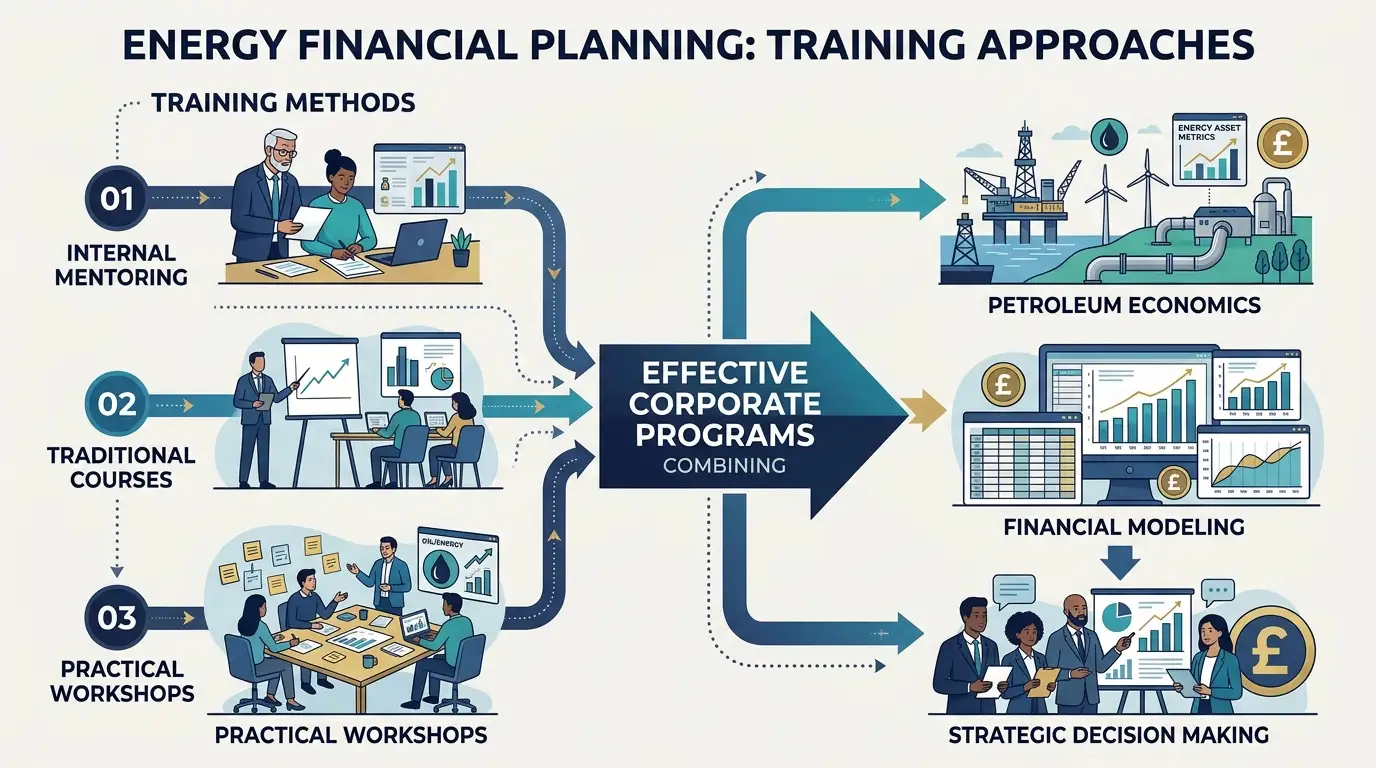
Organisations evaluating capability-building frameworks must address specific skill gaps across both technical engineering teams and financial analysis units. Engineering teams often lack deep corporate finance context, while financial analysts struggle with field operational dynamics.
Selecting structured corporate learning formats ensures that financial teams master industry-specific forecasting workflows. Professionals seeking targeted professional development enroll in the Budgeting & Forecasting for the Annual Budget Cycle Training Course to gain direct exposure to real-world energy asset modeling.
Training Approach | Core Focus Area | Implementation Time | Skill Retention & Business Impact |
Internal Mentoring & Shadowing | Institutional knowledge & historical practices | Ongoing / 6 to 12 months | Low consistency; perpetuates legacy inefficiencies |
Generic Corporate Finance Courses | General accounting rules & standard P&L structures | Short / 2 to 4 days | Low relevance; lacks oil & gas operational context |
Specialized Energy Training | Integrated petroleum economics & field-level forecasting | Focused / 3 to 5 days | High impact; immediate application to asset budgets |
Customized Corporate Workshops | Company-specific models, price decks, & reporting standards | Targeted / 1 to 2 weeks | Maximum alignment; directly optimizes active budget cycles |
Formal corporate training eliminates common modeling mistakes and establishes standardized analytical methods across all operational assets. HR leaders and finance directors evaluate these learning solutions based on their ability to shorten budget cycle duration and improve forecast accuracy.
Implementing the comprehensive Budgeting and Forecasting for the Annual Budget Cycle Training by Institute For Oil & Gas Training equips cross-functional management teams with the skills required to run structured, defensible planning cycles. Professional training ensures asset managers, finance controllers, and corporate strategists speak a unified analytical language.
Frequently Asked Questions
What is oil and gas petroleum budgeting and cost control?
Oil and gas petroleum budgeting and cost control is a financial management framework designed to plan, monitor, and regulate expenditure across upstream, midstream, and downstream operations. It aligns operational field activities with strategic corporate targets to mitigate financial risk and prevent budget overruns. The Institute For Oil & Gas Training provides specialized instruction on setting accurate price decks, establishing cost baselines, and implementing continuous variance monitoring for energy assets.
Why is cost control critical during the annual oil and gas budget cycle?
Cost control is vital in the oil and gas sector because extreme commodity price volatility can rapidly reduce operating margins and compromise project economics. Rigorous expenditure management allows operators to adjust capital allocation, control supply chain inflation, and maintain liquidity during market downturns. Through structured Oil & Gas Petroleum Budgeting & Cost Control frameworks, organizations enforce budget holder accountability and protect operational cash flows.
How do bottom-up and top-down budgeting methods differ in energy finance?
Top-down budgeting establishes financial targets from executive leadership based on high-level strategic goals, whereas bottom-up budgeting builds financial models directly from asset-level operational data and field inputs. Combining both approaches ensures that corporate cash flow expectations remain grounded in physical reservoir capabilities and technical constraints. The Institute For Oil & Gas Training equips finance managers and engineers to reconcile these two methodologies effectively during annual budget challenge sessions.
What key assumptions are required to build an accurate petroleum budget?
Building an accurate petroleum budget requires realistic price deck projections, detailed production decline curves, estimates for planned downtime, and localized cost inflation indices. These parameters directly influence revenue expectations, operating expense models, and long-term capital expenditure schedules across complex field portfolios. Mastering these input variables through professional Oil & Gas Petroleum Budgeting & Cost Control training helps finance teams build resilient, stress-tested financial models.
Who should take a course in oil and gas petroleum budgeting and cost control?
This training is designed for asset managers, petroleum engineers, corporate finance controllers, joint venture accountants, and commercial analysts working in the energy sector. It bridges the gap between field engineering operations and executive financial management, enabling cross-functional teams to speak a unified analytical language. The Institute For Oil & Gas Training delivers this practical curriculum to help energy professionals shorten budget development cycles and improve overall forecast accuracy.
Related training courses
Budgeting & Forecasting for the Annual Budget Cycle Training Course
- Specialisation
- Oil & Gas Petroleum Budgeting & Cost Control
- Duration
- 5 days · 15 CPD hours
Cost Control for Field Development Projects: Overrun Prevention Training Course
- Specialisation
- Oil & Gas Petroleum Budgeting & Cost Control
- Duration
- 5 days · 15 CPD hours
Budget Management and Management Control in the Oil & Gas Industry
- Specialisation
- Oil & Gas Petroleum Budgeting & Cost Control
- Duration
- 5 days · 15 CPD hours
More articles

Cost Control and Variance Analysis for Budget Deviations Training by Institute For Oil & Gas Training
Master budget deviations with the Cost Control & Variance Analysis Training Course by Institute For Oil & Gas Training. Learn financial variance techniques.
Read article →
How to Identify and Analyse Budget Deviations Through Cost Variance Analysis
Learn how to analyse budget deviations with cost variance analysis. Evaluate tracking methods, variances, and training for financial control.
Read article →
Why Cost Variance Analysis Matters in Oil and Gas Budget Control
Learn how cost variance analysis prevents budget overruns in oil and gas projects. Discover key frameworks, execution steps, and measurable ROI.
Read article →