

The Budgeting & Forecasting for the Annual Budget Cycle Training Course addresses operational budget inaccuracies, unaligned fiscal targets, and weak budget holder accountability across upstream, midstream, and downstream energy asset operations through structured financial control frameworks.
In capital-intensive industries like oil and gas, operational managers frequently struggle to align field-level expenditures with overarching corporate financial mandates. Flawed assumptions regarding production volume assumptions and cost inflation assumptions regularly result in significant variance between projected forecasts and actual operational expenditure. Non-finance department heads often lack formal training in financial modelling, leading to friction during corporate reviews and delayed approvals from senior executives.
Organizations that fail to establish rigorous budget oversight suffer from capital misallocation, unmonitored cost overruns, and compromised operational performance. When department leaders submit disconnected spending requests, central finance teams waste valuable weeks attempting manual budget consolidation. This operational disjoint highlights Why Annual Budgeting and Forecasting Matter in Oil and Gas Operations, as unstructured planning directly degrades operating margins and delays critical capital investment decisions.
The Institute For Oil & Gas Training developed the Budgeting & Forecasting for the Annual Budget Cycle Training Course to solve these specific systemic failures. This professional development program bridges the gap between field operations and corporate treasury management. The curriculum equips managers, department heads, and financial analysts with standardized tools to construct defensible budgets, model operational risk, and manage the complete annual fiscal cycle with precision.
By implementing standardized estimation protocols, participating organizations eliminate recurring friction during executive review cycles. The Institute For Oil & Gas Training provides a structured framework that transforms budgeting from an administrative burden into a strategic asset. HR teams and corporate learning directors utilize this program to build long-term financial capability across engineering, operations, logistics, and administrative units.
Why is this training structured around the annual budget cycle?
This training follows the chronological sequence of the corporate fiscal year to ensure participants master every phase of financial planning, from preliminary schedule setup to final executive sign-off and continuous variance analysis.
Financial control within energy corporations cannot be taught effectively as isolated theoretical concepts. Operational budgeting requires a sequential workflow where each phase depends directly on the accuracy of the preceding step. The Institute For Oil & Gas Training structures this curriculum to mirror real-world corporate governance, guiding learners through initial planning, resource estimation, challenge sessions, and formal submission.
The program begins by establishing the organizational architecture needed for synchronized planning across multiple business units. Participants analyze how to establish a clear budget calendar and timetable to prevent process delays across distributed operational teams. Mastering this baseline schedule ensures that department heads submit critical data inputs on time, allowing corporate planning teams sufficient buffer for consolidation and scenario testing.
Understanding how to evaluate operational data requires a clear methodology for comparing top-down targets with field-level requirements. The course breaks down how to balance bottom-up and top-down budgeting methodologies to align executive revenue targets with actual site-level maintenance and production needs. Learning to navigate How to Develop Accurate Budgets and Forecasts for the Annual Oil and Gas Budget Cycle provides participants with the skills needed to justify expenditure requests during intensive corporate review rounds.
Finally, the curriculum addresses the governance mechanics required to secure executive buy-in. Participants learn to navigate budget challenge and review sessions with confidence, defending operational requests against corporate financial benchmarks. The program culminates in teaching participants how to present fully integrated proposals for formal board approval, ensuring compliance with strict corporate governance protocols.
What will participants learn across the course modules?
Participants gain comprehensive mastery over commodity pricing models, volume estimation, cost inflation metrics, consolidated financial statements, and continuous budget monitoring techniques throughout five focused instructional modules.
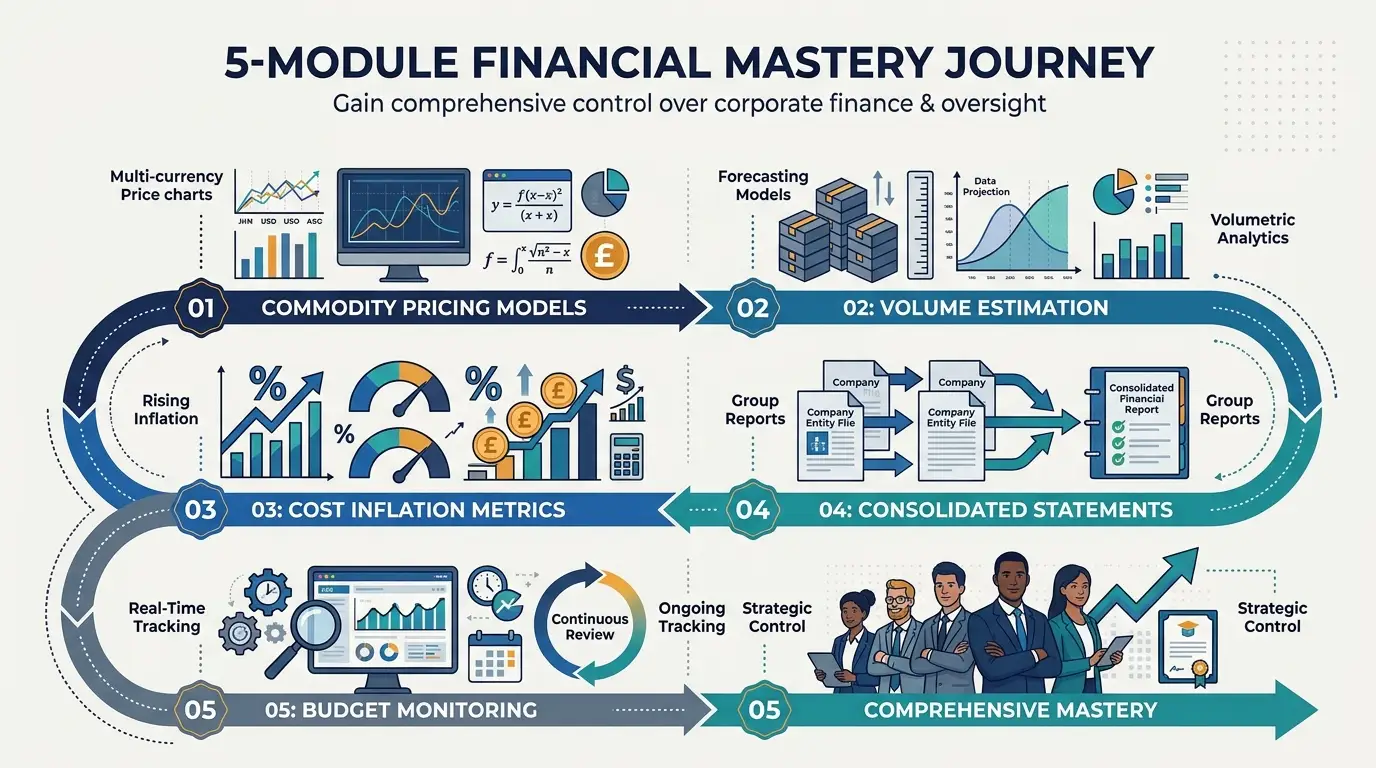
The curriculum delivers targeted technical skills required to build accurate financial models under volatile market conditions. The Institute For Oil & Gas Training organizes content into five progressive modules designed to build applied capability step by step.
Module 1: Fiscal Architecture and Budget Timetables
Designing and implementing a robust corporate budget calendar and timetable.
Standardizing submission formats across exploration, production, refining, and corporate units.
Establishing clear roles, responsibilities, and decision gates for department leaders.
Managing cross-departmental dependencies to eliminate planning bottlenecks.
Module 2: Operational Assumptions and Estimation Methodologies
Establishing defensible price deck assumptions based on global market benchmarks.
Calculating realistic production volume assumptions incorporating field decline curves and planned maintenance downtime.
Applying regional cost inflation assumptions to supply chain procurement, field labour, and equipment leases.
Integrating risk buffers and contingency protocols for high-variance operational environments.
Module 3: Budget Synthesis and Consolidation Techniques
Executing bottom-up and top-down budgeting workflows to harmonize field requests with corporate goals.
Automating budget consolidation processes across multi-asset portfolios and international joint ventures.
Reconciling operating expenditure (OPEX) with capital expenditure (CAPEX) allocations.
Constructing master operational budgets and pro-forma financial statements.
Module 4: Executive Review and Corporate Governance
Preparing documentation and analytical models for budget challenge and review sessions.
Formulating business cases for disputed operational capital requests.
Aligning divisional submissions with corporate strategic mandates to secure final board approval.
Navigating governance protocols to ensure full compliance with regulatory and investor reporting standards.
Module 5: Control, Variance Analysis, and Accountability
Establishing strict metrics for ongoing budget holder accountability.
Performing monthly and quarterly variance analyses to detect cost overruns early.
Developing dynamic rolling forecasts to adapt to shift-heavy operational realities.
Designing corrective action plans to maintain margin targets during commodity price drops.
How is the course delivered and assessed?
The program is delivered through flexible online, live virtual, hybrid, and on-site corporate formats using interactive workshops, practical financial modeling exercises, real-world case simulations, and formal skill assessments.
The Institute For Oil & Gas Training offers multi-modal training delivery tailored to match the operational schedules of energy sector professionals. Organizations can select the training format that aligns best with their workforce distribution and learning objectives.
Delivery Format | Structure & Duration | Ideal For | Key Features |
Live Virtual Classroom | 4 weeks (2 sessions per week, 3 hours each) | Distributed teams and remote asset managers | Real-time instructor guidance, interactive breakout rooms, screen-share model reviews |
Intensive On-Site Workshop | 5 consecutive full days (40 total contact hours) | Corporate cohorts, operational units, management teams | In-person team exercises, customized corporate templates, direct group problem-solving |
Hybrid Learning Model | 2 weeks self-paced modules + 3 days live practical labs | Professionals balancing operational shift duties | Flexible video lectures, digital workbooks, face-to-face scenario testing |
Customized Corporate Cohort | Tailored schedule based on company fiscal planning windows | Dedicated enterprise learning and HR initiatives | Integration of company-specific financial models, proprietary workflows, internal guidelines |
Training methodology focuses on practical application rather than static lecturing. Participants work with real-world energy sector datasets, constructing financial models using professional spreadsheet tools and enterprise planning applications. Every topic is tested through practical application to ensure immediate transferability to the workplace.
Assessment methods are structured to verify demonstrated technical competence. Participants complete baseline diagnostics, mid-course financial modeling assignments, interactive group challenge simulations, and a final practical budget build project. Successful completion of the Budgeting & Forecasting for the Annual Budget Cycle Training Course requires passing all practical evaluations, ensuring that participants possess true operational capability.
What verifiable operational results does this training deliver?
Graduates demonstrate immediate capability in reducing budget variance, streamlining consolidation timelines, defending expenditure requests, and maintaining strict fiscal control across complex asset portfolios.
Enterprise learning programs must deliver clear performance improvements for participating organizations. The Institute For Oil & Gas Training designs its curriculum to generate measurable operational return on investment across multiple enterprise metrics.
Human Resource departments and operational directors track clear performance improvements following training completion:
Reduced Planning Cycle Time: Standardizing data collection streamlines budget consolidation, cutting weeks off the annual preparation schedule.
Improved Forecast Accuracy: Grounding proposals in robust production volume assumptions minimizes quarterly variance between projections and actual spend.
Enhanced Fiscal Governance: Training department heads in financial modeling ensures rigorous budget holder accountability, preventing unchecked cost growth.
Smoother Executive Approvals: Thorough preparation for budget challenge and review sessions leads to faster, frictionless sign-offs for operational expenditure.
Risk Mitigation: Accurately factoring in cost inflation assumptions protects operating margins against sudden supply chain price spikes.
The training equips professionals to handle complex corporate scenarios with professional rigor. Engineering managers learn to articulate technical capital requirements in precise financial terms that corporate finance committees respect. Simultaneously, financial analysts gain deeper insight into field-level operational realities, creating a unified corporate planning culture.
Who is eligible and how does the enrollment process work?
The program is designed for department managers, operational leaders, financial analysts, and HR development cohorts, requiring a foundational understanding of operational workflows or basic accounting concepts.
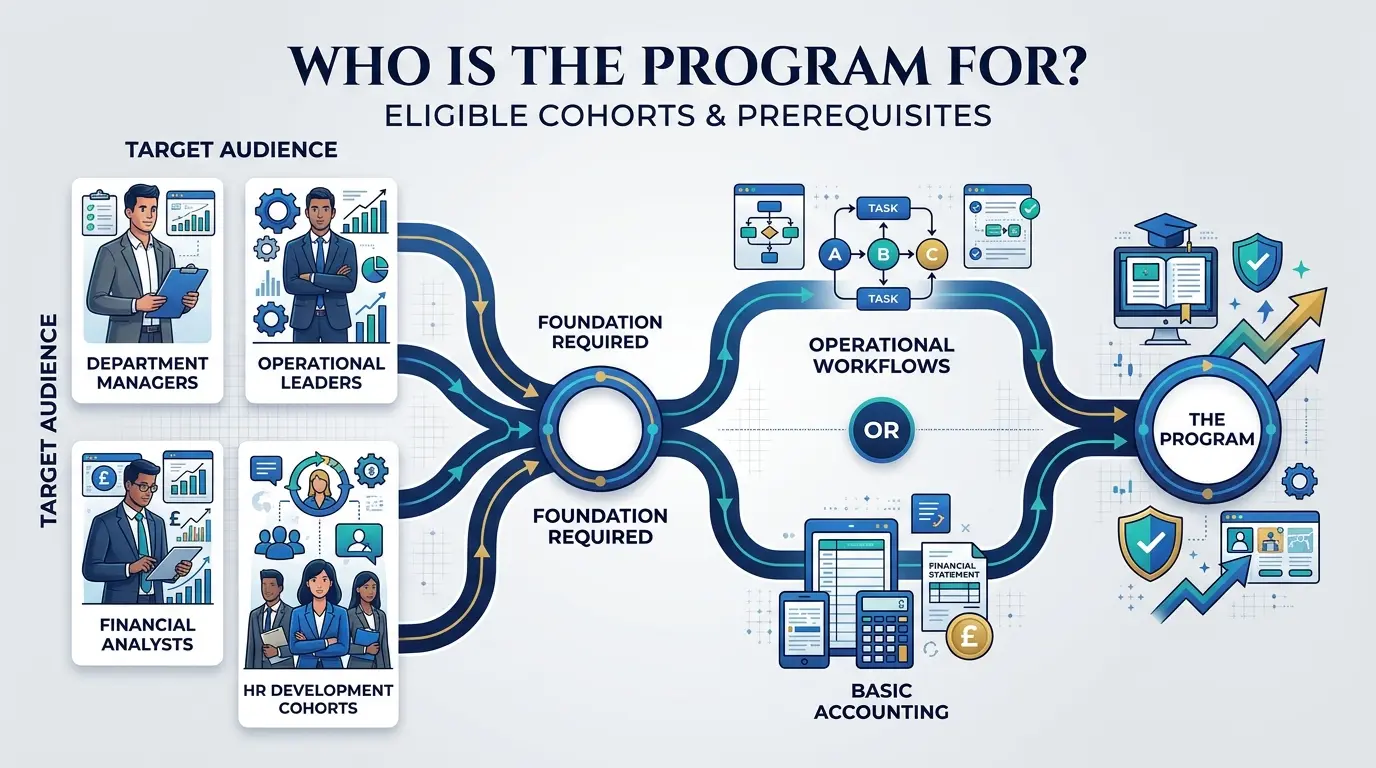
The Institute For Oil & Gas Training maintains open registration for qualified industry professionals while offering tailored onboarding pathways for corporate sponsored cohorts.
Candidate Eligibility Criteria
Operational managers, asset leaders, and engineering heads responsible for departmental spending.
Financial analysts, management accountants, and planning professionals within energy organizations.
Supply chain, logistics, and maintenance leads involved in annual resource estimation.
HR learning cohorts prepared for leadership advancement and broader budget authority.
Enrollment and Completion Workflow
1.Application Submission:Step 1 of 4.
Candidates or corporate HR representatives submit candidate profiles and select their preferred delivery format.
2.Prerequisites and Diagnostic Review:Step 2 of 4.
Participants complete a brief skill assessment to verify basic spreadsheet competence and operational context familiarity.
3.Course Execution:Step 3 of 4.
Learners complete all instructional modules, practical financial modeling labs, and collaborative challenge sessions.
4.Assessment and Certification:Step 4 of 4.
Participants submit their final capstone budget project for evaluation and receive their formal professional certification.
The Institute For Oil & Gas Training provides dedicated support for enterprise teams seeking to train multi-disciplinary cohorts ahead of their upcoming fiscal planning cycle. Learning advisors assist HR teams in selecting optimal schedules to minimize operational disruption while maximizing learning retention.
Securing advanced training in annual financial planning ensures your organization maintains tight capital control and operational alignment throughout the fiscal year. To evaluate full syllabus specifications or reserve seats for your team, enroll in this program.
Frequently Asked Questions
What does the Oil & Gas Petroleum Budgeting & Cost Control course cover?
The Oil & Gas Petroleum Budgeting & Cost Control course by Institute For Oil & Gas Training covers capital expenditure (CAPEX) and operating expenditure (OPEX) management, variance analysis, and financial forecasting methodologies. Participants learn how to establish robust cost baselines, align operational schedules with fiscal targets, and implement effective performance monitoring tools across energy projects.
Who should attend Oil & Gas Petroleum Budgeting & Cost Control training?
This training is designed for asset managers, project engineers, financial analysts, and operations leaders working within upstream, midstream, and downstream sectors. Offered by Institute For Oil & Gas Training, the program benefits both technical professionals seeking financial oversight skills and accounting managers requiring deeper context on energy asset operations.
How does effective petroleum cost control impact oil and gas operations?
Rigorous cost control protocols prevent budget overruns, optimize capital allocation, and protect operating margins against commodity price volatility. By standardizing tracking metrics and variance reporting through Institute For Oil & Gas Training frameworks, operational teams can identify expenditure anomalies early and maintain fiscal accountability throughout the asset lifecycle.
What are the key steps in oil and gas budget formulation?
Oil and gas budget formulation involves defining strategic operational goals, establishing price deck and volume assumptions, and gathering bottom-up cost estimates from field units. Institute For Oil & Gas Training instructs professionals on how to consolidate these divisional inputs into unified financial forecasts, conduct challenge reviews, and prepare defensible submissions for board approval.
Does Institute For Oil & Gas Training offer customized corporate cost control programs?
Yes, Institute For Oil & Gas Training delivers tailored corporate cohorts that integrate an organization's specific financial models, operating guidelines, and reporting workflows into the Oil & Gas Petroleum Budgeting & Cost Control syllabus. These customized sessions ensure immediate alignment with internal fiscal calendars and improve cross-departmental planning performance.
Related training courses
Budgeting & Forecasting: Rolling & Zero-Based Techniques Training Course
- Specialisation
- Oil & Gas Petroleum Budgeting & Cost Control
- Duration
- 5 days · 15 CPD hours
Cost Control for Field Development Projects: Overrun Prevention Training Course
- Specialisation
- Oil & Gas Petroleum Budgeting & Cost Control
- Duration
- 5 days · 15 CPD hours
Cash Calls, AFEs & Work Program/Budget Control: Preparation Training Course
- Specialisation
- Oil & Gas Petroleum Budgeting & Cost Control
- Duration
- 5 days · 15 CPD hours
More articles

Cost Control and Variance Analysis for Budget Deviations Training by Institute For Oil & Gas Training
Master budget deviations with the Cost Control & Variance Analysis Training Course by Institute For Oil & Gas Training. Learn financial variance techniques.
Read article →
How to Identify and Analyse Budget Deviations Through Cost Variance Analysis
Learn how to analyse budget deviations with cost variance analysis. Evaluate tracking methods, variances, and training for financial control.
Read article →
Why Cost Variance Analysis Matters in Oil and Gas Budget Control
Learn how cost variance analysis prevents budget overruns in oil and gas projects. Discover key frameworks, execution steps, and measurable ROI.
Read article →