

Managing foreign exchange risks in energy operations requires a systematic approach to identifying and measuring multi-currency cash flows. Petroleum companies operate across complex global supply chains, where revenue, capital expenditure, and local operating costs often align with different currencies. Effective risk management depends on distinguishing between short-term transactional commitments, long-term balance sheet revaluations, and strategic competitive positioning.
To build an actionable risk mitigation framework, treasury teams must first understand the structural drivers of currency fluctuations across the exploration, production, and distribution cycles. A thorough understanding of Why Identifying Foreign Exchange Exposure Matters for Oil and Gas Companies enables finance leaders to establish appropriate internal controls and hedging strategies. Without precise exposure assessment, energy firms risk severe cash flow volatility, eroded operating margins, and inaccurate financial reporting across international subsidiaries.
How Does Transaction Exposure Impact Petroleum Cash Flows?
Transaction exposure occurs when contractual cash inflows or outflows are denominated in a foreign currency, creating immediate cash flow volatility upon settlement. Petroleum operators measure this risk by calculating net open currency positions across revenue, operating expenses, and procurement contracts.
Energy companies routinely incur local currency cost base obligations for labor, local logistics, and regional engineering services while selling crude oil in US dollars. This structural currency mismatch exposes joint ventures and national oil companies to settlement losses whenever the dollar fluctuates against local operational currencies.
Treasury professionals analyze transaction exposure by mapping operating cash flows across contract lifecycles. Standard cash flow forecasting models isolate fixed-rate vendor contracts, debt service payments, and short-term receivables. By quantifying these net cash exposures, finance teams determine whether to employ operational strategies like natural hedging or financial instruments like forward contracts.
Operational cash flow assessment requires continuous monitoring of vendor payment schedules. Energy projects frequently involve multi-year engineering and construction contracts where mid-project currency shifts significantly alter capital expenditure budgets. Systematic tracking ensures that project managers adjust procurement strategies before currency depreciations destabilize cash reserves.
What Is the Process for Evaluating Translation Exposure in Global Oil Operations?
Translation exposure measures the financial reporting risk when consolidating international subsidiaries' foreign currency balance sheets into the parent entity's presentation currency. Evaluation requires applying functional currency determination rules under accounting standards like IAS 21 or ASC 830.
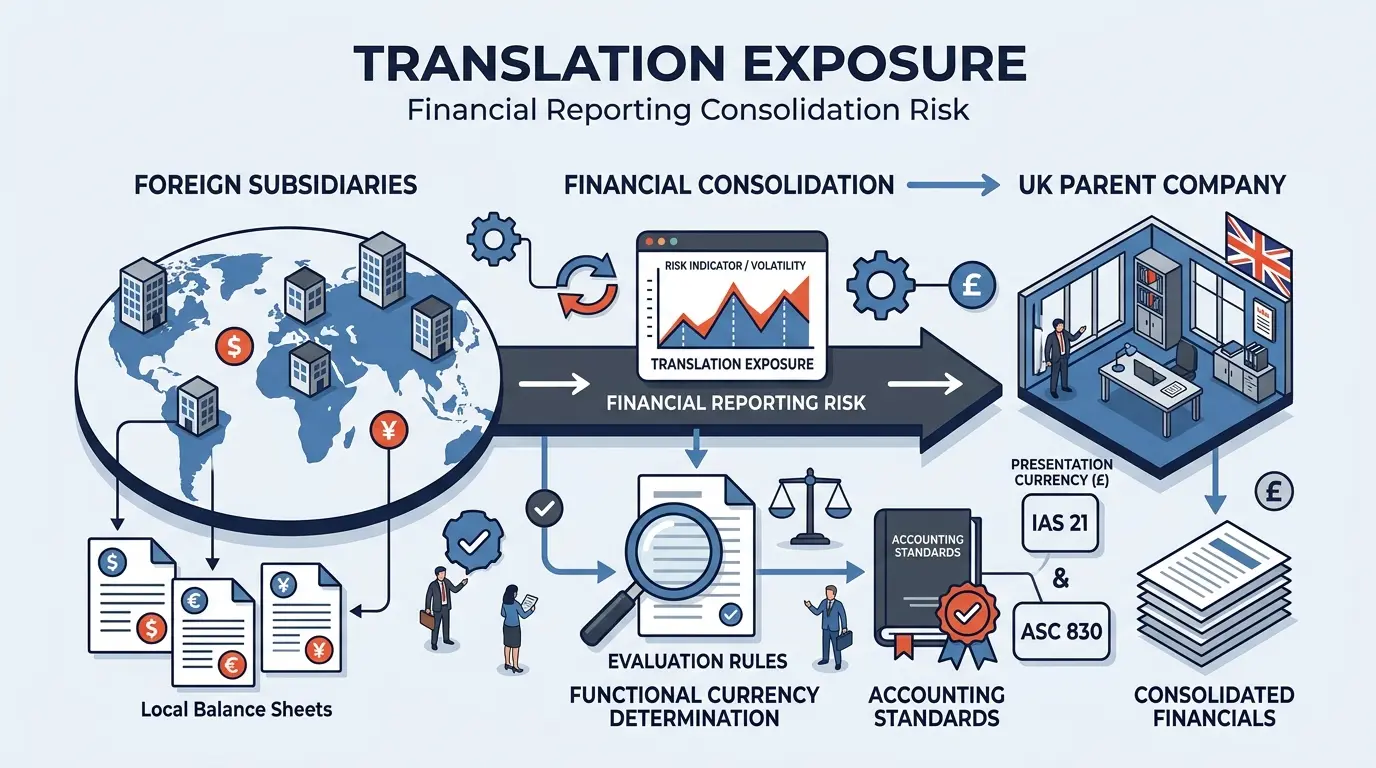
Oil and gas operations often span multiple legal entities with different functional currencies. The evaluation process starts by examining the primary economic environment where each subsidiary operates, assessing cash flow indicators, sales price responsiveness, and financing sources to select the correct functional currency.
Once established, assets and liabilities are translated at closing spot rates, while income statements use average exchange rates. Treasury teams quantify translation exposure by tracking accounting mismatches in net asset positions. These fluctuations pass through Other Comprehensive Income or impact net income, affecting key financial leverage ratios and corporate credit ratings.
Evaluating translation risk requires close coordination between corporate accounting and treasury departments. Foreign currency assets, such as offshore rig infrastructure and regional storage facilities, create persistent translation gaps. Finance teams run sensitivity analyses to project how exchange rate shifts impact consolidated debt-to-equity ratios and bank debt covenants.
How Do Treasury Teams Quantify Economic Foreign Exchange Exposure?
Economic exposure measures how unexpected exchange rate shifts alter the net present value of future operating cash flows and market competitiveness. Teams quantify this strategic risk by modeling cash flow sensitivity against long-term exchange rate scenarios across various market conditions.
Unlike short-term transactional contracts, economic exposure affects a petroleum firm's competitive position over multi-year horizons. For example, a sustained appreciation of an operating country's currency increases local extraction costs relative to international competitors operating in lower-cost currency regimes.
Quantifying economic exposure involves cash flow scenario modeling under varying exchange rate trajectories. Treasury analysts test revenue sensitivity against currency movements, evaluating whether the operator can pass increased local costs onto buyers or if market pricing forces the firm to absorb margin compression.
Strategic exposure management integrates macro-level modeling into long-term capital allocation decisions. When planning offshore field developments, finance teams evaluate how future exchange rates impact long-term unit operating costs. This analysis directly informs site selection, supply chain local-content commitments, and multi-year risk mitigation strategies.
What Are the Key Differences Between FX Exposure Types in Petroleum Operations?
Understanding the distinct characteristics of each exposure type is necessary for implementing target risk management policies. Each classification demands a different measurement approach, financial treatment, and management strategy.
Exposure Type | Primary Risk Driver | Time Horizon | Financial Impact Location | Primary Assessment Metric |
Transaction Exposure | Contractual cash flow settlements in foreign currencies | Short to medium-term (0–12 months) | Cash flow statement and income statement | Net open cash position per currency |
Translation Exposure | Financial statement consolidation of foreign subsidiaries | Ongoing accounting periods | Balance sheet (OCI) or net income | Net foreign currency asset/liability balance |
Economic Exposure | Long-term structural currency shifts and market positioning | Long-term (3–10+ years) | Net present value of enterprise cash flows | Cash flow sensitivity to exchange rate changes |
Differentiation prevents misplaced risk management tactics. Treating economic exposure with short-term financial hedges often increases cash flow volatility without addressing underlying structural imbalances. Conversely, relying solely on operational adjustments fails to protect short-term earnings from acute currency shocks.
How Do Organizations Choose the Right FX Risk Management Training Approach?
Selecting an FX risk management training approach requires evaluating workforce skill gaps, internal treasury systems, and corporate learning delivery models. Organizations assess practical case study application, technical accuracy, and measurable operational risk reduction before committing learning resources.
Building internal capacity to manage complex currency dynamics requires specialized corporate education. HR teams and treasury executives evaluate training methodologies based on how effectively they bridge the gap between academic theory and practical petroleum risk management. Enterprise learning decisions typically balance live, instructor-led workshops with self-paced digital modules.
Structured practical training options, such as the Foreign Exchange (FX) Exposure: Types & Identification Training Course, provide teams with hands-on exposure identification and quantification techniques tailored specifically to energy finance contexts. Evaluating corporate training programs involves examining curriculum depth, practical application exercises, and direct relevance to oil and gas operating environments.
Corporates compare learning formats using clear performance indicators. Standard financial courses often focus on generic retail or banking contexts, neglecting the nuances of production-sharing contracts, joint-operating agreement cash calls, and petrodollar settlement dynamics. Targeted programs ensure treasury analysts learn exposure identification mechanics using realistic industry data sets.
When evaluating learning delivery models, HR directors consider how quickly employees apply new skills to daily workflows. Effective programs incorporate pre- and post-training assessments, scenario-based simulation tools, and post-course workplace application projects to ensure measurable return on investment.
How Can Finance Leaders Implement a Decision Framework for FX Exposure Identification?
Finance leaders implement an exposure decision framework by establishing clear policy guidelines, automated currency tracking systems, and formal risk governance structures. This framework defines operational thresholds, reporting lines, and approved risk mitigation strategies across all operating units.
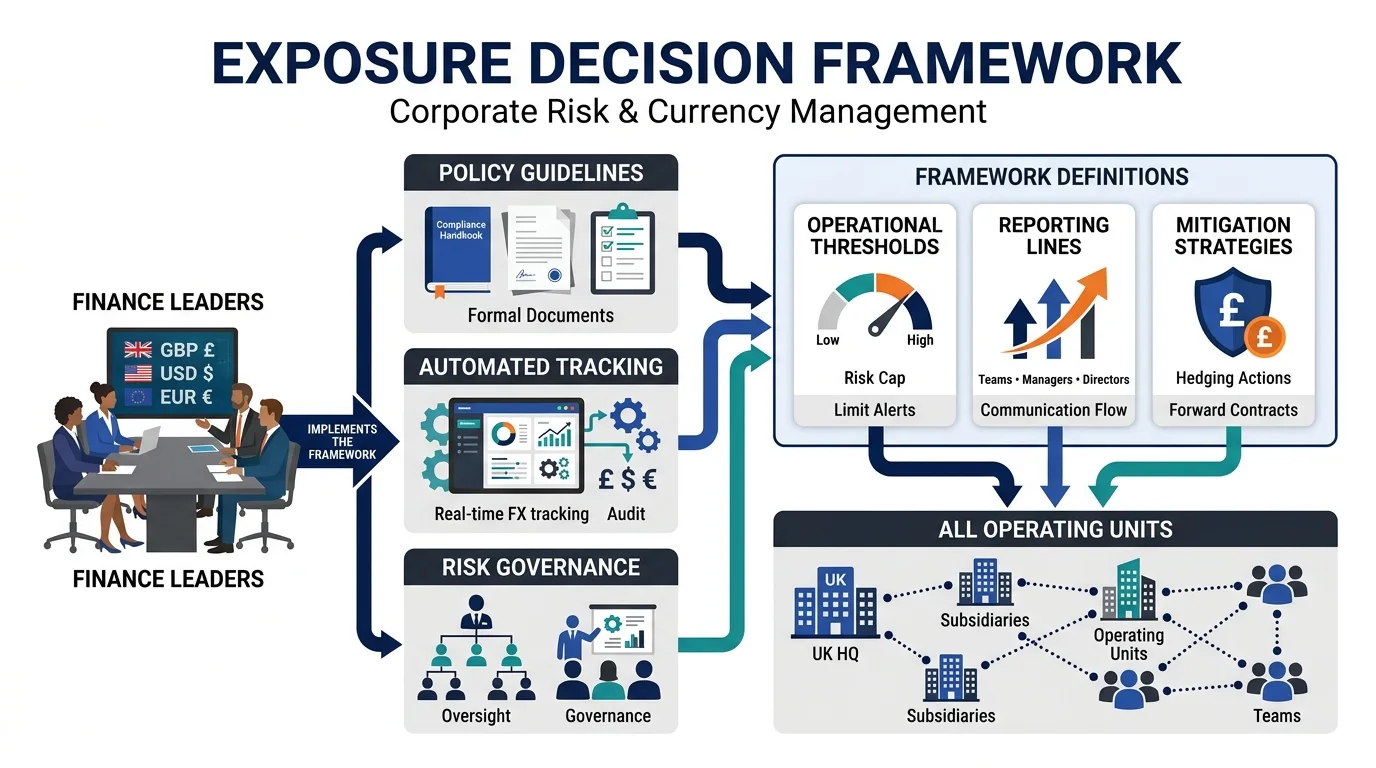
A practical decision framework provides clear steps for identifying, measuring, and reporting currency risks across global operating units. Organizations assess operational readiness by reviewing existing financial software capabilities, staff competencies, and risk governance policies.
When internal skill gaps limit an organization's ability to execute complex exposure assessments, enterprise learning interventions become necessary. Enrolling key personnel in structured programs like Foreign Exchange Exposure Identification Training for Oil and Gas Treasury Professionals equips teams with the practical tools required to audit balance sheet risks, design FX policy frameworks, and execute natural hedging strategies.
Decision Stage | Key Evaluation Focus | Primary Risk Indicator | Required Governance Action |
Exposure Identification | Source, currency, and timing of cash flows | Currency mismatch in contracts | Establish standard exposure logging across business units |
Impact Quantification | Value-at-Risk (VaR) and earnings-at-risk stress testing | Projected cash flow variance > 5% | Escalate high-risk exposures to corporate treasury committee |
Mitigation Selection | Cost-benefit analysis of natural vs. financial hedging | Unhedged net cash flow exposure | Execute approved hedging strategy or operational adjustment |
Performance Review | Post-settlement variance analysis and KPI tracking | Deviation from budgeted FX rate | Adjust FX policy framework and conduct staff capability reviews |
Establishing an operational framework requires continuous refinement based on changing market conditions and organizational growth. Regular audits of treasury practices verify that risk identification techniques align with updated international accounting standards and corporate risk tolerances.
How Do Enterprise Training Programs Measure ROI in FX Risk Management?
Organizations measure training ROI in FX risk management by tracking post-implementation reductions in unhedged currency variances, improved forecast accuracy, and reduced external advisory costs. Quantitative metrics demonstrate clear alignment between workforce capability building and corporate financial performance.
Evaluating corporate learning investments requires tracking both qualitative operational improvements and direct quantitative gains. Finance leaders measure skill retention by evaluating how accurately analysts execute functional currency determination reviews and construct exposure identification spreadsheets following training interventions.
Key performance indicators include:
Forecast Variance Reduction: Measuring the accuracy gap between projected foreign currency cash calls and actual settled amounts over quarterly reporting cycles.
Process Efficiency Gains: Tracking the time required to complete monthly balance sheet translation reviews across international subsidiaries.
Cost Optimization: Reducing reliance on external treasury consultants by building internal capabilities for exposure identification and policy design.
When treasury and HR teams systematically align employee skill development with corporate risk management objectives, enterprise training shifts from an administrative expense to a strategic value driver. Continuous evaluation ensures workforce skills keep pace with volatile global FX markets and evolving energy sector requirements.
Frequently Asked Questions
What is oil and gas petroleum treasury, cash, and banking management?
Oil and gas petroleum treasury, cash, and banking management involves overseeing an energy company's liquidity, multi-currency cash flows, and banking relationships to minimize operational risks. The Institute For Oil & Gas Training provides specialized instruction on managing joint-venture cash calls, petrodollar liquidity pools, and complex cross-border banking structures tailored to petroleum operations.
How do petroleum operators manage foreign exchange and liquidity risks?
Petroleum operators manage foreign exchange and liquidity risks by using cash pooling, natural hedging, and precise cash flow forecasting across exploration and production lifecycles. Through practical programs at the Institute For Oil & Gas Training, finance teams learn to assess currency mismatches between local operational expenses and US dollar revenues to safeguard working capital.
Why is specialized treasury training important for oil and gas treasury professionals?
Specialized treasury training is essential because standard corporate finance frameworks often overlook the unique complexities of upstream joint-operating agreements, production-sharing contracts, and petrodollar settlements. The Oil & Gas Petroleum Treasury, Cash and Banking course equips professionals with industry-specific capabilities to optimize liquidity, reduce foreign exchange exposure, and manage bank risk effectively.
What are the key components of petroleum cash flow forecasting?
The key components of petroleum cash flow forecasting include projecting joint-venture cash calls, capital expenditure schedules, tax obligations, and commodity sales receipts. Training from the Institute For Oil & Gas Training helps treasury analysts align operational timing with dynamic market conditions to ensure optimal cash availability across global energy assets.
How does the Oil & Gas Petroleum Treasury, Cash and Banking program improve financial risk governance?
The Oil & Gas Petroleum Treasury, Cash and Banking program improves financial risk governance by establishing standardized controls for cash handling, counterparty credit assessment, and treasury policy compliance. Professionals trained by the Institute For Oil & Gas Training gain actionable strategies to strengthen internal controls, mitigate counterparty banking risks, and enhance enterprise value.
Related training courses
API 580 Risk Based Inspection Training Course
- Specialisation
- Oil & Gas Asset Integrity Management
- Duration
- 5 days · 15 CPD hours
Corrosion Control by Material Selection Training Course
- Specialisation
- Oil & Gas Corrosion Management and Control
- Duration
- 5 days · 15 CPD hours
Contract Strategy, Risk and Negotiation Training Course
- Specialisation
- Oil & Gas Petroleum Contracts
- Duration
- 5 days · 15 CPD hours
More articles

Bank Relationship Management Training for Petroleum Company Treasury Professionals
Master bank evaluation, RFPs, and fee analysis. Enroll in the Bank Relationship Management Training by Institute For Oil & Gas Training.
Read article →
How to Evaluate Banking Partners and Treasury Services for Oil and Gas Businesses
Evaluate banking partners and treasury services for oil and gas firms with structured criteria, RFP models, and counterparty credit frameworks.
Read article →
Why Bank Relationship Management Matters for Petroleum Companies
Learn how structured bank relationship management training mitigates liquidity risk, lowers financing costs, and improves treasury performance.
Read article →