

Foreign exchange exposure identification is the systematic business process of detecting, measuring, and analyzing currency risks across physical, financial, and accounting operations. It enables petroleum enterprises to protect operating margins, secure capital expenditure budgets, and maintain cash flow stability.
Oil and gas enterprises operate within a multi-currency environment. Standard crude oil contracts clear in United States Dollars, whereas operational expenditures occur in regional tenders like British Pounds, Norwegian Krone, or Nigerian Naira. Foreign exchange exposure arises when cash inflows and cash outflows fluctuate due to unexpected currency shifts. Identifying these vulnerabilities protects cross-border investments and stabilizes corporate earnings.
Corporations categorize these risks into transaction exposure, translation exposure, and economic exposure. Transaction exposure impacts contracted future cash flows. Translation exposure affects balance sheet consolidation across international subsidiaries. Economic exposure impacts long-term enterprise market value and future competitiveness.
Corporate decision-makers structure formal training programs to eliminate skill gaps in treasury, accounting, and commercial operations teams. Unhedged currency volatility erodes project internal rates of return by 15% to 30% during volatile market cycles. Up-skilling finance teams directly limits unpredictable margin leakage.
How Does Foreign Exchange Exposure Impact Corporate Performance and Workforce Efficiency?
Unmanaged currency exposure directly distorts corporate financial reporting, inflates capital procurement costs, and misaligns operating budgets. Structured enterprise training equips multi-disciplinary teams to detect cash mismatch risks, optimize liquidity, and maintain stable operational margins across international projects.
Currency volatility generates structural friction between operational planning and corporate financial reporting. Exploration, drilling, and production projects span multi-year lifecycles. Equipment procurement occurs across international supply hubs, forcing joint operations to handle competing currencies simultaneously. Unaligned treasury practices convert operational gains into financial accounting losses.
Organizations address these operational bottlenecks by establishing an explicit FX policy framework. Workforce capability building enables operational units to perform accurate functional currency determination under International Accounting Standard 21. Treasury officers, procurement leads, and commercial accountants learn to identify underlying structural risks rather than relying on delayed accounting entries.
Cross-functional skill alignment improves operational accuracy across corporate divisions. Organizations with trained finance teams reduce foreign exchange transaction errors by 40% and improve variance analysis speed by 25%. Financial control teams anticipate cash flow shortfalls before drawdowns occur.
How Is Currency Exposure Training Implemented Step by Step in Petroleum Organizations?
Organizations implement currency exposure training through a four-phase structure comprising baseline diagnostic assessments, practical case-based workshops, real-world simulation drills, and post-implementation performance measurement. This systematic approach ensures immediate workplace execution and lasting behavioral transformation.
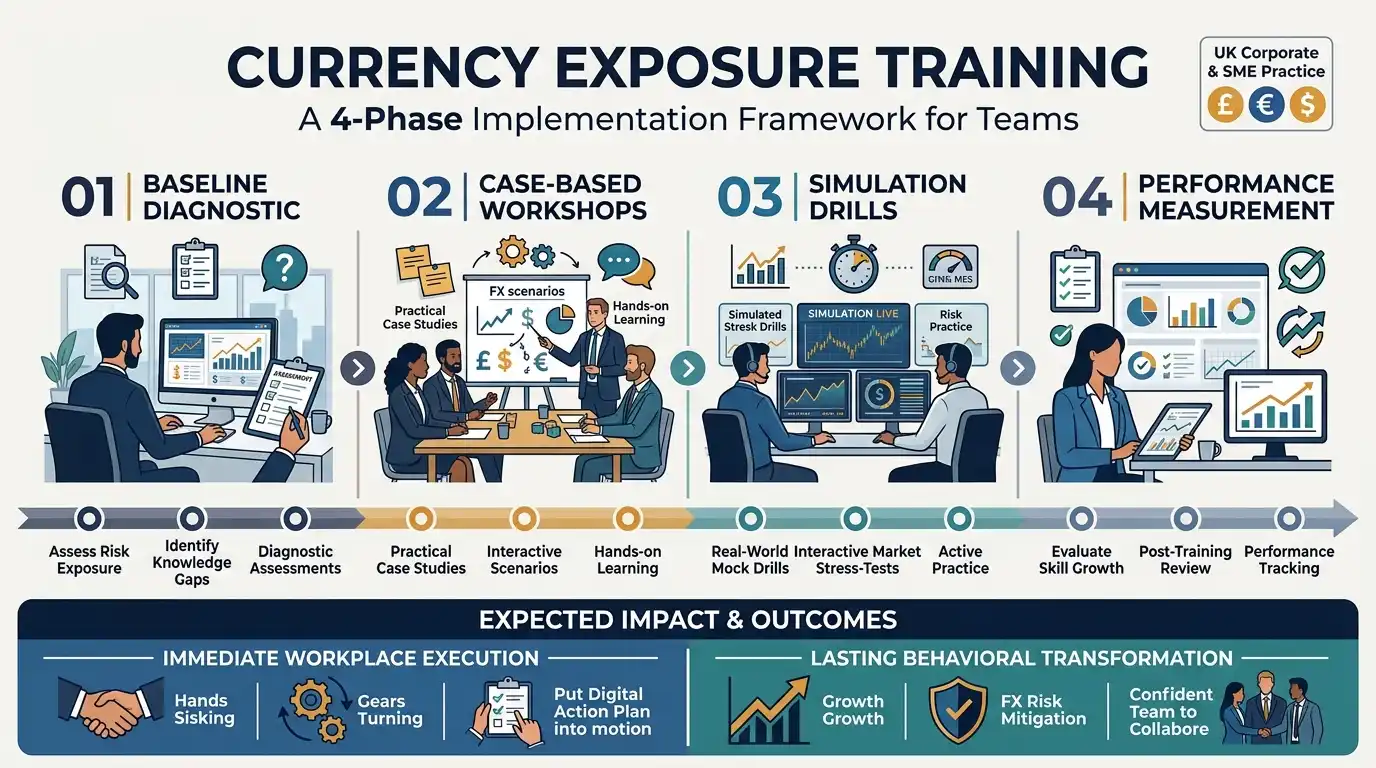
Phase 1: Baseline Diagnostics and Skill Gap Identification
L&D teams evaluate existing treasury capabilities, joint-venture accounting procedures, and commercial risk literacy. Skill gap assessments analyze individual competencies across exposure identification and quantification.
Phase 2: Interactive Case-Based Workshops
Participants analyze real-world petroleum development scenarios. Training modules evaluate upstream joint-operating agreements, midstream transport contracts, and downstream refining margins using live exchange data.
Phase 3: Simulated Risk Drills and Financial Modeling
Workshops run stress-test simulations on multi-currency cash flows. Trainees build dynamic risk dashboards to model currency mismatch impacts across fluctuating exchange rate corridors.
Phase 4: Post-Course Performance Measurement
Corporate leaders evaluate post-training capability transfer using structured 90-day performance reviews. Metrics track accuracy improvements in currency risk reporting, speed of exposure identification, and effective implementation of natural hedging techniques.
Professional development programs deliver measurable improvements when tailored to industry workflows. Classroom theory transfers directly into core corporate systems when supported by structured mentor reviews and active project scenarios.
What Key Components and Skills Form an Effective Foreign Exchange Exposure Framework?
A robust currency risk framework integrates primary financial risk concepts, standardized quantification tools, operational hedging strategies, and targeted delivery formats. Mastering these core modules ensures personnel identify cash flow vulnerabilities prior to financial settlement.
Core Financial Risk Modules
Corporate learning paths focus on three distinct operational layers:
Transaction Exposure Management: Analyzing settlement timing differences on trade payables, equipment leases, and crude sales.
Translation Exposure Mechanics: Managing accounting balance sheet rollups for foreign operations.
Economic Exposure Strategy: Assessing long-term competitive positioning against international energy producers.
Quantification and Analytical Tools
Participants master financial tools required to run sensitivity models, calculate Value-at-Risk, and perform functional currency determinations under global accounting standards.
Strategic Risk Mitigation Techniques
Workforce programs emphasize operational solutions over speculative financial instruments. Professionals structure natural hedging mechanisms by matching revenues with a local currency cost base, reducing dependence on expensive third-party financial derivatives.
Blended learning formats combining 16 hours of instructor-led sessions with self-paced digital modules increase knowledge retention by 35% compared to lecture-only formats.
What Measurable Benefits Do Organizations Gain from Systematic Foreign Exchange Exposure Training?
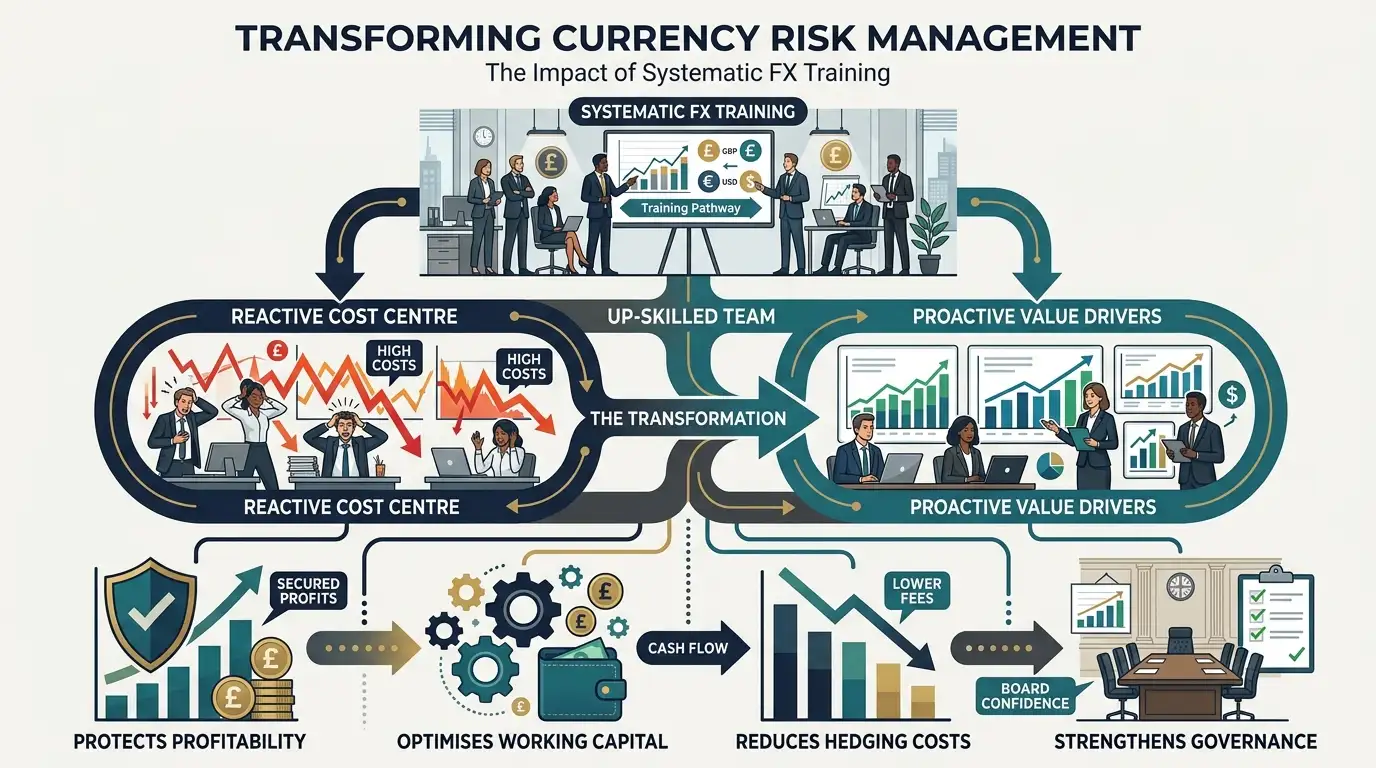
Systematic currency risk training protects corporate profitability, optimizes working capital, reduces hedging execution costs, and strengthens governance structures. Up-skilled corporate teams transform risk management units from reactive cost centers into proactive value drivers.
Organizations operating in energy-producing regions like the North Sea, the Gulf of Mexico, and West Africa face persistent currency volatility. Inadequate risk visibility leads to unbudgeted conversion losses during cross-border fund transfers.
Structured professional development produces four quantifiable organization-wide advantages:
Profitability Protection: Corporate entities insulate EBITDA margins against sharp exchange rate shifts, preserving 12% to 18% of operating net income during currency devaluations.
Working Capital Efficiency: Treasury teams reduce buffer cash holdings by 20% through precise timing of foreign currency settlements.
Reduced Derivative Execution Expenses: Internal teams utilize operational matching techniques, lowering external bank transaction fees by 15%.
Audit Compliance and Governance: Standardized reporting processes ensure 100% compliance with international financial reporting norms and corporate governance guidelines.
Investments in targeted workforce development generate a direct return on investment. Organizations report a 5:1 ROI ratio within 12 months of program completion through avoided conversion losses and streamlined treasury management.
Which Corporate Departments and Teams Require Foreign Exchange Exposure Training?
Cross-functional departments including corporate treasury, joint-venture accounting, commercial procurement, project engineering, and legal compliance require dedicated currency exposure training. Aligning these units ensures risk identification occurs during contract negotiation rather than post-settlement.
Foreign exchange risk impacts multiple business units across the enterprise value chain:
Corporate Treasury Teams: Require advanced skills in exposure identification and quantification to manage enterprise liquidity and design hedging frameworks.
Joint-Venture Accounting Units: Must audit multi-currency cash calls, manage operator billings, and apply accurate exchange rates across partner accounts.
Commercial Procurement Leads: Need practical capabilities to structure supplier contracts, evaluate vendor currency choices, and negotiate FX risk-sharing clauses.
Project Engineering Managers: Require foundational knowledge to estimate capital expenditure items sourced from international manufacturers in industries like energy, maritime construction, and infrastructure.
Legal and Compliance Officers: Must understand exchange controls, cross-border transfer restrictions, and financial regulatory standards across operating jurisdictions.
Targeted training ensures these units collaborate seamlessly. Evaluating currency implications at the procurement stage prevents structural mismatches before legal execution.
When organizations transition from basic risk identification to deep operational analysis, decision-makers must evaluate advanced methodologies for structural risk assessment. Learn How to Assess Transaction Translation and Economic Foreign Exchange Exposure in Petroleum Operations to systematically analyze these three core exposure categories across active energy projects. Building competency in comprehensive exposure assessment prepares corporate leaders to implement the Foreign Exchange (FX) Exposure: Types & Identification Training Course across their global finance and commercial teams.
What Common Misconceptions Impair Foreign Exchange Risk Management Programs?
Common misconceptions include assuming currency risk affects only treasury departments, believing financial derivatives are the sole mitigation tool, and treating FX management as a passive accounting exercise. Overcoming these errors requires practical, industry-specific workforce training.
Misconception 1: "FX Risk Is Exclusively a Treasury Problem"
Operational units often negotiate supplier contracts in foreign currencies without considering settlement implications. Currency exposure originates at contract signature, long before reaching corporate treasury.
Misconception 2: "Financial Derivatives Are the Only Risk Mitigation Tool"
Relying solely on financial options and forward contracts increases bank fees and counterparty risks. Practical training shows teams how to structure natural hedging by aligning operational cost currencies with primary revenue streams.
Misconception 3: "Currency Exposure Is a Passive Accounting Exercise"
Treating exchange adjustments as unavoidable accounting write-offs obscures operational inefficiency. Proactive risk management tracks real-time exposure to protect project margins before reporting periods close.
Misconception 4: "Generic Corporate Finance Training Delivers Sufficient Skills"
Generic financial courses lack the operational context of petroleum production sharing contracts, joint-operating agreement cash calls, and international crude pricing dynamics. Energy sector workforce development requires industry-tailored scenarios to ensure immediate practical impact.
Frequently Asked Questions
What is included in petroleum treasury, cash, and banking management training?
Oil and gas treasury and cash management training covers multi-currency cash positioning, joint-venture cash call handling, international banking operations, and liquidity forecasting for energy enterprises. Participants learn to manage working capital, reduce foreign exchange risk, and execute secure cross-border payment structures. The Institute For Oil & Gas Training provides this practical curriculum to help corporate finance teams streamline treasury controls and safeguard operating margins.
Why do energy companies require specialized corporate treasury and banking training?
Petroleum operations involve multi-currency revenue streams, capital-intensive exploration projects, and complex joint-operating agreements that generic corporate treasury models cannot address. Specialized training ensures finance professionals understand crude settlement dynamics, letters of credit, and regulatory compliance across operating jurisdictions. Up-skilling workforce teams through the Institute For Oil & Gas Training minimizes currency conversion losses and prevents liquidity bottlenecks in international projects.
How does cash flow forecasting improve liquidity control in petroleum operations?
Systematic cash flow forecasting enables oil and gas enterprises to predict capital expenditure requirements, manage vendor payables, and maintain optimal cash balances across global subsidiaries. Accurate forecasting minimizes reliance on short-term debt financing and prevents cash mismatches between local currency costs and USD-denominated revenues. Professionals trained by the Institute For Oil & Gas Training use structured sensitivity models to align operational cash timing with treasury risk policies.
How are joint-venture cash calls and multi-currency accounts managed in the oil and gas sector?
Joint-venture cash calls are managed by calculating operating partner obligations in accordance with joint-operating agreements and distributing funding requests across currency-specific accounts. Finance teams align currency receipts with planned local expenditure to establish natural hedges and avoid unbudgeted FX write-offs. Training programs at the Institute For Oil & Gas Training teach joint-venture accountants and treasury analysts how to standardize cash call workflows and maintain full audit compliance.
What are the primary foreign exchange risks in international petroleum banking operations?
Foreign exchange risks in energy banking include transaction exposure from delayed trade settlements, translation exposure when consolidating international balance sheets, and economic exposure affecting long-term competitiveness. These risks arise when energy sales priced in USD are used to settle operational commitments in foreign currencies. Courses offered by the Institute For Oil & Gas Training equip corporate treasurers with quantification tools and operational hedging frameworks to insulate corporate cash flows from currency market volatility.
Related training courses
Introduction to Conventional and Advanced NDT Techniques Training Course
- Specialisation
- Oil & Gas Inspection and Non-Destructive Testing
- Duration
- 5 days · 15 CPD hours
Acoustic Emission Testing Training Course
- Specialisation
- Oil & Gas Inspection and Non-Destructive Testing
- Duration
- 5 days · 15 CPD hours
Corrosion Monitoring & Testing Training Course
- Specialisation
- Oil & Gas Corrosion Management and Control
- Duration
- 5 days · 15 CPD hours
More articles

Foreign Exchange Exposure Management Training for Oil and Gas Companies in Emerging Markets
Master FX risk, currency convertibility, and devaluation controls in emerging petroleum markets with Institute For Oil & Gas Training.
Read article →
How to Evaluate Foreign Exchange Risk Management Strategies in Emerging Petroleum Markets
Learn how to evaluate foreign exchange risk management strategies in emerging petroleum markets to protect revenue and operational stability.
Read article →
Why Foreign Exchange Risk Matters for Oil and Gas Companies in Emerging Markets
Learn how foreign exchange volatility impacts oil and gas operations in emerging markets and discover strategic corporate FX exposure training solutions.
Read article →