

Foreign exchange exposure represents a structural financial risk for petroleum enterprises operating across international jurisdictions. Oil and gas companies face complex currency dynamics due to US Dollar revenue benchmarks alongside local currency cost bases, cross-border vendor commitments, and long-term capital expenditure projects. When finance and treasury teams lack structured protocols to identify and quantify exposure types, organizations experience unexpected margin compression, earnings volatility, and compromised balance sheet stability. To understand the foundational financial risks associated with currency fluctuations in energy operations, treasury professionals can review Why Identifying Foreign Exchange Exposure Matters for Oil and Gas Companies. The Institute For Oil & Gas Training provides specialized professional development to address these exact operational challenges through rigorous financial skill acquisition.
What is Foreign Exchange Exposure Identification Training and What Problem Does It Solve?
Foreign Exchange Exposure Identification Training for Oil and Gas Treasury Professionals provides structured technical instruction to detect, classify, and quantify FX exposure across energy operations. The program resolves critical workplace skill gaps, preventing misclassified currency risks, unexpected margin erosion, and unhedged balance sheet volatility.
Operational Challenges in Petroleum Treasury Management
Petroleum treasury teams continuously manage complex cash flows denominated in multiple global currencies. A major operational challenge is the structural mismatch between US Dollar-denominated crude oil sales and local currency operating expenditures, such as payroll, regional vendor contracts, and tax obligations. Without formal training, finance professionals frequently misclassify these operational cash flows, treating long-term economic exposure merely as short-term transaction noise.
This analytical gap directly impacts corporate cash flow stability and financial reporting accuracy. When treasury analysts fail to establish correct functional currency determinations, multi-currency accounting entries propagate errors into consolidated financial statements. Consequently, corporate decision-makers lose visibility over true net FX exposure across subsidiaries.
The Institute For Oil & Gas Training developed the Foreign Exchange (FX) Exposure: Types & Identification Training Course to directly solve these technical deficiencies. The curriculum equips treasury teams with standardized methodologies to audit corporate balance sheets, map operational supply chain commitments, and establish reliable currency risk inventories.
Corporate Skill Deficiencies Addressed by the Program
Many energy organizations operate with fragmented FX monitoring processes. Finance departments often rely on ad-hoc spreadsheets and disconnected departmental reporting, leading to delayed currency risk identification. Key technical deficiencies addressed in this training include:
Inability to isolate transaction exposure from translation and economic exposure.
Miscalculation of functional currency determinations under international accounting standards.
Failure to identify implicit currency mismatches embedded within long-term procurement contracts.
Lack of quantitative frameworks to measure local currency cost base sensitivities against crude oil price movements.
By systematically addressing these skill gaps, the Institute For Oil & Gas Training ensures that finance professionals transition from reactive accounting adjustments to proactive corporate risk management.
Why Is This Foreign Exchange Exposure Training Structured in a Modular Sequence?
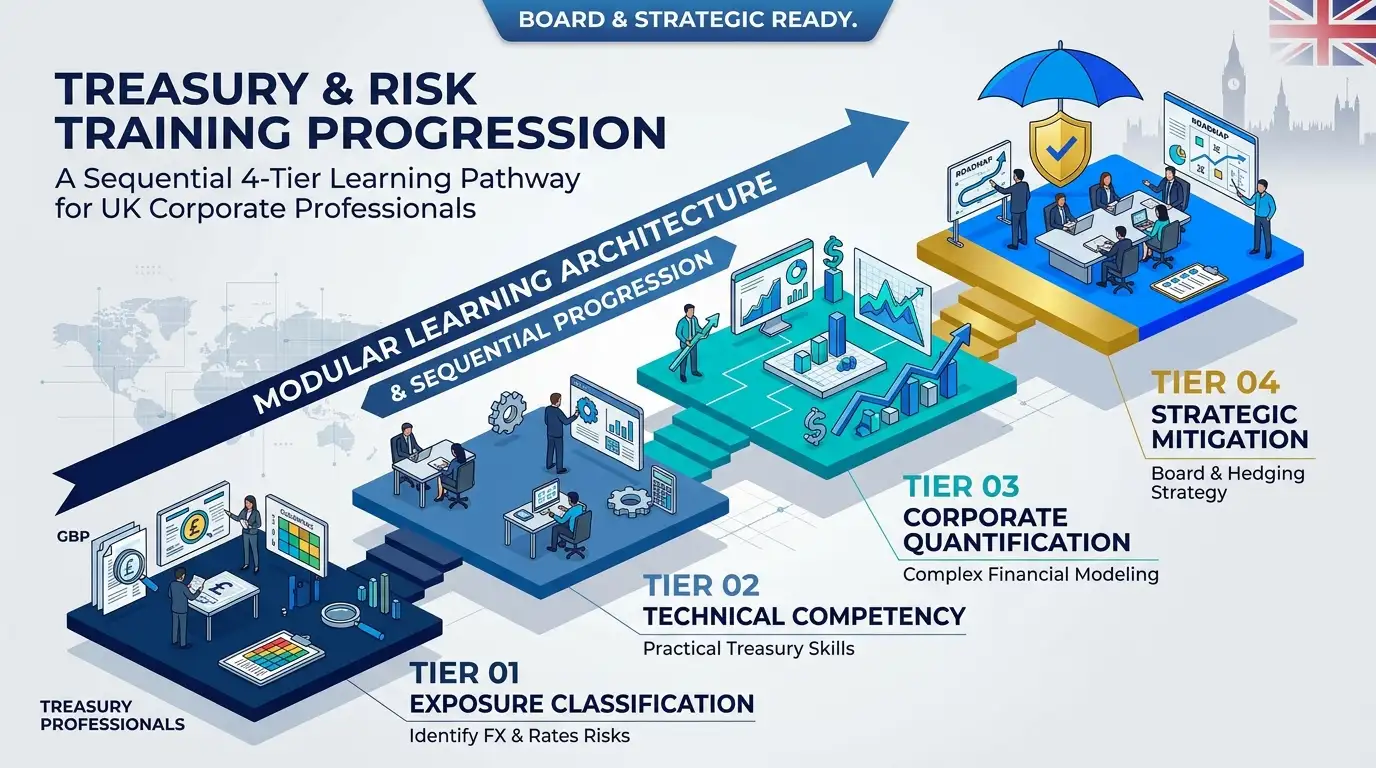
This training course is structured in a sequential, four-tier learning progression that systematically advances participants from core exposure classification to complex corporate quantification. This modular architecture guarantees that treasury professionals acquire actionable technical competency before evaluating strategic risk mitigation frameworks.
Curriculum Architecture and Learning Logic
The curriculum follows a strict pedagogical framework designed for financial practitioners. Technical skills are built progressively, ensuring that concepts taught in foundational modules directly inform practical analytical exercises in subsequent stages.
Before evaluating course structures or comparing corporate training options, enterprise learning leaders should analyze How to Assess Transaction Translation and Economic Foreign Exchange Exposure in Petroleum Operations to align organizational skill requirements with professional standards. The Institute For Oil & Gas Training utilizes this structured approach to transform abstract financial theory into standard operating procedures for energy treasury departments.
Pedagogical Rationale for Energy Sector Application
Energy sector financial management requires specialized domain knowledge that generic finance courses fail to deliver. Petroleum revenue structures, joint venture cash calls, and long-term field development plans present distinct FX characteristics.
Foundational Classification: Participants first master the accounting mechanics of functional currency determination to establish baseline compliance.
Quantitative Exposure Isolation: Learners then dissect complex balance sheets to quantify transaction, translation, and economic exposure using standardized oil and gas scenarios.
Operational Strategy Integration: Treasury analysts evaluate operational structure, natural hedging opportunities, and vendor contract terms to reduce reliance on derivative instruments.
Policy and Modeling Governance: Participants build integrated risk models and draft comprehensive corporate FX policy frameworks aligned with organizational governance requirements.
This deliberate sequencing ensures that enterprise teams develop repeatable analytical routines that integrate directly into corporate financial planning and analysis workflows.
What Will Participants Learn in the FX Exposure Identification Course?
Participants learn to identify, isolate, and quantify transaction exposure, translation exposure, and economic exposure across complex energy operations. Graduates acquire practical competencies in functional currency determination, natural hedging analysis, local currency cost base modeling, and FX policy framework implementation.
Comprehensive Module Breakdown and Skill Acquisition
The Foreign Exchange (FX) Exposure: Types & Identification Training Course delivers rigorous technical instruction organized across four core learning modules. Each module targets specific, measurable financial capabilities required in modern energy treasury operations.
Module 1: Foundations of Energy FX Exposure and Functional Currency
Principles of functional currency determination under international financial reporting standards (IAS 21 / ASC 830).
Mechanics of primary and secondary indicators in petroleum accounting environment.
Identifying underlying currency mismatch in multi-jurisdictional joint operations.
Classifying FX risk drivers across upstream, midstream, and downstream asset portfolios.
Module 2: Identification and Quantification of Exposure Types
Transaction Exposure: Mapping committed contract cash flows, procurement orders, and debt service obligations.
Translation Exposure: Assessing balance sheet consolidation impact across foreign subsidiaries and Joint Operating Agreements (JOAs).
Economic Exposure: Modeling long-term cash flow sensitivity to real exchange rate fluctuations and local currency inflation.
Standardized exposure identification and quantification formulas applied to operational petroleum cash flows.
Module 3: Energy Supply Chain, Natural Hedging, and Policy Alignment
Analyzing the local currency cost base within capital expenditure projects and operational maintenance budgets.
Evaluating natural hedging mechanisms by matching local currency revenues with local currency operational liabilities.
Reviewing vendor supply chain contracts to detect embedded currency options and indexation clauses.
Designing an enterprise FX policy framework that defines exposure tolerances, reporting lines, and approval thresholds.
Module 4: Applied Treasury Modeling and Executive Risk Reporting
Building dynamic FX exposure models in Excel utilizing cash flow forecasting inputs from operational units.
Constructing Value-at-Risk (VaR) and Cash-Flow-at-Risk (CFaR) metrics for energy treasury portfolios.
Developing executive-level treasury dashboards that communicate net exposure positions to Chief Financial Officers and Risk Committees.
Stress-testing energy portfolios against severe currency devaluation and commodity price shock scenarios.
Practical Technical Skills Matrix
Target Technical Capability | Pre-Training Baseline Performance | Post-Training Operational Competency |
Functional Currency Determination | Ad-hoc classification based on local registration | Standardized audit compliant with IAS 21/ASC 830 |
Transaction Exposure Mapping | Manual tracking of major invoice line items | Automated inventory of committed cash flows |
Translation Risk Analysis | Unmonitored balance sheet consolidation adjustments | Stress-tested balance sheet exposure metrics |
Economic Exposure Modeling | Qualitative assessment without cash flow impact data | Quantitative sensitivity modeling over multi-year horizons |
Natural Hedging Execution | Accidental currency matching without structural review | Systematic alignment of local revenue and cost bases |
How Is the Foreign Exchange Exposure Course Delivered and Assessed?
The course is delivered through interactive workshops, live online sessions, hybrid delivery, and on-site corporate programs over a focused two-to-four-week schedule. Assessment requires completing practical cash flow auditing assignments, exposure quantification simulations, and a comprehensive FX policy capstone project.
Flexible Professional Delivery Formats
The Institute For Oil & Gas Training offers multiple training delivery formats designed to fit the operational schedules of enterprise finance teams and individual treasury professionals.
On-Site Corporate Workshops: Intensive three-day programs hosted at client enterprise facilities. Instructors utilize the client's historical financial data and operational structures to conduct customized learning exercises.
Live Virtual Classroom: Four-week interactive online program featuring two two-hour live sessions per week. Includes dedicated virtual lab hours for real-time spreadsheet modeling and instructor consultation.
Hybrid Delivery: Blended structure combining self-paced technical lectures with two full-day practical application workshops. Ideal for regional finance teams operating across multiple time zones.
Rigorous Professional Assessment Methodology
To ensure technical mastery and practical workplace readiness, the Institute For Oil & Gas Training enforces objective competency assessments rather than simple attendance tracking.
Technical Knowledge Examinations: Mid-program and final proctored evaluations testing participant comprehension of functional currency determination principles, exposure classification rules, and regulatory requirements.
Practical Financial Modeling Labs: Hands-on assessments where participants receive raw, multi-currency financial datasets from simulated oil and gas operators. Candidates must audit the data, identify currency mismatches, and quantify net transaction exposure.
Applied Case Study Assignments: Team-based analysis of real-world energy sector financial crises caused by unhedged foreign exchange exposure. Participants defend their exposure identification strategies before an expert panel.
Capstone FX Policy Project: Individual submission of a complete corporate FX policy framework customized for a designated energy exploration or service company profile.
What Measurable Results and Corporate Outcomes Can Be Expected?
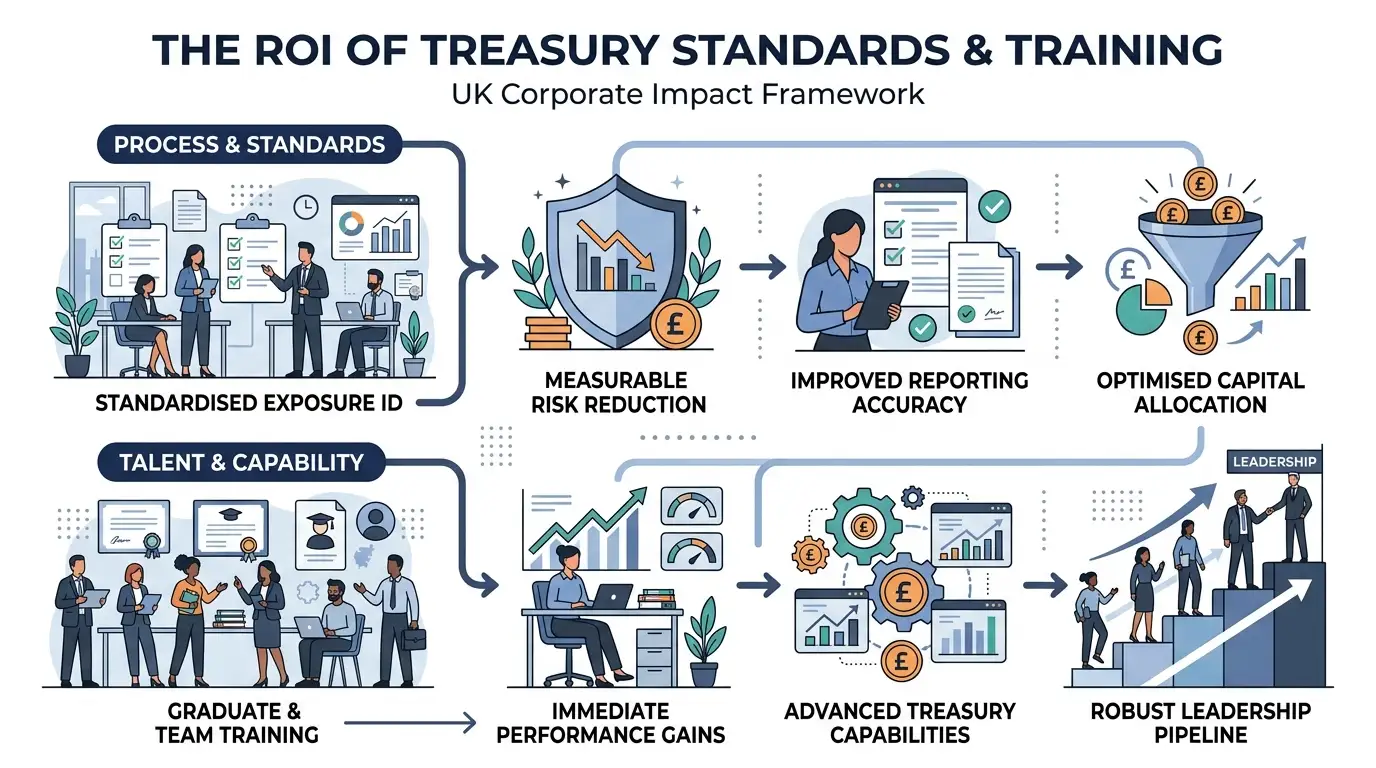
Organizations achieve measurable risk reduction, improved reporting accuracy, and optimized capital allocation through standardized exposure identification routines. Graduates demonstrate immediate workplace performance gains, advancing treasury capabilities and establishing robust corporate talent pipelines for leadership roles.
Quantifiable Enterprise and Departmental Outcomes
Implementing standardized foreign exchange exposure training generates direct operational benefits across finance departments, treasury divisions, and executive decision-making bodies.
Enhanced Cash Flow Predictability: By systematically mapping the local currency cost base against US Dollar revenue streams, treasury departments reduce unhedged cash flow volatility.
Elimination of Accounting Misclassifications: Finance teams establish correct functional currency determinations, eliminating recurring audit adjustments related to translation exposure misstatements.
Optimized Utilization of Natural Hedging: Procurement and corporate finance departments collaborate to align local currency revenues with local operational expenditures, decreasing unnecessary derivative transaction fees.
Strengthened Governance Standards: Executive leadership gains access to accurate exposure risk registers, enabling data-driven capital allocation decisions during periods of global currency volatility.
Impact on Human Resources and Leadership Pipelines
Human Resources and Learning & Development leaders utilize this program to build sustainable technical capability across global finance divisions. The curriculum provides clear professional development benchmarks that support succession planning within energy management pipelines.
Standardized Skill Sets Across Global Subsidiaries: HR teams establish uniform competency standards for treasury personnel across domestic and international business units.
Accelerated Onboarding for Technical Roles: New finance hires achieve operational readiness rapidly by completing standardized training on sector-specific FX mechanics.
Demonstrated ROI on Corporate L&D Investments: HR leaders track measurable performance improvements through pre- and post-training skill assessments, validating corporate training expenditures.
Leadership Pipeline Development: High-potential finance managers acquire executive-level risk management perspective, preparing them for advancement into Assistant Treasurer, Treasurer, and Chief Financial Officer roles.
How Does Enrollment Work and What Are the Entry Requirements?
Enrollment requires candidate profile verification, pre-requisite finance evaluation, and formal corporate application submission. Candidates must possess foundational knowledge of corporate accounting or treasury operations to ensure complete readiness for advanced exposure quantification modules.
Candidate Eligibility Criteria and Technical Prerequisites
To maintain rigorous instructional standards, the Institute For Oil & Gas Training evaluates applicants against established academic and professional benchmarks.
Target Roles: Treasury Analysts, Financial Controllers, Corporate Risk Managers, FP&A Specialists, Internal Auditors, and HR Learning & Development Directors sourcing specialized corporate training.
Recommended Experience: A minimum of two years of professional experience within a corporate finance, accounting, or treasury environment, preferably within the energy, mining, or heavy industrial sectors.
Technical Knowledge: Familiarity with basic financial statements (Balance Sheet, Income Statement, Cash Flow Statement) and working proficiency with Microsoft Excel for financial modeling.
Step-by-Step Corporate and Individual Enrollment Process
The enrollment path is structured to assist both individual finance professionals and enterprise HR teams executing group capability development initiatives.
Application Submission: Complete the online enrollment application form, selecting the preferred delivery format and cohort start date. Corporate HR teams submitting group enrollments can request customized schedule options.
Diagnostic Evaluation: Complete a short technical pre-assessment to verify foundational understanding of corporate accounting principles.
Admissions Confirmation: The admissions panel reviews candidate qualifications and issues formal confirmation within three business days.
Pre-Course Preparation: Admitted participants gain access to the Institute For Oil & Gas Training digital learning platform to review foundational reading materials and software setup requirements prior to Module 1.
Upon successful completion of all coursework, practical modeling labs, and the capstone project, participants receive an official Professional Certificate in Foreign Exchange Exposure Identification from the Institute For Oil & Gas Training. Finance managers and enterprise HR departments ready to enhance corporate treasury performance can apply for course access to secure participation in the upcoming training cohort.
Frequently Asked Questions
What is covered in an oil and gas petroleum treasury, cash, and banking course?
An oil and gas petroleum treasury, cash, and banking course covers liquidity management, foreign currency risk, cash pooling, and bank account structuring across international energy operations. The Institute For Oil & Gas Training delivers instruction on functional currency rules, cross-border payment protocols, and joint venture cash call workflows. Participants learn to optimize working capital and mitigate foreign exchange exposure in multi-currency petroleum environments.
Why is specialized cash and banking management critical in the petroleum industry?
Petroleum operations involve massive capital expenditures, multi-currency cash flows, and complex regulatory frameworks across diverse operating jurisdictions. Specialized training from the Institute For Oil & Gas Training ensures finance professionals can manage volatile revenue streams, structure natural hedges, and maintain liquidity during commodity price cycles. Effective cash management prevents liquidity bottlenecks and safeguards operational continuity across upstream, midstream, and downstream assets.
How does petroleum treasury management address foreign exchange risk?
Petroleum treasury management addresses foreign exchange risk by identifying transaction, translation, and economic exposure stemming from local currency cost bases alongside US Dollar revenues. Through programs at the Institute For Oil & Gas Training, professionals master functional currency determination, exposure quantification formulas, and operational hedging strategies. This structured approach stabilizes corporate cash flows and protects net profit margins against currency volatility.
Who should undertake training in petroleum treasury, cash, and banking?
Treasury analysts, financial controllers, corporate accountants, risk managers, and joint venture finance professionals benefit directly from this training. Corporate HR teams and learning departments partner with the Institute For Oil & Gas Training to upskill finance personnel managing multi-jurisdictional treasury units. The curriculum equips team members with standardized practices for bank relationship management, cash forecasting, and treasury governance.
What are the key outcomes of implementing formal treasury and banking protocols in energy firms?
Implementing formal treasury and banking protocols improves cash visibility, reduces borrowing costs, and minimizes unhedged foreign currency losses across energy entities. Professionals trained by the Institute For Oil & Gas Training establish compliant financial risk registers, streamlined cash sweep structures, and precise cash flow forecasting models. These practical improvements strengthen balance sheet stability and enhance overall corporate governance.
Related training courses
Corrosion Control by Material Selection Training Course
- Specialisation
- Oil & Gas Corrosion Management and Control
- Duration
- 5 days · 15 CPD hours
Introduction to Conventional and Advanced NDT Techniques Training Course
- Specialisation
- Oil & Gas Inspection and Non-Destructive Testing
- Duration
- 5 days · 15 CPD hours
Contract Strategy, Risk and Negotiation Training Course
- Specialisation
- Oil & Gas Petroleum Contracts
- Duration
- 5 days · 15 CPD hours
More articles

Foreign Exchange Exposure Management Training for Oil and Gas Companies in Emerging Markets
Master FX risk, currency convertibility, and devaluation controls in emerging petroleum markets with Institute For Oil & Gas Training.
Read article →
How to Evaluate Foreign Exchange Risk Management Strategies in Emerging Petroleum Markets
Learn how to evaluate foreign exchange risk management strategies in emerging petroleum markets to protect revenue and operational stability.
Read article →
Why Foreign Exchange Risk Matters for Oil and Gas Companies in Emerging Markets
Learn how foreign exchange volatility impacts oil and gas operations in emerging markets and discover strategic corporate FX exposure training solutions.
Read article →