

Transfer pricing represents the financial mechanism and regulatory framework used to price cross-border transactions between enterprise entities within the same corporate group, ensuring profits are taxed where economic value creation and operational risks genuinely occur.
In the energy sector, cross-border related party transactions account for over 70% of global trade volume. Parent entities transfer tangible goods, intangible assets, intellectual property, and intra-group services across multiple tax jurisdictions. These internal transfers include crude oil shipments, equipment leasing, technical assistance, and centralized management services. National tax authorities enforce strict compliance regulations to prevent profit shifting and tax base erosion.
Multinational oil and gas corporations operate across complex supply chains involving exploration, extraction, refining, distribution, and marketing. Each stage occurs in distinct regulatory environments like the United Kingdom, Norway, Nigeria, and the United Arab Emirates. Without standardized financial management skills, internal accounting teams misprice intra-group transactions. Mispricing triggers severe tax audits, financial penalties, and double taxation.
Organizations must train finance managers, tax directors, and operational leaders to apply the arm's length principle. This international standard dictates that transactions between related entities must carry terms identical to those between independent companies in open market conditions. Developing internal technical competence ensures compliance with Organisation for Economic Co-operation and Development standards. Precise execution protects corporate cash flow, optimizes global tax positioning, and maintains institutional integrity.
How Does Transfer Pricing Work in Corporate Environments?
Transfer pricing operates through systematic functional analysis, selection of approved economic methodologies, robust economic benchmarking, and meticulous documentation, supported by continuous cross-functional workforce alignment across finance, legal, and operational leadership teams.
Corporate tax departments implement transfer pricing through a structured three-phase process:
Phase 1: Operational Mapping and Functional Analysis
Finance teams perform a comprehensive functional analysis. This process identifies functions performed, assets employed, and operational risks assumed by each legal entity within the enterprise group. Employees gather operational data from exploration teams, logistics managers, and corporate service providers.
Phase 2: Economic Valuation and Method Selection
Tax professionals select an appropriate transfer pricing methodology based on transaction types like raw material transfers, technical support, or capital allocation. They apply one of five recognized economic valuation methods:
Comparable Uncontrolled Price Method: Compares prices charged for property or services transferred in a controlled transaction to those in an uncontrolled transaction under similar circumstances.
Cost Plus Method: Evaluates markups added to direct and indirect costs incurred during production or service delivery.
Resale Price Method: Evaluates the gross margin realized when reselling products purchased from related parties to independent enterprises.
Transactional Net Margin Method: Examines net profit margins relative to an appropriate base such as costs, sales, or assets.
Profit Split Method: Allocates combined operating profits or losses based on the relative economic contributions of each entity.
Professionals execute a rigorous benchmarking study to gather market data from independent companies operating in similar industries like energy, mining, and heavy manufacturing. Teams apply comparability adjustments to eliminate economic differences between internal transactions and market data points.
Phase 3: Compliance Documentation and Monitoring
Legal and finance teams draft intercompany agreements reflecting real-world commercial terms. Professionals prepare localized tax documentation, including the Master File, Local File, and Country-by-Country Reporting. Operational managers conduct quarterly reviews to ensure actual transaction prices match predetermined transfer pricing policies.
What Key Components Form an Effective Transfer Pricing Strategy?
An effective transfer pricing strategy combines rigorous technical economic methodologies, centralized compliance software tools, structured intercompany contract frameworks, clear internal governance protocols, and continuous workforce skill development across energy enterprise departments.
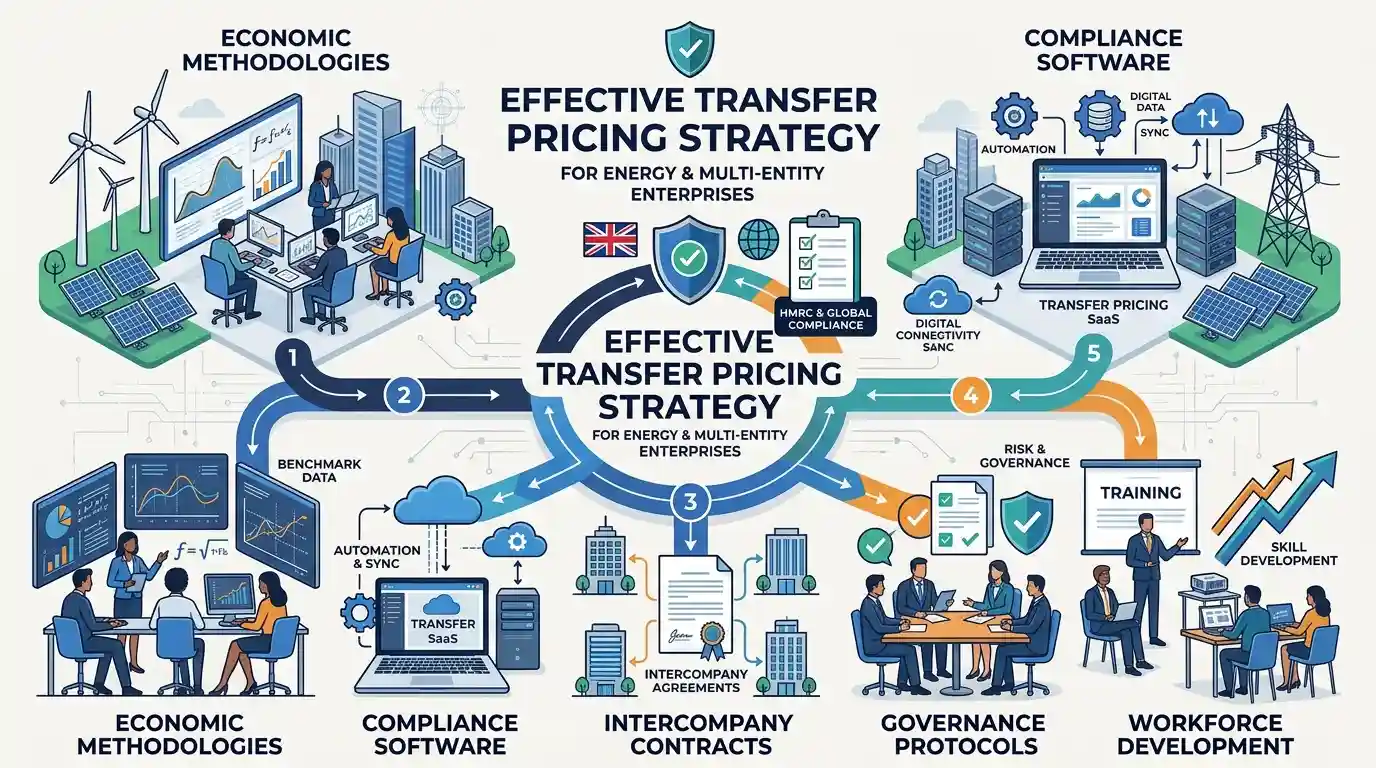
Building robust organizational capabilities requires core components operating across four primary domains:
Category | Essential Components | Primary Corporate Function |
Analytical Frameworks | Functional analysis templates, value chain mapping, risk assignment models | Risk Identification & Asset Valuation |
Economic Methodologies | Transactional Net Margin Method, Cost Plus Method, Comparable Uncontrolled Price Method | Arm's Length Price Determination |
Documentation & Software | Benchmarking databases, Master Files, Local Files, automated intercompany invoicing | Regulatory Compliance & Audit Preparation |
Workforce Competencies | Contract interpretation, accounting skills, regulatory policy analysis | Operational Execution & Governance |
Organizations utilize dedicated benchmarking databases like Orbis or TP Catalyst to gather financial data from independent companies in sectors like engineering, logistics, and chemical processing. Employees must master these software tools to build defensible economic models.
Clear governance structures demand that legal, finance, and operational teams communicate continuously. Organizations establish internal transfer pricing committees that meet quarterly. These committees review intra-group service charges, technical support fees, and management expense allocations to prevent regulatory scrutiny.
Structured corporate learning programs build these technical skills across regional offices. Training delivery formats like interactive workshops, online learning modules, and hybrid learning programs ensure staff master functional analysis, financial modeling, and intercompany contract drafting.
Why Is Transfer Pricing Critical for Organizational Performance and Strategy?
Transfer pricing capabilities directly protect revenue, minimize tax penalties, accelerate financial reporting efficiency, strengthen internal governance, and eliminate double taxation risks across complex multinational operating structures.
Enterprise groups without structured transfer pricing training face substantial financial and operational risks. Tax authorities worldwide issue multi-million-pound tax adjustments and non-compliance penalties against energy companies. Misaligned internal pricing distorts performance evaluation across regional subsidiaries, misleading executive decision-makers regarding unit profitability.
Targeted workforce development in transfer pricing produces direct corporate benefits:
Financial Protection and Compliance: Well-trained tax and finance teams build defensible documentation structures that withstand aggressive regulatory audits from tax authorities like HMRC or the IRS.
Operational Clarity and Fair Evaluation: Clear intercompany pricing ensures parent entities evaluate regional subsidiaries accurately. Performance metrics like return on capital employed accurately reflect local operational efficiency rather than artificial tax structures.
Optimized Resource Allocation: Precise cost allocation for intra-group services allows executive leaders to direct capital investments toward high-performing divisions in sectors like renewable energy, refining, or offshore exploration.
Enhanced Team Collaboration: Structured training breaks down functional silos between tax, legal, and operational leadership. Unified teams design commercial contracts that align operational reality with regulatory compliance.
How Do Organizations Implement Transfer Pricing Best Practices Across Teams?
Organizations implement transfer pricing best practices by executing structured capability assessments, establishing standardized policy guidelines, delivering role-based technical training, automating intercompany invoicing workflows, and conducting annual compliance reviews.
Successful enterprise implementation follows a clear five-step execution roadmap:
1. Conduct Organizational Capability Assessments
Human resources and learning and development leaders identify technical skill gaps across regional finance, legal, and accounting teams. Assessments evaluate staff capabilities in financial modeling, regulatory reading, and benchmarking analysis.
2. Standardize Transfer Pricing Policy Frameworks
Executive leaders establish clear global policies for pricing related party transactions. Policies define precise rules for markup percentages on intra-group services, royalty rates for proprietary technology, and interest rates on intercompany loans.
To understand how to audit existing intercompany financial workflows and measure regulatory exposure across energy operations, executives learn how to evaluate transfer pricing risks and intercompany transactions in oil and gas groups through structured technical assessments.
3. Deliver Outcome-Based Professional Training
Organizations roll out targeted training programs using real-world case-based learning, financial simulations, and practical workshops. Training equips managers to execute benchmarking studies and apply comparability adjustments accurately.
4. Integrate Automated Financial Workflows
Enterprise IT teams configure enterprise resource planning software like SAP or Oracle to automate intercompany calculations. Automated systems generate compliant intercompany invoices automatically, reducing human accounting errors.
5. Establish Continuous Monitoring and Review
Internal audit teams review intercompany transactions every six months. Regular audits ensure operational managers follow established pricing models and maintain updated Local Files across all operating jurisdictions.
What Common Problems and Misconceptions Surround Transfer Pricing?
Common misconceptions treat transfer pricing purely as a year-end tax exercise or aggressive tax avoidance scheme, leading organizations to neglect continuous operational tracking, cross-functional training, and proactive risk management.
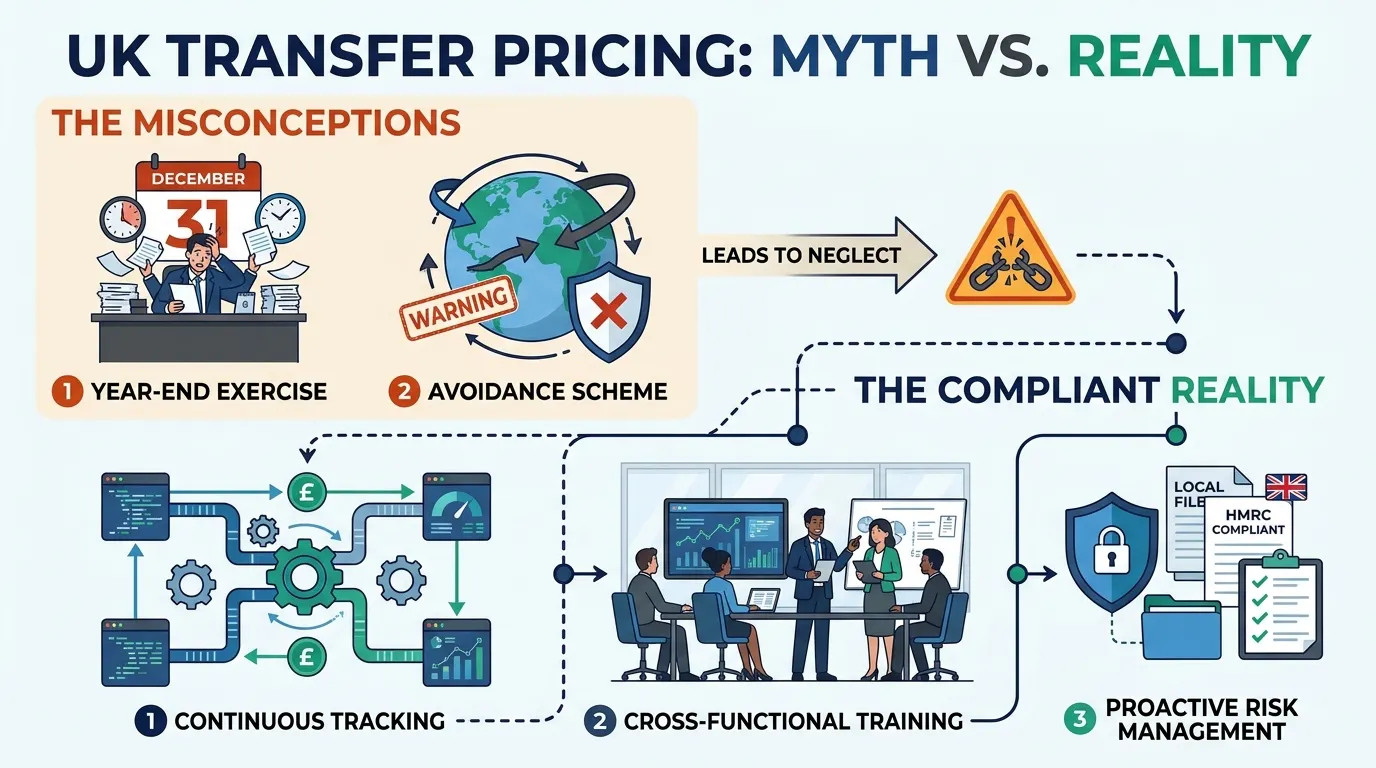
Misconception 1: Transfer Pricing Is Solely an Annual Tax Filing Task
Many business leaders assume transfer pricing requires attention only during annual tax return preparation. In reality, transfer pricing demands daily operational management. Prices calculated incorrectly during real-time transactions corrupt accounting ledgers, making year-end adjustments complex and audit-prone.
Misconception 2: Transfer Pricing Is an Aggressive Profit Shifting Tool
Tax authorities view transfer pricing as a legitimate accounting framework designed to reflect true economic value creation. Modern international regulations demand full transparency. Applying the arm's length principle protects companies against accusations of tax evasion.
Misconception 3: Generic Finance Programs Build Sufficient Capability
Standard corporate accounting courses fail to teach specialized energy sector mechanics. Oil and gas groups deal with unique challenges like joint venture accounting, volatile commodity pricing, production sharing contracts, and high capital expenditure risks. Teams need specialized industry-focused technical training.
Misconception 4: External Consultants Eliminate the Need for Internal Training
Relying entirely on external advisory firms creates high operational costs and dangerous internal skill gaps. External consultants prepare compliance reports, but internal managers execute daily intercompany transactions. In-house staff must hold deep technical knowledge to manage risk continuously.
How Does Professional Development Drive Measurable Outcomes in Transfer Pricing?
Professional development produces measurable business outcomes by reducing audit adjustments, lowering compliance costs, accelerating financial closing cycles, improving workforce retention rates, and strengthening global tax governance.
Investing in structured workforce development like the Transfer Pricing for Oil & Gas Groups Training Course provides clear organizational return on investment. Organizations measure success through clear quantitative indicators:
Reduction in Audit Adjustments and Penalties: Trained finance teams produce defensible economic documentation. Enterprise groups experience fewer tax adjustments and avoid non-compliance fines following revenue authority audits.
Decreased External Advisory Costs: Up-skilling internal accounting and legal professionals reduces dependence on external consulting firms. In-house teams conduct functional analysis and benchmarking studies internally.
Faster Financial Closing Cycles: Standardized intercompany invoicing processes accelerate monthly and annual financial closing schedules across all global subsidiaries.
Higher Employee Retention and Productivity: Professional development opportunities increase employee engagement and retention rates among high-performing finance professionals. Teams resolve complex intercompany disputes efficiently.
Structured professional training transforms transfer pricing from a passive regulatory burden into a strategic driver of global financial control and operational stability.
Frequently Asked Questions
What is oil and gas petroleum taxation training?
Oil and gas petroleum taxation training is a specialized professional development program designed to help finance, legal, and tax professionals master fiscal regimes, royalties, production sharing contracts, and international tax compliance within the energy sector. Delivered by the Institute For Oil & Gas Training, this instruction equips corporate teams with practical skills to evaluate tax liabilities, manage cross-border financial risk, and maintain regulatory compliance.
How does petroleum taxation affect international oil companies?
Petroleum taxation directly impacts an international oil company's net profitability, capital allocation, and project feasibility by dictating government take through royalties, ring-fencing rules, and corporate income taxes. Understanding these complex fiscal frameworks ensures organizations can accurately model revenue streams and negotiate balanced exploration agreements. Through targeted Oil & Gas Petroleum Taxation programs from the Institute For Oil & Gas Training, professionals learn to structure commercial operations to mitigate double taxation and tax audit exposures.
What are the key components of an oil and gas fiscal regime?
An oil and gas fiscal regime typically comprises concessions, production sharing agreements, service contracts, bonuses, royalties, and resource rent taxes tailored to extraction risks. These components govern how economic value and operational costs are split between state host governments and commercial petroleum operators. Comprehensive training in Oil & Gas Petroleum Taxation by the Institute For Oil & Gas Training breaks down these mechanics to improve financial modeling and contract management across corporate teams.
Why is petroleum tax compliance critical for multinational energy groups?
Strict petroleum tax compliance is essential for multinational energy groups to prevent multi-million-pound tax adjustments, non-compliance fines, and reputational damage from global revenue authorities. With tightening international regulations around base erosion and profit shifting, energy companies must align cross-border intercompany transactions with established tax laws. The Institute For Oil & Gas Training provides practical Oil & Gas Petroleum Taxation instruction to help workforce teams build robust tax documentation and defensible audit frameworks.
Who should undertake training in oil and gas petroleum taxation?
Training in Oil & Gas Petroleum Taxation is ideal for tax managers, corporate accountants, legal advisors, financial analysts, and commercial directors working within national and international oil companies. Up-skilling these key decision-makers ensures cross-functional alignment between operational activities and global tax strategy. The Institute For Oil & Gas Training delivers outcome-based courses that turn complex tax concepts into actionable corporate risk-management strategies.
Related training courses
In-line Pipeline Inspection Technologies and Applications Training Course
- Specialisation
- Oil & Gas Pipeline Integrity and Inspection
- Duration
- 5 days · 15 CPD hours
API 570 Piping Inspection and Integrity Assessment Training Course
- Specialisation
- Oil & Gas Inspection and Non-Destructive Testing
- Duration
- 5 days · 15 CPD hours
Metallurgy for Non-Metallurgist Training Course
- Specialisation
- Oil & Gas Corrosion Management and Control
- Duration
- 5 days · 15 CPD hours
More articles

Transfer Pricing Documentation and Country by Country Reporting Training for Oil and Gas Tax Professionals
Master BEPS Action 13 compliance, Master File, Local File, and CbC Reporting with Institute For Oil & Gas Training professional courses.
Read article →
How to Assess Transfer Pricing Documentation and Country by Country Reporting Requirements for Oil and Gas Groups
Evaluate Transfer Pricing Documentation and CbC Reporting requirements for oil and gas groups. Assess compliance risks, frameworks, and audit readiness.
Read article →
Why Transfer Pricing Documentation Matters for Oil and Gas Multinational Groups
Discover why transfer pricing documentation matters for oil and gas groups, how corporate training builds compliance, and ways to mitigate audit risks.
Read article →