

Transfer pricing documentation is the structured record of cross-border intercompany transactions demonstrating that prices reflect arm's length market conditions. It provides tax authorities with evidence that multi-jurisdictional energy groups allocate profits accurately across global operating subsidiaries.
In multinational oil and gas enterprises, transfer pricing documentation forms the foundation of global tax compliance, corporate risk management, and fiscal strategy. Energy corporations operate complex value chains spanning exploration, production, refining, shipping, trading, and distribution across multiple tax jurisdictions. Intercompany transactions involve asset transfers, intellectual property licensing, technical service sharing, intercompany financing, and joint venture cost allocations. Tax authorities globally enforce strict transfer pricing regulations based on the Organisation for Economic Co-operation and Development (OECD) Base Erosion and Profit Shifting (BEPS) Action Plan. Non-compliance exposes multinational groups to severe financial penalties, double taxation, and regulatory scrutiny.
Organizations build workforce capacity through target-driven training programs to prepare tax specialists, finance managers, legal counsel, and corporate leaders to meet global compliance standards. These learning programs teach professionals how to analyze value chains, construct compliant pricing models, and assemble standardized compliance reports.
When tax, accounting, and legal teams master regulatory requirements, multinational oil and gas groups lower their exposure to tax audits and regulatory penalties. Structured corporate training turns tax compliance into a predictable, standardized business operation across international business units.
How Does Transfer Pricing Capability Building Work in Energy Organizations?
Transfer pricing capability building equips interdisciplinary corporate teams with practical knowledge to prepare, audit, and defend cross-border financial transactions. The process uses structured training modules, empirical case analysis, and simulated audit scenarios to align internal financial practices with global tax regulations.
Multinational energy groups deploy structured workforce development programs to upskill teams in tax, finance, treasury, legal, and operational units. Learning initiatives begin with a targeted skills gap analysis to identify technical deficiencies across corporate departments. Finance professionals may lack familiarity with economic benchmarking methodologies, while operational leaders may not understand how intra-group services trigger tax liabilities.
Training execution follows a phased structure, spanning 5 days of intensive instruction or 15 CPD hours of interactive learning:
Core Technical Instruction: Tax experts deliver structured learning on OECD guidelines, BEPS Action Plan mandates, and regional petroleum tax frameworks.
Value Chain Mapping Exercises: Participants map cross-border physical and financial flows within simulated oil and gas group structures.
Benchmarking and Economic Analysis: Learners use economic database software like Moody's Bureau van Dijk Orbis or TP Catalyst to perform comparability searches.
Documentation Drafting Workshops: Finance and legal professionals draft standardized Master Files and Local Files using actual company operating templates.
Simulated Tax Audits and Defense: Teams participate in mock audit negotiations to practice defending intercompany pricing decisions against regulatory scrutiny.
Organizations deliver this training through flexible formats, including on-site corporate workshops, virtual interactive classrooms, and private cohort training. Combining technical theory with practical execution builds institutional competence, ensuring cross-functional teams execute tax strategy consistently across all regional business units.
What Key Components and Skill Frameworks Make Transfer Pricing Training Effective?
Effective transfer pricing training combines regulatory knowledge, economic analysis tools, functional analysis frameworks, and compliance reporting methodologies. It equips corporate teams with exact competencies to execute, document, and defend intercompany pricing structures across international energy operations.

Structured training programs focus on specific technical competencies required for international tax management:
1. Three-Tiered Documentation Standard
Learners master the creation and maintenance of the standardized three-tiered documentation structure mandated by OECD BEPS Action 13:
Master File: High-level overview of global business operations, supply chains, intellectual property, and financing arrangements.
Local File: Detailed transaction-level analysis documenting specific intercompany deals within a local operating jurisdiction.
Country-by-Country Report (CbCR): Aggregated annual breakdown of revenue, profit before tax, income tax paid, employee headcount, and tangible assets for each tax jurisdiction.
2. Functional Analysis and Value Chain Mapping
Training teaches teams to evaluate functions performed, assets deployed, and risks assumed (FAR analysis) across upstream, midstream, and downstream operations. Participants map how exploration rights, technical expertise, capital investments, and market risk contribute to global profit distribution.
3. Economic Benchmarking and Pricing Methodologies
Corporate professionals gain hands-on expertise in selecting and applying the five recognized OECD transfer pricing methodologies:
Comparable Uncontrolled Price (CUP) method (ideal for crude oil and gas commodity pricing)
Cost Plus method (used for technical and operational service charges)
Resale Price method (applied in downstream product distribution)
Transactional Net Margin Method (TNMM)
Profit Split method (used for complex, integrated joint ventures)
4. Advanced Risk Mitigation Frameworks
Instruction provides practical mechanics for proactive risk management tools, including securing an advance pricing agreement with tax authorities to establish locked pricing rules, executing mutual agreement procedure negotiations to resolve cross-border disputes, and maintaining robust transfer pricing policy documentation to withstand a rigorous transfer pricing audit.
Training Component | Target Competency | Practical Workplace Tool | Business Outcome |
FAR Analysis | Value chain risk allocation | Risk-Matrix Spreadsheets | Accurate risk-adjusted profit distribution |
Economic Benchmarking | Intercompany price setting | Database Search Protocols | Defensible arm's length transaction margins |
Document Standardization | Regulatory reporting | Master/Local File Templates | 100% compliance with OECD BEPS standards |
Dispute Resolution | Tax audit defense | Mock Defense Protocols | Reduced adjustment and penalty exposure |
What Measurable Benefits Does Corporate Transfer Pricing Training Produce for Enterprises?
Corporate transfer pricing training reduces double-taxation risk, prevents regulatory penalties, optimizes cross-border cash flow, and enhances internal audit readiness. Organizations achieve quantifiable ROI through reduced compliance costs, faster tax reporting cycles, and improved audit defense capabilities.
Training investment yields measurable operational and financial returns across global energy organizations:
Penalty Prevention and Risk Reduction: Standardized compliance practices lower exposure to tax adjustments, interest charges, and non-compliance penalties that often exceed $10,000,000 in energy tax disputes.
Audit Defense Efficiency: Well-trained tax teams reduce time spent responding to tax authority inquiries by 40% to 60%, maintaining complete audit trails and standardized functional analyses.
Elimination of Double Taxation: Implementing sound pricing policies and leveraging international tax mechanisms, such as the mutual agreement procedure, prevents double taxation on cross-border revenue streams.
Streamlined Reporting Timelines: Training cross-functional teams accelerates the annual compliance cycle, reducing time required to prepare the master file and local file by up to 35%.
Optimized Intercompany Financing: Upskilled finance teams correctly price intercompany loans, cash pools, and financial guarantees according to market interest rates, keeping corporate treasury operations compliant.
Proper workforce training protects enterprise capital while giving leadership confidence that global growth strategies remain fully compliant with international tax law.
Which Roles and Corporate Units Benefit Most from Transfer Pricing Upskilling?
Transfer pricing upskilling benefits tax professionals, corporate finance managers, legal advisors, treasury specialists, operational department heads, and executive decision-makers. Equipping these functional groups ensures seamless coordination across all cross-border business operations.
Energy multinational enterprises rely on multi-department coordination to maintain tax compliance. Specific corporate roles apply transfer pricing knowledge in distinct daily operations:
Corporate Tax and Compliance Teams
Tax specialists use advanced training to draft global compliance reports, perform economic benchmarking, manage regulatory submissions, and represent the organization during tax authority reviews.
Corporate Finance and Accounting Managers
Finance managers apply transfer pricing rules when setting internal transfer prices for intercompany services, technical support, and joint equipment utilization. Training helps them record intercompany transactions accurately in Enterprise Resource Planning (ERP) systems like SAP or Oracle.
Treasury and Corporate Finance Specialists
Treasury teams leverage transfer pricing knowledge to structure intercompany loans, set arm's length interest rates, establish cash pooling arrangements, and document parent company financial guarantees.
Executive Leadership and Business Owners
Decision-makers use strategic transfer pricing insights to evaluate international expansion plans, establish new operating subsidiaries, structure joint ventures, and assess overall tax governance frameworks.
Understanding how to assess transfer pricing documentation and country by country reporting requirements for oil and gas groups helps organizations evaluate internal audit readiness and select structured learning paths like the Transfer Pricing Documentation & CbC Reporting Training Course.
What Common Misconceptions Cause Corporate Transfer Pricing Programs to Fail?
Transfer pricing initiatives fail when organizations treat compliance as a year-end accounting task rather than an ongoing operational discipline. Misaligned assumptions lead to outdated documentation, incorrect pricing practices, and heightened audit vulnerability.
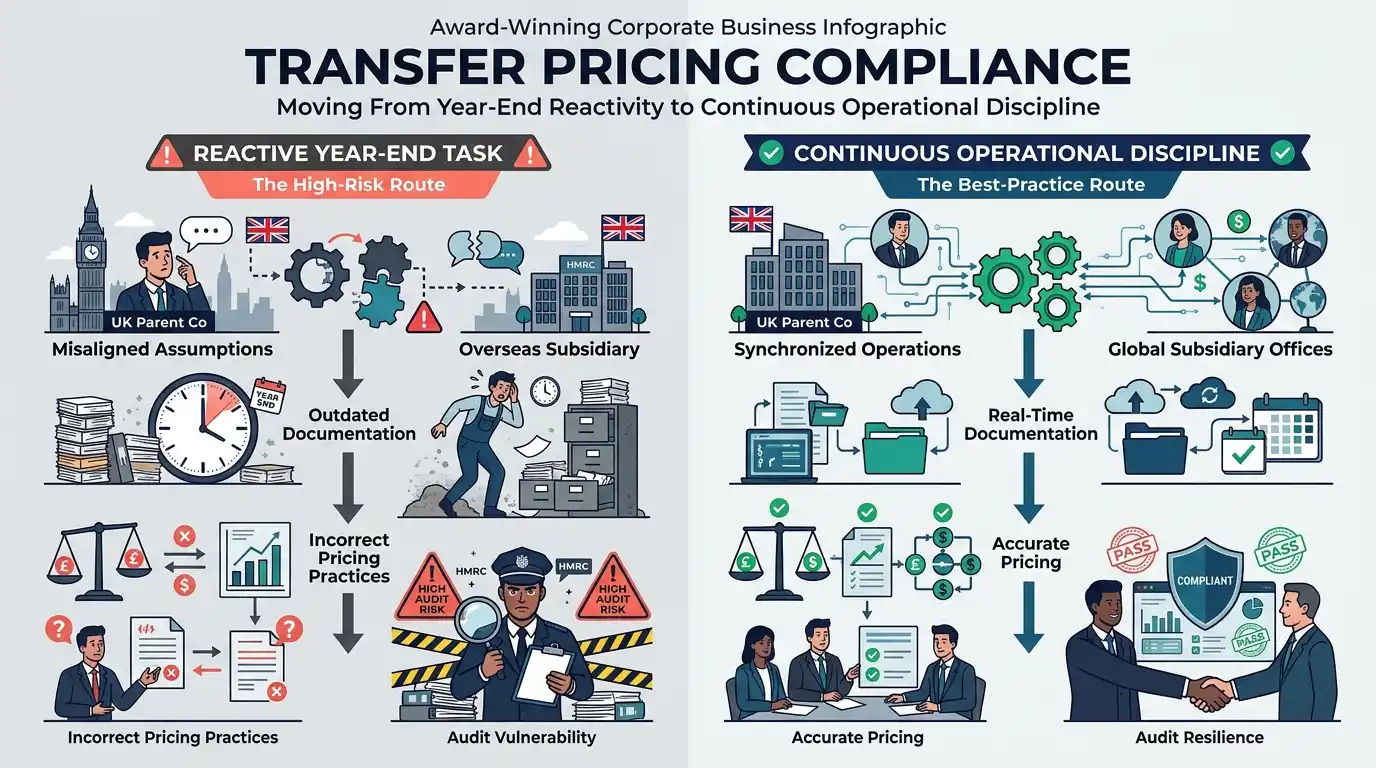
Multinational energy enterprises frequently encounter systemic pitfalls in their transfer pricing management:
1. Treating Transfer Pricing as Solely a Tax Department Responsibility
Many organizations assume transfer pricing is exclusively the responsibility of corporate tax specialists. In practice, operational managers set the commercial terms, contract structures, and service arrangements that create tax exposure. Without cross-departmental training, operational choices frequently conflict with global tax policies.
2. Relying on Generic, Off-the-Shelf Documentation Templates
Using generic documentation templates exposes energy groups to tax adjustments. Oil and gas operations involve unique risk allocations, heavy capital investments, long pay-back horizons, and complex joint-operating agreements. Compliance documentation must reflect the specific commercial realities of energy value chains.
3. Assuming Commodity Prices Automatically Satisfy Arm's Length Standards
Finance teams often assume published market index prices (such as Brent or WTI benchmarks) satisfy transfer pricing requirements for crude oil and gas sales. Tax authorities require detailed adjustments for quality differentials, API gravity, sulfur content, delivery terms (FOB vs CIF), and transportation costs.
4. Viewing Compliance as a Static Annual Event
Treating compliance documentation as a once-a-year filing exercise leaves companies vulnerable to unexpected regulatory shifts. Effective transfer pricing management requires continuous monitoring, mid-year adjustments, and real-time transaction tracking across all operating subsidiaries.
Investing in targeted corporate training resolves these misconceptions. Up-to-date professional development ensures all enterprise teams understand how daily commercial decisions impact global tax compliance, protecting the organization against fiscal disruption.
Frequently Asked Questions
What is Oil & Gas Petroleum Taxation?
Oil & Gas Petroleum Taxation refers to the specialised fiscal regimes, legal frameworks, and tax liabilities applied to upstream, midstream, and downstream energy operations. The Institute For Oil & Gas Training provides comprehensive instruction on these unique structures, covering royalty payments, petroleum revenue taxes, production-sharing contracts, and ring-fenced corporate tax rules. Mastering these principles enables energy professionals to ensure strict regulatory compliance and optimize cross-border tax management.
Why is Oil & Gas Petroleum Taxation crucial for energy companies?
Petroleum tax regimes directly govern project profitability, capital allocation, and investment viability in international resource development. Training from the Institute For Oil & Gas Training equips corporate teams to navigate volatile tax liabilities, mitigate audit risks, and avoid double taxation on multinational assets. Proper understanding of Oil & Gas Petroleum Taxation ensures organizations maintain full compliance while protecting long-term project yields.
Who should undertake training in Oil & Gas Petroleum Taxation?
This specialised training is designed for corporate tax specialists, finance managers, energy lawyers, petroleum accountants, and executive decision-makers within multinational energy groups. The Institute For Oil & Gas Training tailors its practical curriculum to help functional teams align financial planning with global compliance requirements. Participants acquire practical competencies to audit intercompany transactions and manage country-by-country tax reporting.
How does Oil & Gas Petroleum Taxation differ from standard corporate taxation?
Unlike standard corporate taxes, petroleum taxation incorporates ring-fencing provisions, resource rent taxes, sliding-scale royalties, and complex joint-operating cost allocations. The Institute For Oil & Gas Training examines how these regulatory mechanisms isolate energy field income from other commercial activities. Understanding these differences allows corporations to set accurate transfer pricing policies and defend financial disclosures during tax audits.
How can professionals build expertise in Oil & Gas Petroleum Taxation?
Professionals build expertise through structured, industry-aligned training programs that combine legal frameworks, economic analysis, and practical case studies. The Institute For Oil & Gas Training delivers outcome-driven courses covering OECD BEPS standards, transfer pricing, and fiscal risk management. Participating in targeted professional development ensures cross-functional teams effectively protect enterprise capital across global energy jurisdictions.
Related training courses
Gas Transmission and Distribution Pipeline Design Training Course
- Specialisation
- Oil & Gas Pipeline Integrity and Inspection
- Duration
- 5 days · 15 CPD hours
API 570 Piping Inspection and Integrity Assessment Training Course
- Specialisation
- Oil & Gas Inspection and Non-Destructive Testing
- Duration
- 5 days · 15 CPD hours
API 579 Fitness-For-Service Assessment Methods Training Course
- Specialisation
- Oil & Gas Inspection and Non-Destructive Testing
- Duration
- 5 days · 15 CPD hours
More articles

Transfer Pricing Documentation and Country by Country Reporting Training for Oil and Gas Tax Professionals
Master BEPS Action 13 compliance, Master File, Local File, and CbC Reporting with Institute For Oil & Gas Training professional courses.
Read article →
How to Assess Transfer Pricing Documentation and Country by Country Reporting Requirements for Oil and Gas Groups
Evaluate Transfer Pricing Documentation and CbC Reporting requirements for oil and gas groups. Assess compliance risks, frameworks, and audit readiness.
Read article →
Transfer Pricing Training for Oil and Gas Groups and Tax Professionals
Master cross-border tax compliance and intercompany pricing with structured training from Institute For Oil & Gas Training.
Read article →