

Evaluating transfer pricing compliance requires tax executives and corporate leaders to analyze risk exposure across cross-border intra-group transactions. Multinational enterprises in the energy sector face increasing scrutiny from global tax authorities enforcing stringent documentation standards under international frameworks.
Oil and gas groups operate complex value chains involving upstream exploration, midstream transport, refining, and marketing across multiple jurisdictions. Establishing robust compliance requires understanding Why Transfer Pricing Documentation Matters for Oil and Gas Multinational Groups to mitigate regulatory friction, control audit exposure, and align cross-border profit allocation with functional realities.
What Are the Core Documentation Requirements for Oil and Gas Multinational Groups?
Oil and gas multinational groups must maintain a three-tiered documentation structure comprising a master file, a local file, and a country by country report. These filings demonstrate that intra-group transactions reflect arm's length principles and align with economic substance.
Tax authorities enforce three distinct compliance tiers derived from the OECD Base Erosion and Profit Shifting framework. The master file provides a high-level overview of the global enterprise business operations, profit drivers, supply chains, and overall transfer pricing policy documentation. This document gives tax administrations global context regarding enterprise value creation.
The local file complements the master file by detailing specific intra-group transactions involving resident entity operational units. It contains detailed functional analyses, financial data, comparability analyses, and selected transfer pricing methods. In the energy industry, local files must detail high-value transactions including hydrocarbon sales, technical services, equipment leasing, and intercompany financing.
Country by country reporting requires ultimate parent entities to report annual financial metrics for each tax jurisdiction where they operate. This filing includes aggregate data on revenue, profit before income tax, income tax paid, stated capital, accumulated earnings, employee count, and tangible assets. Tax authorities use this information to conduct high-level transfer pricing risk assessments.
How Does the BEPS Action Plan Impact Oil and Gas Transfer Pricing Compliance?
The BEPS action plan aligns profit allocation with economic activity and value creation across global supply chains. Action 13 specifically forces oil and gas groups to increase operational transparency and standardize cross-border tax disclosures across all operating entities.
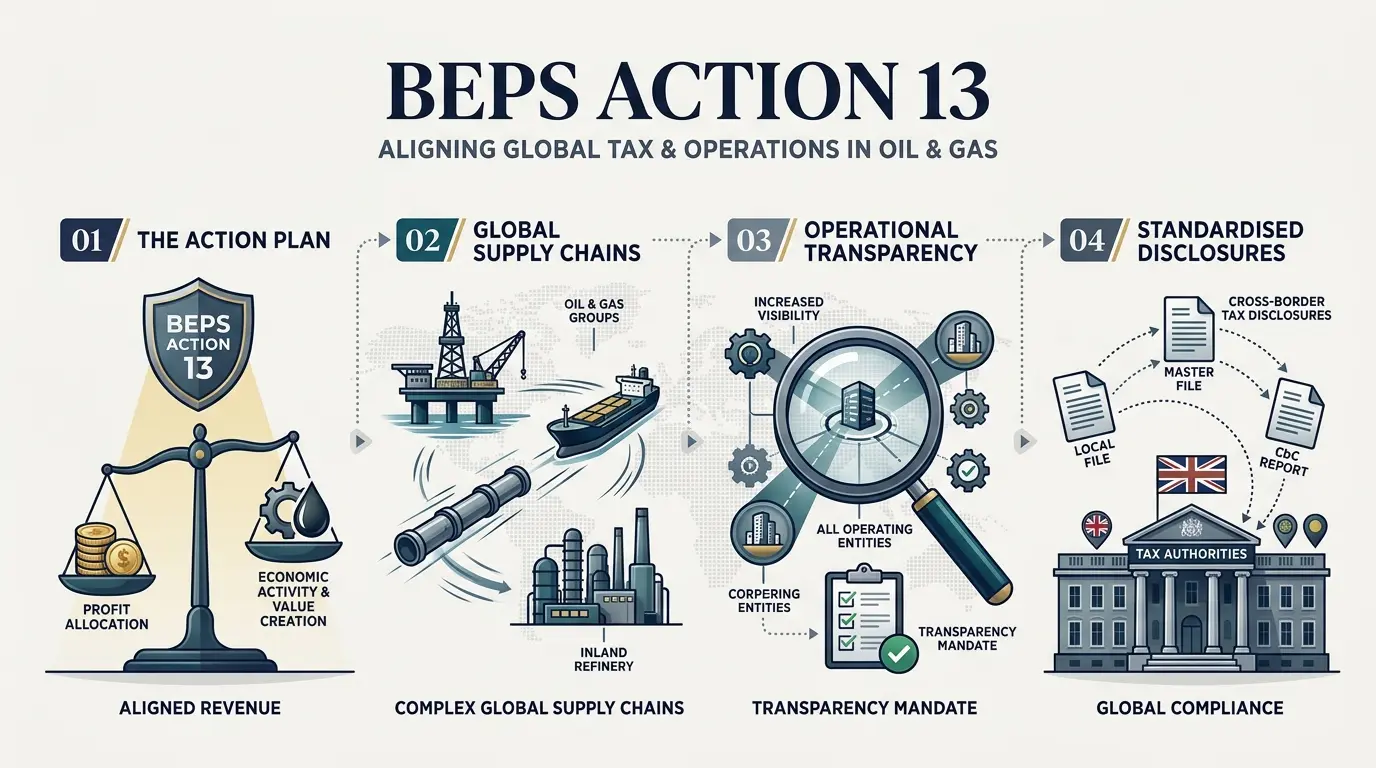
The implementation of Action 13 under the OECD guidelines transformed international tax compliance for energy multinationals. Energy companies manage capital-intensive assets, highly specialized technical know-how, and volatile commodity pricing structures. The framework eliminates tax planning strategies that artificially shift profits to low-tax environments without underlying economic substance.
Tax administrations actively scrutinize cost contribution arrangements, management fees, joint venture allocations, and risk-bearing entities within oil and gas groups. Compliance mandates demand strict alignment between contractual terms and the actual conduct of the parties. Operational teams must substantiate that entities claiming high profits possess the financial capacity and personnel to control corresponding business risks.
Failure to implement standardized reporting across operating subsidiaries increases audit selection probability. Energy companies must establish continuous internal processes to collect uniform operational metrics across exploration, extraction, and refining business units. This systematic approach ensures global alignment and prevents discrepancies between master file declarations and local jurisdiction tax filings.
How Should Energy Groups Evaluate Master File and Local File Preparation Approaches?
Energy groups evaluate preparation approaches by comparing internal in-house tax team execution against external advisory outsourcing. Organizations analyze internal operational capability, specialized technical expertise, software integration, and overall cost efficiency to select the optimal operating model.
In-house preparation grants corporate tax departments direct control over operational data and functional analyses. Internal teams possess deep familiarity with underlying oil and gas assets, intercompany agreements, and operational realities. However, building in-house capability requires significant continuous investment in specialized software platforms, comparative databases, and ongoing professional development.
Outsourcing documentation to global accounting firms provides immediate access to technical transfer pricing experts and regional tax specialists. External advisors bring specialized benchmarking software and comparative databases necessary for robust local file economic analyses. The primary drawbacks include high recurring external professional fees, potential disconnects regarding day-to-day operational nuances, and reduced internal knowledge retention.
Hybrid compliance models combine internal data aggregation with external expert review and benchmarking execution. Corporate headquarters prepares the global master file while regional tax managers collaborate with third-party advisors for local file filings. This balanced approach controls external expenditure while maintaining rigorous technical compliance across complex legal structures.
How Do Tax Teams Conduct Risk Assessments for Transfer Pricing Audits and Penalty Exposures?
Tax teams conduct risk assessments by benchmarking intercompany financial metrics against local regulatory standards and historical tax authority enforcement trends. Identifying functional discrepancies early reduces adjustment and penalty exposure during tax audits.
Transfer pricing audits in the oil and gas sector focus heavily on high-value intercompany transactions, long-term supply contracts, and technical service recharges. Tax authorities evaluate whether intercompany commodity pricing aligns with prevailing market indexes at the exact time of transaction execution. Discrepancies between contractual pricing formulas and actual market conditions trigger immediate audit queries.
Audit exposure escalates when local tax administrations issue secondary adjustments following initial transfer pricing assessments. These adjustments often result in double taxation on the same operating income across two jurisdictions. Furthermore, statutory penalty structures for non-compliance or inadequate documentation can reach 30 to 50 percent of the additional tax assessed.
To evaluate penalty risk, internal tax teams apply systematic risk-scoring matrices across all cross-border legal entities. These matrices assess transaction volume, host country audit aggressiveness, regulatory documentation deadlines, and the availability of comparable uncontrolled price data. Proactive assessment allows tax directors to remediate weak documentation prior to formal tax authority inquiries.
What Role Do Advance Pricing Agreements and Mutual Agreement Procedures Play in Dispute Resolution?
Advance pricing agreements establish binding upfront transfer pricing methodologies with tax authorities to prevent disputes. Mutual agreement procedures provide a formal international dispute resolution mechanism to relieve double taxation arising from post-audit adjustments.
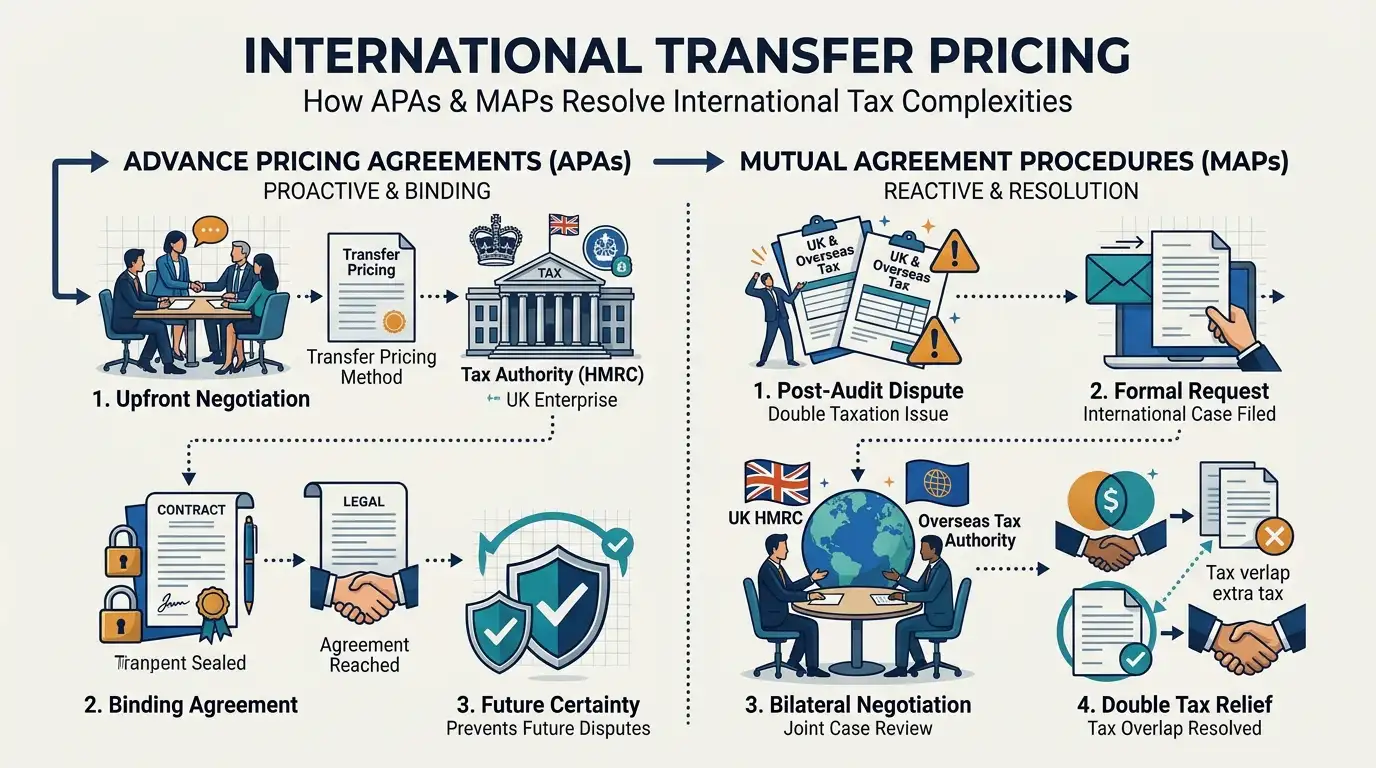
Unilateral, bilateral, and multilateral advance pricing agreements give oil and gas groups long-term certainty regarding intercompany pricing frameworks. Energy projects require multi-billion-dollar capital investments over decades. Securing an advance agreement eliminates transfer pricing uncertainty for major intercompany transactions, such as long-term gas sales agreements, pipeline transportation tariffs, and intellectual property licensing.
When tax authorities issue conflicting adjustments, energy groups rely on the mutual agreement procedure embedded within double tax treaties. This bilateral framework allows competent authorities from both contracting states to negotiate directly and resolve double taxation cases. While effective, dispute resolution through competent authority negotiations can require two to four years to conclude final settlements.
Organizations evaluate whether to pursue proactive advance agreements or reactive dispute resolution based on transaction size, operational longevity, and regulatory stability in host countries. High-value core operational assets justify the upfront financial and administrative investment required to secure bilateral advance pricing agreements.
How Should Corporate HR and Tax Leaders Address Workforce Skill Gaps in Compliance Management?
Corporate HR and tax leaders address skill gaps by implementing structured technical training programs that align cross-functional teams with international compliance standards. Structured upskilling improves cross-departmental coordination, reduces data collection friction, and ensures technical regulatory compliance.
Managing global documentation requirements demands technical expertise spanning international tax law, financial accounting, and energy sector economics. Organizations frequently experience critical skill gaps between core tax managers, business unit controllers, and operational HR managers. Operational teams often fail to recognize how daily commercial decisions impact statutory compliance obligations.
Corporate human resources departments partner with tax directors to design targeted professional development pathways for finance and legal personnel. Structured corporate learning interventions reduce reliance on expensive external tax counsel by building robust internal execution capabilities. Finance professionals learn to extract, validate, and structure operational data required for country by country disclosures efficiently.
Organizations seeking to build internal technical proficiency enroll specialized professionals in dedicated professional training programs. Enrolling key personnel in the Transfer Pricing Documentation and Country by Country Reporting Training for Oil and Gas Tax Professionals establishes consistent technical standards across global operations. Specialized training ensures that in-house teams master functional analysis, economic benchmarking, and audit defense strategies tailored specifically to energy enterprise operations.
For corporate learning directors evaluating structured curriculum solutions, integrating the formal Transfer Pricing Documentation & CbC Reporting Training Course into annual workforce development plans ensures systematic capability building. Aligning corporate learning initiatives directly with regulatory compliance requirements delivers measurable return on investment through reduced external advisory fees and minimized tax exposure.
How to Select the Right Compliance Management and Upskilling Framework?
Selecting the right framework requires evaluating organizational structure, cross-border transaction volume, internal technical expertise, and total compliance budget. Organizations balance external advisory reliance against internal capability development to build a sustainable compliance strategy.
Corporate decision-makers must evaluate their global footprint and the complexity of intercompany transactions across upstream, midstream, and downstream operations. Companies operating in high-risk tax jurisdictions require stronger documentation defenses and robust economic benchmarking. Leaders must audit existing internal tax department competencies to identify specific knowledge deficits in financial modeling, functional risk allocation, and regulatory reporting formats.
Evaluating the total cost of compliance involves analyzing both direct external expenditures and internal resource allocation. Investing in formal technical training yields substantial cost efficiencies for organizations managing multi-jurisdictional reporting burdens. Upfront skill development creates a self-sustaining internal architecture capable of managing annual compliance cycles independently.
Final selection demands aligning tax risk management with broader enterprise growth objectives. HR executives, corporate tax directors, and chief financial officers must collaboratively implement a integrated compliance roadmap. Combining robust documentation protocols with targeted employee skill development protects oil and gas groups against tax authority challenges and financial penalties globally.
Frequently Asked Questions
What is oil and gas petroleum taxation training?
Oil and gas petroleum taxation training covers the complex fiscal regimes, production sharing contracts, and revenue management strategies specific to the energy sector. Delivered by experts at the Institute For Oil & Gas Training, this professional instruction equips finance and legal teams to navigate international tax compliance, transfer pricing, and host government entitlements efficiently.
Why is specialized tax knowledge necessary for the oil and gas sector?
The upstream and downstream energy industries operate under unique financial structures, including resource rent taxes, ring-fencing rules, and joint venture accounting. Specialized training from the Institute For Oil & Gas Training helps finance directors and tax managers mitigate compliance risks and manage double taxation liabilities across multi-jurisdictional projects.
Who should attend an Oil & Gas Petroleum Taxation course?
This practical program is designed for tax managers, corporate accountants, finance directors, legal advisors, and government regulators working in energy group operations. The Institute For Oil & Gas Training delivers this curriculum to build core competencies in fiscal modeling, cross-border tax planning, and regulatory compliance for corporate workforce development.
How do petroleum fiscal regimes affect corporate tax liabilities?
Petroleum fiscal regimes—such as concessionary royalty-tax systems and contractual service agreements—determine how gross revenues and production volumes are divided between national governments and operating partners. A thorough understanding of Oil & Gas Petroleum Taxation allows corporate tax teams to evaluate contract terms accurately, optimize cost recovery, and maintain audit readiness.
How does petroleum taxation training assist with international tax compliance?
Mastering Oil & Gas Petroleum Taxation enables energy groups to align intercompany transactions with Base Erosion and Profit Shifting (BEPS) guidelines and global transfer pricing standards. Training through the Institute For Oil & Gas Training ensures professionals can structure cross-border service agreements, manage country-by-country reporting obligations, and prevent costly penalty exposures during international tax audits.
Related training courses
API 570 Piping Inspection and Integrity Assessment Training Course
- Specialisation
- Oil & Gas Inspection and Non-Destructive Testing
- Duration
- 5 days · 15 CPD hours
API 579 Fitness-For-Service Assessment Methods Training Course
- Specialisation
- Oil & Gas Inspection and Non-Destructive Testing
- Duration
- 5 days · 15 CPD hours
Corrosion Metallurgy & Failure Prevention Training Course
- Specialisation
- Oil & Gas Corrosion Management and Control
- Duration
- 5 days · 15 CPD hours
More articles

Transfer Pricing Documentation and Country by Country Reporting Training for Oil and Gas Tax Professionals
Master BEPS Action 13 compliance, Master File, Local File, and CbC Reporting with Institute For Oil & Gas Training professional courses.
Read article →
Why Transfer Pricing Documentation Matters for Oil and Gas Multinational Groups
Discover why transfer pricing documentation matters for oil and gas groups, how corporate training builds compliance, and ways to mitigate audit risks.
Read article →
Transfer Pricing Training for Oil and Gas Groups and Tax Professionals
Master cross-border tax compliance and intercompany pricing with structured training from Institute For Oil & Gas Training.
Read article →