

Financial evaluation in procurement ensures that organisations select suppliers capable of delivering long-term value without introducing commercial risk. Procurement teams analyze pricing models, cost structures, and balance sheets to prevent cost overruns, supplier failure, or poor performance during contract execution.
Mastering this evaluation framework protects capital investments across complex industrial projects. For a deeper understanding of why these commercial checks matter before tender assessment begins, consult our guide on Why Financial Evaluation Is Critical in Oil and Gas Supplier Selection.
How Do You Conduct a Commercial Bid Evaluation?
A commercial bid evaluation compares supplier pricing structures, payment terms, cost break downs, and contractual risks against the tender budget. Procurement specialists use standardized scoring models, should-cost modeling, and financial benchmarks to determine the true value of each proposal.
The commercial bid evaluation process converts raw price submissions into normalized, comparable figures. Unadjusted lump-sum prices obscure underlying commercial risks. Evaluating a bid requires breaking down the offer into core components: direct labor, material overheads, equipment rates, indirect margins, and contingency allocations.
First, procurement teams verify administrative compliance. Proposals must match the requested scope, currency, currency exchange assumptions, and tax structures. Unpriced line items or non-compliant payment terms alter the overall financial risk profile.
Second, evaluator teams apply cost breakdown analysis. Extracting unit rates and labor hours reveals where contractors underprice or overprice work packages. Bidders often load overheads into early project deliverables to maximize early cash flow—a practice known as front-end loading. Identifying this practice protects project cash flow.
Third, teams normalize all compliant bids against identical operational parameters. Variance analysis pinpoints outliers in labor rates, equipment maintenance allocations, or material markups. Comparing normalized bids against internal estimates highlights commercial discrepancies across all sub-factors.
What Are the Key Methods for Assessing Contractor Financial Health?
Contractor financial health assessment examines balance sheets, liquidity ratios, profitability metrics, and debt exposure. Evaluators calculate working capital, altman z-score, quick ratio, and leverage metrics to confirm the bidder can fund operations without insolvency risks.
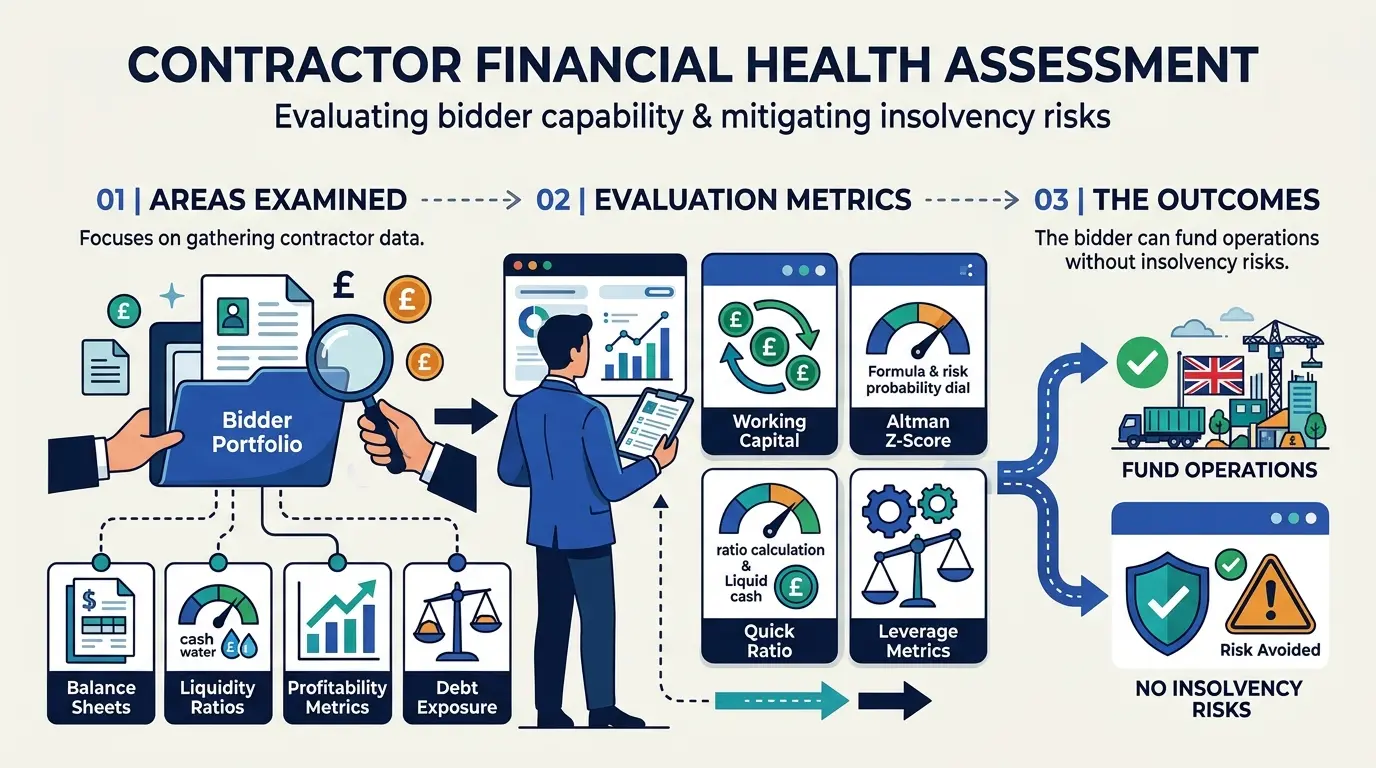
Assessing financial health determines whether a contractor remains solvent throughout the contract term. A low price offer carries severe risk if the contractor lacks working capital to procure materials, pay subcontractors, or manage cash delays.
Evaluators focus on four primary categories of financial metrics:
Liquidity Ratios: Current ratio (current assets divided by current liabilities) measures short-term debt coverage. A current ratio below 1.0 signals immediate cash constraints. The quick ratio removes inventory to measure immediate liquidity.
Solvency and Debt Exposure: The debt-to-equity ratio reveals capital structure stability. High debt leverage increases vulnerability to market downturns or project delays.
Profitability Trends: Stable gross margins over three consecutive financial years show operational consistency. Declining operating margins indicate inefficient cost control.
Cash Flow Stability: Operating cash flow must remain positive. Net income without positive operating cash flow indicates revenue recognition issues or uncollected receivables.
Reviewing audited financial statements for the past three years provides an accurate baseline. Parent company guarantees or bank comfort letters add protection when working with newly formed joint ventures or subsidiaries.
How Does Total Cost of Ownership Differ From Initial Tender Price?
Total Cost of Ownership calculates the complete financial impact of acquiring, operating, maintaining, and disposing of an asset or service over its lifespan. Initial tender price represents only the upfront purchase or construction cost, often ignoring long-term expenses.
Relying solely on the upfront tender price leads to suboptimal procurement choices. Equipment or services with a lower initial purchase cost frequently require higher maintenance expenditure, frequent spare parts replacement, or excessive energy consumption.
A structured lifecycle cost comparison calculates all cash flows over the operational lifespan using Net Present Value (NPV) formulas. Discount rates convert future operating and maintenance expenditures into present-day monetary values, allowing fair comparison between capital-intensive and low-CAPEX offers.
To master these complex lifecycle evaluation frameworks, commercial teams utilize the Financial Evaluation of Suppliers & Contractors: Tender Evaluation Training Course to build precise evaluation models.
Operational expenditures include energy consumption, routine servicing, software licensing, operator training, and downtime risks. Selecting higher-efficiency equipment with a 15 percent premium on initial price often lowers lifecycle costs by 30 percent over a ten-year operational span.
Contractors must submit detailed operational cost schedules alongside their initial pricing. Establishing binding operational performance guarantees within the tender documentation ensures contractors remain accountable for their lifecycle projections.
How Do Evaluators Detect and Handle Abnormally Low Bids?
Evaluators detect abnormally low bids by comparing proposals against internal should-cost models, historical benchmarks, and median bid values. Bids falling 15 to 20 percent below the benchmark trigger mandatory financial clarification and detailed cost justification.
An abnormally low bid presents severe risks to project execution. Contractors offering unrealistically low prices face margin collapse, leading to scope cuts, low-quality materials, dispute escalation, or supplier insolvency mid-project.
Detecting these offers relies on structured pricing comparisons:
Rate Benchmarking: Evaluators compare unit rates for labor, plant, and key materials against prevailing market rates.
Should-Cost Modeling: Internal estimators construct an independent bottom-up cost model based on engineering scopes, required productivity rates, and baseline resource costs. Bids deviating significantly below this baseline require review.
Variance Analysis: Evaluators measure individual line-item deviations against the median bid average. Extreme negative variances in critical path items flag potential scope misunderstandings.
Upon detecting an abnormally low bid, procurement teams issue a formal request for clarification. The contractor must provide evidence of specialized execution methods, discounted supply chain agreements, or unique technological advantages that justify the low cost.
If the contractor cannot demonstrate commercial viability, the evaluation committee disqualifies the proposal. Accepting unviable bids damages supply chain stability and guarantees cost growth through claims during execution.
What Role Do Price Escalation and Payment Terms Play in Evaluation?
Price escalation clauses and payment terms dictate cash flow distribution, inflation exposure, and commercial risk sharing between parties. Evaluators adjust financial scores based on payment advance requests, milestones, and price adjustment indexations.
Payment terms directly influence contractor cash flow and client working capital. Offers requesting high advance payments without bank guarantees transfer cash flow risk to the client.
Evaluators assess payment terms by evaluating:
Advance Payment Limits: Advance payments must match mobilization expenses and require an unconditional bank guarantee.
Milestone Alignment: Payment milestones must align strictly with verified physical progress rather than calendar dates.
Retentions: Standard performance retentions (typically 5 to 10 percent) protect against defective execution during the defects liability period.
Price escalation clauses define how inflation, fuel spikes, or commodity price shifts affect the contract price over time. Fixed-price contracts transfer inflation risk to the contractor, but contractors include higher risk contingencies in their base bids to compensate.
Indexation formulas link cost adjustments to official economic publication indices. Evaluators model various inflation scenarios to estimate maximum contract price exposure over multi-year agreements.
Evaluation Metric | Fixed-Price Structure | Index-Linked Escalation Structure |
Inflation Risk Allocation | Transferred entirely to contractor | Shared between client and contractor |
Initial Base Tender Price | Higher (includes contingency padding) | Lower (reflects current market rates) |
Price Predictability | High initial certainty | Variable over contract lifetime |
Contract Administration | Simple invoice processing | Requires index tracking and recalculation |
Suitability | Short duration (<12 months) | Multi-year or commodity-dependent projects |
How Do You Use Negotiation Levers to Secure Commercial Improvements?
Procurement teams use negotiation levers like payment term adjustments, scope rationalization, volume commitments, and risk re-allocation during post-tender negotiations. Evaluators identify target cost drivers within bid proposals to negotiate commercial savings.
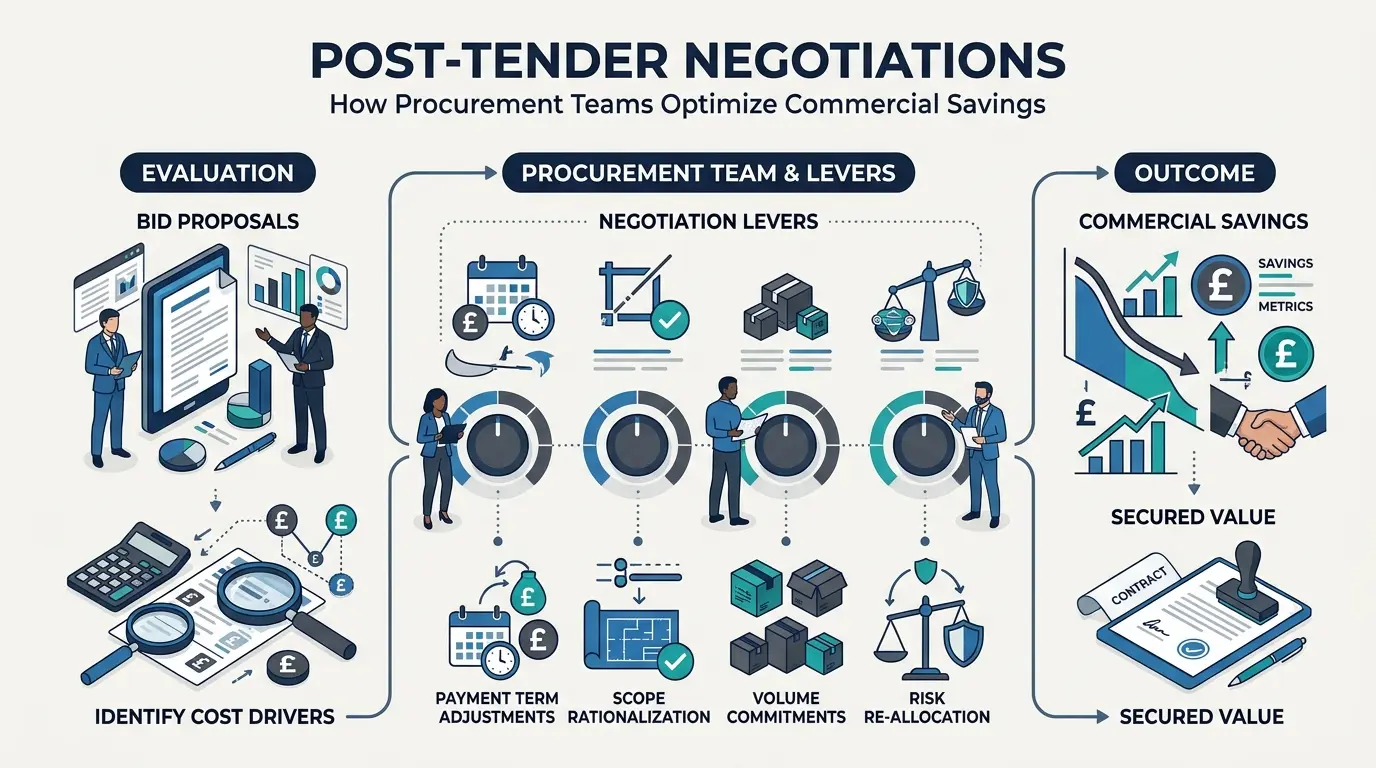
Negotiation occurs after bid scoring narrows the tenderers to a shortlisted group. Utilizing effective negotiation levers requires understanding the contractor’s underlying cost drivers, profit margins, and capacity utilization.
Evaluators extract negotiation targets directly from the cost breakdown analysis. Unreasonable equipment markups, inflated preliminary costs, or excessive contingency allocations form the primary targets for commercial discussions.
Standard negotiation levers include:
Payment Speed for Price Discounts: Offering shorter payment cycles (e.g., 30 days instead of 60 days) in exchange for a reduction in total contract price.
Risk Re-allocation: Removing severe penalty clauses or indemnity caps that forced the contractor to price large risk contingencies into their tender.
Scope Optimization: Rationalizing non-essential specifications or substituting materials without lowering operational standards.
Volume Commitments: Guaranteeing higher work volumes or extended contract terms across multiple sites in exchange for lower unit rates.
Organisations seeking to build these negotiation capabilities within their procurement teams routinely adopt structured corporate training frameworks like the Financial Evaluation of Suppliers and Contractors Tender Evaluation Training by Institute For Oil & Gas Training to establish standardized evaluation practices.
Systematic commercial negotiation relies on clear, evidence-based cost data rather than arbitrary price reduction demands.
How Do You Build a Structured Financial Evaluation Framework?
A structured financial evaluation framework combines clear scoring weights, commercial compliance gates, financial ratio analysis, and cost modeling into a repeatable matrix. This matrix standardizes tender evaluation across procurement teams.
Developing a reliable evaluation framework prevents subjective decision-making and ensures compliance with corporate governance standards. The matrix must assign explicit weighting between technical and commercial capabilities based on project complexity.
The decision framework below outlines the process for evaluating commercial proposals:
Evaluation Stage | Primary Objective | Key Deliverables & Methods | Pass/Fail or Weighted |
1. Commercial Compliance | Verify tender submission completeness | Administrative check, tax status, currency verification | Pass/Fail Gate |
2. Financial Solvency | Assess contractor balance sheet risk | Liquidity ratios, Altman Z-Score, balance sheet audit | Pass/Fail Gate |
3. Cost Structure Analysis | Identify front-loading and outliers | Cost breakdown analysis, rate benchmarking | Formative Assessment |
4. Lifecycle Costing | Determine total cost of ownership | Net Present Value (NPV) calculation, operational modeling | Weighted Scoring (30-50%) |
5. Risk & Escalation Check | Evaluate exposure to claims and indexation | Index modeling, payment term adjustment | Weighted Scoring (10-20%) |
6. Commercial Recommendation | Final rank and negotiation strategy | Target savings plan, final evaluation report | Decision Output |
Building internal capability in applying this evaluation framework ensures consistent commercial decisions across all major capital purchases.
Frequently Asked Questions
What is covered in the Oil & Gas Petroleum Procurement training course?
The Oil & Gas Petroleum Procurement course by the Institute For Oil & Gas Training covers the complete supply chain lifecycle, including vendor selection, commercial bid evaluation, and contract administration. Participants learn how to mitigate supply chain risks, analyze total cost of ownership, and apply international procurement standards specific to upstream, midstream, and downstream operations.
How does specialized procurement training benefit oil and gas professionals?
Specialized procurement training equips energy professionals with the strategic sourcing frameworks and negotiation skills required to manage high-capital contracts efficiently. By studying industry-specific risk allocation, rate benchmarking, and category management through the Institute For Oil & Gas Training, teams reduce project cost overruns and improve vendor compliance in Oil & Gas Petroleum Procurement.
Who should attend an Oil & Gas Petroleum Procurement course?
This program is designed for procurement managers, supply chain specialists, contract administrators, and commercial specialists working within the energy sector. Organizations enrol their supply chain and legal personnel in the Institute For Oil & Gas Training to bridge workforce skill gaps and align strategic purchasing decisions with measurable business outcomes.
What are the key challenges in petroleum procurement and supply chain management?
Petroleum procurement faces unique challenges, including volatile commodity pricing, complex geopolitical compliance regulations, and severe supplier solvency risks. The Oil & Gas Petroleum Procurement curriculum at the Institute For Oil & Gas Training addresses these issues by teaching advanced should-cost modeling, abnormally low bid detection, and robust price escalation clauses.
How does this course improve supplier financial evaluation during tendering?
The course trains procurement specialists to analyze contractor balance sheets, cash flow stability, and liquidity ratios before awarding contracts. Through practical frameworks provided by the Institute For Oil & Gas Training, participants master Oil & Gas Petroleum Procurement techniques that protect capital projects against contractor default and hidden operational expenditures.
Related training courses
Procure-to-Pay (P2P) End-to-End Process for Oil & Gas Training Course
- Specialisation
- Oil & Gas Petroleum Procurement
- Duration
- 5 days · 15 CPD hours
Vendor Management & Local Content Requirements: ICV Compliance Training Course
- Specialisation
- Oil & Gas Petroleum Procurement
- Duration
- 5 days · 15 CPD hours
Financial Evaluation of Suppliers & Contractors: Credit Assessment Training Course
- Specialisation
- Oil & Gas Petroleum Procurement
- Duration
- 5 days · 15 CPD hours
More articles

Financial Evaluation of Suppliers and Contractors Tender Evaluation Training by Institute For Oil & Gas Training
Evaluate commercial bids effectively. Join the Financial Evaluation of Suppliers & Contractors: Tender Evaluation Training Course today.
Read article →
Why Financial Evaluation Is Critical in Oil and Gas Supplier Selection
Learn why financial evaluation of oil and gas suppliers mitigates supply chain risks, ensures financial stability, and improves tender decisions.
Read article →
Financial Evaluation of Suppliers and Contractors Credit Assessment Training by Institute For Oil & Gas Training
Master credit assessment for procurement risks with Institute For Oil & Gas Training. Evaluate contractor financial health and liquidity.
Read article →