

Corporate tax planning and compliance represent the strategic alignment of financial operations with statutory regulations to ensure precise tax provisioning, error-free return filing, reduced penalty exposure, optimized current and deferred tax assets, and complete transparency during statutory audit reviews.
Organizations operate within dynamic, multi-jurisdictional tax landscapes that demand systematic execution. Corporate tax planning involves structured forecasting of operational decisions, capital investments, and transaction structures to ensure legal tax minimization. Compliance encompasses the continuous monitoring, preparation, and submission of statutory documentation within legal deadlines. In modern enterprises, tax planning and compliance function not as passive accounting tasks, but as cross-functional operational disciplines requiring integration across finance, legal, supply chain, and executive leadership teams.
When organizations neglect systematic tax management, financial statements become susceptible to material misstatements, legal penalties, and restatements. Integrating structured tax planning directly with tax provisioning ensures that current tax liabilities and deferred tax accounts reflect realistic balance sheet positions under international accounting standards such as IFRS 112 and IAS 12. Corporate decision-makers rely on clear tax governance frameworks to preserve operational liquidity, protect cash flows, and present transparent financial metrics to stakeholders, external auditors, and regulatory bodies.
How Does Tax Governance Work Across Business Operations?
Tax governance operates through systematic cross-departmental protocols, structured financial data workflows, automated compliance tracking, clear internal controls, continuous reconciliation, and mandatory risk assessment frameworks that align daily transaction accounting directly with regulatory filing obligations and provisioning standards.
The execution of corporate tax governance relies on synchronized steps across the entire accounting lifecycle. General ledger transactions from enterprise resource planning systems undergo continuous scrutiny to categorize taxable income, allowable deductions, and non-deductible operational expenses. Finance teams translate operational accounting data into formal tax positions, calculating current tax obligations and deferred tax balances. This systematic process ensures that statutory tax returns align perfectly with public financial disclosures and periodic balance sheet reports.
Successful corporate execution requires formal workflows between accounting specialists, operational managers, and corporate leaders. The table below details the operational stages of tax governance:
Governance Stage | Primary Operational Focus | Key Deliverable / Outcome |
1. Data Ingestion | ERP general ledger extraction and mapping | Clean financial data ledger |
2. Tax Classification | Distinguishing temporary vs permanent differences | Accurate taxable income base |
3. Provisioning Calculation | Computing current tax liabilities and deferred tax assets | IAS 12 / ASC 740 balance sheet entries |
4. Compliance Execution | Managing statutory submission schedules | Timely return filings without penalties |
5. Audit & Reconciliation | Matching filed returns against financial provisions | Verified tax reconciliation statement |
Organizations build robust internal control structures to manage risk exposure across these five operational stages. Senior finance leaders establish sign-off protocols, continuous balance sheet reviews, and automated check-ins to verify that tax provisions accurately mirror real-world operational liabilities. Systematic workflows eliminate reliance on isolated spreadsheet calculations, creating scalable corporate compliance frameworks across multi-national entities.
What Key Components Form a Complete Corporate Tax Framework?
A complete corporate tax framework includes structured compliance calendars, systematic tax return preparation, current and deferred tax provisioning modules, tax reconciliation processes, uncertain tax position evaluations, regulatory correspondence management, and strict record retention protocols.
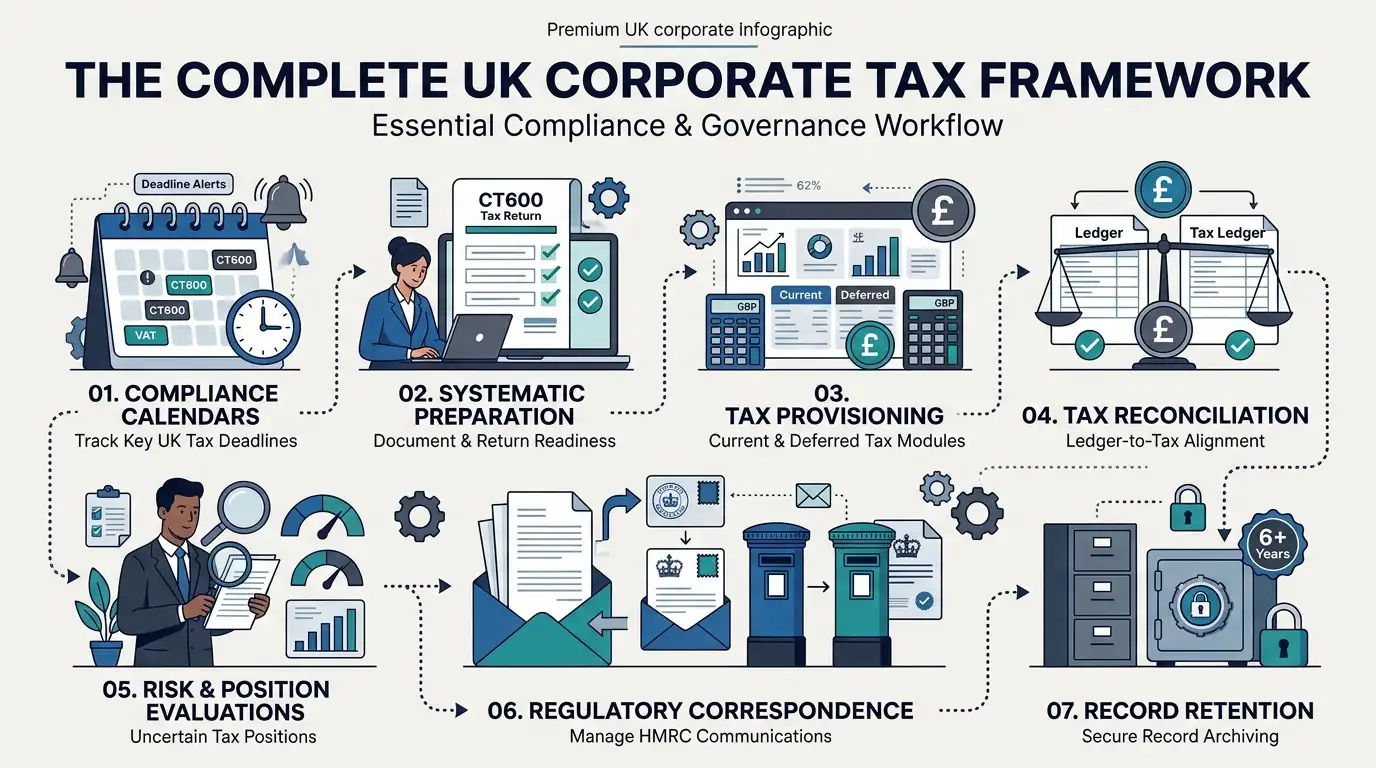
Core Components of Enterprise Tax Management
Tax Compliance Calendar: A structured management system establishing strict timelines for corporate tax filings, statutory audits, and mandatory payments across local, national, and international jurisdictions.
Tax Return Preparation: Systematic compilation and verification of corporate financial statements to ensure error-free submission of corporate tax declarations.
Instalment and Provisional Payments: Ongoing cash flow management frameworks calculated to satisfy advance tax obligations throughout the fiscal year and prevent late-payment interest charges.
Current and Deferred Tax Provision: Financial accounting structures calculating immediate tax liabilities alongside future tax assets or liabilities arising from temporary accounting differences.
Tax Reconciliation: Formal mathematical alignment matching statutory tax expenses with accounting profits multiplied by applicable tax rates.
Uncertain Tax Positions: Risk management frameworks identifying, quantifying, and reserving capital for aggressive or debatable tax positions subject to authority challenge.
Tax Authority Correspondence: Standardized communication protocols managing official inquiries, information requests, statutory notices, and formal tax dispute procedures.
Record Retention Requirements: Legal data management policies mandating the secure storage and retrieval of financial records, transaction receipts, and working papers for 7 to 10 years.
Why Is Employee Upskilling Essential for Tax Filing Accuracy?
Workforce upskilling bridges critical competency gaps, eliminates recurring manual accounting errors, equips finance teams with updated statutory interpretations, standardizes multi-entity tax procedures, and ensures that internal teams calculate current and deferred tax provisions without relying on external consultants.
Corporate finance teams frequently encounter significant skill gaps when tax laws undergo statutory revisions. Without structured workforce development, accounting personnel rely on outdated calculation methods that introduce material errors into current and deferred tax provisioning. Upgrading the technical skills of tax professionals, corporate accountants, and finance managers ensures that complex tax treatments—such as asset depreciation, cross-border transfer pricing, and research credits—are correctly applied across internal financial ledgers.
To achieve lasting institutional capability, organizations must evaluate their operational processes and underlying risk exposures before executing targeted learning initiatives. Business leaders often ask how to evaluate tax filing processes and tax provisioning risks in oil and gas companies to pinpoint structural vulnerabilities in capital-intensive sectors before training their personnel. Structured capability building transforms corporate tax teams from transactional accountants into strategic financial advisers capable of mitigating complex compliance risks.
Standardizing technical competencies across global subsidiaries eliminates operational friction during quarterly consolidation reviews. When teams possess advanced training in tax reconciliation and statutory compliance calendar maintenance, internal handoffs become seamless. Corporate learning initiatives empower teams to manage complex tax authority correspondence, document retention protocols, and tax provision calculations internally, reducing corporate reliance on external advisory firms by up to 35%.
What Key Capabilities Are Developed Through Structured Tax Training?
Structured tax training builds core competencies in tax provisioning calculations, deferred tax asset valuation, cross-border tax compliance management, statutory reconciliation, advance tax forecasting, statutory record retention compliance, and risk mitigation strategies for uncertain tax positions.
Professional development programs deliver structured knowledge across technical accounting dimensions:
Advanced Tax Provisioning and Balance Sheet Accounting
Finance professionals master the precise accounting mechanics required under IAS 12 and ASC 740. Participants learn to isolate permanent tax differences from temporary timing differences, ensuring accurate current tax provision calculations. Training builds proficiency in assessing the realisable value of deferred tax assets, calculating deferred tax liabilities, and recording balance sheet adjustments with absolute precision.
Automated Compliance Management and Risk Mitigation
Workforce development focuses on establishing robust organizational systems. Professionals acquire skills to design and execute an enterprise-wide tax compliance calendar, ensuring zero missed statutory deadlines across operating subsidiaries. Teams learn structured protocols to assess uncertain tax positions, quantify potential penalty exposures, manage regulatory correspondence, and implement compliant record retention policies across physical and digital archives.
Financial Statement Tax Reconciliation
Participants master the technical preparation of tax reconciliations that connect statutory rate expectations with actual effective tax rates reported in corporate financial statements. Training equips staff to analyze permanent disallowances, tax credits, rate differentials, and prior-year adjustments. The Tax Planning & Compliance for Filing & Provisioning Training Course equips finance professionals with these exact practical competencies, providing structured frameworks to streamline filing operations and master balance sheet tax accounting.
How Do Organizations Implement Corporate Tax Upskilling Programs?
Organizations implement corporate tax upskilling through a four-stage process: assessing baseline technical capabilities, designing job-aligned training modules, delivering practical interactive workshops, and embedding post-training performance metrics to verify operational application.
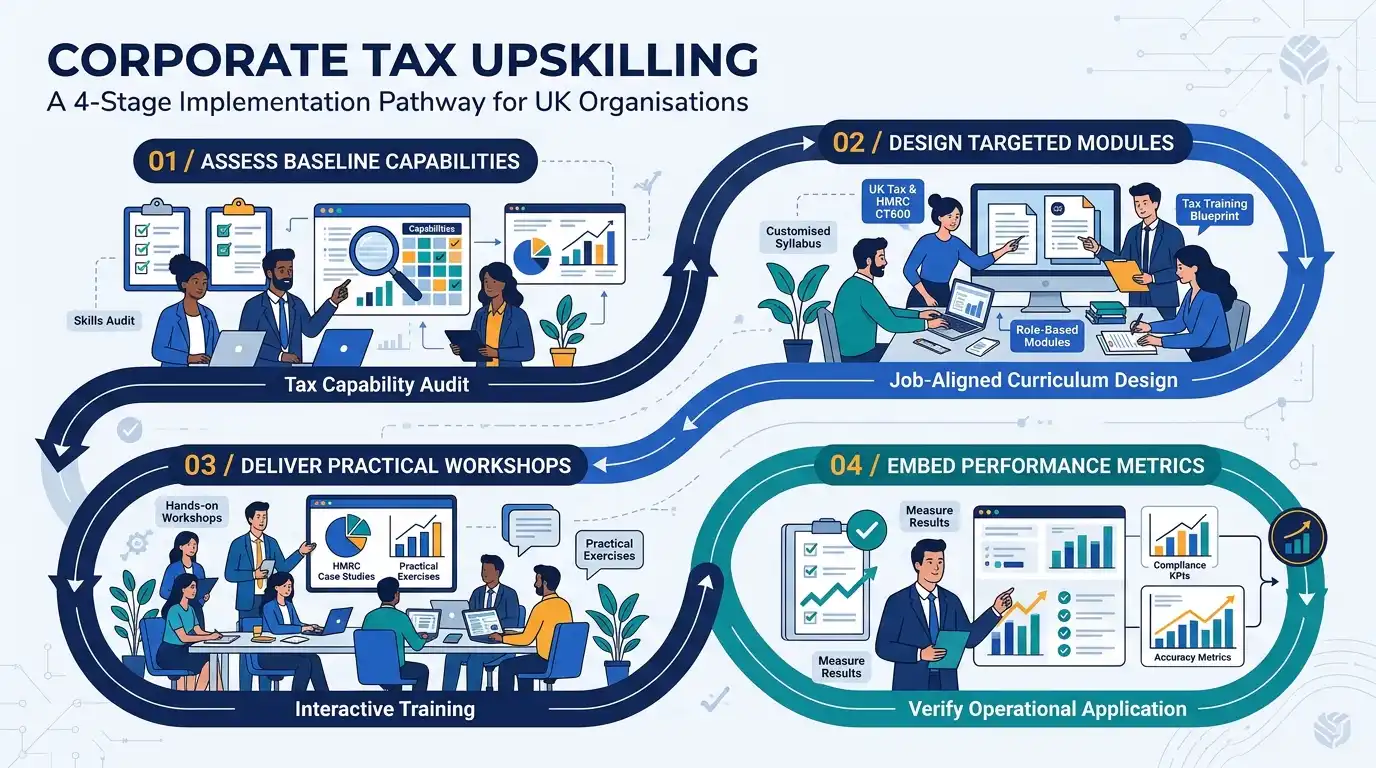
Successful organizational implementation requires a disciplined approach to learning design. Learning and development leaders partner with corporate tax heads to map current skills against operational requirements. This ensures that training directly addresses specific corporate vulnerabilities, such as deferred tax miscalculations, delayed provisional tax payments, or inadequate working paper retention.
Corporate learning programs yield the highest return on investment when delivered through practical methodologies:
Case-Based Corporate Simulations: Finance teams analyze real-world corporate tax returns, working through complex adjustments for depreciation, non-deductible expenses, and tax credits.
Interactive Provisioning Workshops: Accountants build dynamic current and deferred tax provisioning models using realistic enterprise balance sheet data.
Role-Playing Regulatory Correspondence: Team leaders simulate tax authority audits, practicing clear response protocols, evidence presentation, and negotiation strategies.
Hybrid Learning Pathways: Professionals complete self-paced technical e-learning modules on tax regulations, followed by live, expert-led workshops focusing on practical application.
Embedding these learning formats into corporate training schedules ensures immediate workplace application. Teams translate classroom learning directly into refined accounting workflows, standardized working papers, and enhanced risk assessment matrices during quarterly financial closes.
What Measurable Business Outcomes Does Tax Compliance Training Produce?
Tax compliance training produces measurable business outcomes, including an 85% reduction in statutory filing errors, a 40% decrease in tax authority penalty exposure, a 30% reduction in quarterly close cycle times, and complete elimination of material audit restatements.
Investing in structured corporate training delivers clear, quantifiable financial returns for business organizations across sectors like manufacturing, energy, telecommunications, and financial services. By upgrading internal technical capabilities, organizations safeguard cash flow, reduce reliance on external advisory retainer fees, and protect brand reputation against public tax dispute exposure.
Continuous professional development transforms the tax function from a cost center into a value-generating asset. Well-trained finance professionals identify legitimate tax saving opportunities, manage cash flows efficiently through accurate provisional tax payment forecasting, and maintain flawless compliance documentation. Corporate leaders gain total confidence in their financial reports, knowing that internal teams possess the technical expertise required to navigate complex tax regulations successfully.
Frequently Asked Questions
What is oil and gas petroleum taxation training?
Oil and gas petroleum taxation training covers the complex fiscal regimes, statutory compliance requirements, and tax provisioning frameworks specific to the energy sector. Delivered by specialists at the Institute For Oil & Gas Training, this professional instruction equips corporate finance, accounting, and legal teams to manage production-sharing contracts, ring-fencing rules, and petroleum profit tax obligations accurately.
Why is specialized petroleum taxation expertise required in the energy sector?
Petroleum taxation involves unique fiscal mechanisms, including royalties, cost recovery, windfall profit taxes, and complex depreciation schedules for capital investments. Enterprise teams rely on Oil & Gas Petroleum Taxation skills to calculate current and deferred tax liabilities correctly, maintain regulatory compliance, and reduce penalty exposure during authority audits.
Who should enroll in an oil and gas petroleum taxation program?
This professional development program targets corporate tax managers, petroleum accountants, finance leaders, legal advisers, and compliance managers working in upstream, midstream, or downstream energy companies. Organizations partner with the Institute For Oil & Gas Training to upskill decision-makers responsible for fiscal planning, statutory filing, and enterprise risk management.
How does petroleum taxation impact tax provisioning and corporate risk?
Miscalculating petroleum tax obligations can result in substantial balance sheet adjustments, statutory penalties, and delayed financial reporting cycles. Mastering Oil & Gas Petroleum Taxation ensures that corporate teams properly evaluate uncertain tax positions, maintain mandatory record retention standards, and accurately align accounting profits with statutory tax reconciliation frameworks.
What core topics are covered in the Institute For Oil & Gas Training petroleum tax course?
The curriculum explores fiscal regime structures, production sharing agreements, transfer pricing rules, tax compliance calendars, deferred tax asset valuation, and tax authority correspondence protocols. Through practical case studies, the Institute For Oil & Gas Training prepares finance professionals to execute precise return filings and optimize corporate tax management across global operations.
Related training courses
API 581 Risk Based Inspection Training Course
- Specialisation
- Oil & Gas Asset Integrity Management
- Duration
- 5 days · 15 CPD hours
Pipeline Defect Assessment and Fitness-for-Service Training Course
- Specialisation
- Oil & Gas Pipeline Integrity and Inspection
- Duration
- 5 days · 15 CPD hours
Pipeline Inspection Data Analysis and Integrity Evaluation Training Course
- Specialisation
- Oil & Gas Pipeline Integrity and Inspection
- Duration
- 5 days · 15 CPD hours
More articles

How to Evaluate Tax Filing Processes and Tax Provisioning Risks in Oil and Gas Companies
Evaluate tax filing processes and tax provisioning risks in oil and gas companies with structured risk assessment frameworks and training metrics.
Read article →
Transfer Pricing Training for Crude Marketing and Financing in the Oil and Gas Industry
Master transfer pricing for crude marketing and intercompany financing. Spec-driven training by Institute For Oil & Gas Training for compliance teams.
Read article →
How to Evaluate Transfer Pricing Methods for Crude Marketing and Oil and Gas Financing Transactions
Evaluate transfer pricing methods for crude marketing and oil financing transactions to ensure regulatory compliance and tax efficiency.
Read article →