

This training course addresses complex intercompany transaction risks by providing tax, finance, and legal professionals with practical frameworks for pricing crude sales, marketing margins, intra-group loans, and head office service allocations in full compliance with global OECD standards.
Multinational energy companies operate within intricate cross-border structures where internal transactions are subject to intense scrutiny from global tax authorities. Misalignments in internal pricing models lead directly to severe audit adjustments, double taxation, penalties, and protracted legal disputes. Establishing defensible transfer pricing policies requires specialized technical skill sets that bridge crude oil commercial trading, corporate finance principles, and international tax law.
Organizations frequently face challenges when establishing compliant pricing structures for physical trading and financial transactions. To understand the initial economic drivers and tax risks behind these intercompany arrangements, tax and finance professionals can review our comprehensive analysis on Why Transfer Pricing Matters in Crude Oil Marketing and Intercompany Financing. Building upon these foundational principles, operational teams require structured, spec-driven training to implement compliant systems within their daily workflows.
The Institute For Oil & Gas Training has developed the Transfer Pricing for Crude Marketing & Financing Training Course to solve these exact operational and compliance bottlenecks. This program delivers practical methodologies for valuing physical commodities, calculating arm's length financing terms, and distributing overhead expenses across corporate entities.
What is the course and what problem does it solve?
The program is an intensive technical workshop designed to eliminate compliance gaps, reduce audit exposure, and standardize internal transaction pricing for corporate energy finance, tax, and legal departments operating in volatile international crude oil markets across complex multinational business structures.
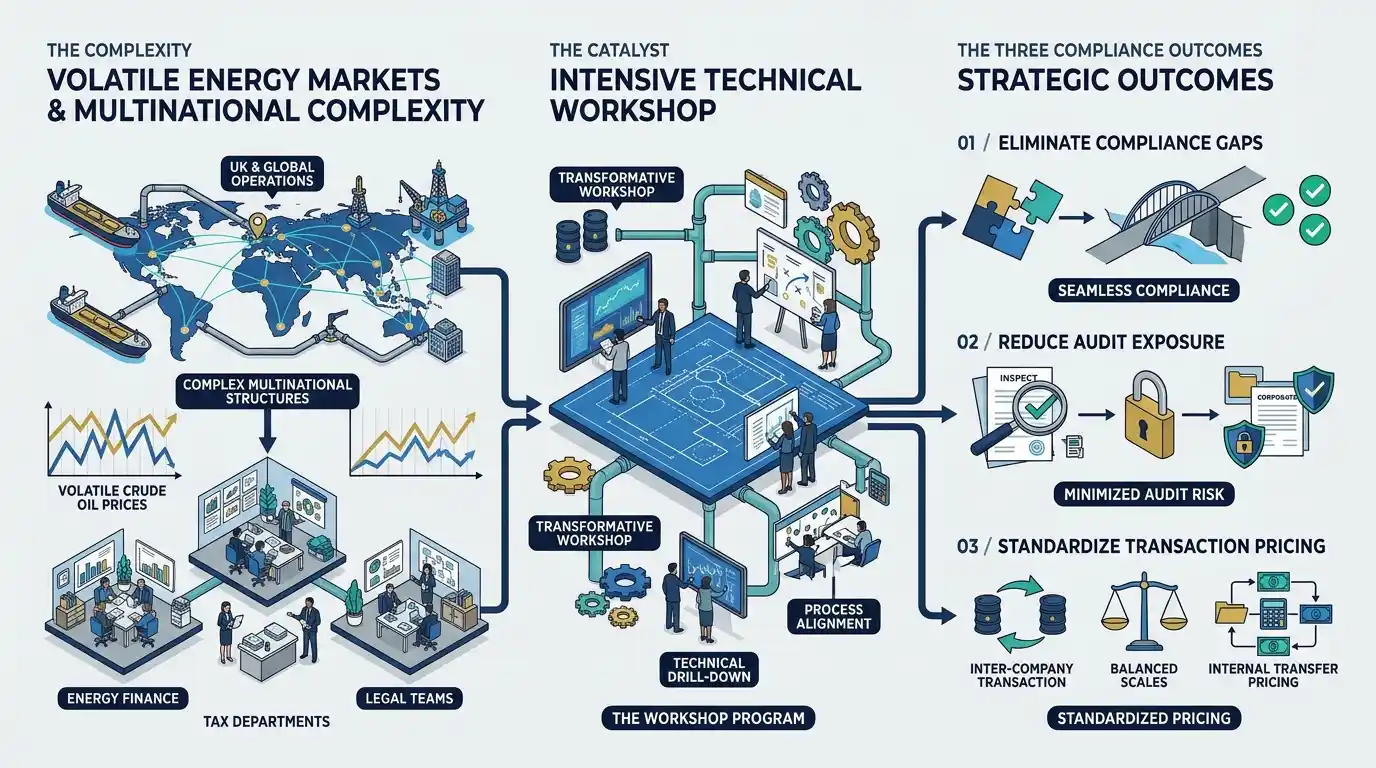
Corporate tax governance in the energy sector demands precise alignment between operational value creation and tax reporting. Energy enterprises frequently struggle with inconsistent transfer pricing policies across international subsidiaries, resulting in tax friction and exposure during regulatory audits. The primary operational gap lies in translating abstract OECD arm's length principles into functional trading room procedures, accounting entries, and legal agreements.
Tax departments often lack direct insight into physical trading mechanics, such as quality differentials and freight adjustments. Conversely, commercial trading desks rarely understand how their deal structures impact global tax liabilities or trigger arm's length compliance issues. This operational disconnect creates substantial tax liabilities, particularly when pricing cross-border physical crude streams or establishing interest rates for internal treasury loans.
The Institute For Oil & Gas Training designed this curriculum to bridge the gap between commercial oil trading operations and corporate tax compliance frameworks. Through structured instruction, the course establishes clear protocols for benchmark selection, transfer pricing documentation, and intercompany contract drafting. Participants gain the precise capabilities required to defend internal pricing structures before national tax authorities.
HR teams and department heads use this training program to upskill tax, finance, and treasury personnel into highly aligned compliance units. By formalizing intercompany pricing policies, organizations eliminate operational redundancies and build internal defenses against aggressive tax audits.
Why is this course structured this way?
The curriculum follows a progressive pedagogical architecture that moves systematically from foundational economic transfer pricing principles to advanced physical crude valuation, intercompany financial instrument modeling, and complex corporate cost allocation methodologies to maximize practical workplace retention and execution.
A practical transfer pricing program must reflect the real-world sequence of corporate finance and tax operations. Isolated theoretical modules fail because intercompany transactions in the energy sector are deeply interconnected. A physical crude trading strategy directly influences regional marketing margins, treasury capital structure decisions, and corporate overhead allocations.
The curriculum begins with the core economic principles governing physical commodity transactions before advancing to complex financial capital structures and head office charges. This sequential structure ensures that learners build an operational understanding of functional analysis before attempting to value complex financial instruments or defend pricing policies during audits. Participants evaluate real-world trade flows alongside legal contract terms to verify that contractual allocations match actual economic conduct.
When evaluating external educational programs, learning directors must assess whether the curriculum structure aligns with real-world corporate challenges. A detailed framework on How to Evaluate Transfer Pricing Methods for Crude Marketing and Oil and Gas Financing Transactions provides explicit criteria for selecting appropriate methodologies across varied transaction types. The curriculum structure directly mirrors these evaluation criteria to ensure immediate workplace application.
The Institute For Oil & Gas Training continuously refines this module flow using empirical feedback from corporate tax directors and energy CFOs. The resulting structure eliminates theoretical fluff, focusing strictly on functional methodologies, analytical models, and audit-ready documentation frameworks required by energy sector employers.
What will participants learn?
Participants master five core competencies: physical crude pricing adjustments, marketing margin determination, intra-group financial instrument pricing, head office cost allocation modeling, and transfer pricing audit defense documentation compliant with international regulatory standards.
Module 1: OECD Framework & Regulatory Fundamentals for Energy
Mapping physical crude trading flows against legal contract terms to identify functional risk allocations.
Applying the arm's length principle to integrated upstream, midstream, and downstream corporate structures.
Evaluating the impact of Base Erosion and Profit Shifting (BEPS) Action Plans on cross-border energy transactions.
Analyzing functional profiles: tolling entities, full-fledged distributors, and support service providers.
Module 2: Crude Sales to Related Parties & Physical Valuations
Valuing crude sales to related parties using the Comparable Uncontrolled Price (CUP) method and transactional net margin methods.
Utilizing reference pricing and posted prices alongside Platts and Argus benchmark quotations for pricing formulas.
Adjusting baseline commodity prices for quality differentials, API gravity variances, sulphur content, and loading locations.
Establishing defensible marketing margin levels for offshore trading hubs and regional distribution entities.
Module 3: Intra-Group Loan Pricing & Treasury Transactions
Structuring intra-group loan pricing models based on credit rating emulation and credit default swap benchmarks.
Applying local thin capitalisation rules to determine debt-to-equity ratios and maximum allowable intercompany leverage.
Navigating interest deductibility limitation regulations (such as net interest caps based on EBITDA metrics).
Pricing financial guarantees, cash pooling arrangements, and cross-border hedging facilities across group subsidiaries.
Module 4: Head Office Cost Allocation & Technical Personnel Charges
Designing equitable head office cost allocation models using direct and indirect cost-pooling methodologies.
Identifying non-deductible stewardship and shareholder expenses to prevent double taxation exposures.
Calculating secondment and personnel charges for technical engineering, legal, and managerial staff cross-charging.
Applying arm's length markups to routine administrative support functions versus high-value intellectual property services.
Module 5: Transfer Pricing Audit Defense & Controversy Management
Assembling compliant OECD Master Files, Local Files, and Country-by-Country Reports (CbCR).
Conducting comparability searches using specialized financial databases (such as Orbis and TP Catalyst).
Preparing robust defense dossiers to mitigate transfer pricing adjustments during revenue authority audits.
Formulating strategies for Advance Pricing Agreements (APAs) and Mutual Agreement Procedures (MAP).
How is the course delivered?
The course is delivered through three structured, specification-driven learning formats—intensive classroom workshops, live virtual interactive sessions, and customized corporate in-house programs—utilizing real-world case studies, financial modeling templates, and practical exercises.
Executive Classroom Workshops
Four consecutive days of immersive, face-to-face instruction held in major global energy hubs (including London, Dubai, Houston, and Singapore). These sessions feature direct instructor feedback, peer networking, group case study resolution, and intensive hands-on financial modeling workshops using professional analytical software.
Live Virtual Interactive Seminars
Delivered over two business weeks in structured four-hour daily modules. This format accommodates busy working professionals by combining real-time lectures with digital whiteboard exercises, digital break-out sessions, and downloadable financial spreadsheets for immediate self-paced review.
Custom Corporate In-House Programs
The Institute For Oil & Gas Training designs fully customized training deployments delivered directly at client facilities worldwide. In-house programs incorporate the organization’s specific corporate structure, internal pricing policies, and regional tax risks to ensure immediate operational relevance for attending teams.
Assessment & Certification Methodology
Participant competency is evaluated using practical, problem-based assessment frameworks rather than simple multiple-choice testing:
Financial Modeling Assignments: Participants build functional spreadsheet models to calculate arm's length interest rates and physical crude price adjustments.
Case Study Resolution: Groups analyze real-world tax audit disputes, identifying errors in functional analysis and drafting corrective transfer pricing documentation.
Final Competency Assessment: A practical scenario-based examination testing the participant's ability to select and defend pricing methods under strict regulatory constraints.
Upon successful completion of all assessment components, attendees earn a formal Certificate of Competency issued by the Institute For Oil & Gas Training.
What results can be expected?
Graduates demonstrate immediate, measurable workplace capabilities including audit-ready transfer pricing documentation, defensible intercompany loan pricing models, standardized overhead allocation systems, and significant reductions in corporate tax exposure.
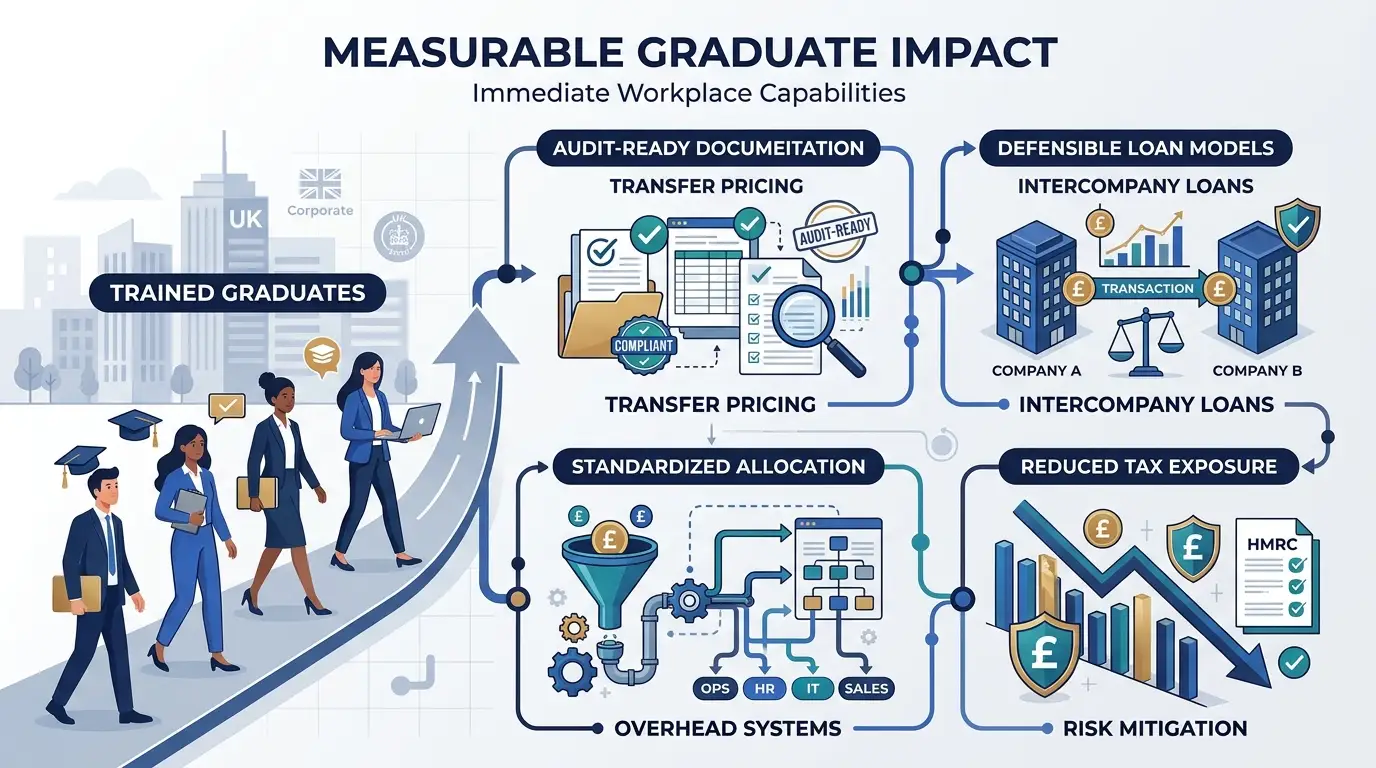
Organizations that enroll their finance and tax teams into this course realize tangible operational improvements. Department leaders report accelerated preparation times for transfer pricing documentation, higher accuracy in pricing intercompany trades, and reduced reliance on external tax advisory consultants.
Individual Skill Development
Tax Managers: Gain the technical confidence to defend complex physical crude pricing models before revenue auditors.
Treasury Analysts: Acquire the ability to benchmark intra-group debt and document interest rate selections using market-standard credit rating models.
Commercial Energy Traders: Understand how contract terms, delivery points, and pricing formulas impact the group's global tax liabilities.
Financial Controllers: Master the construction of transparent head office cost allocation keys and cross-border personnel recharge mechanisms.
Corporate Organizational Impact
Companies training complete operational units establish unified intercompany governance policies across international operations. By standardizing transfer pricing practices across corporate entities, energy enterprises eliminate inconsistencies between physical trading desks, regional accounting teams, and central tax departments.
The Institute For Oil & Gas Training equips organizational teams with practical templates, benchmarking methodologies, and legal drafting guidelines. This ensures that every intercompany transaction—from crude sales and treasury loans to personnel secondments—is supported by robust arm's length documentation.
How does enrollment work?
Enrollment involves a structured three-step process designed to evaluate participant eligibility, align corporate learning objectives, and confirm candidate placement within upcoming training cohorts.
Eligibility & Entry Requirements
To maintain high-level classroom discussions and effective group case study interactions, applicants must meet the following professional criteria:
Minimum of two years of professional experience in corporate tax, energy finance, treasury management, oil trading, accounting, or corporate legal affairs.
Basic familiarity with international financial reporting concepts and general energy market mechanics.
Functional proficiency in professional English to engage in technical legal and financial exercises.
Registration Process
Submit Application: Complete the formal online registration form, selecting the preferred delivery format, location, and cohort start date.
Profile Evaluation: The admissions committee reviews candidate credentials to confirm class compatibility and background suitability.
Formal Seat Confirmation: Approved candidates receive an official letter of acceptance along with invoice details and payment instructions.
Pre-Course Onboarding: Two weeks prior to course start, participants receive preliminary reading materials, reference manuals, and financial modeling templates.
Group Corporate Bookings
Organizations sponsoring three or more employees qualify for custom corporate team onboarding packages, including pre-course skill assessments and dedicated post-training review sessions with senior course instructors.
To secure seat allocations for upcoming public cohorts or to schedule a customized corporate workshop, teams can enroll in this program to initiate the formal candidate registration process.
Frequently Asked Questions
What is included in the Oil & Gas Petroleum Taxation training course?
The Oil & Gas Petroleum Taxation course by Institute For Oil & Gas Training provides a comprehensive overview of fiscal regimes, production sharing contracts, royalties, and international tax frameworks. Participants learn to analyze tax liabilities, evaluate concession agreements, and manage tax risks across upstream, midstream, and downstream operations.
Who should take an Oil & Gas Petroleum Taxation training program?
This specialized course is designed for tax professionals, corporate finance managers, legal advisors, and government regulators working within the energy sector. Institute For Oil & Gas Training delivers tailored instruction that helps financial teams and legal departments master complex petroleum fiscal policies and compliance standards.
How do petroleum fiscal regimes differ from standard corporate taxation?
Petroleum fiscal regimes incorporate specialized mechanisms such as ring-fencing, signature bonuses, profit oil splitting, and resource rent taxes that do not exist in standard corporate tax law. Understanding these distinct structures through Institute For Oil & Gas Training enables energy professionals to accurately forecast project economics and assess sovereign fiscal terms.
What are the main tax challenges in cross-border energy transactions?
Cross-border petroleum operations face significant complexities related to transfer pricing, permanent establishment risk, double taxation treaties, and foreign tax credits. Institute For Oil & Gas Training addresses these challenges in its Oil & Gas Petroleum Taxation modules by offering practical strategies to maintain compliance and prevent double taxation exposures.
Why is specialized petroleum tax training important for energy finance teams?
Unintended tax miscalculations or non-compliance in capital-intensive energy projects can lead to severe financial penalties and distorted investment returns. Completing the Oil & Gas Petroleum Taxation curriculum at Institute For Oil & Gas Training equips finance professionals with the skills required to optimize fiscal strategies, minimize compliance exposure, and support strategic decision-making.
Related training courses
API 581 Risk Based Inspection Training Course
- Specialisation
- Oil & Gas Asset Integrity Management
- Duration
- 5 days · 15 CPD hours
Pipeline Defect Assessment and Fitness-for-Service Training Course
- Specialisation
- Oil & Gas Pipeline Integrity and Inspection
- Duration
- 5 days · 15 CPD hours
Pipeline Inspection Data Analysis and Integrity Evaluation Training Course
- Specialisation
- Oil & Gas Pipeline Integrity and Inspection
- Duration
- 5 days · 15 CPD hours
More articles

How to Evaluate Tax Filing Processes and Tax Provisioning Risks in Oil and Gas Companies
Evaluate tax filing processes and tax provisioning risks in oil and gas companies with structured risk assessment frameworks and training metrics.
Read article →
Why Tax Planning and Compliance Matter for Accurate Tax Filing and Provisioning
Learn how strategic tax planning and compliance drive accurate corporate tax filing, robust provisioning, risk mitigation, and workforce accuracy.
Read article →
How to Evaluate Transfer Pricing Methods for Crude Marketing and Oil and Gas Financing Transactions
Evaluate transfer pricing methods for crude marketing and oil financing transactions to ensure regulatory compliance and tax efficiency.
Read article →