

Transfer pricing in the oil and gas sector governs how transactions between related entities within a multinational enterprise are valued and recorded. Evaluating transfer pricing methods for crude oil marketing and intercompany financing requires an understanding of OECD Transfer Pricing Guidelines, arm’s length principles, and specific energy sector operating models. Multinational energy corporations must balance regulatory tax compliance across jurisdictions while accurately reflecting the economic realities of trading desks, risk allocation, and capital management.
Establishing robust compliance framework models prevents double taxation, audit penalties, and legal friction with tax authorities globally. To build a complete foundational perspective on corporate risk exposure, tax liability, and economic rationale before evaluating individual calculation methods, tax teams and financial analysts should review Why Transfer Pricing Matters in Crude Oil Marketing and Intercompany Financing. Assessing transaction types systematically ensures that intra-group sales and financial arrangements satisfy local tax laws and align with international standards.
How Do You Evaluate Transfer Pricing Methods for Related-Party Crude Oil Sales?
Evaluating transfer pricing methods for related-party crude sales requires comparing the Comparable Uncontrolled Price method with profit-based methods while adjusting for quality differentials, delivery terms, volume discounts, and reference pricing mechanisms to ensure full compliance with arm's length principles.
Crude oil marketing involves high transactional volumes, price volatility, and complex supply chain logistics. Crude sales to related parties must reflect market prices observed between independent enterprises operating under identical or comparable circumstances. Tax authorities scrutinize intercompany oil sales because minor pricing distortions yield substantial tax base shifts across jurisdictions.
The primary method for pricing physical crude sales is the Comparable Uncontrolled Price (CUP) method. Internal CUPs rely on sales made by the enterprise to unrelated third parties, whereas external CUPs rely on quoted market prices from independent reporting agencies such as S&P Global Platts or Argus Media. Applying a CUP requires rigorous adjustments for physical and commercial variations. Crude quality attributes, including API gravity, sulphur content, and Total Acid Number (TAN), directly impact market value. Contractual terms such as Incoterms (FOB, CIF, CFR), credit arrangements, delivery schedules, and volume commitments also dictate pricing adjustments.
When independent benchmarks or reliable adjustments are unavailable, multinational energy firms evaluate alternative transactional methods. The Resale Price Method applies when a related marketing entity resells crude to independent parties without adding substantial physical value. The Cost Plus Method is suitable for service-oriented marketing entities that perform routine functions without assuming price or inventory risks. The Transactional Net Margin Method (TNMM) measures net profit margins relative to an appropriate base, such as operating costs or revenue, when transactional complexity prevents direct price comparisons.
Accurate pricing evaluation depends on reference pricing and posted prices issued by national oil companies or market benchmarks. Tax authorities compare intercompany contract prices against official posted prices to verify arm's length standards. Evaluating a marketing margin requires functional analysis to isolate the specific tasks performed by trading entities, including market analysis, price risk management, blending operations, and logistics coordination.
Which Transfer Pricing Frameworks Apply to Oil and Gas Intercompany Financing?
Applying transfer pricing frameworks to intercompany financing involves determining arm's length interest rates, evaluating credit standing, assessing debt capacity, enforcing thin capitalisation rules, and quantifying head office cost allocations using detailed functional and economic benchmarking analysis.
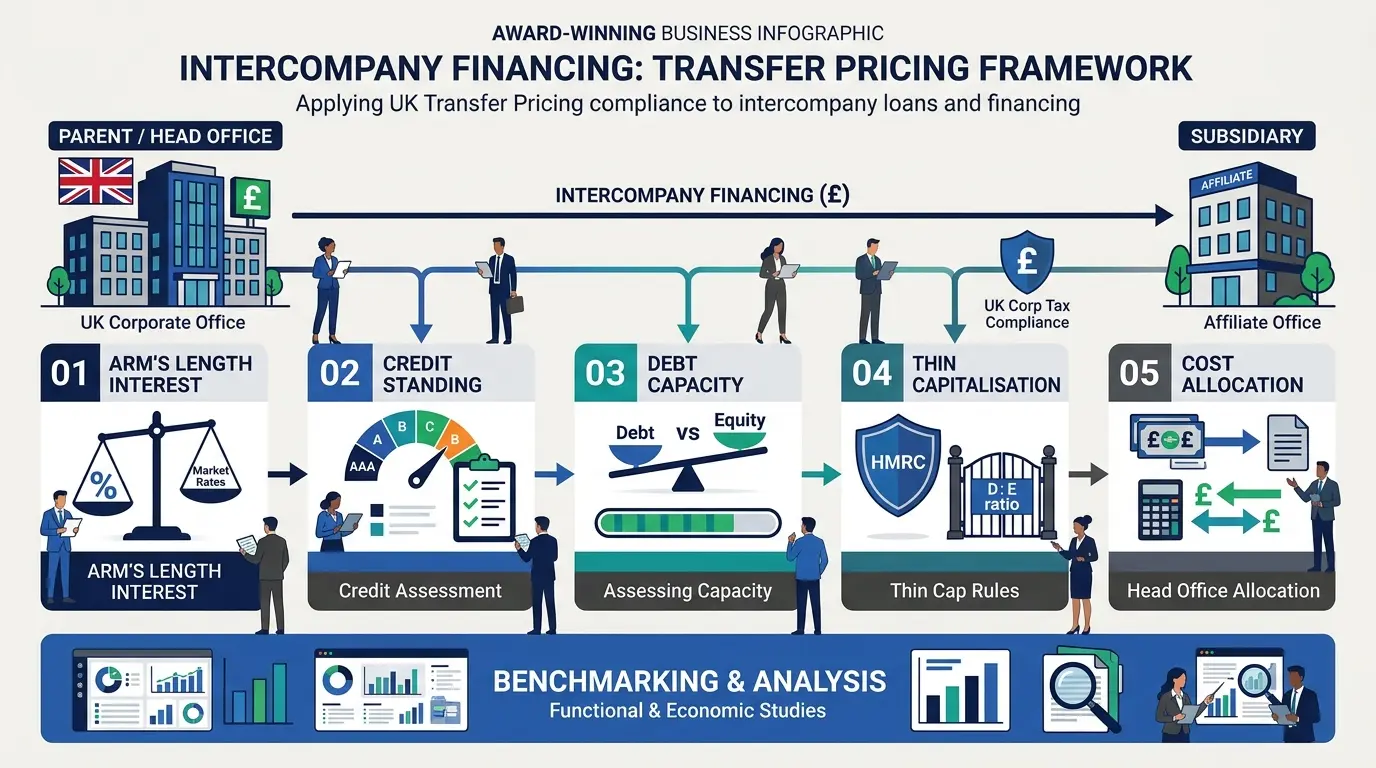
Intercompany financial transactions within multinational energy groups involve treasury management, intra-group loans, cash pooling, financial guarantees, and captive insurance. Tax administrations aggressively audit intercompany financial arrangements to limit base erosion and profit shifting through excessive interest deductions.
Evaluating intra-group loan pricing requires a multi-step analysis. First, the transaction must be accurately delineated to determine whether the transfer of funds constitutes genuine debt or an equity contribution. Factors influencing this determination include the presence of a fixed maturity date, repayment obligations, interest payment history, and the borrower's debt capacity. Second, the borrower’s standalone creditworthiness must be assessed, accounting for parental support and implicit group affiliation. Third, an arm’s length interest rate is identified using market yield curves, credit rating comparisons, or comparable bank quotes.
Compliance with thin capitalisation rules is vital when structuring energy sector capital structures. Tax jurisdictions enforce statutory debt-to-equity ratios or earnings-based caps to restrict tax deductibility. The interest deductibility limitation frameworks under OECD Base Erosion and Profit Shifting (BEPS) Action 4 limit net interest deductions to a fixed percentage of an entity's Earnings Before Interest, Taxes, Depreciation, and Amortisation (EBITDA), typically ranging between 10 percent and 30 percent.
Beyond loans, financing structures require precise evaluation of administrative and operational support charges. A head office cost allocation must demonstrate that services provided by a centralized management unit confer genuine economic or commercial value to operating subsidiaries. Duplicative services, shareholder activities, and incidental group benefits must be excluded from cost pools.
Similarly, secondment and personnel charges for technical experts assigned to overseas operations require cost-plus markup adjustments based on functional responsibility and market availability. Organizations addressing these operational compliance hurdles often enroll their finance, tax, and legal professionals in corporate programs such as Transfer Pricing Training for Crude Marketing and Financing in the Oil and Gas Industry to establish compliant corporate structures.
Transfer Pricing Method | Primary Application Area | Strengths in Energy Sector | Key Limitations & Audit Risks |
Comparable Uncontrolled Price (CUP) | Physical crude sales, benchmarked financial loans | High regulatory acceptance; uses transparent market indices (Platts, Argus) | Requires high product comparability; extensive adjustments needed for grade and location |
Resale Price Method (RPM) | Marketing subsidiaries reselling to third parties | Effective for pure distribution entities without complex physical processing | Ineffective when marketing units add value through blending or complex risk management |
Cost Plus Method (CPM) | Technical support, routine marketing services, secondments | Simple administration; aligns with accounting expense records | Difficult to establish arm's length markups for specialized energy sector skills |
Transactional Net Margin Method (TNMM) | Complex trading services, integrated treasury functions | Less sensitive to product differences; relies on broad financial ratios | Tax authorities scrutinize comparable selection; operational profit distortions |
Profit Split Method (PSM) | Joint trading desks, unique intangible exploitation | Reflected allocation of multi-entity value creation and shared risk | Subjective allocation keys; high administrative burden and documentation requirements |
How Do You Select the Optimal Transfer Pricing Method for Energy Transactions?
Selecting the optimal transfer pricing method requires evaluating transaction complexity, functional profiles, risk allocation, data availability, and regulatory requirements through a structured decision framework that prioritizes direct market comparisons before utilizing transactional profit methods.
Method selection follows the OECD principle of choosing the "most appropriate method" for the specific circumstances of the case. The evaluation process begins by mapping functions performed, assets employed, and risks assumed (FAR analysis) across all participating entities within the corporate structure.
For physical crude trading, the CUP method remains the primary choice when reliable benchmark prices exist. If crude grade differences, transportation logistics, or pricing windows cannot be reliably adjusted, financial analysts evaluate TNMM or profit split approaches. For financial transactions, market-based indicators such as syndicated loan yields, corporate bond spreads, and credit default swap rates serve as baseline comparables for CUP applications.
Organizations must maintain comprehensive transfer pricing documentation, including a Master File, Local File, and Country-by-Country Reporting (CbCR). Inconsistent method selection across operating jurisdictions increases audit exposure, leading to multi-year tax disputes, interest charges, and penalties.
Decision Criteria | CUP Method Priority | TNMM Priority | Profit Split Priority |
Product / Service Standardization | High (Standard crude grades, public debt) | Medium (Differentiated service, routine desk) | Low (Unique, highly integrated trading operations) |
Availability of Uncontrolled Data | High (Public commodity indices, bank quotes) | High (Financial databases, corporate filings) | Low (Internal management accounting reliance) |
Functional Complexity & Risk | Low to Medium (Routine purchase/sale, direct loan) | Medium (Routine distribution, administrative services) | High (Shared risk trading desks, joint IP creation) |
Tax Authority Preference | Highest preference across global regulators | Broad acceptance as secondary choice | Reserved for highly integrated global trading models |
To ensure execution, corporate energy leaders deploy targeted capability development initiatives. Finance professionals master these decision hierarchies by completing the Transfer Pricing for Crude Marketing & Financing Training Course, which equips internal teams to defend pricing choices against regulatory scrutiny.
How Can Corporate Energy Teams Implement Compliant Transfer Pricing Systems?
Implementing compliant transfer pricing systems requires establishing clear operational workflows, integrating intercompany accounting software, training cross-functional teams, enforcing regular benchmarking updates, and conducting periodic internal risk audits.

Practical implementation translates transfer pricing policies into daily operational execution. Disconnects between tax policy design and commercial operations create compliance vulnerabilities.
Energy companies establish operational transfer pricing mechanisms within Enterprise Resource Planning (ERP) systems to automate calculations. Automated systems apply pre-approved pricing formulas, reference price feeds, and service markup calculations directly to intercompany invoices. This automation minimizes manual error and maintains auditable data trails.
Cross-functional collaboration between tax, legal, trading, finance, and human resources teams is essential. Trading desks must understand how contract terms alter tax risk profiles. HR teams managing international staff assignments must coordinate with tax specialists to align secondment and personnel charges with local market rates and permanent establishment rules.
Continuous monitoring ensures policy adherence. Companies perform quarterly or annual true-up adjustments to reconcile projected transfer prices with actual operational results. Periodic updating of financial benchmarks, credit rating evaluations, and economic comparability studies ensures compliance throughout shifting commodity cycles and macroeconomic interest rate environments.
Frequently Asked Questions
What is included in an Oil & Gas Petroleum Taxation training course?
The Oil & Gas Petroleum Taxation training course by the Institute For Oil & Gas Training covers fiscal regimes, production sharing contracts (PSCs), joint venture accounting, and international tax structuring. Participants learn how to calculate ring-fenced tax liabilities, evaluate fiscal terms, and navigate resource rent taxes across global upstream operations.
Who should attend the Oil & Gas Petroleum Taxation program?
This professional program is designed for finance managers, corporate tax specialists, legal advisors, and government officials working within energy sector fiscal frameworks. Delivered by the Institute For Oil & Gas Training, the curriculum equips professionals to manage upstream tax compliance, contract negotiations, and corporate financial planning effectively.
How does petroleum taxation differ from standard corporate taxation?
Petroleum taxation incorporates specialized fiscal mechanisms such as ring-fencing provisions, royalty calculations, signature bonuses, and cost recovery limits within production sharing agreements. Courses provided by the Institute For Oil & Gas Training explain how these unique mechanisms balance host government revenue requirements with investor risk profiles.
Why is transfer pricing critical in Oil & Gas Petroleum Taxation?
Transfer pricing regulates intercompany transactions between multinational oil entities, including related-party crude sales, equipment leasing, and intra-group financing. The Institute For Oil & Gas Training teaches delegates how to establish arm's length pricing models that comply with OECD guidelines and local tax administration rules.
How do fiscal regimes impact upstream oil and gas investment decisions?
Fiscal regimes determine the economic viability of exploration and production projects by governing revenue distribution between concession operators and host governments. Training through the Institute For Oil & Gas Training enables commercial analysts to evaluate fiscal terms, model cash flows, and assess tax risks before committing capital to energy ventures.
Related training courses
Pipeline Defect Assessment and Fitness-for-Service Training Course
- Specialisation
- Oil & Gas Pipeline Integrity and Inspection
- Duration
- 5 days · 15 CPD hours
Pipeline Inspection Data Analysis and Integrity Evaluation Training Course
- Specialisation
- Oil & Gas Pipeline Integrity and Inspection
- Duration
- 5 days · 15 CPD hours
Pipeline Corrosion Monitoring and Mitigation Training Course
- Specialisation
- Oil & Gas Pipeline Integrity and Inspection
- Duration
- 5 days · 15 CPD hours
More articles

How to Evaluate Tax Filing Processes and Tax Provisioning Risks in Oil and Gas Companies
Evaluate tax filing processes and tax provisioning risks in oil and gas companies with structured risk assessment frameworks and training metrics.
Read article →
Why Tax Planning and Compliance Matter for Accurate Tax Filing and Provisioning
Learn how strategic tax planning and compliance drive accurate corporate tax filing, robust provisioning, risk mitigation, and workforce accuracy.
Read article →
Transfer Pricing Training for Crude Marketing and Financing in the Oil and Gas Industry
Master transfer pricing for crude marketing and intercompany financing. Spec-driven training by Institute For Oil & Gas Training for compliance teams.
Read article →