

Evaluating tax filing processes and tax provisioning risks in upstream and downstream energy operations requires a systematic review of data integration, valuation models, and regulatory schedules. Enterprise finance teams must audit accounting workflows, quantify exposure from uncertain tax positions, and benchmark internal capabilities against evolving global standards.
Petroleum tax accounting presents structural complexities driven by production sharing contracts, complex royalty regimes, dynamic joint venture auditing, and variable commodity pricing. Organizations must understand Why Tax Planning and Compliance Matter for Accurate Tax Filing and Provisioning to build robust internal controls, prevent double taxation, and maintain audit readiness across international jurisdictions. Operating in multi-jurisdictional environments exposes energy entities to distinct operational, financial, and reputational risks during quarter-end and year-end reporting periods.
How Do Upstream Operational Factors Create Tax Provisioning Risks?
Upstream operational factors create tax provisioning risks by introducing complex revenue recognition rules, fluctuating royalty obligations, joint venture cost allocations, and volatile reserve valuations. These variable inputs lead to errors in calculating deferred tax assets, liabilities, and current period income tax liabilities.
Energy extraction activities operate under unique contractual frameworks that directly influence tax accounting. Upstream entities often operate under Production Sharing Contracts (PSCs), Joint Operating Agreements (JOAs), or risk-service contracts. Each contract type dictates unique rules for cost recovery, profit oil distribution, and tax deductibility.
Cost recovery mechanisms require continuous tracking of capital expenditures and operating expenses. Misclassifying an unallowable expense under a PSC triggers adjustments during state audits. These adjustments create retrospective tax liabilities and alter the current tax provision.
Decommissioning and site restoration obligations present significant valuation challenges. Asset Retirement Obligations (AROs) require long-term discounting assumptions. Changes in discount rates, inflation expectations, or environmental remediation scope alter the carrying value of ARO liabilities. These adjustments generate temporary differences that impact deferred tax accounting under IAS 12 and ASC 740.
Joint venture accounting introduces additional risk layers. Operating partners handle cash calls and bill non-operating partners through Joint Interest Billings (JIBs). Discrepancies between JOA accounting definitions and statutory tax laws result in unallowable tax deductions. Finance teams must reconcile JIB statements with statutory tax returns to avoid material misstatements.
Transfer pricing within integrated energy firms adds structural complexity. Transferring crude oil, natural gas, or refined products between extraction, transportation, and refining subsidiaries requires defensible arm's-length pricing documentation. Failure to substantiate internal transfer prices leads to severe transfer pricing adjustments, penalties, and double taxation across operating entities.
What Key Components Framework Defines an Effective Oil and Gas Tax Filing Process?
An effective oil and gas tax filing process comprises a centralized tax compliance calendar, automated data pipelines, standardized tax return preparation protocols, and integrated record retention requirements. These components establish verifiable operational controls, streamline reporting workflows, and reduce compliance failure risks.
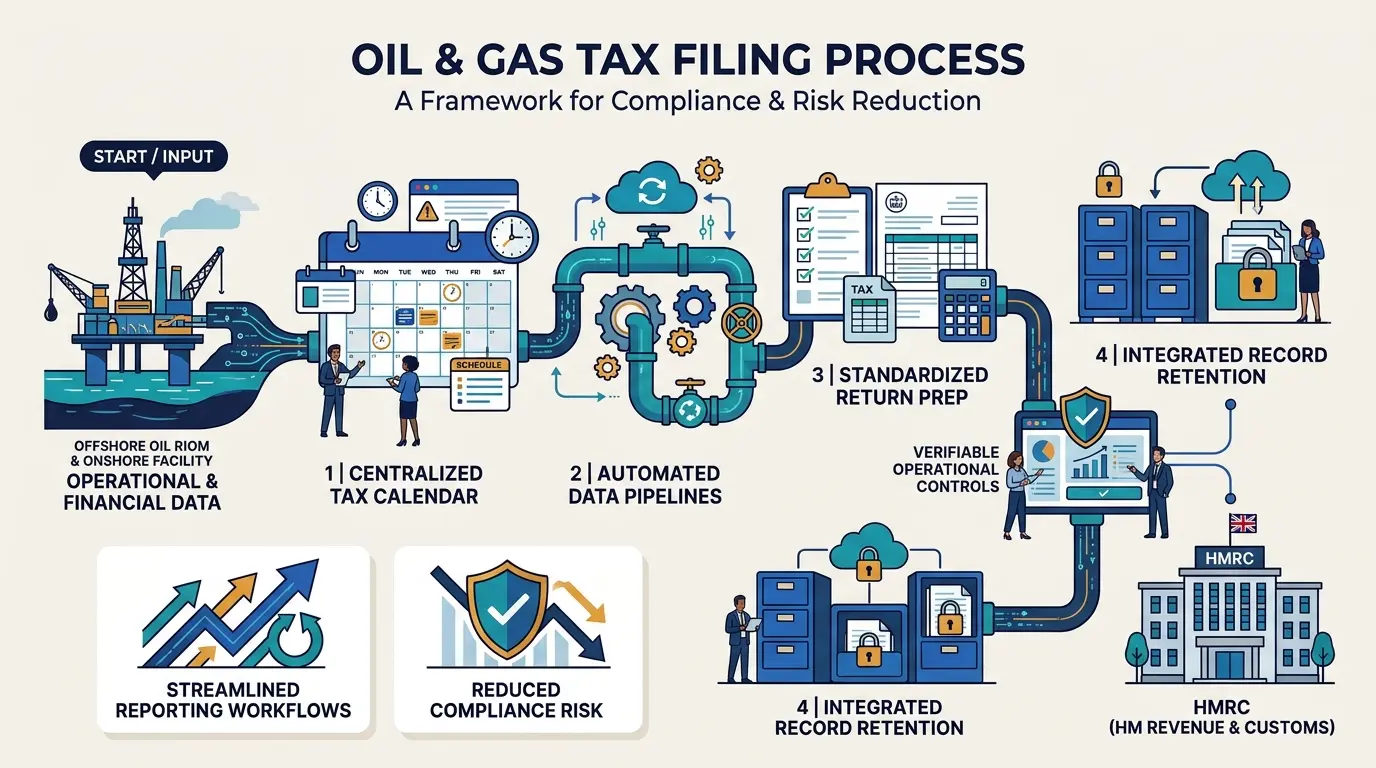
Establishing a structured compliance architecture is essential for managing multi-jurisdictional tax obligations. Upstream and downstream entities manage hundreds of annual tax deadlines across local, regional, and national tax authorities.
1. Statutory Compliance Schedules
A centralized tax compliance calendar serves as the foundational control mechanism for finance departments. The calendar tracks statutory deadlines for income tax returns, indirect taxes, production royalties, and corporate withholding taxes. It assigns explicit operational ownership to specific finance personnel, incorporates automated alerts, and tracks completion milestones to prevent missed statutory filings.
2. Data Extraction and Tax Return Preparation
Manual data extraction from Enterprise Resource Planning (ERP) systems introduces human error into tax return preparation. Effective processes deploy automated data pipelines that directly connect general ledger modules with specialized tax engines. Standardized workpapers automatically map financial accounting data to tax accounting rules, preserving audit trails and line-item granularity.
3. Record Retention Infrastructure
Oil and gas operations face extended statutory limitation periods and lengthy tax authority audits. Robust record retention requirements mandate secure, indexed digital archives for all source documents, contract agreements, tax returns, and correspondence. Storage systems must preserve geological surveys, JOA agreements, cost recovery statements, and transfer pricing documentation for 10 to 15 years depending on jurisdictional requirements.
How Do Finance Teams Evaluate Uncertain Tax Positions and Tax Reconciliation Accuracy?
Finance teams evaluate uncertain tax positions and tax reconciliation accuracy by conducting probability-weighted technical assessments, measuring income tax reconciliation differences, and stress-testing provision models. This process ensures financial statements reflect realistic tax exposure levels under statutory reporting standards.
Accounting standards such as IFRIC 23 and ASC 740-10 require rigorous assessment of uncertain tax positions. Energy companies operate in complex fiscal regimes where tax legislation is open to interpretation.
Evaluating tax positions involves a two-step recognition and measurement framework:
Recognition Threshold: The entity determines whether a tax position is more likely than not (>50% probability) to be sustained upon examination by relevant tax authorities, based solely on its technical merits.
Measurement Phase: If the recognition threshold is met, the entity measures the tax benefit as the largest amount of tax benefit that has a cumulative probability greater than 50% of being realized upon ultimate settlement.
Uncertainties frequently arise around intangible drilling costs (IDCs), depletion allowances, foreign tax credit usability, and ring-fencing provisions. Rings-fenced regimes prevent losses from one concession area from offsetting taxable profits in another. Misapplying ring-fencing rules distorts current tax calculations and requires immediate provision adjustments.
Tax reconciliation connects the theoretical tax expense based on statutory rates to the actual effective tax rate (ETR) reported on the income statement. A continuous tax reconciliation process isolates permanent differences from temporary differences. Permanent differences include non-deductible fines, specific royalty structures, and depletion excesses. Temporary differences stem from accelerated depreciation of oil and gas assets versus statutory tax depreciation schedules.
Regular reconciliation reviews prevent unexpected ETR volatility during fiscal reporting. Teams must perform monthly tax reconciliations to identify discrepancies between general ledger tax accounts and underlying tax return calculations before final period-end closes.
What Framework Metrics Measure the Efficiency of Current and Deferred Tax Provisions?
Framework metrics measure current and deferred tax provision efficiency by tracking key performance indicators such as tax closing cycle time, provision-to-return variance, effective tax rate stability, and manual journal entry frequency. Standardized metrics reveal internal process bottlenecks and data accuracy gaps.
Evaluating tax provisioning performance requires specific numerical metrics to assess both efficiency and risk exposure. Corporate management and audit committees use these Key Performance Indicators (KPIs) to benchmark finance team productivity and system accuracy.
Performance Metric | Target Benchmark | Measurement Purpose | Risk Indicator |
Tax Close Cycle Time | 3 to 5 Business Days | Measures speed and integration of year-end and quarter-end tax calculations. | Extended cycles indicate reliance on manual spreadsheets and fragmented data inputs. |
Provision-to-Return (PTR) Variance | < 1.5% Absolute Variance | Measures accuracy of period-end tax estimations against filed tax returns. | Variances above 2% signal poor estimation methodologies or late financial adjustments. |
Manual Journal Entry Rate | < 5% of Total Tax Entries | Measures automated integration between ERP systems and tax provisioning software. | High manual entry volumes increase human error risk and weaken internal controls. |
Audit Adjustment Ratio | < 1% of Total Tax Provision | Measures accuracy of underlying technical tax positions during statutory audits. | Frequent post-audit adjustments indicate misinterpretation of statutory rules. |
Effective Tax Rate (ETR) Volatility | < 2% Unexplained Variance | Evaluates predictability and consistency of overall corporate tax expense. | Unexplained swings highlight weak forecasting of permanent and temporary differences. |
Calculating the current and deferred tax provision requires accurate separation of immediate tax obligations from long-term tax assets and liabilities. Upstream capital expenditure programs create substantial deferred tax liabilities due to initial 100% tax write-offs or accelerated depreciation mechanisms. Monitoring deferred tax assets for valuation allowances is equally vital. If an enterprise lacks sufficient future taxable income within a specific ring-fenced jurisdiction, it must write down deferred tax assets, directly impacting net income.
How Do Enterprise Training Programs Eliminate Tax Filing and Provisioning Gaps?
Enterprise training programs eliminate tax filing and provisioning gaps by updating workforce knowledge on evolving energy tax codes, standardizing technical accounting workflows, and training staff on advanced tax technology systems. Structured capability development directly reduces audit penalties, operational errors, and filing delays.
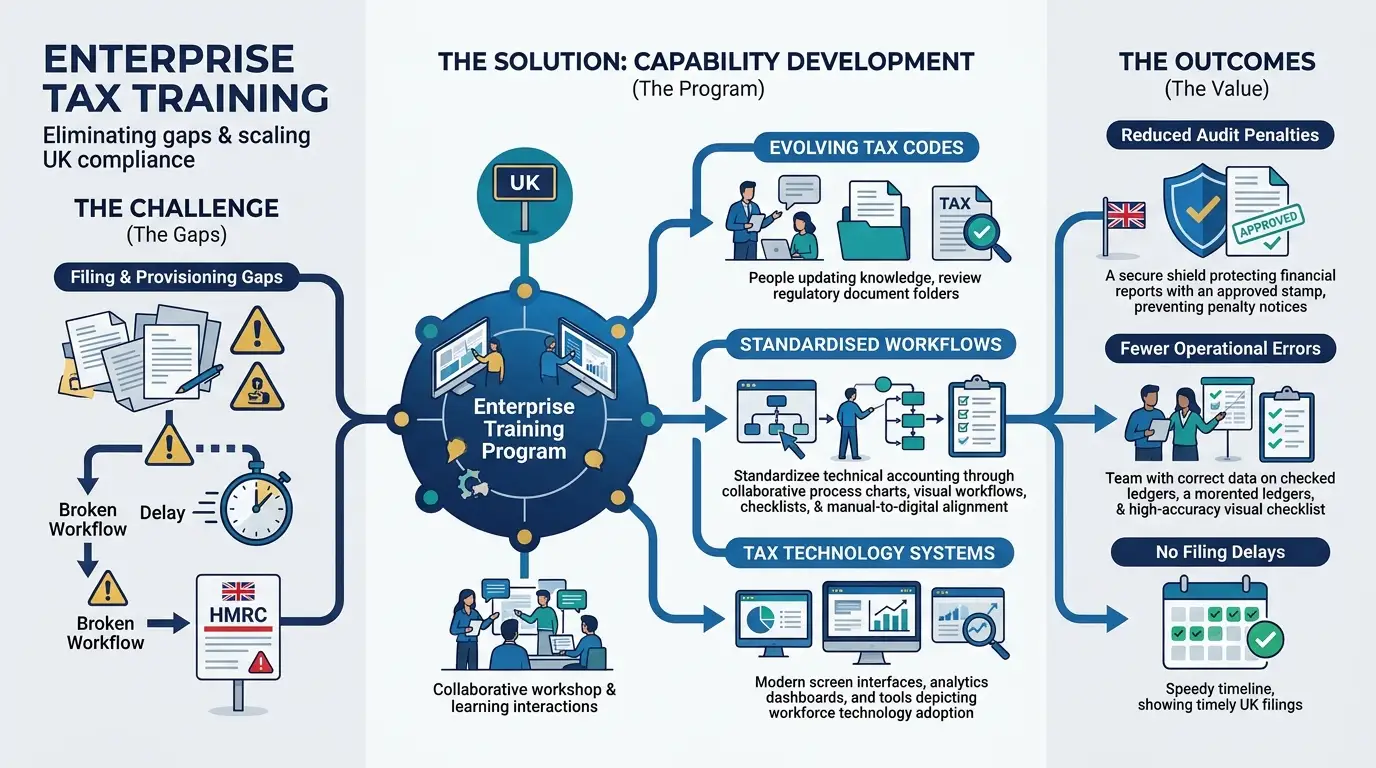
To address compliance vulnerabilities and build internal capabilities, organizations evaluate structured learning interventions. Organizations seeking structured capability frameworks often implement the Tax Planning & Compliance for Filing & Provisioning Training Course to align cross-functional finance teams with global industry practices.
1. Addressing Workforce Skill Gaps
Tax accounting inside energy companies requires dual competency in technical accounting standards (IFRS/US GAAP) and sector-specific tax law. Finance personnel often understand general corporate taxation but lack deep expertise in cost oil allocation, foreign tax credits, and farm-out transaction accounting. Structured professional development builds deep domain knowledge, preventing costly reliance on external advisors for routine compliance tasks.
2. Learning Delivery Models for Global Teams
International oil and gas entities operate across dispersed geographic locations. Human resource leaders and tax executives must select delivery models that balance operational continuity with learning effectiveness:
Instructor-Led Live Workshops: Ideal for senior tax managers and finance directors focusing on complex tax structuring, transfer pricing defense, and handling tax authority correspondence.
Blended Digital Learning: Direct self-paced modules covering baseline statutory rules, basic deferred tax calculations, and system navigation, paired with practical case study reviews.
In-Person Corporate Cohorts: Dedicated team training designed to resolve specific corporate accounting challenges, standardize workpapers, and realign internal workflows.
Evaluating training providers requires examining their industry specificity. Generic corporate tax courses fail to address petroleum revenue taxes, production sharing agreements, or environmental taxes. Specialized technical training ensures immediate application to daily finance operations.
Which Training Delivery Approach Best Aligns with Organizational Needs?
Selecting the optimal training delivery approach requires evaluating team size, geographic dispersion, budget allocations, and the complexity of operational tax risks. Organizations must compare delivery methodologies to balance learning retention against corporate operational disruption.
Energy corporations must evaluate training solutions using explicit criteria. Comparing available learning approaches clarifies structural tradeoffs between cost, customization, and practical impact.
Evaluation Attribute | In-House Customized Workshops | External Open Enrollment | Virtual Blended Learning |
Primary Focus | Company-specific tax structures, PSCs, and ERP workflows. | General industry standards and cross-company networking. | Flexible, baseline technical knowledge acquisition. |
Target Audience | Entire tax and finance department (10+ professionals). | Individual specialists, new hires, or promoted managers. | Geographically dispersed regional finance teams. |
Customization Level | High (uses company chart of accounts and actual contracts). | Low (uses generic industry case studies). | Medium (standardized modules with variable electives). |
Operational Impact | Fast alignment across internal financial workflows. | Individual skill improvement; slower operational integration. | Gradual capability build; minimal immediate workflow shift. |
Cost Efficiency | High ROI for large groups (lower cost per participant). | Moderate ROI for isolated specialist training. | High ROI for baseline training across distributed offices. |
Risk Mitigation | Direct reduction in company-specific reporting errors. | Broad risk reduction based on general best practices. | Moderate reduction in basic compliance errors. |
When evaluating learning frameworks, decision-makers must assess the provider's capacity to deliver real-world case studies. Practical exercises involving real tax provision models, complex joint interest billing reconciliations, and actual audit dispute scenarios produce measurable capability improvements compared to purely theoretical lectures.
How Should HR and Finance Leaders Select a Tax Compliance Capability Partner?
HR and finance leaders should select a tax compliance capability partner by assessing industry domain expertise, curriculum alignment with specific energy accounting standards, practical instruction quality, and measurable post-training business outcomes.
Selecting an enterprise capability provider requires a structured evaluation framework. HR teams and Chief Financial Officers must avoid generic training vendors and evaluate partners based on rigorous selection criteria.
1. Technical Energy Focus
The provider must demonstrate exclusive focus on energy sector taxation. Instructors must possess practical experience managing production sharing contracts, ring-fenced tax regimes, and multi-jurisdictional oil field operations.
2. Practical Application and Case Material
Curricula must use realistic accounting data, real-world taxation training frameworks, actual tax authority audit cases, and standard industry provision engines. Theory must be balanced with hands-on workpaper preparation and risk identification exercises.
3. Solution Integration
For organizations seeking specialized, practical instruction on risk mitigation, provision modeling, and statutory compliance workflows, implementing a targeted program like Tax Planning and Compliance Training for Oil and Gas Tax Filing and Provisioning ensures finance teams gain directly applicable skills.
4. Measurable Return on Investment
Selecting a learning partner requires defining post-training performance metrics. Organizations must track tangible operational improvements following training completion:
Investing in specialized workforce capabilities transforms the tax function from a reactive compliance unit into a resilient, strategic asset that protects enterprise value and ensures reporting accuracy across international operations.
Frequently Asked Questions
What is covered in an Oil & Gas Petroleum Taxation training program?
An Oil & Gas Petroleum Taxation course covers the specialized fiscal regimes, tax structures, and accounting standards governing upstream, midstream, and downstream energy operations. Participants study corporate income tax, windfall profit taxes, production sharing contracts (PSCs), royalties, and ring-fencing provisions. Training delivered by the Institute For Oil & Gas Training equips finance and tax professionals with practical frameworks to manage tax liabilities and maintain regulatory compliance.
How do production sharing contracts impact petroleum taxation in the energy sector?
Production sharing contracts (PSCs) dictate how oil and gas production revenues, cost recovery, and profit splits are allocated between national governments and operating entities. These contractual arrangements directly determine taxable income, statutory deductions, and tax obligations under local energy fiscal laws. Through specialized training at the Institute For Oil & Gas Training, corporate finance teams learn to accurately account for PSC cost oil, profit oil, and associated tax provisioning risks.
Why is specialized petroleum taxation training important for oil and gas companies?
General corporate tax standards often fail to address the complex fiscal mechanisms unique to the energy industry, such as high capital expenditure write-offs, decommissioning liabilities, and joint venture audits. Specialized instruction in Oil & Gas Petroleum Taxation ensures tax practitioners and financial managers can navigate multi-jurisdictional compliance requirements while optimizing corporate tax structures. The Institute For Oil & Gas Training provides practical, industry-aligned instruction to reduce tax audit exposure and improve period-end reporting accuracy.
What are the primary tax risks faced by international oil and gas operators?
International energy companies face significant tax risks arising from volatile commodity pricing, transfer pricing adjustments on cross-border transactions, double taxation, and evolving fiscal regulations. Inaccuracies in calculating deferred tax assets, royalty obligations, or ring-fenced losses can lead to severe financial penalties and audit disputes with host tax authorities. The Institute For Oil & Gas Training helps organizations mitigate these exposure risks by establishing robust tax planning and compliance frameworks.
Who should attend an Oil & Gas Petroleum Taxation training course?
This professional development program is designed for tax managers, corporate accountants, finance directors, joint venture accountants, and legal advisors working within the energy sector. It is also highly beneficial for government officials and tax authority personnel who oversee petroleum fiscal regimes and state audits. Enterprise programs at the Institute For Oil & Gas Training help cross-functional finance teams align internal accounting controls with international tax compliance standards.
Related training courses
Process Plant Equipment Integrity Training Course
- Specialisation
- Oil & Gas Asset Integrity Management
- Duration
- 5 days · 15 CPD hours
Pipeline Inspection Data Analysis and Integrity Evaluation Training Course
- Specialisation
- Oil & Gas Pipeline Integrity and Inspection
- Duration
- 5 days · 15 CPD hours
Pipeline Corrosion Monitoring and Mitigation Training Course
- Specialisation
- Oil & Gas Pipeline Integrity and Inspection
- Duration
- 5 days · 15 CPD hours
More articles

Why Tax Planning and Compliance Matter for Accurate Tax Filing and Provisioning
Learn how strategic tax planning and compliance drive accurate corporate tax filing, robust provisioning, risk mitigation, and workforce accuracy.
Read article →
Transfer Pricing Training for Crude Marketing and Financing in the Oil and Gas Industry
Master transfer pricing for crude marketing and intercompany financing. Spec-driven training by Institute For Oil & Gas Training for compliance teams.
Read article →
How to Evaluate Transfer Pricing Methods for Crude Marketing and Oil and Gas Financing Transactions
Evaluate transfer pricing methods for crude marketing and oil financing transactions to ensure regulatory compliance and tax efficiency.
Read article →