

Fiscal regime reform uncertainty refers to the commercial risk and regulatory volatility caused when host governments alter tax rates, royalty structures, or production-sharing terms, directly undermining the financial predictability required for long-term capital allocation in petroleum projects.
In corporate environments, this uncertainty disrupts financial modeling, delays final investment decisions (FIDs), and increases the cost of capital. Oil and gas ventures require upfront capital expenditures spanning decades. When legislative bodies modify resource laws, investment committee members cannot accurately project net present value (NPV) or internal rates of return (IRR). Workforce development addresses this challenge by building institutional capabilities in fiscal analysis, contract negotiation, and risk mitigation. Organizations utilize structured learning programs to transform regulatory volatility into quantifiable risk parameters.
Understanding these shifts requires precise conceptual definitions across economic, legal, and operational domains.
Core Entities and Financial Mechanisms
Production-Sharing Contracts (PSCs): Legally binding agreements between host governments and international oil companies (IOCs) defining profit-oil split, cost recovery ceilings, and tax obligations.
Concessionary Tax-and-Royalty Systems: Frameworks where private operators hold title to petroleum resources, paying fixed royalties on gross production alongside corporate income taxes.
R-Factor Mechanisms: Sliding-scale fiscal levers that adjust tax rates or profit splits based on cumulative revenue-to-cost ratios.
Resource Rent Taxes (RRT): Super-profit taxes triggered only after a project achieves a pre-negotiated threshold rate of return.
Discounted Cash Flow (DCF) Sensitivity: Valuation models assessing asset liquidity under fluctuating tax regimes, inflation rates, and commodity price thresholds.
How Does Fiscal Regime Volatility Impact Corporate Investment Decisions?
Fiscal regime volatility degrades capital efficiency by forcing energy corporations to apply higher discount rates, freeze project pipelines, re-evaluate asset portfolios, and allocate excessive capital reserves toward legal contingencies rather than exploration and production activities.
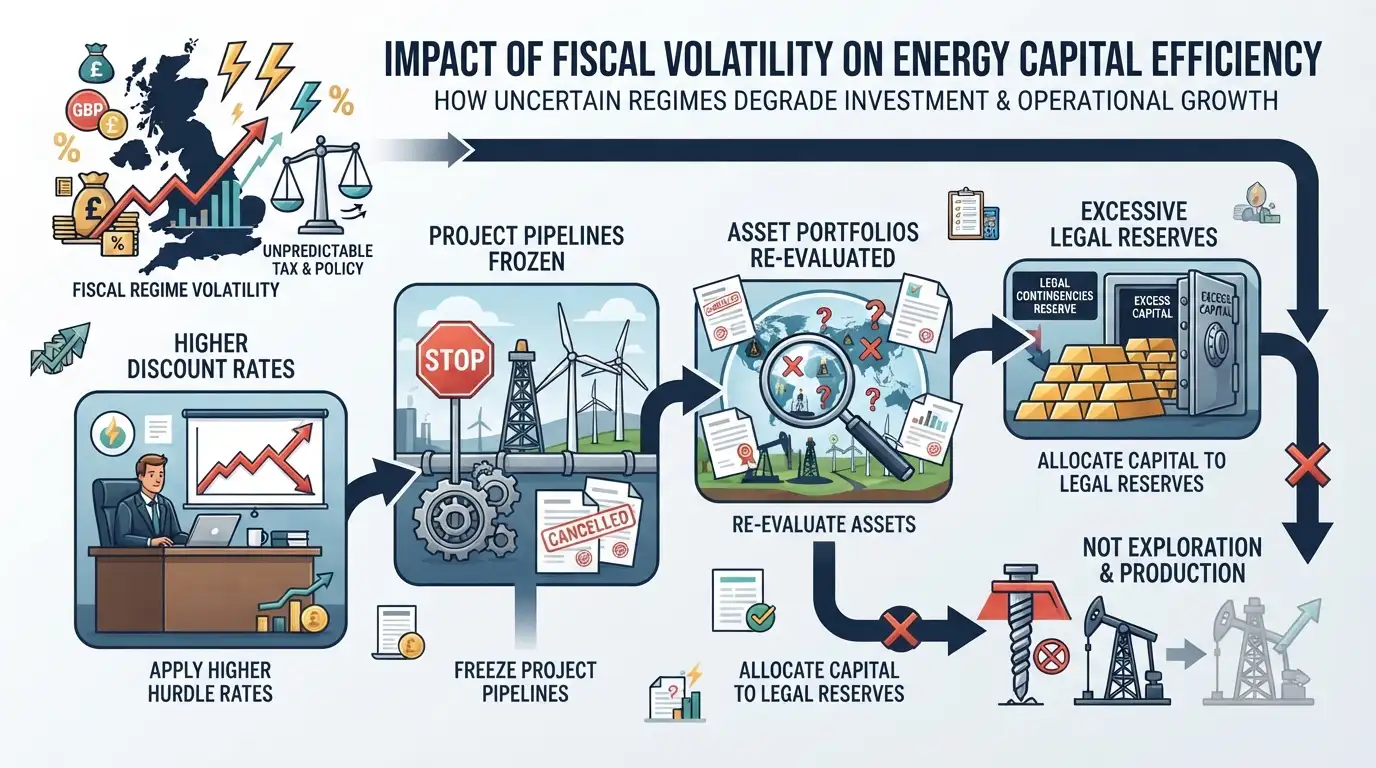
Capital deployment in the energy industry relies on long-term stability. Unplanned modifications to government take—such as sudden increases in severance taxes or altered depreciation schedules—reduce project profitability instantly. Boards of directors require economic models that account for legislative shifts across 20-year to 30-year lifecycle horizons.
To manage this exposure, legal, finance, and commercial management teams must understand the specific legal instruments designed to protect investments.
Structural Legal Safeguards in Petroleum Contracts
Stabilisation Clause Enforcement: Contractual provisions that freeze fiscal terms at signing or mandate host government compensation for compliance costs caused by legislative changes.
Grandfathering Provisions: Statutory rules exempting active licences from newly enacted, stricter fiscal terms.
Retrospective Fiscal Change: Legislation applying new tax liabilities or royalty rates to past production periods, raising sovereign risk indicators.
Petroleum Act Reform: Comprehensive statutory overhauls restructuring national energy policies, state participation requirements, and licensing terms.
Fiscal Term Renegotiation: Formal processes where operators and state entities modify existing economic terms to restore commercial viability.
Contract Conversion to New Regime: Mandated migration of legacy concession agreements or PSCs into modern regulatory and fiscal frameworks.
Arbitration and Dispute Exposure: Institutional vulnerabilities arising from international arbitration mechanisms like ICSID when fiscal disputes escalate.
Transition Arrangements for Existing Licences: Bridge policies defining how active exploration and production rights operate during statutory overhauls.
Organizations mitigate these risks by upskilling multidisciplinary teams. Training programs establish standardized protocols for evaluating legal protections, quantifying financial exposure, and designing proactive negotiation strategies.
How Do Organisations Train Workforces to Evaluate Fiscal Reform Risks?
Organisations train workforces by deploying practical, case-based learning programs that combine financial modeling, legal analysis, and strategic scenario planning across targeted 3-day to 5-day intensive workshops and blended learning modules.
Effective workforce development transitions employees from theoretical understanding to operational execution. Training initiatives analyze historical reform cycles in energy-producing nations across regions like West Africa, South America, and Southeast Asia. Participants process live data sets, build dynamic fiscal models, and evaluate policy shifts using real-world case studies.
The 4-Stage Workforce Capability Development Framework
Diagnostic Skill Gap Analysis: Assessment of finance, legal, and commercial teams to establish baseline capabilities in petroleum fiscal mechanics and economic modeling.
Instructional Content Delivery: Structured learning modules covering PSC mechanics, concessionary systems, windfall profit taxes, and stabilization clauses.
Applied Practical Simulations: Hands-on exercises where cross-functional cohorts run stress tests on corporate assets against proposed tax modifications.
Operational Performance Auditing: Post-training evaluation measuring model accuracy, decision-making speed, and risk integration into board-level investment memos.
This structured progression ensures that legal, commercial, and engineering divisions speak a unified analytical language when assessing foreign assets.
What Key Components Are Included in Fiscal Risk Evaluation Training?
Fiscal risk evaluation training includes dynamic financial modeling tools, legal framework analysis, regulatory negotiation simulations, scenario-planning frameworks, and standardized risk-scoring matrices delivered through hybrid, digital, or instructor-led corporate formats.
Comprehensive training programs combine multiple technical disciplines into a single decision-making framework. Organizations must equip teams with both technical analytical software tools and soft strategic negotiation skills.
When evaluating training programs, decision-makers should review how to evaluate fiscal reform risks and their impact on petroleum investment decisions to ensure external curricula align directly with internal corporate risk tolerances.
Core Curricular Pillars and Delivery Formats
Financial Sensitivity Analytics: Excel and Python-based modeling modules calculating project NPV variance across changing tax rates and cost-recovery ceilings.
Legal Safeguard Mechanics: Practical workshops examining the enforceability of stabilization clauses, bilateral investment treaties (BITs), and international arbitration awards.
Contract Negotiation Simulations: Role-playing exercises where participants simulate high-stakes negotiations between international oil companies and host-country state entities.
Blended Learning Delivery Formats: Flexible structures incorporating self-paced online modules for fundamental concepts, followed by intensive 3-day instructor-led workshops.
Executive Briefing Toolkits: Frameworks designed for senior leaders to condense complex fiscal risks into concise investment committee presentation formats.
Building these capabilities across internal departments converts reactive risk management into a proactive strategic advantage.
What Measurable Business Outcomes Does Strategic Risk Training Produce?
Strategic risk training produces measurable business outcomes, including up to 35% faster investment committee reviews, 20% improvements in financial model accuracy, zero compliance failures during regulatory shifts, and enhanced long-term portfolio resilience.
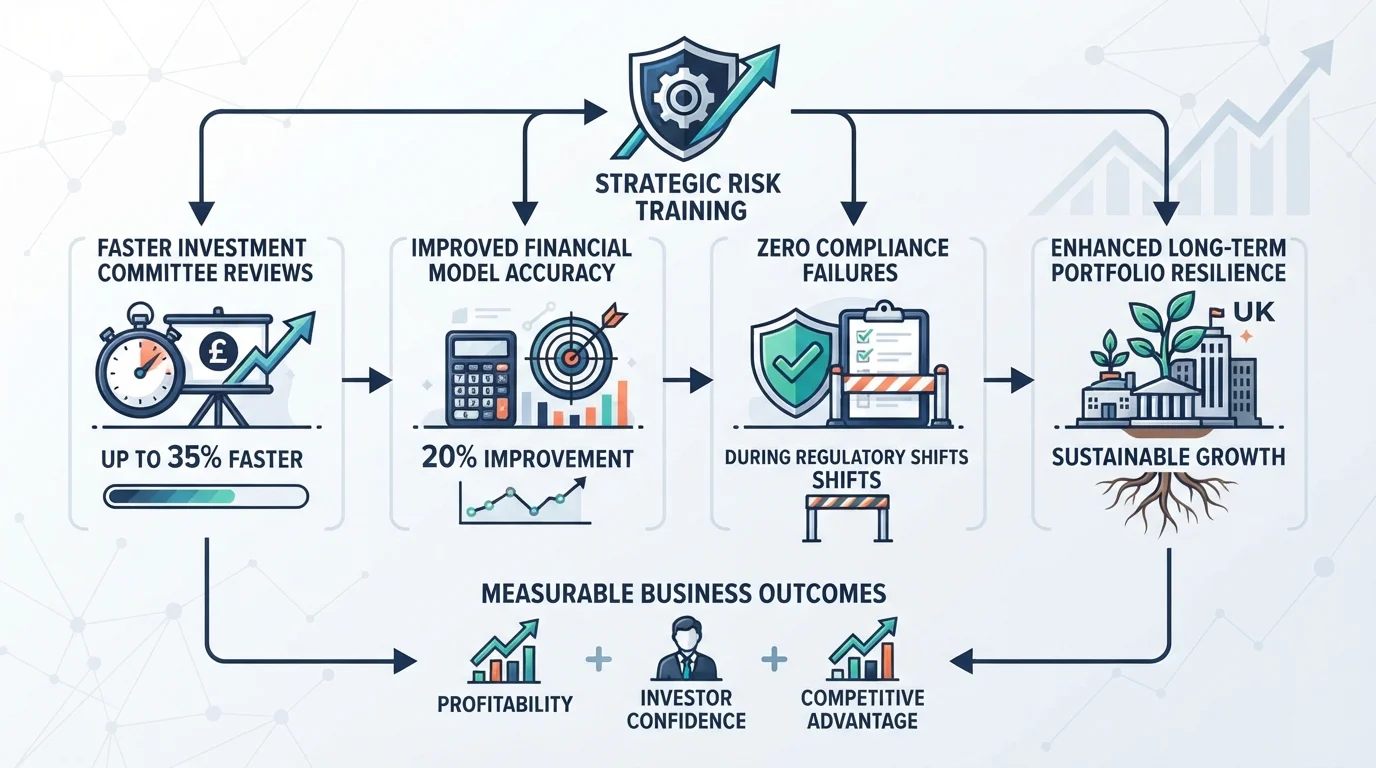
Workforce training delivers clear organizational metrics. Unprepared teams spend weeks recalculating financial models when host governments announce draft energy legislation. Trained teams execute rapid scenario analyses using pre-built dynamic frameworks within hours.
Strategic Organizational Benefits
Capital Preservation: Reduces exposure to unmitigated sovereign risk by establishing strict fiscal stress-testing thresholds prior to asset acquisition.
Accelerated Decision-Making: Standardized risk assessment methodologies streamline communication between regional business units and executive leadership.
Enhanced Negotiation Leverage: Equips commercial leaders with data-driven counter-proposals during fiscal term renegotiation cycles with national oil companies.
Optimized Resource Allocation: Identifies unviable assets early, allowing organizations to reallocate capital toward stable jurisdictions.
Cross-Functional Alignment: Eliminates operational silos between legal counsel, petroleum engineers, and corporate finance executives.
Which Corporate Teams Require Training on Fiscal Regime Reforms?
Corporate teams requiring training include business development executives, project finance analysts, legal counsel, commercial managers, government relations specialists, and senior decision-makers across energy, natural resources, infrastructure, and investment banking sectors.
Fiscal uncertainty impacts every major functional unit within an enterprise operating in capital-intensive industries like oil, gas, mining, and offshore wind power. A legal team cannot protect contract terms without understanding how tax mechanics alter economic returns, just as financial analysts cannot build reliable DCF models without understanding legal stabilization clauses.
Primary Use Cases Across Corporate Functions
Business Development & M&A Teams: Evaluating target company valuations during asset acquisitions in jurisdictions undergoing legislative revisions.
Corporate Legal Counsel: Drafting robust contractual protections and assessing dispute options before signing production-sharing contracts.
Government Relations Divisions: Engaging constructively with ministry officials to communicate the economic impacts of proposed tax hikes on foreign direct investment.
Asset Management Units: Stress-testing mature brownfield operations to determine ongoing economic viability under modified royalty terms.
Executive Investment Committees: Reviewing capital expenditure proposals with clear, standardized risk-adjusted return metrics.
Tailoring technical training to these specific operational units ensures that learning outcomes translate into immediate workflow improvements.
What Common Misconceptions Limit the Effectiveness of Corporate Fiscal Risk Training?
Common misconceptions include viewing fiscal risk as exclusively a legal responsibility, relying on generic off-the-shelf finance courses, assuming senior staff do not need skill updates, and treating training as a one-time event rather than an ongoing competency requirement.
Generic corporate training fails to address the specific economic and legal realities of upstream energy ventures. Off-the-shelf financial modeling courses cover general corporate finance but omit specialized mechanisms like cost-recovery oil caps, signature bonuses, and R-factor escalators.
Structural Pitfalls in Enterprise Learning Programs
Siloed Training Delivery: Teaching finance and legal teams separately, preventing cross-functional collaboration during real project evaluations.
Lack of Practical Application: Overemphasizing theoretical regulatory policy without training employees on functional financial models or live case simulations.
Ignoring Local Regulatory Contexts: Using static global examples that fail to reflect the nuances of specific regional energy frameworks.
Unmeasured Learning Outcomes: Failing to audit employee post-training performance, leading to unverified skill gains and low learning ROI.
Overcoming these limitations requires structured learning pathways tailored to real-world corporate assets and shifting regulatory environments. Specialized workforce development options like the Fiscal Regime Comparison & Reform Risk Training Course provide focused, practical instruction designed to solve these operational challenges.
Frequently Asked Questions
What is an oil and gas petroleum fiscal regime?
An oil and gas petroleum fiscal regime is the legal, regulatory, and financial framework that determines how revenue, taxes, royalties, and production are shared between host governments and foreign investors. These frameworks typically operate as either concessionary systems or contractual arrangements, such as production-sharing contracts (PSCs). The Institute For Oil & Gas Training provides professional courses covering the commercial and legal mechanics of an Oil & Gas Petroleum Fiscal Regime to help corporate teams evaluate sovereign risk and asset profitability.
How do changes in petroleum fiscal terms impact investment decisions?
Changes in petroleum fiscal terms, such as altered tax rates, reduced cost-recovery ceilings, or windfall profit levies, directly alter a project's cash flow projections and internal rate of return (IRR). Unplanned regulatory shifts increase the weighted average cost of capital (WACC) and cause energy companies to delay final investment decisions (FIDs). Through structured industry learning programs, the Institute For Oil & Gas Training helps commercial and legal decision-makers stress-test their models against shifting Oil & Gas Petroleum Fiscal Regime terms.
What is the difference between a concessionary system and a production-sharing contract?
In a concessionary system, the operator holds title to the petroleum resources and pays corporate income taxes along with fixed royalties on gross production to the host nation. Conversely, under a production-sharing contract (PSC), the state retains resource ownership while the operating company recovers its capital expenditures through cost oil before splitting profit oil with the government. Understanding these distinct structures in an Oil & Gas Petroleum Fiscal Regime is a core competency taught by the Institute For Oil & Gas Training to energy analysts and corporate counsel.
How do stabilization clauses protect petroleum investors from fiscal changes?
Stabilisation clauses are legal mechanisms embedded in petroleum contracts that freeze the fiscal terms applicable at signing or require host governments to compensate operators for compliance costs caused by subsequent legislative changes. These clauses safeguard long-term capital investments against retrospective tax modifications and statutory overhauls. Industry specialists at the Institute For Oil & Gas Training analyze the enforceability and negotiation strategies of stabilization clauses within a modern Oil & Gas Petroleum Fiscal Regime.
Why is training important for evaluating petroleum fiscal reform risks?
Evaluating petroleum fiscal reform risks requires cross-functional expertise spanning financial modeling, international energy law, and strategic contract negotiation. Without specialized workforce capability, corporate teams risk miscalculating project net present values (NPV) or missing crucial contractual protections during regulatory transitions. The Institute For Oil & Gas Training delivers outcome-based corporate learning programs designed to build internal capability in navigating complex Oil & Gas Petroleum Fiscal Regime shifts.
Related training courses
Fiscal Regime Comparison & Reform Risk Training Course
- Specialisation
- Oil & Gas Petroleum Fiscal Regime
- Duration
- 5 days · 15 CPD hours
Royalties, Bonuses & Government Take: Fiscal Waterfall Modelling Training Course
- Specialisation
- Oil & Gas Petroleum Fiscal Regime
- Duration
- 5 days · 13 CPD hours
Fiscal Disputes, Cost Recovery and Contract Resolution Training Course
- Specialisation
- Oil & Gas Petroleum Fiscal Regime
- Duration
- 5 days · 15 CPD hours
More articles

Data Governance and Master Data Ownership and Standards Training by Institute For Oil & Gas Training
Evaluate the Data Governance & Master Data Ownership & Standards Training Course syllabus, delivery, outcomes, and enrollment requirements.
Read article →
How to Define Data Ownership and Master Data Standards for Petroleum Operations
Learn how petroleum operations define data ownership, establish master data management standards, and improve data governance frameworks.
Read article →
Why Data Governance and Master Data Standards Matter in Oil and Gas
Learn why data governance and master data standards transform petroleum operations, resolve enterprise risk, and drive ROI across global energy assets.
Read article →