

Data governance in petroleum operations is a structural framework of policies, accountabilities, and standards that converts raw operational datasets into verified business assets, directly eliminating multi-million-pound decisions based on corrupted, incomplete, or duplicated subsurface and asset metrics.
Modern energy enterprises handle petabytes of operational input daily across exploration, drilling, production, and refining processes. In complex operational environments, unmanaged data streams generate massive operational friction. Misaligned pressure metrics, duplicate asset part numbers, and ambiguous well log definitions directly delay maintenance routines and compromise safety protocols.
Data governance structures establish strict data ownership and stewardship parameters, clear operational definitions, and precise technical boundaries. This structural alignment ensures that exploration directors, asset managers, and financial compliance officers access a unified, accurate dataset. Enterprise teams achieve seamless coordination when telemetry, geological surveys, and supply chain records follow standardized corporate protocols.
Organizations that institute rigorous data governance reduce asset downtime, prevent regulatory fines, and accelerate production cycles. Establishing operational control over enterprise datasets converts passive information stores into active strategic drivers across upstream, midstream, and downstream sectors.
Why Do Data Standards Directly Drive Upstream and Downstream Enterprise Performance?
Data standards drive upstream and downstream enterprise performance by establishing unified technical definitions, validation rules, and structural formats that eliminate operational misalignments, reduce supply chain redundancies by 35%, and guarantee safety compliance across multi-site assets.
Petroleum assets require precise synchronization between field operations and central administrative functions. When field units utilize localized nomenclature for equipment maintenance, procurement teams unintentionally order duplicate parts, resulting in inflated inventory carrying costs. Master data management solves this challenge by establishing a single source of truth—the golden record—for all core business entities.
Standardized reference data protocols eliminate ambiguities in well log analytics, pipeline corrosion reports, and safety tracking metrics. Upstream operations standardise reservoir data metrics to calculate reserve estimations accurately. Downstream refineries standardise feed-stock quality classifications to optimize processing speeds and prevent catastrophic unit shutdowns.
Enforcing strict data quality dimensions—accuracy, completeness, consistency, timeliness, validity, and uniqueness—prevents operational errors before field execution begins. Standardized systems allow automated tools to run data quality monitoring and remediation continuous cycles without requiring manual intervention from senior engineering staff.
How Do Enterprise Skill Gaps Sabotage Data Governance Implementations?
Enterprise skill gaps sabotage data governance implementations when cross-functional workforce teams lack technical training on governance frameworks, view compliance as an administrative burden, and lack core capabilities required for active data stewardship and lineage tracking.
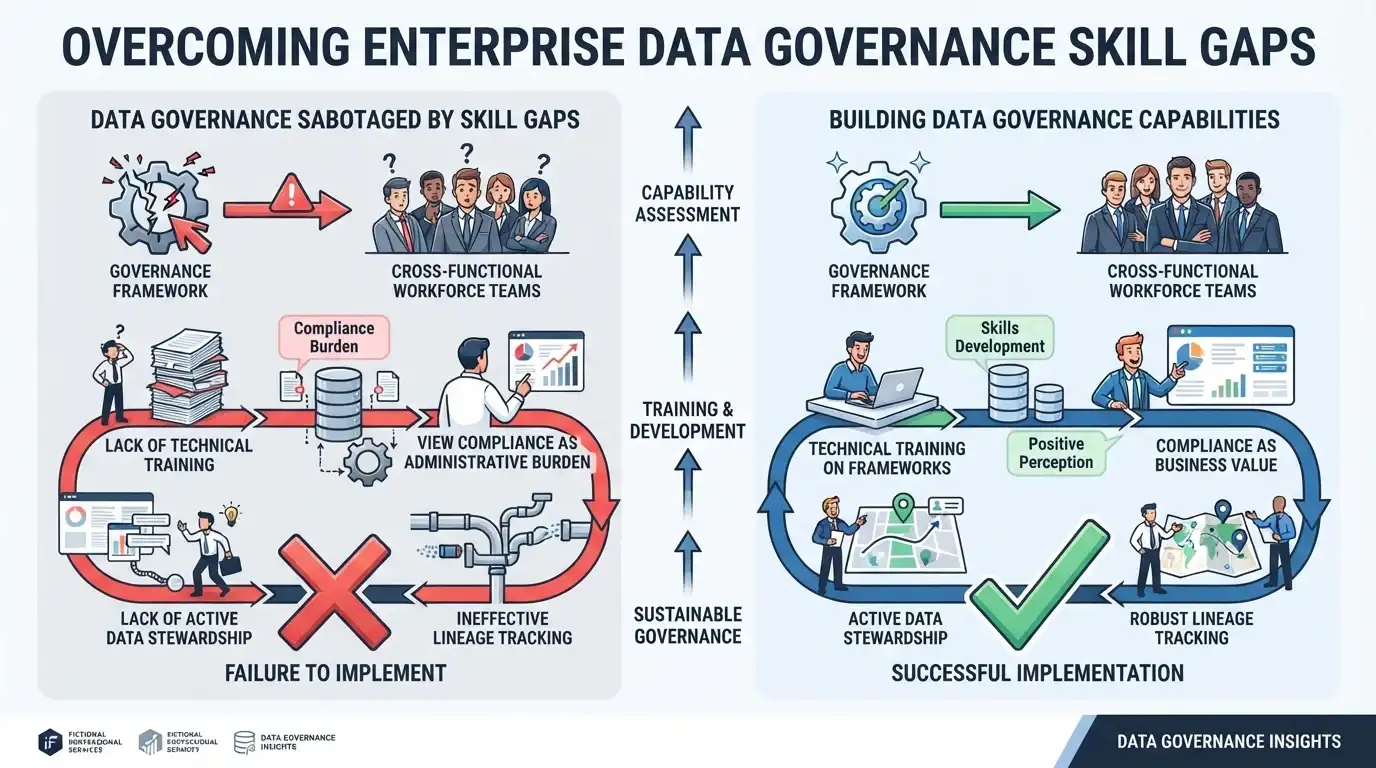
Organizations frequently invest millions of pounds in enterprise software platforms while failing to build parallel workforce capabilities. When engineers, logistics coordinators, and financial analysts do not understand systemic data lineage, they manually modify datasets inside isolated spreadsheets. This practice breaks enterprise data lineage, destroys audit trails, and reintroduces errors into master records.
Professional skill deficits in data ownership and stewardship lead directly to systemic failures across global assets:
Stewardship Confusion: Subject matter experts refuse governance responsibilities because job profiles lack explicit operational steward metrics.
Inconsistent Definitions: Technical teams create localized definitions rather than utilizing the corporate data dictionary and business glossary.
Manual Workarounds: Workforce teams bypass enterprise validation workflows, corrupting master records across production systems.
Remediation Bottlenecks: Technical staff fail to execute data quality monitoring and remediation steps, allowing corrupted records to cascade through logistics systems.
Closing these skill gaps requires structured workforce development initiatives that transform passive software users into active data stewards capable of protecting enterprise informational assets.
How Can Organizations Build Governance Capabilities Through Structured Corporate Training?
Organizations build governance capabilities through structured corporate training by implementing role-tailored workforce development programs that combine theoretical governance frameworks with practical scenario assessments, enterprise case-based learning modules, and simulated data remediation workflows.
Effective enterprise learning programs move past generic IT software instruction. They focus directly on operational contexts, demonstrating how accurate data standards prevent equipment failures, optimize drilling schedules, and fulfill statutory reporting mandates.
Successful capability development programs execute through structured multi-phase learning models:
Foundational Awareness Workshops: Cross-functional leadership teams explore core principles of master data management, corporate risk mitigation, and strategic asset optimization.
Technical Stewardship Bootcamps: Designated operational stewards master the configuration of a technical data dictionary and business glossary, execute schema validation, and maintain asset registries.
Applied Remediation Simulations: Technical teams analyze real-world case studies featuring corrupted field data, practicing live remediation within simulated environments.
Governance Integration Seminars: Department leads learn to enforce data validation protocols across daily operational routines without degrading workflow velocity.
Classroom theory combined with applied field scenarios ensures employees internalize systemic dependencies. Teams master how upstream data entry precision directly influences downstream financial audits and maintenance schedules.
To execute this transition effectively, organizations rely on targeted professional development frameworks like the Data Governance & Master Data: Ownership & Standards Training Course, which provides structured blueprints for establishing operational accountability across complex industrial assets.
What Key Components Must Be Included in a Petroleum Data Governance Framework?
A petroleum data governance framework must include clear organizational ownership models, unified master data standards, comprehensive metadata management tools, continuous quality monitoring protocols, and robust data lineage tracking systems across the operational lifecycle.
Building an resilient governance architecture requires integrating five foundational pillars into daily operations:
1. Data Ownership and Stewardship Protocols
Data governance fails when governance remains restricted to IT departments. Operational domain experts must assume formal stewardship roles over assets within their operational domains. Production managers own volume metrics, procurement heads own vendor master records, and chief geologists own subsurface survey files.
2. Master Data Management and Golden Records
Master data management isolates core business entities from transactional systems to construct an authoritative golden record. In oil and gas operations, this includes master records for wells, facilities, pipelines, equipment parts, and commercial vendors across all operating regions.
3. Metadata Management, Glossary, and Reference Standards
Centralized documentation prevents cross-departmental confusion. A corporate data dictionary and business glossary establishes universal definitions for key operational variables. Coupled with rigid reference data standards, these systems ensure technical units calculate metrics identically across all business units.
4. Data Quality Monitoring and Remediation Frameworks
Organizations must define six explicit data quality dimensions: accuracy, completeness, consistency, timeliness, validity, and uniqueness. Automated routines track these indicators continuously, triggering alert workflows whenever operational metrics fall below acceptable thresholds.
5. Data Lineage and Traceability
Understanding the origin and transformation path of operational numbers is vital for safety compliance and regulatory audits. Robust data lineage maps data journeys from initial field sensor readings through processing systems into executive reporting dashboards.
How Do Leading Oil and Gas Firms Successfully Implement Governance Programs?
Leading oil and gas firms successfully implement governance programs by securing executive sponsorship, selecting practical delivery formats like hybrid workshops, establishing measurable baseline KPIs, and executing phased rollouts anchored in operational pilot projects.
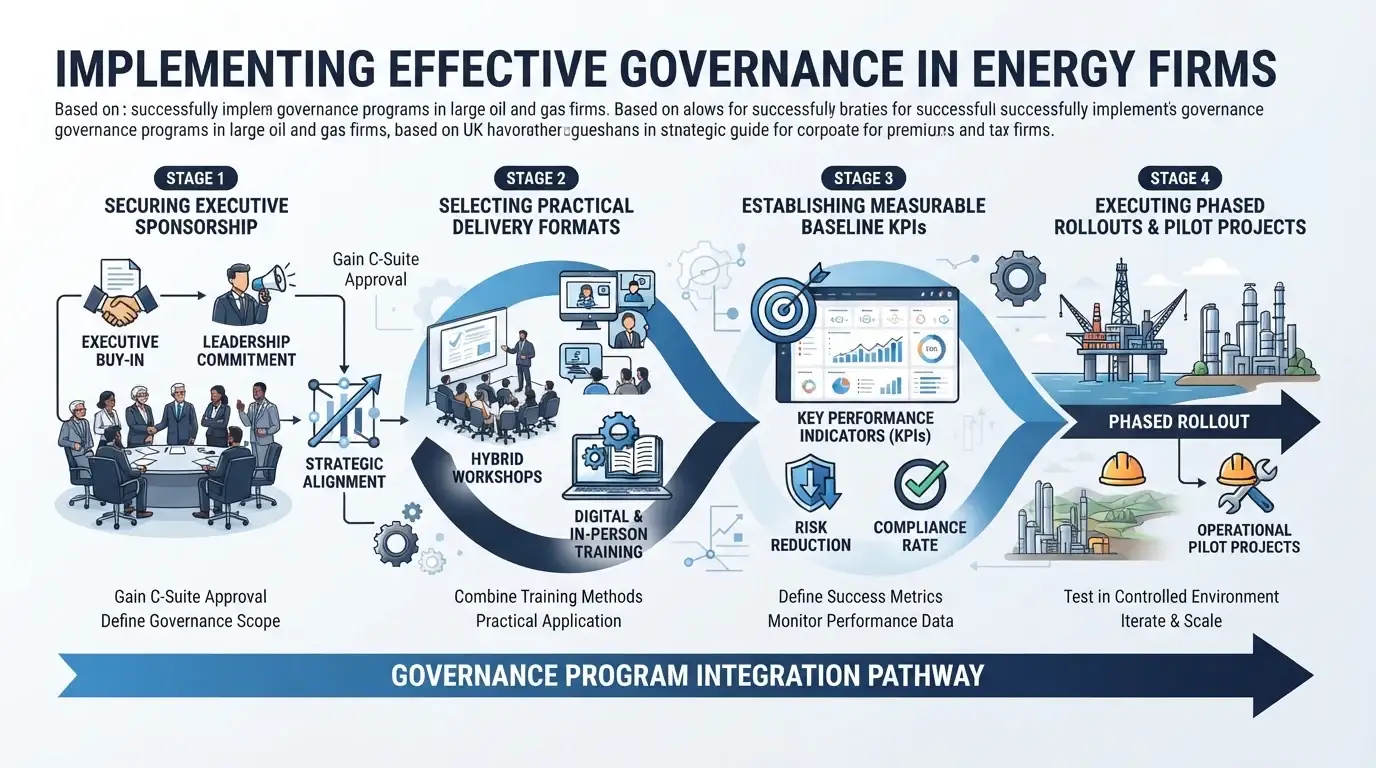
Implementing governance across international energy operations requires a structured implementation plan:
Executive Alignment: C-suite leaders establish data governance as an enterprise risk and operational efficiency initiative.
Current-State Assessment: Audit teams evaluate existing data health, mapping skill deficits across operational business units.
Pilot Program Execution: Organizations pilot governance protocols within a single operational domain—such as offshore asset maintenance—to demonstrate initial ROI.
Workforce Capability Deployment: L&D leaders deliver targeted hybrid learning programs combining self-paced online modules with live expert-led workshops.
Scale and Continuous Audit: Governance boards expand successful protocols enterprise-wide, running continuous data quality monitoring and remediation routines.
Transitioning from strategic planning to field execution requires operational teams to master tactical frameworks detailed in our guide on [How to Define Data Ownership and Master Data Standards for Petroleum Operations].
Structured training programs ensure staff master theoretical governance principles while applying technical validation skills directly to daily operational routines.
What Measurable Business Outcomes Does Enterprise Data Governance Produce?
Enterprise data governance produces clear business outcomes, including a 40% reduction in report reconciliation time, 25% lower inventory carrying costs, zero non-compliance audit fines, and improved asset uptime across global processing facilities.
Deploying standardized governance frameworks across petroleum assets yields quantifiable financial and operational returns:
Lower Operational Costs: Unified supply chain master data prevents duplicate purchasing of high-value equipment parts, lowering carrying costs by 25%.
Accelerated Decision Velocity: Clean golden records allow executive boards to model production capacity scenarios rapidly, cutting report assembly times by 40%.
Mitigated Compliance Risk: Rigorous lineage tracking ensures regulatory reports withstand external statutory audits, eliminating penalty risks.
Enhanced Plant Safety: Standardized maintenance records ensure safety-critical valves and instrumentation undergo inspection precisely on schedule.
Optimized Enterprise IT ROI: Clean baseline data ensures smooth, cost-effective migrations during enterprise ERP or cloud transformations.
Investing in structured workforce training ensures data governance frameworks move beyond static policy documents to deliver measurable operational performance improvements across global energy portfolios.
Frequently Asked Questions
What is Oil & Gas Petroleum Digital Finance & Automation training?
Oil & Gas Petroleum Digital Finance & Automation training provided by the Institute For Oil & Gas Training equips finance professionals and energy executives with technical skills to modernise financial operations across petroleum assets. The program covers automated joint-venture accounting, robotic process automation for hydrocarbon billing, and real-time financial reporting systems. Participants learn to replace manual spreadsheet workflows with enterprise digital solutions aligned with global energy sector compliance standards.
How does digital finance automation benefit petroleum companies?
Implementing digital finance automation streamlines complex upstream accounting, improves audit readiness, and significantly reduces billing cycle times across joint operating agreements. By centralising transaction flows, energy organisations eliminate manual reconciliation errors and gain real-time visibility into capital expenditures. Institute For Oil & Gas Training helps finance teams adopt these tools to optimize cash flow management and lower administrative overhead.
Who should attend an Oil & Gas Petroleum Digital Finance & Automation course?
This course is designed for financial controllers, joint-venture accountants, finance managers, internal auditors, and L&D professionals developing financial talent within the energy sector. It caters to practitioners looking to automate complex hydrocarbon cost allocations, tax compliance, and multi-currency reporting across international projects. Candidates gain practical experience leveraging digital tools to drive financial precision in modern corporate environments.
What key topics are covered in petroleum digital finance automation?
The curriculum focuses on enterprise financial frameworks, predictive financial analytics, cloud accounting integration, and automated reconciliation for upstream and downstream operations. Learners examine case studies on implementing smart contracts, managing digital ledgers, and setting up automated compliance reporting. Institute For Oil & Gas Training structures these topics around real-world oil and gas scenarios to ensure immediate workplace application.
How do organisations measure ROI from digital finance training in oil and gas?
Organisations evaluate return on investment by tracking metrics such as reduced month-end closing times, decreased accounting error rates, and lower transaction processing costs. Training enables teams to execute faster financial decision-making and maintain strict regulatory compliance across global petroleum assets. Through targeted capability building with the Institute For Oil & Gas Training, energy firms achieve higher operational efficiency and sustainable workforce transformation.
Related training courses
Data Governance & Master Data: Vendor & Well Training Course
- Specialisation
- Oil & Gas Petroleum Digital Finance & Automation
- Duration
- 5 days · 15 CPD hours
Automation of JV & PSC Reporting: Data Integration Training Course
- Specialisation
- Oil & Gas Petroleum Digital Finance & Automation
- Duration
- 5 days · 15 CPD hours
ERP Systems for Oil & Gas: Access Controls Training Course
- Specialisation
- Oil & Gas Petroleum Digital Finance & Automation
- Duration
- 5 days · 13 CPD hours
More articles

Data Governance and Master Data Ownership and Standards Training by Institute For Oil & Gas Training
Evaluate the Data Governance & Master Data Ownership & Standards Training Course syllabus, delivery, outcomes, and enrollment requirements.
Read article →
How to Define Data Ownership and Master Data Standards for Petroleum Operations
Learn how petroleum operations define data ownership, establish master data management standards, and improve data governance frameworks.
Read article →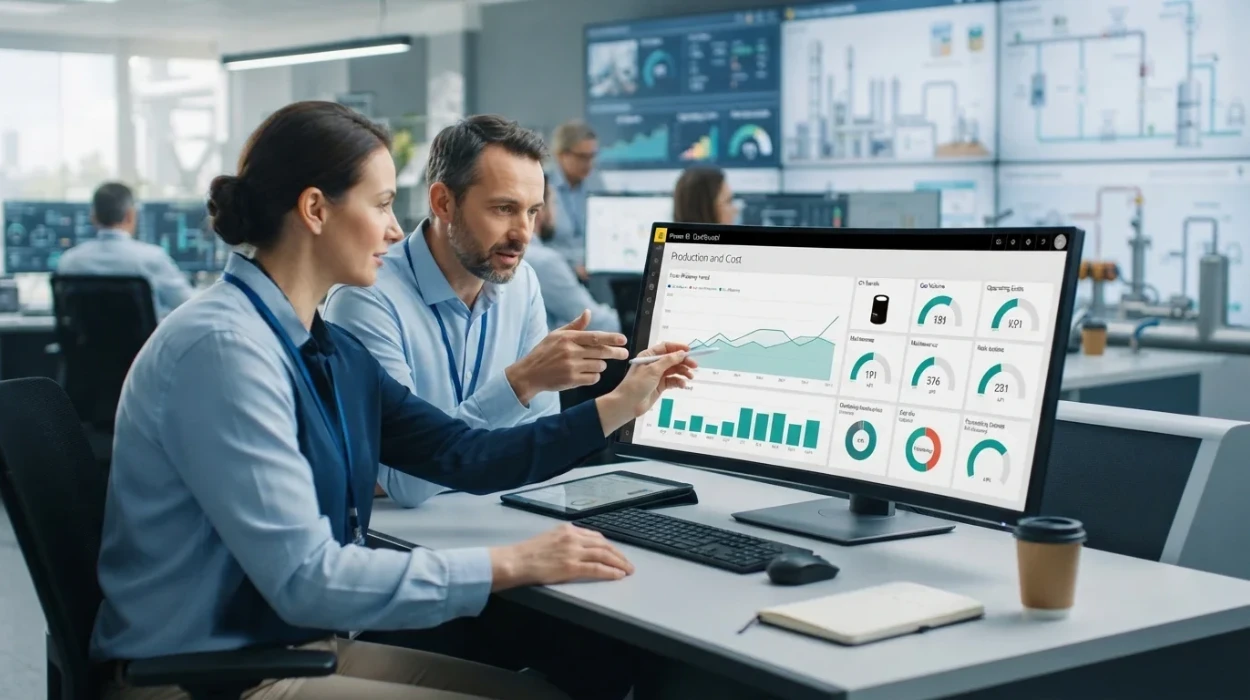
Power BI for Production and Cost Dashboards Design Training by Institute For Oil & Gas Training
Evaluate the Power BI Production & Cost Dashboards Design Training Course curriculum, delivery formats, skill outcomes, and corporate enrollment details.
Read article →