

Petroleum operations generate massive volumes of subsurface, operational, and financial information daily. Without clear accountability and standardized definitions, upstream and downstream organizations face data silos, costly operational errors, and compromised safety reporting. Managing these assets requires structured operational models that turn raw data into verified corporate intelligence.
Defining accountable roles and technical rules forms the core foundation of energy sector data governance. Establishing clear accountability models ensures every dataset has a designated functional authority across its operational lifecycle. Organizations seeking to build foundational awareness around these foundational concepts can review the baseline principles in our guide on Why Data Governance and Master Data Standards Matter in Oil and Gas.
How Do Petroleum Companies Establish Clear Data Ownership and Stewardship Roles?
Establishing clear data ownership in petroleum companies requires assigning ultimate business accountability to functional executives while appointing technical stewards to maintain daily quality. Executive data owners define access rules and data definitions, whereas operational stewards execute validation workflows across production, exploration, and refining systems.
Data ownership in energy organizations differs significantly from general corporate IT governance. Upstream operations involve complex geospatial, geological, and drilling data streams that originate from multiple field systems. Assigning a single IT department to manage these assets leads to context loss and operational friction.
Data owners are business leaders, such as Exploration Managers or Operations Directors. They hold budget accountability and decision-making authority over specific domains. Data stewards are domain experts who work alongside field engineers, geoscientists, and plant operators to enforce metadata accuracy.
The RACI Model for Energy Data Management
Implementing a Responsible, Accountable, Consulted, and Informed (RACI) matrix prevents operational gaps between field personnel and central database administrators.
Organizations that deploy structured stewardship frameworks reduce data ingestion errors by 40% within six months of implementation. HR leaders and technical directors must collaborate to build clear job descriptions for operational stewards, ensuring governance responsibilities integrate into standard performance evaluations.
What Are the Key Data Quality Dimensions for Master Data Management in Energy Operations?
Master data management in energy operations relies on six core data quality dimensions: accuracy, completeness, consistency, timeliness, validity, and uniqueness. Measuring these dimensions continuously prevents costly engineering miscalculations, reduces field downtime, and ensures regulatory compliance across complex exploration and production activities.
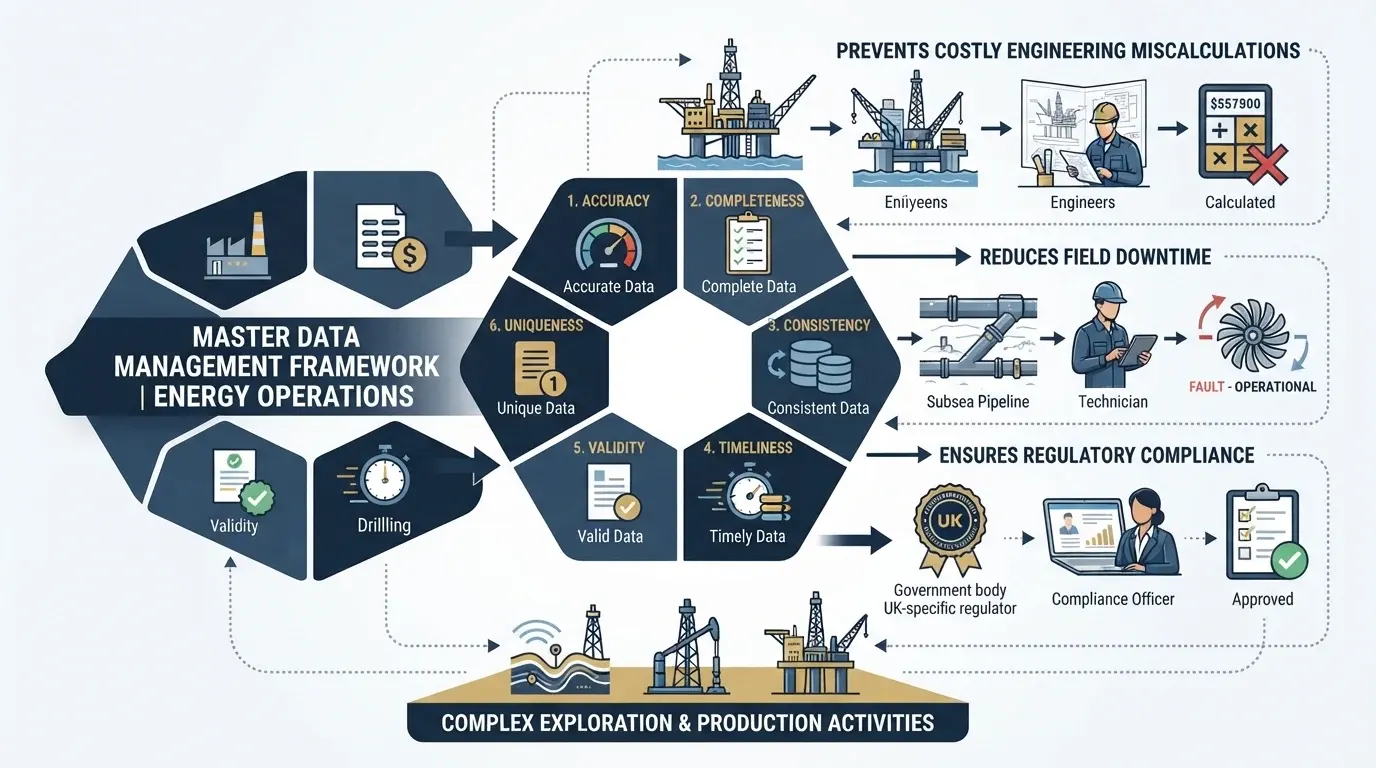
Evaluating energy data assets against structured dimensions isolates operational risks before data feeds enter analytical engines or executive dashboards.
Accuracy: Physical field measurements must match recorded digital values. For example, wellbore casing pressure logs must match calibrated gauge outputs down to specified decimal tolerances.
Completeness: Mandatory attributes cannot remain blank. Well records missing surface location coordinates or formation tops fail basic completeness thresholds.
Consistency: Data values across disparate systems must align. A pump asset ID in the computerized maintenance management system must reflect the identical serial code in the enterprise resource planning engine.
Timeliness: High-frequency SCADA sensor streams must reflect operational realities without latency that hampers real-time production monitoring.
Validity: Data values must follow defined technical ranges and formats, such as standard API gravity scale limits for crude grading.
Uniqueness: Every physical entity requires a single canonical digital representation to eliminate double-counting of reserves or duplicate maintenance orders.
Systematic monitoring of these dimensions directly impacts operational expenditure. Companies maintaining high data quality scores report 15% lower maintenance overhead due to accurate asset tracking and reduced duplicate ordering of long-lead field equipment.
How Do Petroleum Companies Establish a Golden Record Using Reference Data Standards?
Petroleum companies establish a golden record by merging duplicate data streams through automated matching rules, master reference tables, and standardized business glossaries. This process consolidates disparate well, equipment, and financial records into a single, highly trusted master record across enterprise applications.
Upstream assets accumulate multiple digital identities across their decades-long lifecycles. Drilling systems, production databases, and accounting software frequently reference the identical physical well using different naming conventions.
Building the Golden Record Architecture
Creating a unified master record requires a multi-stage data integration pipeline that harmonizes raw inputs into structured assets.
Reference data standards dictate allowed code sets for attributes like fluid types, well status, and geographic basins. Utilizing international petroleum standards, such as PPDM (Professional Petroleum Data Management) data models, ensures interoperability across vendor systems.
Establishing a centralized business glossary eliminates semantic confusion. Terminology like "initial production rate" must carry an exact mathematical formula agreed upon by both reservoir engineering and financial planning teams.
Organizations implementing structured golden record workflows cut data preparation time for subsurface modeling from weeks to hours, accelerating field development decisions.
Which Learning Delivery Approaches Build Effective Master Data Competencies in Technical Workforces?
Building effective master data competencies requires hands-on contextual learning delivered through blended training models, cross-functional workshops, and simulation-based exercises. Upstream technical teams acquire governance capabilities faster when training uses actual operational datasets rather than generic administrative theoretical concepts.
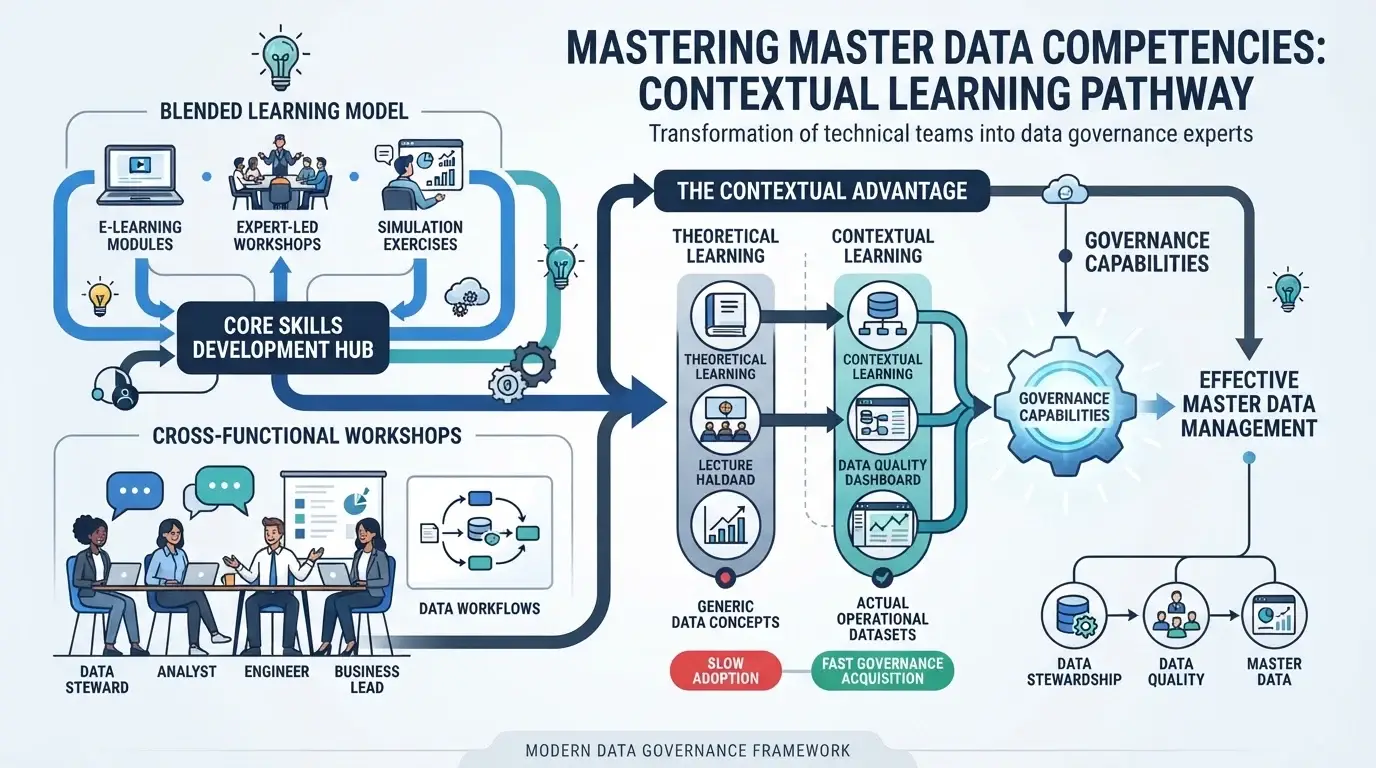
Workforce skill gaps represent the primary bottleneck in enterprise data governance programs. Engineering and field teams often perceive data entry and validation as administrative burdens rather than core technical responsibilities.
Evaluating Workforce Training Approaches
Selecting the correct educational framework requires evaluating skill acquisition efficiency against operational disruption.
Evaluation Attribute | Self-Paced E-Learning | Vendor-Led Tool Training | Specialized Industry Framework Training |
Contextual Relevance | Low (Generic examples) | Medium (Focuses on software UI) | High (Oil and gas operational focus) |
Skill Retention Rate | 20% to 30% | 40% to 50% | 75% to 85% |
Cross-Functional Alignment | Poor | Isolated to software users | Strong across IT and Operations |
Implementation Speed | Immediate | Requires software deployment | Rapid skill application |
Cost Efficiency | High initial, low retention | High vendor licensing fees | High return on competency investment |
Corporate HR teams evaluating competency frameworks must prioritize programs that address the unique technical constraints of petroleum workflows. Structured learning pathways prepare stewards to handle complex edge cases, such as merging historical legacy acquisition data with real-time cloud analytics feeds.
Organizations seeking structured, practical capability development rely on dedicated operational programs. A structured program like the Data Governance and Master Data Ownership and Standards Training by Institute For Oil & Gas Training delivers targeted curricula that align cross-functional engineering teams with modern data governance frameworks.
How Do Organizations Measure the ROI of Data Governance and Quality Remediation?
Organizations measure data governance ROI by tracking reductions in manual data correction costs, improvements in asset uptime, faster regulatory reporting cycles, and reduced drilling risk. Quantifying baseline error rates prior to remediation provides clear financial metrics that prove operational efficiency gains.
Calculating financial returns on governance initiatives requires tracking tangible operational performance indicators alongside technical quality metrics.
Key Performance Indicators for Data Governance ROI
Non-Productive Time (NPT) Reduction: Inaccurate subsurface data leads to improper bit selection or fluid planning, causing drilling delays. Remediating well master data reduces NPT caused by faulty offset well analysis by up to 18%.
Supply Chain Optimization: Unstandardized spare parts catalogs lead to redundant purchasing. Enforcing master data standards for equipment records cuts inventory holding costs by 10% to 12%.
Regulatory Compliance Speed: Automated data lineage tracking reduces the labor hours required to assemble environmental and safety compliance reports by 60%.
Enrolling key stakeholders in the Data Governance & Master Data: Ownership & Standards Training Course provides workforce teams with practical methodologies to design, execute, and monitor these data quality remediation pipelines across enterprise operations.
Establishing clear ownership models, robust technical standards, and continuous capability development transforms raw petroleum data into a secure strategic enterprise asset.
Frequently Asked Questions
What is oil and gas petroleum digital finance and automation?
Oil and gas petroleum digital finance and automation refers to the integration of modern digital tools, robotic process automation (RPA), and advanced financial workflows within energy sector accounting. This discipline optimizes joint venture accounting, operational budgeting, and financial reporting across complex exploration and production operations. Training from the Institute For Oil & Gas Training equips finance teams with practical skills to streamline enterprise resource planning systems and automate financial data compliance.
How does financial automation improve profitability in upstream oil and gas operations?
Financial automation reduces manual processing errors, accelerates joint interest billing cycles, and provides real-time visibility into operational expenditures. By streamlining routine ledger entries and invoice reconciliations, energy organizations minimize revenue leakage and optimize cash flow management. Through specialized programs by the Institute For Oil & Gas Training, professionals learn to implement digital frameworks that enhance financial accuracy and operational efficiency.
What key skills are required for digital transformation in petroleum financial management?
Professionals managing petroleum finance require expertise in automated joint venture auditing, predictive financial modeling, real-time cost tracking, and energy supply chain data integration. Mastery of digital tools enables corporate teams to execute rapid financial planning and maintain regulatory compliance. The Institute For Oil & Gas Training delivers structured learning pathways focused on bridging workforce skill gaps in energy-specific digital finance technologies.
Why should corporate HR teams invest in petroleum digital finance training?
Upskilling finance departments in digital automation accelerates overall operational agility and reduces non-productive administrative time across capital-intensive projects. Targeted workforce development equips accounting teams to handle complex production sharing contracts and joint operating agreements with higher accuracy. The Institute For Oil & Gas Training offers practical corporate training models designed to yield measurable business outcomes and high return on investment.
How do master data standards impact automated petroleum finance systems?
Standardized master data ensures that financial inputs from field operations, SCADA sensors, and procurement databases reconcile accurately within automated accounting engines. Clean reference data eliminates redundant transaction records, improves cost control monitoring, and simplifies multi-entity financial audits. Industry-driven curricula from the Institute For Oil & Gas Training show finance leaders how to build standardized governance frameworks for seamless automation.
Related training courses
ERP Systems for Oil & Gas: Core Modules Training Course
- Specialisation
- Oil & Gas Petroleum Digital Finance & Automation
- Duration
- 5 days · 15 CPD hours
ERP Systems for Oil & Gas: Access Controls Training Course
- Specialisation
- Oil & Gas Petroleum Digital Finance & Automation
- Duration
- 5 days · 13 CPD hours
Automation of JV & PSC Reporting: Process Candidates Training Course
- Specialisation
- Oil & Gas Petroleum Digital Finance & Automation
- Duration
- 5 days · 15 CPD hours
More articles

Data Governance and Master Data Ownership and Standards Training by Institute For Oil & Gas Training
Evaluate the Data Governance & Master Data Ownership & Standards Training Course syllabus, delivery, outcomes, and enrollment requirements.
Read article →
Why Data Governance and Master Data Standards Matter in Oil and Gas
Learn why data governance and master data standards transform petroleum operations, resolve enterprise risk, and drive ROI across global energy assets.
Read article →
Power BI for Production and Cost Dashboards Design Training by Institute For Oil & Gas Training
Evaluate the Power BI Production & Cost Dashboards Design Training Course curriculum, delivery formats, skill outcomes, and corporate enrollment details.
Read article →