

Oil and gas operations generate vast volumes of raw operational, extraction, and financial telemetry across dispersed assets, upstream wells, midstream pipelines, and downstream processing facilities. Converting these multi-source data streams into structured actionable insight requires specialized analytical models rather than generic administrative reporting frameworks. Institute For Oil & Gas Training provides structured corporate technical programs designed to bridge technical data engineering gaps and build advanced reporting capabilities. To understand why unified reporting systems drive operational performance and capital allocation, read Why Production and Cost Dashboards Matter in Oil and Gas Decision Making.
The Power BI for Production & Cost Dashboards: Modelling Training Course addresses core operational bottlenecks where petroleum engineers, financial analysts, and asset managers struggle to consolidate isolated spreadsheet inventories. Without a centralized data architecture, reporting teams experience recurring reconciliation errors, latent decision cycles, and poor cost visibility. This curriculum replaces fragmented manual workflows with automated, scalable, and audit-ready reporting frameworks tailored to the economic realities of energy production.
What Is the Power BI for Production & Cost Dashboards Course and What Problem Does It Solve?
This course is an intensive corporate technical training program designed to eliminate operational data silos, manual reporting latency, and complex schema errors by establishing standardized production and financial data models using advanced Microsoft Power BI engineering principles.
In the energy sector, production volumes, lifting costs, operating expenditure (OPEX), and capital expenditure (CAPEX) are routinely stored in separate software systems. Field operations log daily barrel outputs in specialized SCADA platforms, maintenance management systems track equipment servicing overhead, and corporate finance logs expenditures within enterprise resource planning (ERP) databases. When analysts aggregate these assets using traditional spreadsheets, the resulting workflows are fragile, non-reusable, and prone to human calculation error.
This structural fragmentation creates significant business risk. Executive leadership often receives monthly cost allocation reports weeks after the accounting period closes, preventing proactive cost-control interventions on high-variance wells or subsea structures. Furthermore, mismatched grain sizes between daily barrel outputs and monthly financial accruals complicate net margin calculations per lease or field asset.
The Institute For Oil & Gas Training engineered this course to resolve these operational bottlenecks through direct application of enterprise business intelligence principles. Participants learn to standardize disparate operational tables, resolve complex many-to-many relationship structures, and automate daily data refreshing pipelines. By establishing a single source of truth, organizations eliminate time-consuming manual reconciliations and accelerate operational decision velocity.
Why Is This Curriculum Structured Around Upstream and Midstream Data Architecture?
The curriculum is structured logically to build expertise sequentially from dirty data ingestion and semantic model optimization to sophisticated dynamic calculations, ensuring participants master upstream operational analytics before attempting executive-level financial metrics modeling.
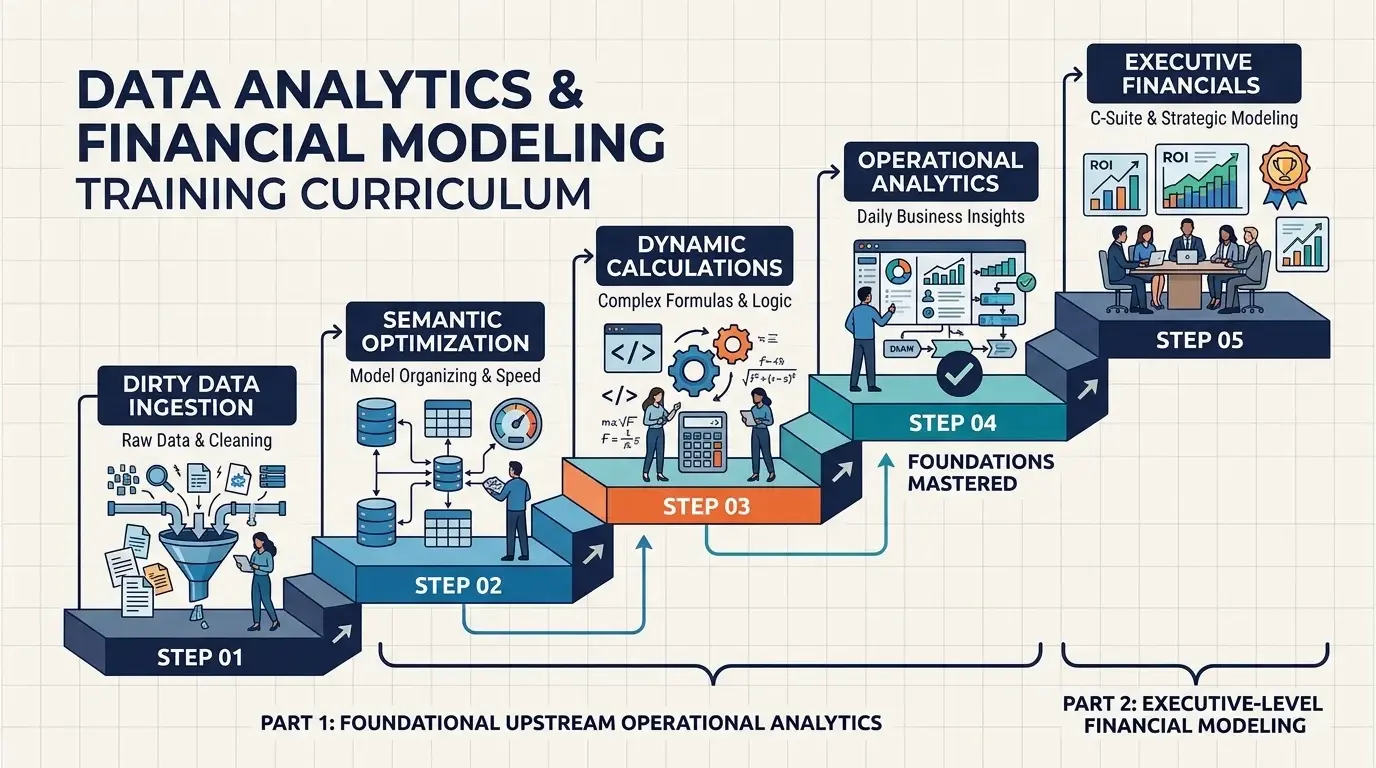
Energy analytics requires a dedicated architectural approach due to the specialized nature of oil and gas operational metrics. Unlike generic retail or software metrics, petroleum reporting relies on complex physical relationships, fluid dynamics logs, joint venture accounting rules, and volatile commodity pricing structures. The Institute For Oil & Gas Training structures this training progression to align directly with real-world energy data pipelines.
The course begins with Power Query transformation to handle inconsistent field log formatting, missing pressure readings, and mismatched date formats. Participants establish automated data cleaning routines that process raw imports without manual user intervention. Once data streams are normalized, the curriculum shifts toward establishing an optimal data model and relationships framework. Constructing an optimized star schema design ensures that high-volume transaction tables, such as daily well-head gauge logs, link efficiently to dimensional context tables like asset locations, operator shifts, and cost centers.
With a scalable schema active, the course moves into complex business logic using DAX measures and calculated columns. Analysts learn to model nuanced operational KPIs, including decline curve forecasts, lease operating expenses (LOE) per barrel of oil equivalent (BOE), and variance against annual field budgets. Finally, the curriculum covers visual selection, drill through and slicers, and report performance optimisation, enabling swift navigation from macro-level regional portfolio overviews down to individual well-head lift pumps.
What Specific Technical Skills and Modules Will Participants Master?
Participants master advanced data transformation, star schema data modeling, complex DAX calculations, custom time intelligence logic, interactive visual design, and memory performance tuning specifically configured for energy production and cost datasets.
Module 1: Production and Cost Data Ingestion and ETL Transformation
Executing advanced Power Query transformation routines on unstructured field CSVs, maintenance logs, and SQL database exports.
Unpivoting daily production logs, handling null values from offline wells, and merging disparate operating expense sheets.
Standardizing measurement units across international assets, including standard cubic feet (SCF), barrels of oil (BBL), and metric tonnes.
Module 2: Enterprise Semantic Data Modeling
Designing robust star schema design architectures to segregate heavy fact tables from descriptive dimension tables.
Managing complex data model and relationships configurations, including active vs. inactive relationships and filter propagation direction.
Implementing dedicated Date, Asset, Well, Cost Center, and Account code dimensions to streamline multi-field analysis.
Module 3: Applied Energy Calculations with DAX
Formulating precise DAX measures for dynamic Lease Operating Expenses per BOE (LOE/BOE), downtime percentage, and deferment volumes.
Configuring calculated columns selectively to avoid unnecessary memory overhead within large historical field datasets.
Leveraging time intelligence functions to compute cumulative production, month-to-date (MTD), year-to-year (YTY) growth, and moving average decline rates.
Module 4: Interactive Dashboard Interface and Performance Optimisation
Implementing intuitive drill through and slicers functionality to enable rapid navigation from field level down to component mechanics.
Applying target-driven visual selection concepts to display production target variances, cost trends, and equipment health indicators cleanly.
Executing report performance optimisation strategies, including DAX Studio queries, VertiPaq engine compression analysis, and visual query reduction.
Detailed guidance on handling complex multi-source petroleum schema transformations is covered in How to Model Production and Cost Data for Effective Power BI Dashboards.
How Is the Training Delivered Across Different Corporate Formats?
The course is delivered through instructor-led live online workshops, immersive on-site corporate bootcamps, and flexible hybrid models, all utilizing real-world oil and gas datasets within hands-on lab environments.
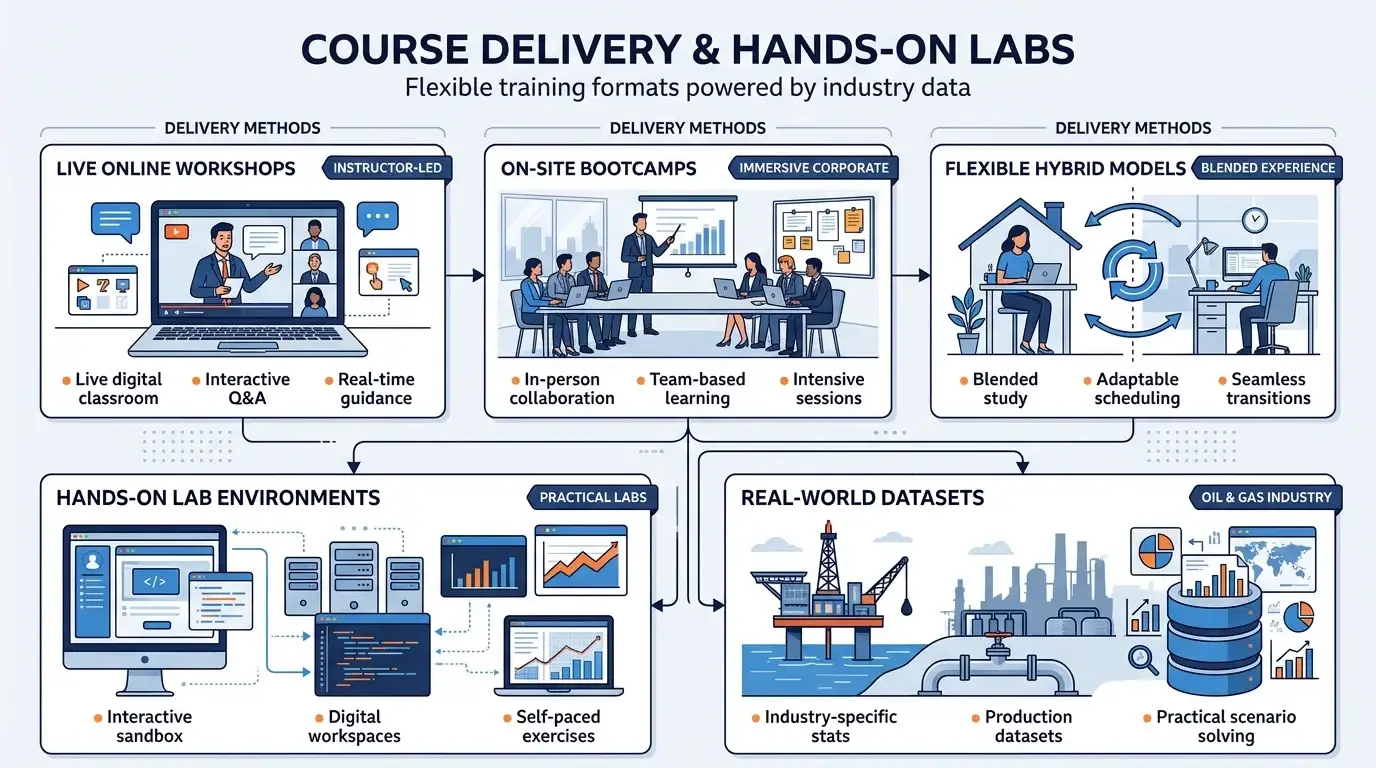
The Institute For Oil & Gas Training provides flexible corporate learning structures designed to minimize operational disruption while ensuring knowledge retention. Organizations can select from three primary delivery modalities based on team geographic distribution and project schedules.
Instructor-Led Live Virtual Workshops
Delivered across interactive digital learning environments, this format spans four weeks with two intensive three-hour sessions per week. Distributed analytics teams, off-shore personnel, and regional engineering groups access live instruction, real-time screen sharing troubleshooting, and recorded technical sessions for review.
On-Site Corporate Bootcamps
Conducted directly at company headquarters, field offices, or operational sites over four consecutive full days. This immersive option allows the Institute For Oil & Gas Training instructor team to align practical exercises directly with the client's internal operational templates, data security policies, and specific reporting requirements.
Hybrid Learning Frameworks
Combining self-paced modular video technical lectures on core syntax with live weekly practical breakout labs. This structure caters specifically to rotational shift workers, offshore engineers, and busy asset managers who require flexible study hours alongside structured expert guidance.
Every delivery format emphasizes practical exercise execution over passive instruction. Participants work directly within sandboxed Microsoft Power BI Desktop environments populated with authentic, anonymized upstream and midstream operational data.
What Measurable Performance Results and Corporate Outcomes Can Be Expected?
Organizations achieve up to an 80% reduction in reporting preparation cycles, complete elimination of manual spreadsheet reconciliation errors, and faster executive identification of field-level cost overruns.
Implementing standardized business intelligence models directly elevates operational performance across technical, financial, and management tiers. Human Resources departments, learning managers, and operational leaders utilizing programs from the Institute For Oil & Gas Training track quantifiable improvements in employee technical capabilities and operational output.
Accelerated Decision Loops
By replacing static monthly slide decks with dynamic, automated dashboards, asset managers track daily production volume changes against budget targets in real time. Operational anomalies, such as sudden artificial lift failures or pipeline pressure drops, are identified and addressed within hours rather than during monthly review meetings.
Enhanced Cost Control and OPEX Visibility
Custom DAX measures tracking Lease Operating Expenses per barrel empower finance teams to isolate high-cost wells immediately. Factoring electricity consumption, chemical injection costs, and workover expenses into dynamic dashboards provides granular visibility into true field profitability.
Standardized Corporate Reporting Metrics
Training technical staff on unified star schema design practices eliminates discrepancies between departmental reports. Engineering, field operations, and corporate accounting report against identical, centralized data definitions, eliminating conflicting production volume statements in executive briefings.
What Are the Entry Requirements, Assessment Methods, and Enrollment Path?
Applicants require basic proficiency in Microsoft Excel and familiarity with general operational or financial concepts in energy, completing the program through practical assessments, a capstone modeling project, and professional certification.
The Institute For Oil & Gas Training maintains structured entry and assessment criteria to ensure all participants achieve professional competency upon graduation.
Prerequisites and Target Audience
This course is structured specifically for energy industry professionals, including:
Petroleum, Production, and Reservoir Engineers seeking to automate operational reporting.
Financial Analysts, Cost Accountants, and Business Analysts managing OPEX/CAPEX models.
Asset Managers and Operations Leads requiring real-time portfolio performance visibility.
IT and Data Management Professionals building analytics pipelines for corporate teams.
Participants should possess a functional understanding of Microsoft Excel, including basic formulas, pivot tables, and tabular data structures. Prior experience with DAX or SQL is beneficial but not required.
Practical Assessment Framework
To earn certification, participants complete targeted practical milestones throughout the course:
Weekly Applied Labs: Hands-on exercises focused on specific technical skills, such as executing a complex Power Query transformation or writing advanced time intelligence functions.
Comprehensive Capstone Project: Constructing a complete, end-to-end production and cost dashboard model using raw, uncleaned operational datasets. The model is evaluated on data schema efficiency, calculation accuracy, UI usability, and overall report performance optimisation.
Upon successful project evaluation, graduates receive an industry-recognized professional credential from the Institute For Oil & Gas Training validating their expertise in energy data modeling.
Organizations seeking to upgrade their analytical capabilities and eliminate manual reporting overhead can submit corporate team registrations or request tailored syllabus adaptations directly through the institute. To review upcoming session dates, request private team pricing, or secure individual seats, enroll in this course program.
Frequently Asked Questions
What is Oil & Gas Petroleum Digital Finance & Automation training?
Oil & Gas Petroleum Digital Finance & Automation training is a specialized professional development program designed by the Institute For Oil & Gas Training. It equips finance, accounting, and operational personnel with digital skills to automate financial workflows, streamline Joint Interest Billing (JIB), optimize Lease Operating Expenses (LOE), and implement automated reporting frameworks across energy operations.
How does digital finance automation benefit petroleum accounting teams?
Digital finance automation reduces manual data entry errors, accelerates monthly closing cycles, and provides real-time visibility into capital expenditure (CAPEX) and operating costs. By implementing modern automated workflows through training from the Institute For Oil & Gas Training, energy companies can seamlessly integrate ERP systems with field asset telemetry to improve cash flow forecasting and joint venture financial management.
Who should enroll in the Oil & Gas Petroleum Digital Finance & Automation program?
This program is structured for petroleum accountants, financial controllers, energy analysts, joint venture managers, and corporate finance leads operating in upstream, midstream, or downstream sectors. Participants trained by the Institute For Oil & Gas Training gain practical experience in leveraging robotic process automation (RPA), data modeling tools, and cloud financial systems specifically tailored for petroleum industry assets.
What core topics are covered in the Oil & Gas Petroleum Digital Finance & Automation curriculum?
The curriculum focuses on automated revenue accounting, digital joint venture auditing, production cost modeling, and integrated financial dashboards. Delivered by the Institute For Oil & Gas Training, the course also covers data governance for energy finance, predictive budgeting via machine learning, and automated compliance tracking for petroleum tax and royalty frameworks.
How is the Oil & Gas Petroleum Digital Finance & Automation course delivered by the Institute For Oil & Gas Training?
The Institute For Oil & Gas Training offers flexible delivery options, including instructor-led live virtual classes, interactive on-site corporate workshops, and hybrid learning formats. The training emphasizes hands-on case studies, real-world petroleum financial dataset exercises, and actionable software modeling techniques designed to fit diverse operational schedules.
Related training courses
ERP Systems for Oil & Gas: Access Controls Training Course
- Specialisation
- Oil & Gas Petroleum Digital Finance & Automation
- Duration
- 5 days · 13 CPD hours
Digital Transformation in Petroleum Finance: AI & RPA Training Course
- Specialisation
- Oil & Gas Petroleum Digital Finance & Automation
- Duration
- 5 days · 15 CPD hours
Data Governance & Master Data: Vendor & Well Training Course
- Specialisation
- Oil & Gas Petroleum Digital Finance & Automation
- Duration
- 5 days · 15 CPD hours
More articles
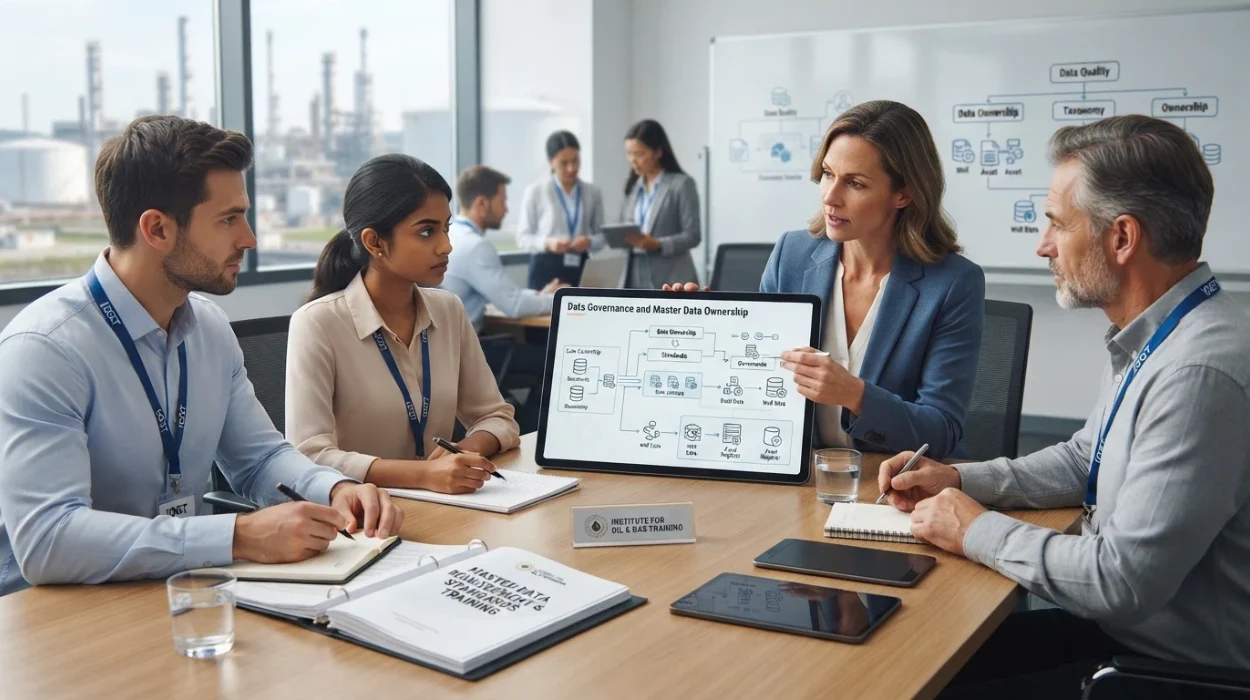
Data Governance and Master Data Ownership and Standards Training by Institute For Oil & Gas Training
Evaluate the Data Governance & Master Data Ownership & Standards Training Course syllabus, delivery, outcomes, and enrollment requirements.
Read article →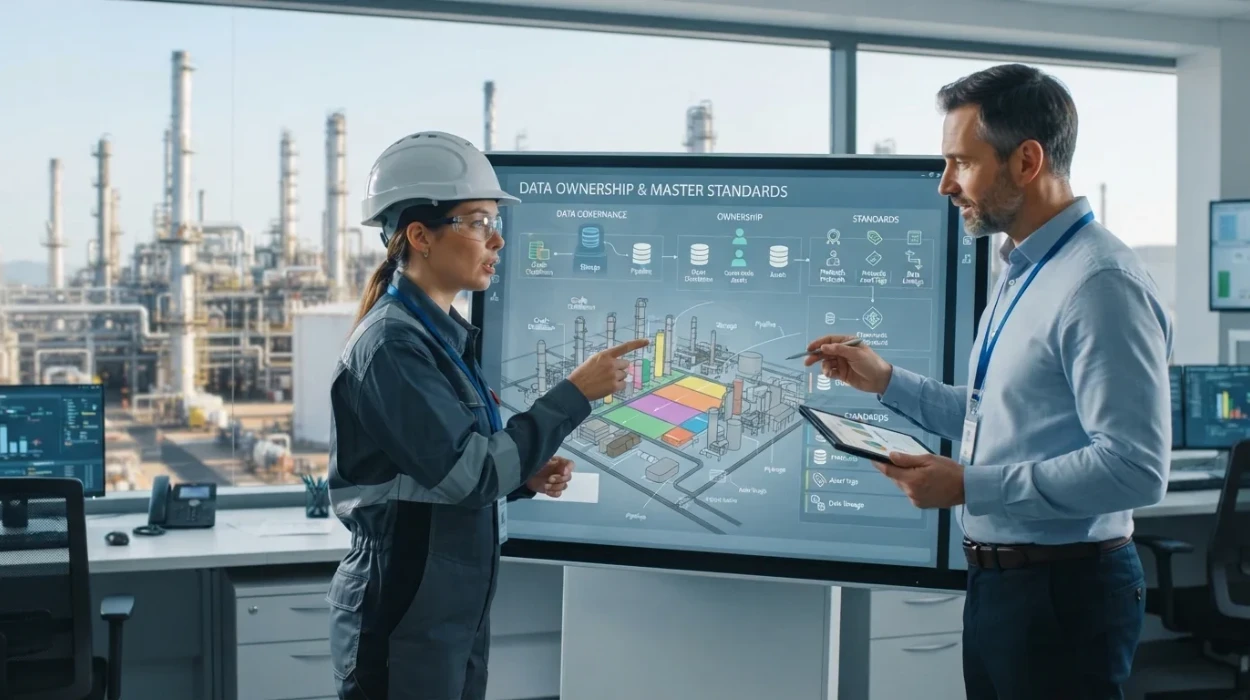
How to Define Data Ownership and Master Data Standards for Petroleum Operations
Learn how petroleum operations define data ownership, establish master data management standards, and improve data governance frameworks.
Read article →
Why Data Governance and Master Data Standards Matter in Oil and Gas
Learn why data governance and master data standards transform petroleum operations, resolve enterprise risk, and drive ROI across global energy assets.
Read article →