

Financial operations in energy sector organisations face unique structural pressures. Upstream joint venture accounting, complex capital expenditure tracking, commodity hedging analytics, and regulatory reporting require extensive manual data handling across multiple systems. Finance teams routinely spend critical hours consolidating complex spreadsheets, extracting operational figures from lengthy contracts, and manually drafting variance summaries for executive boards. This operational overhead slows decision-making cycles and increases the risk of human error in critical reporting environments. To understand why energy companies are adopting generative AI to solve these operational bottlenecks, read Why Microsoft Copilot Matters for Oil and Gas Finance Teams.
The Microsoft Copilot for Oil & Gas Finance Applications Training Course by Institute For Oil & Gas Training bridges this precise technical capability gap. It converts standard Microsoft 365 environments into high-efficiency analytical engines customized specifically for oil and gas financial management workflows.
What is the course and what problem does it solve?
The Microsoft Copilot for Oil & Gas Finance Applications Training Course solves core financial operational inefficiencies by training corporate finance teams to integrate AI-driven automation, advanced formula generation, document synthesis, and automated variance reporting directly into daily energy accounting workflows.
Modern oil and gas finance departments operate under immense data volume pressures. Upstream joint venture billing, midstream tariff calculations, downstream retail margin tracking, and field operational expense reconciliations require significant manual labor. Professionals spend up to sixty percent of their time extracting raw operational data from disparate accounting systems and reformatting it into spreadsheets. This high operational load leads to reporting delays, reduced capacity for strategic risk analysis, and burnout among financial analysts.
Generic software training fails to resolve these challenges because generic programs ignore energy-specific financial structures. Generic tutorials demonstrate standard consumer prompts rather than complex joint operating agreement audits or production sharing contract adjustments. Finance professionals require domain-specific instruction that directly addresses oil and gas ledger entries, multi-currency revenue distributions, and complex capital expenditure forecasting models.
The Institute For Oil & Gas Training designed this curriculum to solve this technical gap. The program shifts participants from manual, multi-step spreadsheet manipulation to prompt-driven analytical orchestration using Microsoft 365 Copilot. Professionals learn to write structured prompts that analyze dynamic data models, build complex financial formulas, and draft executive briefings instantly.
By standardising these competencies across corporate finance divisions, energy firms eliminate low-value data handling overhead. HR teams and department managers gain a structured path to upskill their workforce, establishing verified operational standards that increase output quality while maintaining strict corporate governance.
Why is this training course structured this way?
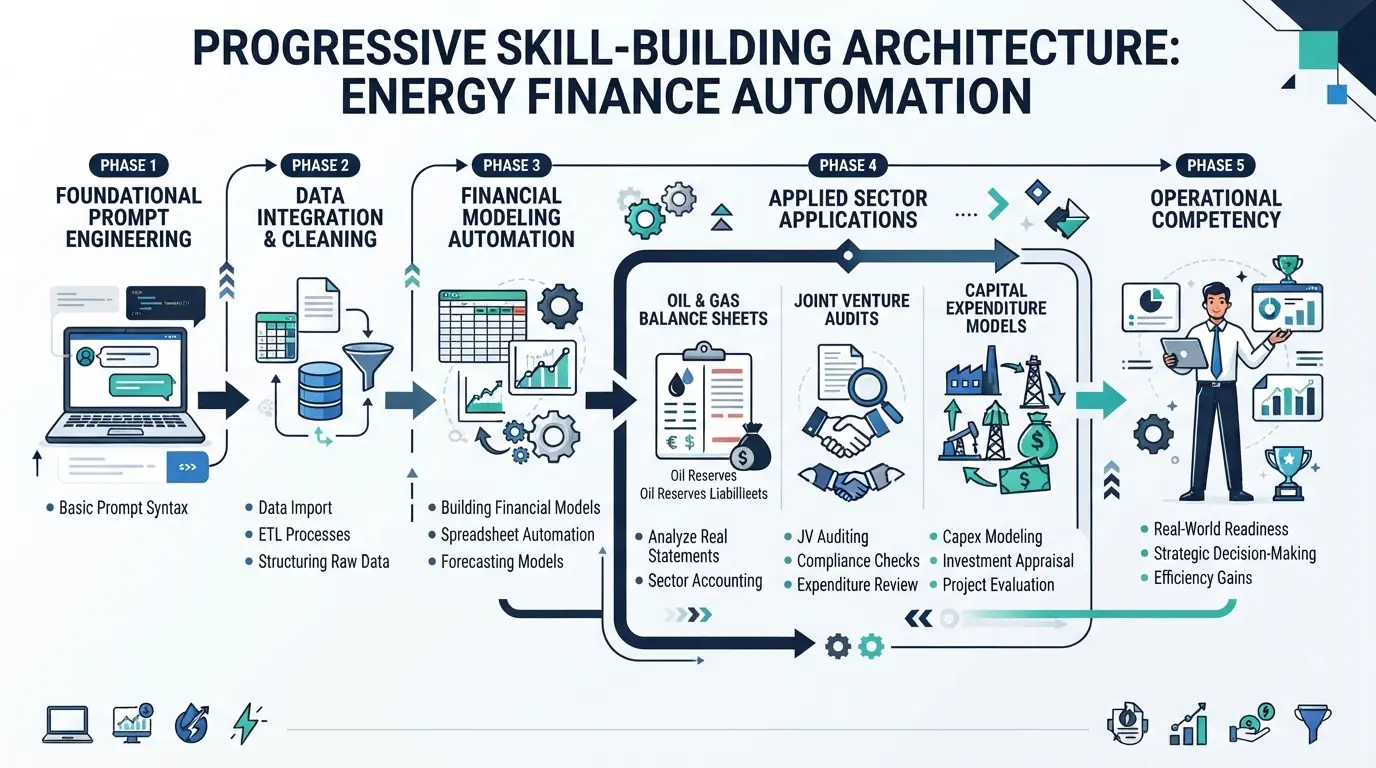
The curriculum uses a progressive skill-building architecture, advancing from basic prompt syntax to complex energy finance automation, ensuring participants build applied operational competency using real oil and gas balance sheets, joint venture audits, and expenditure models.
To evaluate how software applications fit into existing departmental workflows before enrolling, review How to Evaluate Microsoft Copilot Applications for Oil and Gas Finance Workflows.
The pedagogical design follows a practical application matrix developed by the Institute For Oil & Gas Training. Training begins with foundational natural language interaction within spreadsheet environments, progresses to cross-document data synthesis, and culminates in advanced scenario modeling for capital projects. This step-by-step structure prevents cognitive overload and ensures participants master fundamental syntax before attempting complex multi-layered workflows.
The structural design isolates specific operational pain points faced by energy accounting teams. Each module focuses directly on a core financial deliverable, such as joint venture cash call analysis, impairment testing documentation, or quarterly board report generation. By grounding training in real oil and gas scenarios, the curriculum eliminates passive learning and maximizes immediate workplace utility.
The course structure integrates rigorous feedback loops, guided practice exercises, and energy sector datasets. This ensures that skills learned during training transfer seamlessly to live corporate environments without disrupting active financial operations.
What will participants learn in the curriculum?
Participants learn to apply prompt writing for finance tasks, execute complex data analysis prompts, automate formula generation in Copilot in Excel, execute automated meeting summarisation, draft report narratives, and build predictive capital allocation models.
The Microsoft Copilot for Oil & Gas Finance Applications Training Course is structured into six comprehensive modules, combining technical software mechanics with energy sector financial practices.
Module 1: Foundational Prompting for Energy Finance
This module covers the core mechanics of natural language processing within enterprise financial environments. Participants study the structural architecture of Microsoft 365 Copilot, focusing on enterprise data privacy, security boundaries, and contextual data retrieval. Learners acquire core skill sets in prompt writing for finance tasks, learning how to construct precise inputs using contextual parameters, specific constraints, and output formatting rules.
Understanding enterprise data isolation and security guardrails in Microsoft 365.
Mastering the four-part prompt structure: Context, Task, Source Data, and Output Specification.
Eliminating generic responses through domain-specific energy accounting terminology.
Establishing standardized prompt libraries across corporate finance teams.
Module 2: Advanced Data Analytics with Copilot in Excel
This module transforms standard spreadsheet workflows through Copilot in Excel. Financial analysts learn to query complex datasets using natural language, execute rapid variance calculations across multi-subsidiary ledgers, and automate complex formula construction without manual coding.
Automating formula generation for complex nested calculations, XLOOKUP functions, and dynamic arrays.
Running natural language data analysis prompts to identify cost anomalies across field operations.
Building dynamic conditional formatting rules to highlight operating expense variations automatically.
Executing rapid data cleanup, restructuring messy ERP extracts into audit-ready tabular formats.
Module 3: Document Drafting Assistance and Financial Reporting
This module focuses on document drafting assistance across Microsoft Word and PowerPoint. Finance professionals learn to convert raw numerical data into comprehensive, boardroom-ready narrative reports. Participants practice generating initial commentary for monthly management accounts, board packs, and regulatory disclosures.
Executing report narrative drafting directly from raw Excel workbooks and financial models.
Synthesising long-form joint operating agreements to extract relevant financial liabilities.
Automating initial slide deck creation for financial performance presentations.
Standardising technical language and tone across institutional investment documents.
Module 4: Meeting Summarisation and Collaboration in Finance Workflows
This module addresses collaboration overhead through automated meeting summarisation in Microsoft Teams and Outlook. Participants learn to capture financial decisions, action items, and audit discussions during complex multi-party energy negotiation calls.
Extracting actionable financial decisions from recorded joint venture committee meetings.
Automating follow-up task distribution and email draft creation for accounting teams.
Synthesizing complex cross-departmental discussions into concise memo updates.
Maintaining structured digital audit trails of financial strategy decisions.
Module 5: Strategic Capital Expenditure & Risk Modeling
Focused on upstream and midstream capital investments, this module teaches participants to evaluate large-scale energy projects using predictive prompting techniques. Learners test asset viability under variable commodity price scenarios and inflation assumptions.
Constructing scenario analysis prompts to test field development sensitivity to price volatility.
Drafting comprehensive risk assessments for international exploration block acquisitions.
Automating comparative analysis of long-term equipment leasing versus capital purchasing.
Synthesising historical cost performance to refine future capital allocation models.
Module 6: Corporate Governance, Verification, and Audit Compliance
The final module establishes rigorous quality control frameworks for AI-generated financial outputs. Participants learn verification strategies to ensure all generated figures match primary general ledger source records precisely.
Applying verification protocols to eliminate mathematical hallucinations in generated reports.
Establishing clear institutional guidelines for AI usage in public financial disclosures.
Auditing generated formulas for hidden logic errors prior to model deployment.
Ensuring compliance with international financial reporting standards and local energy regulations.
How is the training course delivered?
The Institute For Oil & Gas Training delivers this program through flexible live instructor-led online sessions, immersive on-site corporate workshops, or hybrid formats, combining direct instruction with supervised hands-on lab environments.
Delivery options adapt to organizational scheduling needs, team size, and geographical distribution. The Institute For Oil & Gas Training offers three primary delivery tracks designed for corporate implementation:
The course structure relies heavily on applied learning. Lectures make up less than thirty percent of total instructional time; the remaining time focuses on interactive practical exercises. Participants work within isolated sandboxes, applying prompt techniques to real-world energy sector financial tasks.
Instruction is delivered by senior financial technology experts with extensive energy sector experience. Every session includes direct live feedback, real-time prompt optimization, and technical troubleshooting. This practical emphasis ensures participants develop true operational autonomy rather than simple theoretical understanding.
What measurable results can organizations expect?
Organizations achieve up to forty percent reductions in monthly financial reporting cycles, eliminate manual spreadsheet data entry errors, accelerate variance analysis, and secure clear productivity gains in finance workflows.
Corporate adoption of the Microsoft Copilot for Oil & Gas Finance Applications Training Course yields clear, quantifiable performance improvements across finance departments.
For HR directors and executive leadership teams, this training program provides a verifiable framework for talent development. Upskilling key financial personnel directly enhances departmental capacity without expanding headcount. Analysts transition away from repetitive data consolidation tasks, focusing instead on strategic financial analysis, risk mitigation, and capital optimization.
By standardising productivity gains in finance workflows, corporate teams build institutional efficiency. Financial reporting schedules become faster and more reliable, internal audit workflows gain precision, and executive decision-makers receive clear financial intelligence faster.
How does enrollment work for individuals and corporate teams?
Enrollment involves a formal candidate pre-assessment, cohort selection, technical environment preparation, and structured enterprise registration managed directly by the Institute For Oil & Gas Training.
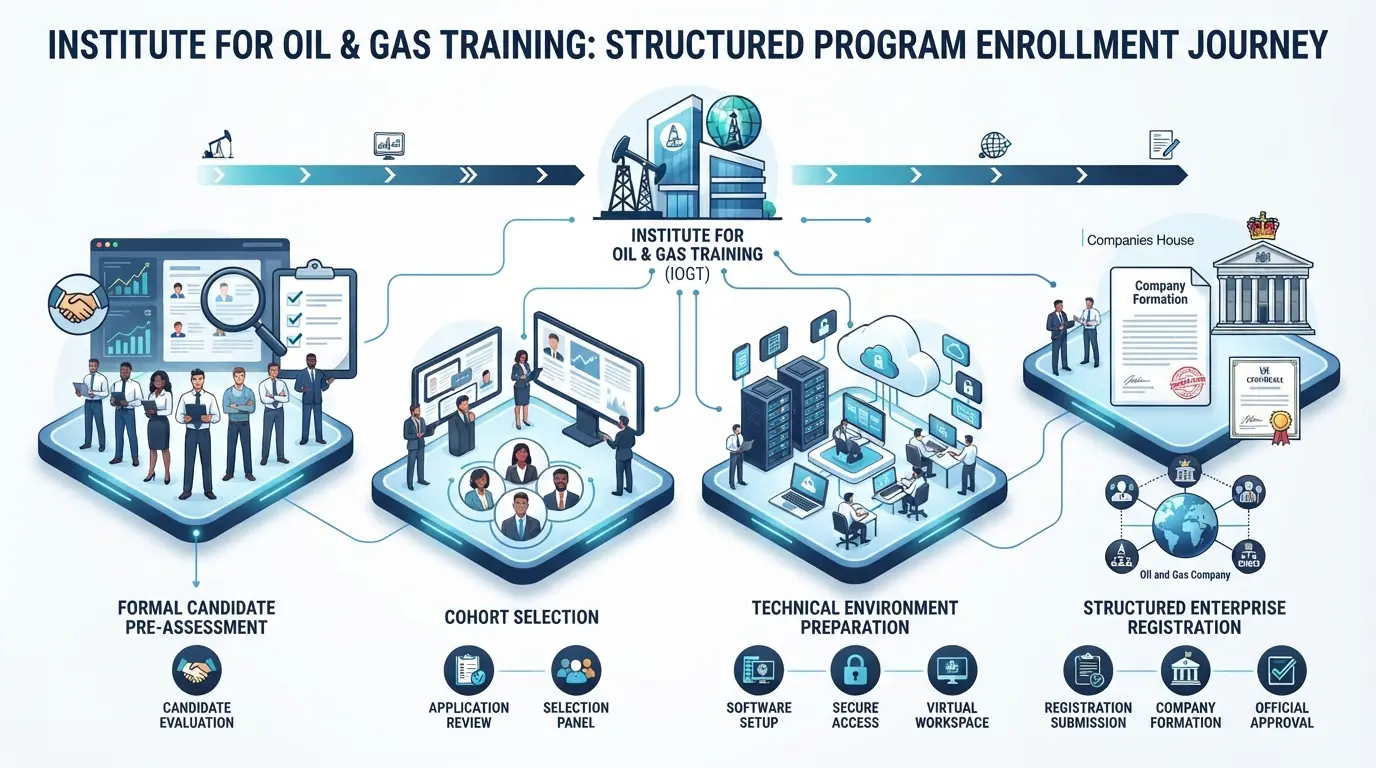
The registration process follows a structured path to ensure technical readiness and alignment with organizational learning objectives.
Candidate Pre-Assessment: Applicants submit an initial profile detailing current finance roles, basic proficiency in Microsoft Excel, and specific organizational goals. This step confirms that participants hold the foundational financial knowledge required for advanced automation.
Technical Environment Verification: The IT and technical support team at Institute For Oil & Gas Training collaborates with corporate IT departments to ensure required Microsoft 365 Copilot licenses, tenant settings, and security permissions are properly configured prior to class start dates.
Cohort Placement & Registration: Corporate groups and individual professionals select their preferred delivery format and training dates. Custom enterprise cohorts are arranged for corporate teams requiring customized company case studies.
Program Onboarding & Pre-Reading: Confirmed participants receive preparatory material outlining core prompt design concepts, enabling immediate practical work during the first live training session.
The Institute For Oil & Gas Training maintains capped cohort sizes to guarantee direct instructor interaction, detailed prompt reviews, and personalized performance feedback. Upon completing all practical modules and passing the final case study evaluation, participants earn an industry-recognized professional credential verifying their capability in AI-driven energy finance applications.
To secure your place in an upcoming cohort or arrange a custom workshop for your corporate finance team, enroll in this program.
Frequently Asked Questions
What is Oil & Gas Petroleum Digital Finance & Automation training?
Oil & Gas Petroleum Digital Finance & Automation training is a specialized professional development program delivered by the Institute For Oil & Gas Training. It equips energy sector accounting and finance personnel with practical skills in automated general ledgers, digital joint-venture auditing, and algorithmic petroleum financial modeling. The training bridges the gap between traditional energy accounting principles and modern enterprise resource planning (ERP) systems to enhance workflow accuracy.
How does digital finance automation improve oil and gas accounting?
Implementing Oil & Gas Petroleum Digital Finance & Automation reduces manual data-entry errors, accelerates month-end reporting cycles, and streamlines complex joint-interest billing calculations. The Institute For Oil & Gas Training designs workflows that integrate real-time field data with corporate financial models. This allows energy finance teams to perform dynamic capital expenditure tracking, variance analysis, and audit-ready reporting with speed and precision.
Who should enroll in an oil and gas digital finance course?
This course is designed for petroleum accountants, corporate finance managers, energy financial analysts, and joint-venture auditors seeking to modernize their skill set. The Institute For Oil & Gas Training provides structured, practical instruction tailored to both upstream E&P and midstream financial operations. It is particularly valuable for professionals transition-planning toward digital energy management and automated risk assessment.
What core skills are taught in Oil & Gas Petroleum Digital Finance & Automation?
Participants in the Oil & Gas Petroleum Digital Finance & Automation course gain proficiency in automated revenue accounting, joint-operating agreement (JOA) compliance tracking, and predictive capital allocation. The Institute For Oil & Gas Training incorporates real-world energy datasets to teach process automation, robotic process automation (RPA) in ledger reconciliations, and energy-specific data analytics. Learners master building dynamic dashboards for real-time executive decision-making.
Does the Institute For Oil & Gas Training offer corporate group sessions for digital finance automation?
Yes, the Institute For Oil & Gas Training provides customized in-house and virtual corporate training tailored to specific organizational workflows. These corporate sessions align the Oil & Gas Petroleum Digital Finance & Automation curriculum with an enterprise's specific ERP configuration, internal controls, and operational structure. This ensures seamless team-wide adoption, improved compliance, and immediate productivity gains across finance departments.
Related training courses
Data Governance & Master Data: Vendor & Well Training Course
- Specialisation
- Oil & Gas Petroleum Digital Finance & Automation
- Duration
- 5 days · 15 CPD hours
Automation of JV & PSC Reporting: Process Candidates Training Course
- Specialisation
- Oil & Gas Petroleum Digital Finance & Automation
- Duration
- 5 days · 15 CPD hours
Digital Transformation in Petroleum Finance: Strategy & Roadmap Training Course
- Specialisation
- Oil & Gas Petroleum Digital Finance & Automation
- Duration
- 5 days · 15 CPD hours
More articles

Data Governance and Master Data Ownership and Standards Training by Institute For Oil & Gas Training
Evaluate the Data Governance & Master Data Ownership & Standards Training Course syllabus, delivery, outcomes, and enrollment requirements.
Read article →
How to Define Data Ownership and Master Data Standards for Petroleum Operations
Learn how petroleum operations define data ownership, establish master data management standards, and improve data governance frameworks.
Read article →
Why Data Governance and Master Data Standards Matter in Oil and Gas
Learn why data governance and master data standards transform petroleum operations, resolve enterprise risk, and drive ROI across global energy assets.
Read article →