

Cross-border oil and gas operations generate intricate financial flows, including dividend distributions, interest payments, equipment leases, and technical service fees. Evaluating tax compliance requires a precise assessment of local statutory obligations against international treaty provisions. Petroleum companies operating across jurisdictions face rigorous scrutiny from foreign revenue authorities, making structured evaluation frameworks essential for mitigating exposure to double taxation, penalties, and operational delays.
Managing international tax exposure requires balancing statutory withholding obligations with treaty entitlements. Understanding Why Tax Compliance and Treaty Relief Matter for Cross Border Oil and Gas Payments enables finance leaders, tax managers, and corporate counsel to establish robust internal controls. Evaluating these mechanisms requires analyzing beneficial ownership requirements, tax residence verification, remittance timelines, and anti-abuse regulations. A systematic evaluation framework ensures that cross-border petroleum transfers remain compliant while maximizing available treaty benefits.
What Are the Key Evaluation Criteria for Withholding Tax and Treaty Relief Compliance?
Evaluating withholding tax compliance requires verifying tax residence certificates, testing beneficial ownership, assessing permanent establishment risks, calculating correct withholding rates, meeting remittance deadlines, and applying anti-abuse provisions. These criteria ensure that cross-border petroleum payments comply with local laws and tax treaties.
A thorough evaluation process begins with verifying the payee’s eligibility under a Double Tax Agreement (DTA). Tax authorities scrutinize international petroleum payments to prevent treaty abuse and unlawful tax avoidance. Organizations must establish a standardized checklist to evaluate every cross-border payment prior to disbursement.
Tax Residence Verification and Beneficial Ownership
The tax residence certificate serves as the primary document establishing an entity’s eligibility for treaty benefits. Foreign revenue authorities require a valid certificate issued by the tax administration of the payee’s home country for the specific tax year.
Evaluating the payee’s status under the beneficial ownership test forms the second critical barrier against compliance failure. The recipient entity must demonstrate economic substance, operational autonomy, and control over the received funds. Intermediate conduit companies established in low-tax jurisdictions without real economic activity fail this test, leading to the immediate denial of reduced treaty rates.
Statutory Withholding Rates vs Treaty Relief Rates
Local tax codes impose baseline withholding tax rates on cross-border payments, often ranging from 10 percent to 30 percent. Tax treaties modify these statutory rates, providing reduced withholding percentages or full exemptions for specific income categories.
Evaluating transaction classifications ensures correct rate application. Payment categories in the petroleum sector carry distinct treaty implications:
Technical Service Fees: Frequently reclassified as business profits unless a specific technical services article exists in the relevant treaty.
Equipment Rentals: Classified as royalties under several older treaty models, attracting higher withholding rates.
Dividends and Interest: Subject to specific holding period requirements and equity thresholds to qualify for lower treaty rates.
Anti-Abuse Rules and Principal Purpose Tests
Modern tax treaties incorporate the Principal Purpose Test (PPT) under the Multilateral Instrument (MLI). Tax authorities disallow treaty benefits if obtaining that benefit was one of the principal purposes of an arrangement or transaction.
Corporate compliance evaluations must examine the commercial rationale of corporate structures involved in petroleum projects. Detailed documentation demonstrating genuine operational necessity protects the enterprise against retroactive tax assessments and severe penalties for late withholding.
How Do Organizations Compare Methods for Managing Tax Treaty Relief?
Organizations compare tax treaty relief management methods by evaluating manual in-house reviews, automated tax software, outsourced advisory, and structured workforce training. Selection depends on transaction volume, internal technical expertise, regulatory risk tolerance, software integration capabilities, and overall cost efficiency.

Choosing the right approach to manage treaty relief and withholding tax remittance deadlines requires assessing corporate capabilities against transaction complexity. Petroleum companies must weigh the operational friction of each method against its long-term reliability and compliance cost.
Comparing Operational Approaches to Tax Compliance
Evaluation Attribute | Manual In-House Review | Automated Tax Software | Outsourced Advisory | Structured Internal Training |
Transaction Processing Speed | Slow; high risk of bottlenecking payments. | Fast; automated processing for routine flows. | Medium; dependent on external counsel availability. | Fast; empowered teams handle complex flows internally. |
Error Rate in Complex Cases | High; manual oversight risks missing treaty updates. | Moderate; software struggles with ambiguous treaty clauses. | Low; specialized external experts review edge cases. | Low; technical training builds precise case-handling skills. |
Cost Scalability | Low; requires linear headcount expansion. | High; fixed license costs scale across volume. | Low; variable billing per transaction or advisory hour. | High; upfront investment yields recurring capability. |
Audit Defense Preparedness | Fragmented; documentation stored across individual drives. | High; centralized digital audit trail. | High; external legal memos provide formal backing. | High; standardized internal documentation protocols. |
Adaptability to Treaty Changes | Slow; relies on individual staff awareness. | Dependent on vendor update cycles. | Immediate; advisors track real-time law changes. | Continuous; trained personnel actively monitor changes. |
Manual Processing vs Tech-Enabled Workflows
Manual tracking of withholding tax rates using spreadsheets exposes petroleum operators to catastrophic compliance failures. A single oversight in tracking a tax reclaim procedure deadline results in unrecoverable cash leakages.
Automated tax platforms calculate withholding obligations at the point of invoice processing. However, software solutions require accurate initial parameters and human validation for non-standard joint venture agreements and production-sharing contracts.
Outsourcing vs Building In-House Expertise
Relying exclusively on third-party accounting firms for routine cross-border tax clearance generates substantial recurring expenditure. While external advisors provide essential support for high-stakes dispute resolution, relying on them for daily operational payments slows supply chain execution.
Developing internal capabilities reduces dependency on external counsel for standard transactions. Corporate finance and legal teams equipped with direct training evaluate treaty residence certificates, compute reduced rates, and manage withholding tax remittance deadlines without external delays.
How Do You Evaluate the Business Impact of Tax Compliance Gaps in Petroleum Operations?
Tax compliance gaps impact petroleum operations by causing immediate cash leakage, triggering severe late payment penalties, restricting foreign tax credit utilization, disrupting joint venture partnerships, and damaging corporate reputation during regulatory audits.
Unmanaged tax exposures directly erode project margins in upstream, midstream, and downstream joint ventures. Financial evaluation must account for both direct monetary penalties and broader operational friction caused by non-compliance.
Direct Financial Penalties and Loss of Foreign Tax Credits
Failure to deduct and remit withholding tax within statutory deadlines results in severe consequences:
Financial Penalties: Fines ranging from 10 percent to 100 percent of the unpaid tax liability.
Interest Accrual: Monthly compound interest applied to overdue tax balances.
Loss of Deductibility: Total disallowance of the underlying expense for corporate income tax calculations.
Cross-border tax mismanagement undermines the utilization of the foreign tax credit. Revenue authorities in the parent company’s jurisdiction reject credit claims if the underlying tax was paid at statutory rates when a reduced treaty rate was legally available. This creates permanent double taxation, directly reducing net earnings.
Joint Venture Friction and Cash Flow Restrictions
Petroleum joint ventures involve shared cash calls and cost-recovery mechanisms. If the operating partner fails to apply double taxation treaty relief correctly, non-operating partners absorb unnecessary tax costs, leading to formal audit disputes and delayed cash distributions.
Tax authorities possess legal powers to freeze local bank accounts or impound equipment for unpaid withholding obligations. Such enforcement actions halt drilling programs and field development, multiplying the financial impact far beyond the underlying tax dispute.
What Decision Framework Determines the Right Capability-Building Approach for HR and Tax Executives?
HR and finance executives determine the optimal capability-building approach by assessing team skill gaps, transaction complexity, regulatory exposure, and operational volume. A structured framework evaluates internal training against outsourcing to balance long-term capability with cost management.
When internal audit results reveal recurring errors in tax reclaim procedure filings or treaty rate applications, executives must upgrade organizational skills. HR leaders working alongside Chief Tax Officers evaluate structured learning interventions to systematically eliminate skill deficits.
Step-by-Step Selection Framework
Strategic Evaluation Matrix for Training Investments
Decision Factor | Low Internal Capability / High Volume | High Internal Capability / Low Volume | Complex Non-Routine Transactions |
Recommended Strategy | Implement specialized corporate training program. | Conduct periodic internal knowledge-sharing sessions. | Engage specialized external counsel for targeted opinion. |
Primary Objective | Establish standardized operational compliance workflows. | Maintain existing expertise and review law updates. | Mitigate high-value legal litigation risk. |
Target Audience | Finance managers, tax accountants, procurement teams. | Senior tax specialists, internal legal counsel. | Executive board, corporate strategy leaders. |
Target Outcome | 100% compliance on routine cross-border disbursements. | Sustained internal compliance efficiency. | Structured risk sign-off for major corporate restructuring. |
For organizations seeking to eliminate compliance bottlenecks, enrollment in specialized corporate education provides direct operational benefits. Professional training equips staff to handle complex documentation requirements, execute correct tax reclaim procedures, and maintain rigorous compliance standards across all petroleum ventures.
Organizing direct professional development for key staff ensures long-term operational resilience. Organizations evaluating professional upskilling options should review the comprehensive curriculum provided in the Withholding Tax Compliance & Treaty Relief Training Course to systematically build in-house technical capabilities.
How Should Organizations Implement Professional Upskilling to Ensure Long-Term Compliance?
Organizations implement professional upskilling by embedding practical case studies, real-world treaty application exercises, cross-functional collaboration protocols, and continuous regulatory monitoring into their corporate learning frameworks to protect cross-border petroleum transactions.
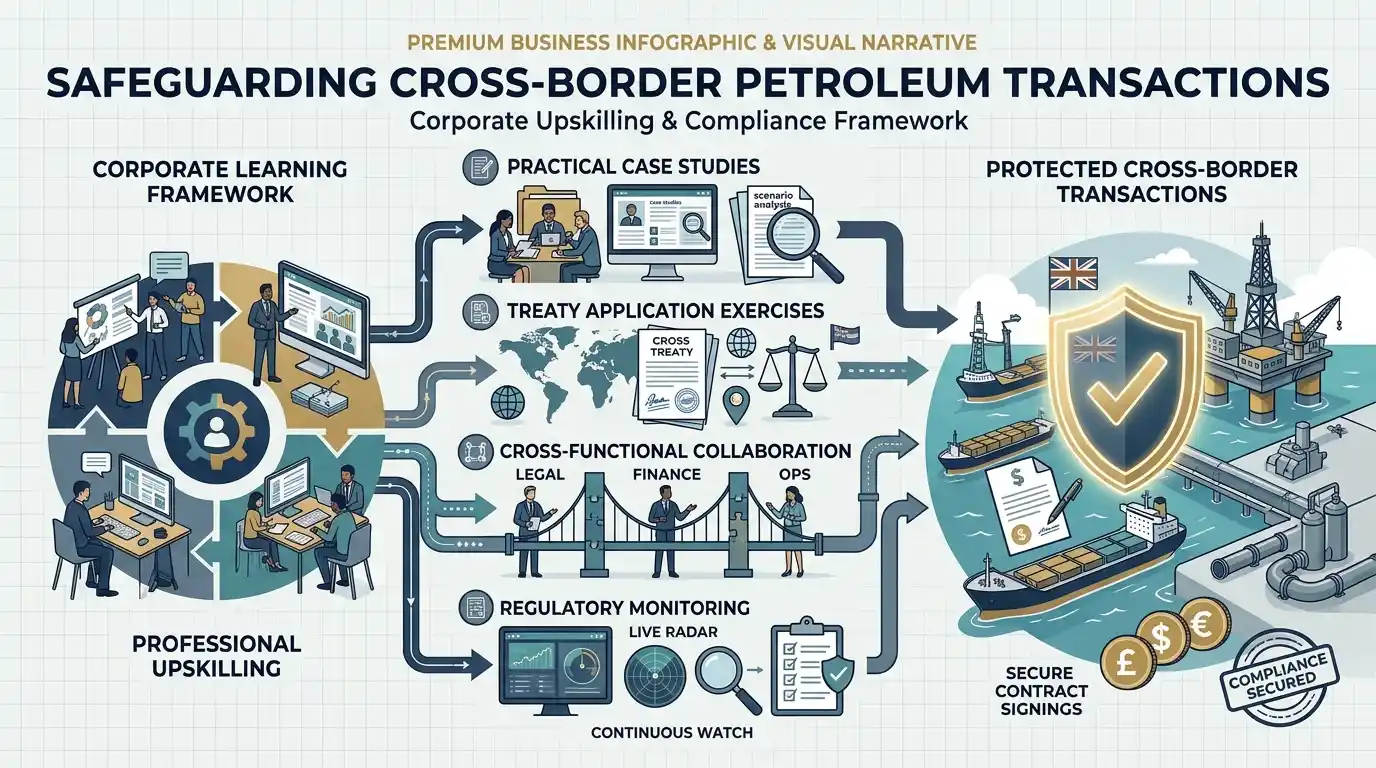
To transition from passive understanding to operational execution, petroleum companies require structured professional development programs tailored specifically to oil and gas financial management. Enrolling finance, legal, and tax personnel in targeted Withholding Tax Compliance and Treaty Relief Training for Oil and Gas Tax Professionals ensures that cross-border teams gain direct practical experience in applying complex treaty provisions.
Essential Components of an Effective Corporate Training Framework
An effective learning program addresses the unique financial structures of the energy sector:
Practical Case Analysis: Evaluating actual joint operating agreements, farm-in arrangements, and technical service contracts to identify withholding exposure.
Simulated Audit Readiness: Training personnel to assemble complete compliance packages, including beneficial ownership documentation and tax residence certificates, before tax authority inquiries occur.
Cross-Functional Integration: Aligning procurement, legal, and finance departments so that contract drafting accounts for withholding tax remittance deadlines and treaty requirements prior to signing.
Measuring ROI on Corporate Compliance Training
HR leaders and finance directors evaluate training effectiveness through clear operational key performance indicators (KPIs):
Reduction in Late Remittance Penalties: Achieving a zero-penalty record across all cross-border operating jurisdictions.
Increased Treaty Relief Utilization: Successfully applying reduced treaty rates on all qualifying cross-border transactions, eliminating unnecessary cash withholding.
Lower External Advisory Spend: Decreasing routine legal and accounting consultation fees by resolving standard compliance questions internally.
Faster Invoicing Cycles: Eliminating payment holds caused by ambiguous withholding tax requirements or missing vendor documentation.
By systematically upskilling the workforce, petroleum enterprises build an internal defense against regulatory enforcement. Establishing technical competency across all operational levels secures cross-border cash flows, protects joint venture margins, and ensures permanent alignment with global tax compliance standards.
Frequently Asked Questions
What is Oil & Gas Petroleum Taxation, and why is it critical for energy professionals?
Oil & Gas Petroleum Taxation refers to the specialized framework of fiscal regimes, production-sharing contracts (PSCs), royalties, and international tax treaties governing upstream, midstream, and downstream operations. Offered by the Institute For Oil & Gas Training, this training equips tax managers, legal counsel, and finance leaders with the technical expertise needed to structure cross-border transactions, ensure regulatory compliance, and prevent costly penalty exposure.
What key topics are covered in the Oil & Gas Petroleum Taxation program by the Institute For Oil & Gas Training?
The curriculum addresses essential tax mechanisms, including double taxation treaty relief, foreign tax credit utilization, ring-fencing provisions, transfer pricing guidelines, and beneficial ownership assessments. Participants also learn to manage withholding tax remittance deadlines and evaluate complex concession agreements to minimize financial risk across multi-jurisdictional energy operations.
Who should enroll in the Institute For Oil & Gas Training's Oil & Gas Petroleum Taxation course?
This course is designed for corporate tax specialists, finance directors, legal advisors, joint venture managers, and revenue authority auditors working within the energy sector. Professionals responsible for managing cross-border payments, joint operating agreements, or fiscal compliance in petroleum transactions will derive immediate operational benefit from the framework.
How does understanding petroleum fiscal regimes help prevent double taxation in international transactions?
A thorough knowledge of international petroleum taxation allows operators to correctly apply Double Tax Agreements (DTAs), tax residence certificates, and reduced withholding rates at the point of disbursement. Through structured learning at the Institute For Oil & Gas Training, professionals master practical tax reclaim procedures and statutory guidelines to ensure full credit recognition without triggering tax authority disputes.
What practical business outcomes can organizations expect from upskilling teams in Oil & Gas Petroleum Taxation?
Organizations that upskill their finance and legal teams through the Institute For Oil & Gas Training experience reduced reliance on costly external advisors, zero late-payment penalty assessments, and optimized cash flow across international joint ventures. Establishing in-house expertise speeds up contract reviews and protects corporate project margins against retroactive regulatory adjustments.
Related training courses
In-line Pipeline Inspection Technologies and Applications Training Course
- Specialisation
- Oil & Gas Pipeline Integrity and Inspection
- Duration
- 5 days · 15 CPD hours
API 570 Piping Inspection and Integrity Assessment Training Course
- Specialisation
- Oil & Gas Inspection and Non-Destructive Testing
- Duration
- 5 days · 15 CPD hours
Metallurgy for Non-Metallurgist Training Course
- Specialisation
- Oil & Gas Corrosion Management and Control
- Duration
- 5 days · 15 CPD hours
More articles

How to Evaluate Transfer Pricing Risks and Intercompany Transactions in Oil and Gas Groups
Evaluate transfer pricing risks in oil and gas intercompany transactions. Learn methods, functional analysis, and arm's length compliance strategies.
Read article →
Why Transfer Pricing Matters for Multinational Oil and Gas Groups
Learn why transfer pricing matters for multinational oil and gas groups, including compliance frameworks, risk management, and workforce development.
Read article →
Withholding Tax Compliance and Treaty Relief Training for Oil and Gas Tax Professionals
Master cross-border oil and gas tax compliance. Evaluate syllabus, delivery, and outcomes for the Institute For Oil & Gas Training course.
Read article →