

Evaluating transfer pricing risks requires analyzing intercompany transactions across upstream, midstream, and downstream operations to ensure tax compliance. Energy groups must assess functional profiles, choose appropriate valuation methods, examine contract structures, and maintain thorough documentation to satisfy global tax authorities.
Multinational energy enterprises operate across complex cross-border value chains, moving crude oil, refined products, specialized equipment, and technical services between related entities. Managing fiscal alignment across jurisdictions demands robust risk evaluation frameworks, as highlighted in Why Transfer Pricing Matters for Multinational Oil and Gas Groups. Corporate finance teams, tax executives, and human resource directors face mounting pressure from international revenue bodies auditing high-value intercompany arrangements. This article provides an analytical evaluation of transfer pricing risks, intercompany transaction structures, functional analysis models, and formal training methodologies necessary to protect corporate capital and build organizational compliance capabilities.
What Are the Core Transfer Pricing Risks in Oil and Gas Intercompany Transactions?
Core transfer pricing risks arise from misaligned profit allocations, improper valuation of cross-border commodity sales, incorrect management service charges, and unverified financial transactions. Tax authorities target these discrepancies because minor transfer price adjustments trigger multi-million-pound tax exposure, penalties, and double taxation.
Commodity Trading and Upstream Marketing Allocations
Upstream extraction entities frequently sell raw crude or natural gas to centralized trading desks located in different tax jurisdictions. Risk emerges when the internal transfer price diverges from real-time market benchmarks. Revenue authorities closely audit the timing of pricing formulas, quotation periods, and quality differentials applied to intercompany sales. If an offshore trading desk captures profits without performing genuine commercial functions, tax auditors reallocate those earnings back to the producing state.
Technical Services and Cost Allocations
Exploration and production activities depend heavily on centralized technical expertise, including reservoir engineering, seismic analysis, and legal counsel. Parent companies pool these expenditures and bill regional subsidiaries through intra-group services agreements. Risks materialize when subsidiaries cannot prove the economic benefit of these services or when mark-up percentages exceed acceptable market standards. Tax authorities routinely disallow deductions for duplicated overhead or vague corporate stewardship costs.
Financing Arrangements and Intangible Assets
Intercompany loans, financial guarantees, and proprietary technology transfers generate substantial fiscal scrutiny. Energy groups frequently finance capital-intensive field developments using internal debt instruments. Transfer pricing risk increases if interest rates deviate from market yields or if the borrowing entity lacks the financial capacity to service the debt independently. Furthermore, licensing proprietary extraction technology or specialized data assets to related entities demands strict economic justification to avoid profit-shifting adjustments.
How Does Functional Analysis Identify Value Drivers and Tax Exposure?
Functional analysis identifies transfer pricing exposure by systematically mapping the functions performed, assets deployed, and commercial risks assumed by each related party in a transaction. This process aligns taxable profits with actual economic activity across the corporate group value chain.

Mapping Functions Performed Across Operations
A comprehensive functional analysis examines the operational reality of every group entity involved in exploration, production, refining, and marketing. Analysts assess which team designs field development plans, manages drilling campaigns, negotiates third-party charter agreements, or executes physical off-take contracts. Mapping these operational activities ensures profit allocation reflects actual operational substance rather than contractual labels.
Asset Deployment and Capital Allocation
Energy operations require massive capital investments in physical assets, such as offshore platforms, pipelines, and refineries, alongside valuable intangible assets like reservoir data models and specialized operational patents. The risk evaluation process documents which entity owns these assets, which entity funded their development, and which entity maintains them. Profits must accrue to the company bearing the capital outlay and asset risks.
Risk Allocation and Contractual Substance
Tax regulators evaluate who bears operational, financial, and market risks within the group. The analysis evaluates operational downtime risk, subsurface geological uncertainty, commodity price volatility, and environmental liability. Contractual arrangements must match commercial conduct. If a regional subsidiary contractually assumes market price risk, it must possess the decision-making authority and financial capacity to manage that risk independently.
Which Transfer Pricing Methods Apply to Energy Sector Transactions?
Transfer pricing methods apply based on transaction type, data availability, and functional complexity. Energy groups select direct transaction methods like Comparable Uncontrolled Price for commodities, while relying on profit-based methods like Transactional Net Margin for complex, integrated operations.
Direct Transactional Methods
Direct transactional methods compare prices or margins in intercompany dealings directly with independent market transactions.
Comparable Uncontrolled Price Method: The comparable uncontrolled price method serves as the primary approach for valuing physical crude oil and natural gas sales. It compares the intercompany price directly to public index prices, such as Brent or WTI, adjusted for API gravity, sulphur content, transport costs, and delivery terms.
Cost Plus Method: The cost plus method applies predominantly to routine manufacturing, midstream processing agreements, and centralized engineering support services. This framework adds an appropriate arm's length mark-up to the direct and indirect costs incurred by the service provider.
Resale Price Method: The resale price method suits regional distribution entities that purchase refined petroleum products or specialized lubricants from related manufacturers and resell them to third-party industrial customers without substantial processing.
Transactional Profit Methods
When direct market comparisons are unavailable due to operational integration or unique intangible assets, profit-based methods provide the necessary economic measurement.
Transactional Net Margin Method: The transactional net margin method examines net profit margins relative to an appropriate base, such as costs, sales, or assets. Energy firms utilize this approach for routine operating entities, shared service centers, and technical support branches.
Profit Split Method: The profit split method addresses highly integrated operations where both related parties contribute unique, valuable intangibles or share joint operational risks. This approach splits total combined profits from an intercompany venture based on an economic assessment of each party's relative contribution.
How Do You Select the Optimal Transfer Pricing Method?
Selecting the optimal transfer pricing method depends on the functional complexity of the entities, the availability of reliable market data, and the nature of the intercompany transaction. Tax teams select the method that provides the most direct, verifiable economic comparison.
Evaluating Data Availability and Market Benchmarks
Choosing between pricing methods requires conducting a rigorous benchmarking study to identify independent transactions operating under similar commercial conditions. For standard physical oil trades, market index data is abundant, making direct price comparisons straightforward. Conversely, pricing specialized offshore drilling rigs or proprietary refinery catalysts requires specialized database searches to establish defensive profit ranges.
Factoring in Operational Adjustments
Raw market data rarely mirrors intercompany transactions perfectly. Financial analysts must perform precise comparability adjustments to correct for differences in payment terms, volume discounts, geographical market conditions, and credit risk profiles. If reliable adjustments cannot eliminate material differences, tax teams must reject the direct pricing model and adopt a profit-based methodology.
Method Comparison for Oil and Gas Intercompany Transactions
The table below contrasts the five core transfer pricing methods across primary application areas, data requirements, and auditing complexity in the energy sector.
Transfer Pricing Method | Primary Application in Energy Groups | Data Requirements | Regulatory Audit Complexity |
Comparable Uncontrolled Price | Raw crude, natural gas, and standard refined product sales | Public spot market indices and pricing databases | Low to Moderate (if quality adjustments are documented) |
Cost Plus Method | Centralized technical support, joint venture operator costs, and contract drilling | Internal cost accounting records and service provider mark-ups | Low |
Resale Price Method | Downstream distribution of lubricants and specialty chemicals | Third-party distributor gross margins | Moderate |
Transactional Net Margin Method | Shared service centers, regional marketing support, and routine logistics | Commercial benchmarking databases (e.g., Orbis, TP Catalyst) | Moderate to High |
Profit Split Method | Integrated deepwater projects, joint technology developments, and global trading desks | Detailed internal cost and revenue breakdowns for all participating entities | Very High |
How Do Organizations Build Effective Transfer Pricing Compliance Frameworks?
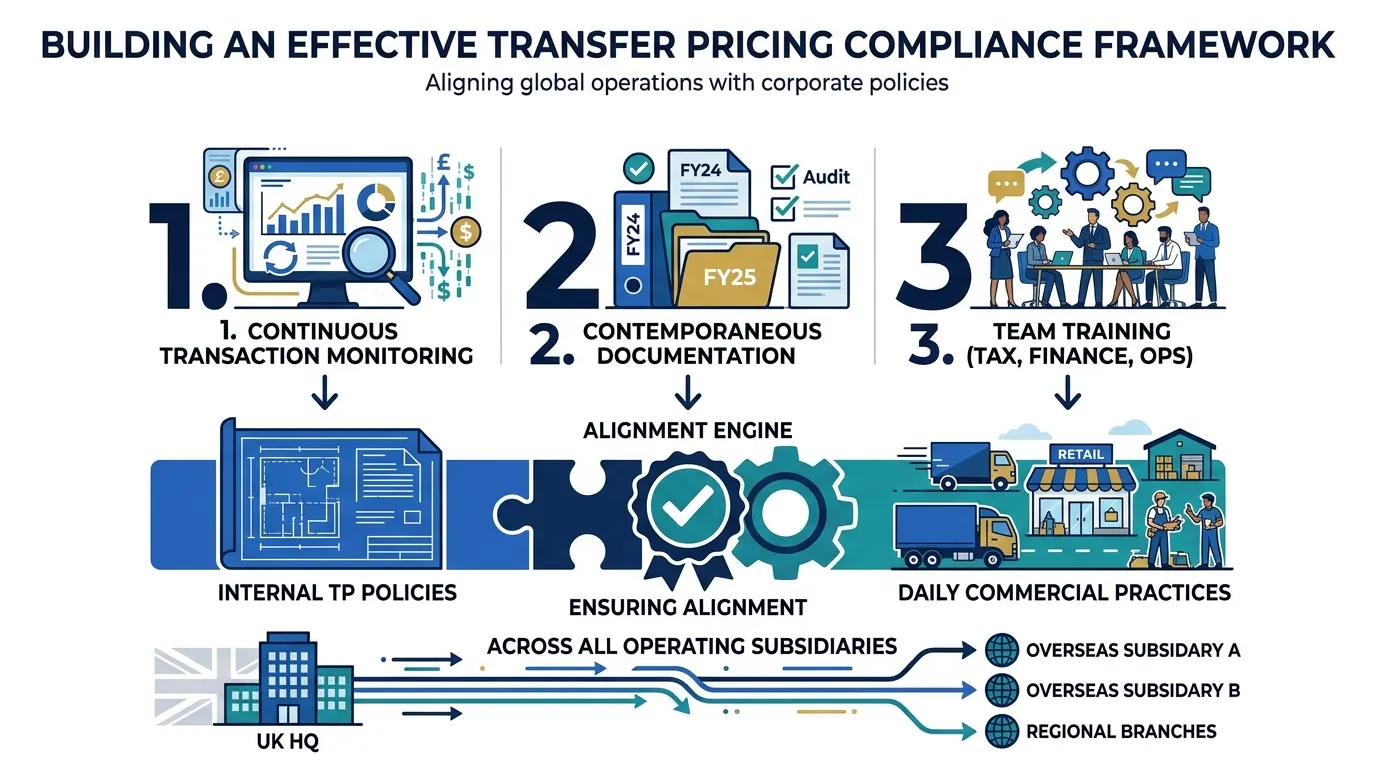
Organizations build effective transfer pricing compliance frameworks by implementing continuous transaction monitoring, maintaining robust contemporaneous documentation, and training tax, finance, and operational teams. These structures ensure internal policies match actual daily commercial practices across all operating subsidiaries.
Implementing Contemporaneous Documentation Standards
Tax authorities worldwide mandate strict documentation rules following international standards, including Master File, Local File, and Country-by-Country Reporting requirements. Enterprise risk management demands that finance teams draft documentation simultaneously with transaction execution rather than reconstructing records during a tax audit. Documenting commercial rationale, pricing formulas, and board decisions at the time of the transaction creates an defensible audit trail.
Structuring Cross-Functional Governance
Transfer pricing governance cannot remain isolated within the corporate tax department. Operational teams, commercial traders, procurement officers, and HR personnel make daily decisions that directly impact transfer pricing exposure. Establishing a cross-functional compliance committee ensures that contract modifications, operational changes, and new asset deployments trigger immediate reviews of intercompany transfer pricing agreements.
How Does Professional Capability Building Reduce Transfer Pricing Risk?
Professional capability building reduces transfer pricing risk by equipping corporate teams with practical analytical frameworks, legal awareness, and technical expertise. Structured workforce upskilling bridges the critical gap between theoretical tax rules and real-world operational execution.
Identifying Workforce Skill Gaps in Corporate Finance
Multinational oil and gas enterprises frequently encounter operational disconnects between field-level commercial teams and central tax strategists. Local commercial managers may modify contract terms or adjust service delivery schedules without recognizing the tax governance implications. These skill gaps expose the group to uncoordinated related party transactions that fail tax authority audits. Organizations eliminate these vulnerabilities by delivering targeted professional development programs across finance, legal, and operational leadership functions.
Selecting Learning Delivery Models for Enterprise Teams
HR leaders and corporate training managers evaluate several learning delivery formats to upskill enterprise finance and tax professionals.
Organizations seeking comprehensive practical upskilling send key financial and legal personnel to the Transfer Pricing for Oil & Gas Groups Training Course. Specialized instruction ensures participants master industry-specific benchmarking, functional analysis design, and defense strategies required for complex energy operations.
Measuring Training ROI and Risk Reduction
Corporate training initiatives must demonstrate clear business outcomes. Organizations track the return on investment from specialized tax training through tangible operational metrics:
Audit Resolution Times: Trained internal teams respond faster to tax authority inquiries, reducing legal defense costs by 35% to 50%.
Documentation Accuracy: Up-skilled finance teams maintain contemporaneous records that reduce penalty exposures during tax audits.
Cross-Functional Efficiency: Improved alignment between commercial operations and tax departments accelerates new intercompany contract execution while ensuring full adherence to the arm's length principle.
Decision Framework for Transfer Pricing Training Selection
The following framework helps HR directors and tax executives evaluate training options based on organizational complexity, team size, and immediate risk profiles.
Organizational Requirement | Recommended Training Approach | Target Audience | Expected Business Outcome |
Establishing Foundational Awareness | Foundational compliance workshops | Junior accountants, regional procurement staff | Elimination of basic intercompany invoicing errors |
Navigating Active Tax Audits | Intensive defense and benchmarking case studies | Senior tax managers, legal counsel | Successful defense of group pricing methods against audit claims |
Transforming Enterprise Governance | Transfer Pricing Training for Oil and Gas Groups and Tax Professionals | Finance directors, enterprise HR leaders, business unit heads | Integrated corporate governance and standardized documentation across all subsidiaries |
Frequently Asked Questions
What is covered in an Oil & Gas Petroleum Taxation training course?
An Oil & Gas Petroleum Taxation training program provides an in-depth analysis of fiscal regimes, production sharing contracts, royalties, and tax compliance across energy supply chains. Participants learn how to handle international tax frameworks, evaluate transfer pricing risks, and manage corporate tax liabilities in multi-jurisdictional energy operations. The curriculum delivered by the Institute For Oil & Gas Training equips finance, legal, and tax professionals with practical skills to navigate complex energy tax legislation effectively.
Why is specialized petroleum tax training important for energy sector professionals?
Petroleum operations are subject to unique fiscal systems, ring-fencing rules, windfall profit taxes, and complex cross-border joint venture accounting principles. General corporate tax knowledge is often insufficient to address the intricate fiscal challenges faced by upstream, midstream, and downstream enterprises. Specialized Oil & Gas Petroleum Taxation programs at the Institute For Oil & Gas Training ensure enterprise tax teams and financial controllers can mitigate compliance risks and optimize tax planning strategies.
Who should attend an Oil & Gas Petroleum Taxation professional development program?
This specialized training is designed for corporate tax managers, finance directors, energy accountants, legal advisors, and government regulators seeking to deepen their technical expertise in energy sector fiscal policy. It is equally valuable for corporate HR leaders and department heads aiming to bridge skill gaps within their finance and compliance teams. Professional development through the Institute For Oil & Gas Training enables cross-functional teams to align commercial operational decisions with statutory tax requirements.
How do petroleum taxation courses help mitigate international transfer pricing risks?
Petroleum taxation programs cover the evaluation of intercompany transactions, functional risk analyses, and arm's length principle applications for cross-border energy operations. Finance teams learn to apply acceptable valuation methods—such as the comparable uncontrolled price and cost-plus methods—to intra-group service charges and commodity sales. Specialized instruction from the Institute For Oil & Gas Training helps multinational oil and gas groups establish defensible documentation and withstand regulatory audits from tax authorities.
What is the difference between production sharing contracts and concessionary fiscal regimes in petroleum tax?
Concessionary fiscal regimes allow energy companies to own extracted resources subject to direct royalties, surface rentals, and petroleum income taxes paid to the host state. In contrast, production sharing contracts allocate physical crude or natural gas production between the operating company and the host government to recover capital costs and share profit oil. Understanding these distinct contractual frameworks through the Institute For Oil & Gas Training enables tax professionals to accurately project cash flows, calculate tax liabilities, and support strategic investment decisions.
Related training courses
API 570 Piping Inspection and Integrity Assessment Training Course
- Specialisation
- Oil & Gas Inspection and Non-Destructive Testing
- Duration
- 5 days · 15 CPD hours
API 579 Fitness-For-Service Assessment Methods Training Course
- Specialisation
- Oil & Gas Inspection and Non-Destructive Testing
- Duration
- 5 days · 15 CPD hours
Corrosion Metallurgy & Failure Prevention Training Course
- Specialisation
- Oil & Gas Corrosion Management and Control
- Duration
- 5 days · 15 CPD hours
More articles

Why Transfer Pricing Matters for Multinational Oil and Gas Groups
Learn why transfer pricing matters for multinational oil and gas groups, including compliance frameworks, risk management, and workforce development.
Read article →
Withholding Tax Compliance and Treaty Relief Training for Oil and Gas Tax Professionals
Master cross-border oil and gas tax compliance. Evaluate syllabus, delivery, and outcomes for the Institute For Oil & Gas Training course.
Read article →
How to Evaluate Withholding Tax Compliance and Double Tax Treaty Relief for Petroleum Transactions
Evaluate withholding tax compliance and double tax treaty relief for cross-border petroleum transactions to optimize cross-border oil and gas tax strategy.
Read article →