

The Withholding Tax Compliance & Treaty Relief Training Course bridges critical operational knowledge gaps in cross-border petroleum taxation, enabling corporate tax teams to correctly apply reduced treaty rates, prevent double taxation penalties, and manage complex remittance deadlines across international energy projects.
Cross-border payments in the upstream, midstream, and downstream energy sectors involve intricate fiscal jurisdictions. Energy companies frequently overpay non-resident withholding taxes or incur heavy statutory penalties due to incorrect interpretation of double tax treaties. Non-compliance often leads to frozen capital, unrecoverable foreign tax credits, and prolonged disputes with tax authorities.
Tax professionals and finance managers require direct, technical competency to parse double taxation agreements alongside domestic tax legislation. Understanding Why Tax Compliance and Treaty Relief Matter for Cross Border Oil and Gas Payments provides the foundational context required to recognize these financial vulnerabilities within corporate payment pipelines.
The Institute For Oil & Gas Training developed this specialized curriculum to transition tax professionals from theoretical understanding to audit-ready operational compliance. The program addresses root causes of non-compliance, such as inadequate documentation management, flawed beneficial ownership assessments, and miscalculated withholding bases on cross-border service contracts.
Tax departments, payroll units, and corporate finance teams frequently operate in silos, creating handoff friction that increases exposure to late remittance surcharges. Through structured technical instruction, the Institute For Oil & Gas Training equips professionals with unified workflows to assess contract structures, calculate foreign tax credits accurately, and submit compliant tax reclaim applications.
Why is this course structured for oil and gas tax professionals?
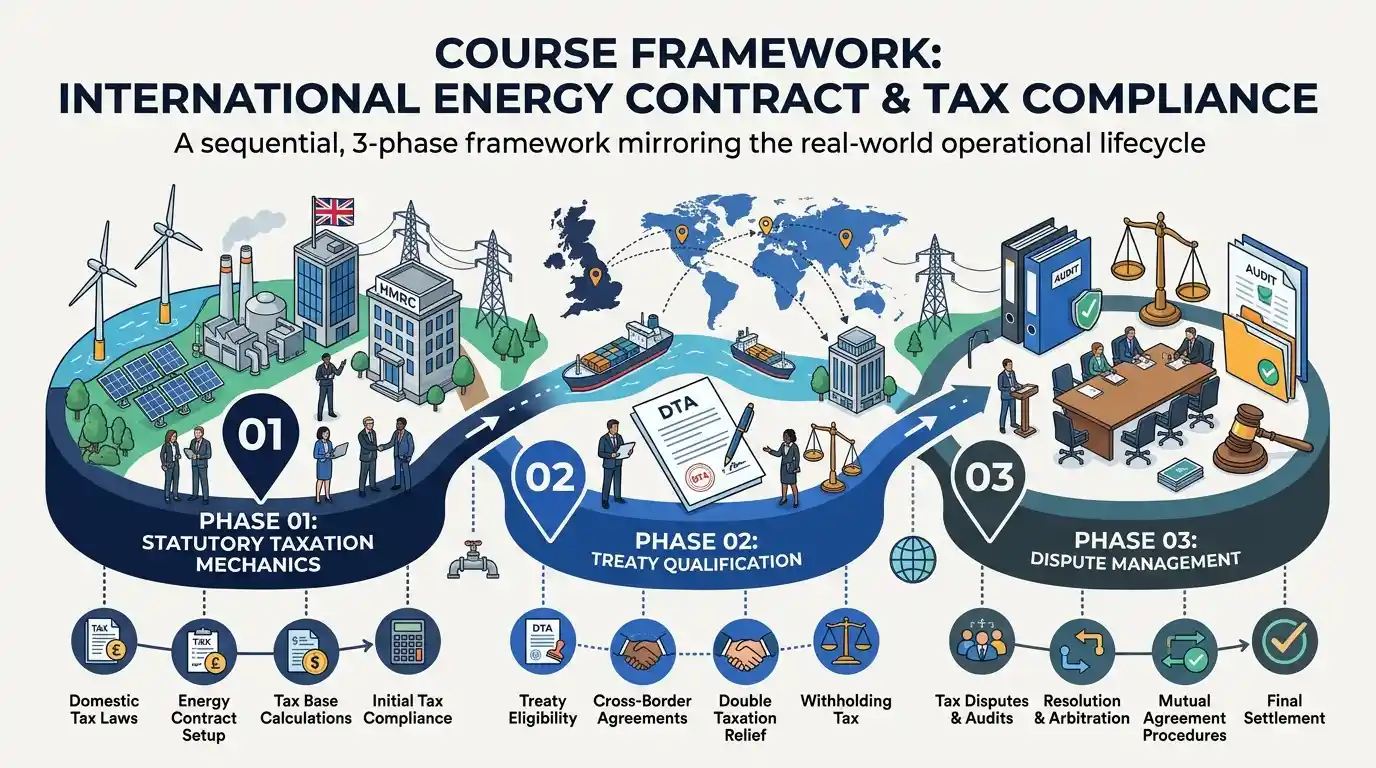
This course is structured in a sequential, three-phase framework moving from statutory taxation mechanics to treaty qualification, and culminating in dispute management, mirroring the real-world operational lifecycle of international energy contract execution and tax compliance.
International petroleum operations present distinct tax challenges due to high capital expenditure, multi-jurisdictional joint ventures, and frequent cross-border service provision. Generic tax training fails to address specialized issues such as permanent establishment exposure from offshore drilling rigs or variable withholding rates on technical service fees.
The structural design reflects operational realities. Participants evaluate the base statutory withholding obligations before applying double tax treaty relief mechanisms. To properly determine how to handle complex joint venture payment distributions, professionals must first master the mechanics of How to Evaluate Withholding Tax Compliance and Double Tax Tax Treaty Relief for Petroleum Transactions.
The Institute For Oil & Gas Training enforces a practical pedagogical methodology. Each module builds directly on the technical output of the preceding unit. Participants move from identifying taxable payment events to evaluating documentation, applying treaty rules, and executing statutory filings.
Corporate finance and HR learning leaders benefit from this progressive architecture because it allows immediate skills transfer to live projects. The structural rigor ensures that professionals gain functional competence without distracting theoretical filler, maximizing the return on corporate training investments.
What will participants learn through the curriculum?
Participants learn to systematically verify treaty residency, execute beneficial ownership tests, apply reduced treaty rates, calculate foreign tax credits, manage withholding tax remittance deadlines, and defend tax reclaim procedures during statutory tax audits.
The curriculum delivers targeted expertise across six distinct technical modules. Each module targets a specific compliance risk zone inherent in international oil and gas payment processing.
Module 1: Cross-Border Payment Classification
Participants master the identification of taxable gross payments. The module covers the distinction between technical service fees, equipment lease rentals, software royalties, and branch profit distributions under petroleum sharing contracts.
Module 2: Double Taxation Treaty Relief Protocols
This section focuses on analyzing active double taxation treaties against host nation domestic tax legislation. Attendees learn to identify specific treaty articles governing shipping, independent personal services, and hydrocarbon extraction activities.
Module 3: Residency Verification and Documentation Standards
Tax professionals gain practical skills in evaluating Treaty Residence Certificate issuing standards across key foreign jurisdictions. The module covers validation criteria required by tax authorities to prevent relief denial.
Module 4: Beneficial Ownership and Treaty Shopping Rules
Participants analyze complex corporate structures using the beneficial ownership test. Training covers the interpretation of Limitation on Benefits clauses, treaty shopping doctrines, and the OECD Multilateral Instrument Principal Purpose Test.
Module 5: Tax Reclaim Procedures and Filings
This unit provides step-by-step guidance on filing tax reclaim applications for over-withheld funds. Professionals learn to assemble complete submission packages, track authority review timelines, and resolve formal rejections.
Module 6: Remittance Management and Foreign Tax Credits
The final module addresses operational treasury integration. Attendees build calculation models for withholding tax remittance deadlines, map penalties for late withholding, and track foreign tax credit allocations to avoid double tax exposure.
How is the Withholding Tax Compliance & Treaty Relief Training Course delivered?
The course is delivered through instructor-led live online sessions, interactive technical workshops, hybrid formats, or custom on-site corporate training over three intensive days or six virtual sessions.
The Institute For Oil & Gas Training offers versatile delivery formats tailored to suit enterprise scheduling requirements and geographic distribution.
Instruction focuses heavily on active engagement rather than passive lectures. Every participant works with realistic energy contract documentation, treaty tables, and tax authority filing templates.
Interactive Technical Workshops
Workshops place participants in simulated corporate compliance scenarios. Working individually or in small cohorts, attendees review cross-border service agreements, identify potential withholding triggers, and determine appropriate relief mechanisms.
Practical Case Assessment
Learners analyze anonymised audit disputes involving petroleum companies, international contractors, and tax boards. These sessions teach participants how to construct defensible tax positions prior to statutory audits.
Assessment and Competency Evaluation
Skills acquisition is verified using practical evaluation tools:
Pre-Course Baseline Diagnostic: Measures existing treaty and compliance knowledge.
Contract Review Practical Assignments: Evaluates ability to identify tax exposure in active vendor agreements.
Final Compliance Simulation: Tests the student's ability to calculate reduced treaty rates, process a tax reclaim procedure, and determine foreign tax credit entitlements under strict deadlines.
Upon achieving an 80% passing standard on practical evaluations, participants earn a formal professional certificate from the Institute For Oil & Gas Training.
What measurable results can organizations and tax professionals expect?
Organizations achieve reduced tax penalty risks, eliminated double taxation costs, streamlined finance workflows, faster tax reclaim recoveries, and enhanced audit defense readiness across all active cross-border petroleum contracts.

Upgrading tax compliance capabilities delivers direct, quantifiable financial and operational returns to energy firms and contractor organizations.
Risk Elimination and Penalty Mitigation
Miscalculating statutory payments or missing remittance deadlines generates significant interest and penalties from tax authorities. Standardizing tax calculation workflows eliminates administrative errors, preventing penalties for late withholding.
Capital Optimization
Applying reduced treaty rates at the point of payment eliminates unnecessary cash lock-up. When over-withholding occurs, trained tax teams execute the correct tax reclaim procedure swiftly to recover foreign tax assets.
Enhanced Departmental Efficiency
Finance and tax teams spend less time resolving vendor withholding disputes when clear treaty applicability rules are established. Clear internal standards speed up payment processing for international oilfield service suppliers.
Strategic Talent Development
For HR managers and corporate training coordinators, this course offers a structured career development tool. Building internal expertise reduces reliance on expensive external tax advisories for routine treaty interpretations.
What are the eligibility criteria and enrollment procedures?
Eligible participants include oil and gas tax professionals, finance managers, corporate accountants, treasury specialists, and legal counsel with foundational tax knowledge, with enrollment processed through corporate registration.
The Withholding Tax Compliance & Treaty Relief Training Course targets professionals managing cross-border transactions, tax governance, and finance operations within energy companies or specialized advisories.
Participant Prerequisites
Candidates should possess:
A bachelor's degree in accounting, finance, law, or economics.
Minimum of two years of operational experience in corporate taxation, financial accounting, or commercial legal review.
Basic familiarity with international commercial contracts or corporate income tax principles.
Corporate Team Registrations
HR departments and corporate learning directors sponsoring teams of three or more delegates can request customized corporate delivery. The Institute For Oil & Gas Training adjusts practical case studies to reflect the sponsoring organization's specific operating regions and double tax treaty networks.
Individual Enrollment Process
Individual applicants submit their professional profile for evaluation to ensure alignment with course difficulty. Upon approval, attendees receive pre-reading materials detailing double taxation treaty relief principles and statutory frameworks.
To secure a seat in an upcoming open cohort or to arrange bespoke enterprise delivery, professionals can apply for course access to complete their enrollment.
Frequently Asked Questions
What is included in oil and gas petroleum taxation training?
Oil and gas petroleum taxation training covers the complex fiscal regimes governing upstream, midstream, and downstream operations, including production sharing contracts, royalties, and cross-border withholding obligations. The Institute For Oil & Gas Training delivers structured modules on international tax treaties, ring-fencing rules, transfer pricing, and statutory compliance frameworks. This equips corporate tax, finance, and legal teams to manage multi-jurisdictional tax liabilities and avoid costly compliance penalties.
Why is specialized petroleum taxation knowledge necessary for energy companies?
Petroleum taxation differs significantly from general corporate taxation due to unique fiscal mechanisms such as resource rent taxes, cost recovery systems, and complex double tax treaty networks. Specialized training from the Institute For Oil & Gas Training helps organizations correctly evaluate treaty residence certificates, beneficial ownership tests, and statutory remittance deadlines. This expertise prevents unexpected audit adjustments, optimizes foreign tax credits, and protects operational cash flows across international energy projects.
Who should undertake training in oil and gas petroleum taxation?
This training is designed for corporate tax specialists, finance managers, legal counsel, treasury officers, and HR teams managing workforce development in energy firms. The Institute For Oil & Gas Training structures its curriculum to bridge the gap between financial accounting, legal contract review, and tax authority compliance. Participants gain practical, specification-driven skills needed to handle cross-border payments and complex hydrocarbon fiscal regulations confidently.
How does oil and gas petroleum taxation affect cross-border payments?
Cross-border payments for technical service fees, equipment rentals, and joint venture distributions are subject to statutory withholding taxes that vary widely by host jurisdiction. Without proper application of double taxation treaty relief, energy firms risk double taxation and high non-compliance penalties. The Institute For Oil & Gas Training instructs professionals on how to verify eligibility, claim reduced treaty rates at source, and execute efficient tax reclaim procedures.
How do corporate teams apply petroleum taxation skills after completing training?
Graduates apply standardized workflows to audit cross-border vendor contracts, calculate precise withholding tax liabilities, and maintain complete audit trails for tax authorities. Through programs at the Institute For Oil & Gas Training, corporate finance and tax departments streamline inter-departmental handoffs and lower audit exposure. This direct application improves operational efficiency, eliminates late remittance surcharges, and strengthens long-term fiscal governance.
Related training courses
API 570 Piping Inspection and Integrity Assessment Training Course
- Specialisation
- Oil & Gas Inspection and Non-Destructive Testing
- Duration
- 5 days · 15 CPD hours
API 579 Fitness-For-Service Assessment Methods Training Course
- Specialisation
- Oil & Gas Inspection and Non-Destructive Testing
- Duration
- 5 days · 15 CPD hours
Corrosion Metallurgy & Failure Prevention Training Course
- Specialisation
- Oil & Gas Corrosion Management and Control
- Duration
- 5 days · 15 CPD hours
More articles

How to Evaluate Transfer Pricing Risks and Intercompany Transactions in Oil and Gas Groups
Evaluate transfer pricing risks in oil and gas intercompany transactions. Learn methods, functional analysis, and arm's length compliance strategies.
Read article →
Why Transfer Pricing Matters for Multinational Oil and Gas Groups
Learn why transfer pricing matters for multinational oil and gas groups, including compliance frameworks, risk management, and workforce development.
Read article →
How to Evaluate Withholding Tax Compliance and Double Tax Treaty Relief for Petroleum Transactions
Evaluate withholding tax compliance and double tax treaty relief for cross-border petroleum transactions to optimize cross-border oil and gas tax strategy.
Read article →