

National Oil Companies (NOCs), Ministries of Petroleum, and international operators continuously evaluate upstream fiscal frameworks to balance state revenue against project commerciality. High capital costs, extended development timelines, and extreme technical risks define deepwater developments, whilst marginal fields suffer from constrained reserves, low initial flow rates, and compressed economic lifespans. Selecting or negotiating the optimal fiscal structure requires rigorous comparative analysis across royalty rates, tax holidays, cost recovery ceilings, and production-sharing splits.
Governments and investors must understand why marginal and deepwater oil fields require different fiscal approaches before designing or selecting fiscal instruments. Traditional flat-rate concessions often render small or complex fields commercially unviable, leading to stranded resources and lost national revenues. Establishing an adaptive fiscal regime enables asset managers, commercial planners, and ministry officials to align risk allocation with geological and economic realities, ensuring optimal resource extraction and sustained capital investment across varying market cycles.
What Key Factors Define Marginal Field and Deepwater Fiscal Evaluations?
Evaluating marginal field and deepwater fiscal regimes requires assessing geological risk, capital intensity, price sensitivity, and government take. Decisions rest on balancing investor return hurdles against sovereign revenue requirements through tailored instruments like sliding-scale royalties, investment allowances, and cost recovery caps.
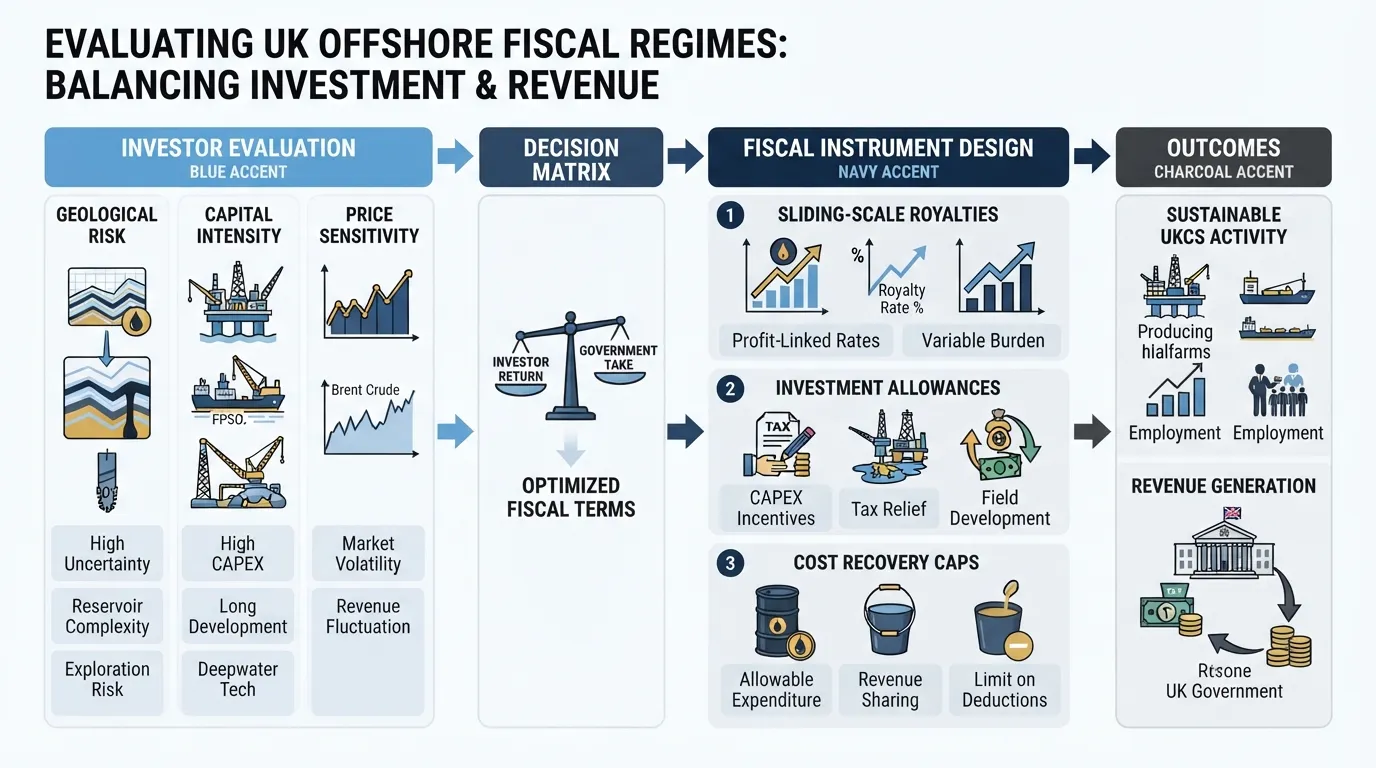
Evaluating upstream petroleum assets demands clear distinction between asset classes. Marginal fields possess limited recoverable reserves, low production potential, or remote infrastructure access, making them vulnerable to oil price fluctuations. Deepwater projects require massive upfront capital expenditures, long gestation periods, and complex technical risk profiles, though they offer substantial reserve upside once online.
Fiscal regime design directly impacts project economics by altering the Internal Rate of Return (IRR) and Net Present Value (NPV). Flat fiscal terms impose high tax burdens during early cash-flow stages, severely threatening project bankability. Adaptive terms shift government take toward profit-based mechanisms, ensuring operators recoup sunk capital before progressive tax rates apply.
State governments and corporate operators must analyze four core fiscal parameters during evaluation:
Capital Exposure and Cost Recovery: Deepwater assets require higher cost-recovery ceilings to allow rapid payout of multi-billion-dollar field developments.
Production and Revenue Dynamics: Marginal fields need front-end relief, such as reduced royalties, to remain viable through lower volume ceilings.
Risk Allocation Mechanisms: Progressive fiscal systems automatically scale government take up or down based on field profitability or cumulative production ratios.
Resource Preservation: Strict fiscal frameworks risk early abandonment of marginal deposits, leaving valuable national hydrocarbon reserves unrecovered.
Commercial viability hinges on aligning fiscal instruments with field development dynamics. Regulators and petroleum negotiators must model how individual fiscal terms interact under diverse cost and price scenarios.
How Do Specific Fiscal Terms Impact Marginal Fields and Deepwater Projects?
Marginal field and deepwater fiscal terms alter cash flows through targeted incentives like investment allowances, sliding-scale royalties, ring-fencing relief, and gas-specific mechanisms. These terms directly affect project internal rate of return, capital payback periods, and long-term economic field life.
Upstream petroleum fiscal regimes incorporate specific mechanisms to balance government revenue collection against investor capital security. The structure of these individual mechanisms determines whether complex fields proceed to Final Investment Decision (FID) or remain unexploited.
Marginal Field Fiscal Incentives
Marginal fields require targeted interventions to improve project bankability. Marginal field fiscal incentives typically combine reduced initial royalty rates with accelerated depreciation schedules to accelerate capital recovery. Ministries often lower or waive production bonuses, ensuring early project revenues service debt obligations rather than immediate sovereign payments.
Deepwater Sliding Scale Terms
Deepwater assets utilize deepwater sliding scale terms to adjust royalty rates and profit oil splits based on water depth, daily production rates, or cumulative project returns. As daily production expands or water depth increases, fiscal terms dynamically adjust. This mechanism prevents early-stage fiscal over-burdening while securing higher state take during peak production phases.
Gas Specific Fiscal Terms
Associated and non-associated natural gas developments require separate terms from crude oil. Gas specific fiscal terms provide extended cost recovery windows, lower royalty tiers, and flexible pricing structures to reflect the high capital expenditure of gas compression, processing, and pipeline transport infrastructure.
Domestic Supply Obligation
A domestic supply obligation (DSO) mandates operators sell a portion of domestic hydrocarbon production to local markets, often at controlled prices. For marginal fields, strict DSOs can destroy project economics. Flexible DSO pricing or reduced volume allocations preserve commercial viability while fulfilling national energy security mandates.
Investment Allowance and Uplift
An investment allowance and uplift permits operators to deduct a percentage beyond actual capital expenditure from taxable income. This incentive reduces the effective tax rate during development, encouraging capital deployment into high-risk deepwater assets or low-margin field developments.
Ring Fencing Versus Consolidation
Ring fencing versus consolidation dictates whether expenses from one block can offset tax liabilities from another. Strict ring-fencing isolates asset risk, protecting state revenues from unrelated project losses. Consolidation allows multi-asset operators to write off exploration costs against producing assets, accelerating new field development.
Tax Holidays and Reliefs
Targeted tax holidays and reliefs offer complete or partial corporate income tax exemptions during early production years. These reliefs improve short-term project cash flows, directly enhancing Net Present Value (NPV) calculations and loan coverage ratios for project financing.
Fiscal Terms Negotiation
Successful fiscal terms negotiation balances government take, investor returns, and risk exposure. Host governments and commercial entities must model field sensitivity against price volatility, cost overruns, and reservoir performance to construct stable, long-term contractual agreements.
How Do Concessionary and Production Sharing Regimes Compare?
Concessionary systems grant direct resource ownership while collecting royalties and taxes, whereas Production Sharing Contracts retain state resource ownership and split profit oil. Selecting between them depends on national legal frameworks, administrative capabilities, and the required degree of fiscal flexibility.
Choosing between royalty-tax concessions and Production Sharing Contracts (PSCs) fundamental determines how host nations and oil companies manage asset risks. Royalty-tax frameworks rely on corporate income tax, resource rent taxes, and royalties levied directly on gross production. PSCs establish state ownership over hydrocarbons, compensating the contractor through cost oil allocations and profit oil splits.
For deepwater developments, PSCs offer high structural flexibility. Cost oil ceilings ensure operators prioritize development expenditure recovery, while profit oil splits adjust via R-factor mechanisms (ratio of cumulative receipts to cumulative expenditures). R-factor mechanics allow the state’s share to increase automatically as the project achieves key payback milestones. Concessionary regimes require progressive tax rates or sliding-scale royalties to achieve similar flexibility.
Marginal field operators often prefer concessionary regimes featuring low royalty rates and consolidation provisions. The administrative simplicity of tax-royalty arrangements reduces compliance costs for smaller, independent operators. PSCs introduce administrative burdens through Joint Operating Committees and approval processes for annual work programs and budgets, which can delay decision-making on time-sensitive marginal field operations.
A rigorous fiscal evaluation compares how each system performs under changing market environments. When crude prices fall, fixed royalties in concessionary systems impose severe financial distress on marginal field operators. In contrast, PSCs with high cost oil ceilings absorb price shocks by converting a larger portion of gross production into cost recovery, protecting operator cash flow.
Fiscal Attribute | Concessionary (Royalty-Tax) System | Production Sharing Contract (PSC) |
Resource Ownership | Transferred to operator at wellhead | Retained fully by the Host Government |
Cost Recovery Mechanism | Tax depreciation and investment allowances | Cost Oil ceiling (e.g., 40%–70% of gross revenue) |
Government Take Mechanism | Royalties, Corporate Income Tax, Resource Rent Tax | Profit Oil splits, Royalties, Corporate Tax |
Administrative Complexity | Low to moderate (managed by tax authorities) | High (requires state oil company monitoring) |
Marginal Field Suitability | High (when combined with consolidated tax relief) | Moderate (requires high cost oil ceilings to work) |
Deepwater Suitability | High (if progressive rent taxes are utilized) | High (naturally adapts via R-Factor profit splits) |
What Decision Framework Best Guides Fiscal Regime Selection?
Evaluating fiscal regimes requires a multi-criteria decision framework analyzing economic yield, neutral risk distribution, administrative complexity, and fiscal stability. Regulators and commercial teams model fiscal scenarios across price curves, operational expenditure variances, and field life cycles to select optimal fiscal terms.
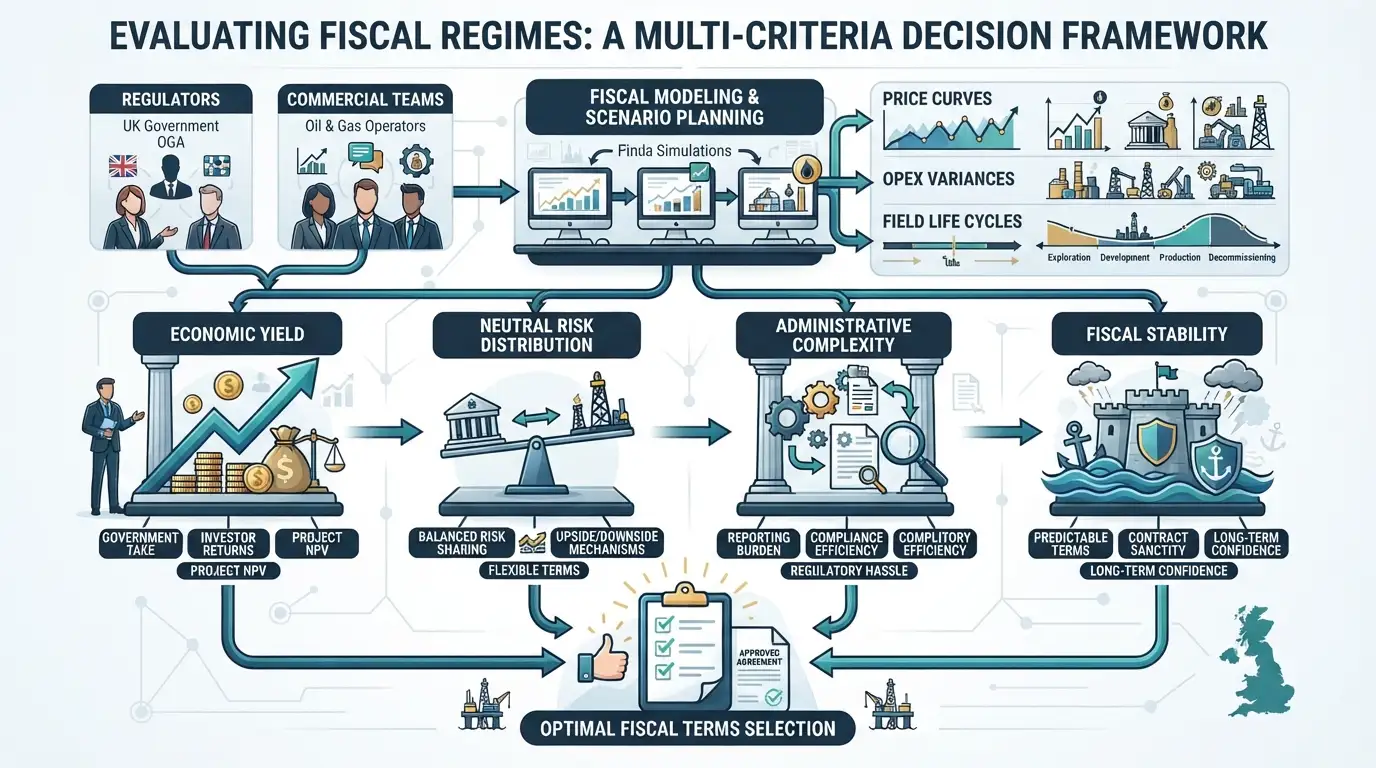
Selecting or modifying an upstream fiscal framework demands systematic evaluation across distinct project phases. Decision-makers must evaluate fiscal terms against technical realities rather than relying on standardized legal templates. A structured decision matrix ensures all commercial, legal, and operational factors are evaluated prior to fiscal terms negotiation.
First, commercial analysts conduct cash flow sensitivity modeling. This process tests fiscal regime resilience under low crude oil prices, project cost overruns, and production delays. A robust fiscal framework maintains operator profitability during market downturns while securing progressive government take during high-price cycles.
Second, governments assess the administrative capability required to execute each fiscal option. Managing complex PSC mechanisms, auditing cost recovery accounts, and verifying domestic supply obligations demand dedicated regulatory infrastructure. Host governments with limited auditing capacity often achieve better revenue realization through simplified concessionary frameworks with clear sliding-scale royalties.
Third, regulatory stability and fiscal neutrality guide long-term policy selection. Fiscal neutrality ensures the tax structure does not alter the economic ranking of upstream projects or induce premature field abandonment. Regulators prevent resource sterilization by designing fiscal terms that automatically adjust to marginal asset metrics, ensuring smaller fields reach commercial production.
Evaluation Criteria | Operational Focus | Key Performance Indicator | Decision Target |
Investor Economic Viability | Project returns under price stress | Internal Rate of Return (IRR), Payback Period | IRR above corporate hurdle rate (e.g., 15%–18%) |
State Revenue Optimization | Long-term sovereign yield capture | Government Take Percentage (% of net cash flow) | Balanced take across asset life (e.g., 60%–80%) |
Fiscal Neutrality | Unbiased investment decision-making | Marginal Effective Tax Rate (METR) | Minimal distortion of field development plans |
Progressivity | Flexibility during price volatility | R-Factor / Price-Sliding Scale Sensitivity | Sovereign revenue scales dynamically with profits |
Administrative Feasibility | State regulatory monitoring burden | Audit Cost vs. Revenue Realized Ratio | Streamlined compliance without revenue leakage |
How Can Corporate Teams Master Fiscal Regime Modeling and Negotiation?
Corporate teams and government officials master fiscal modeling through practical comparative training on petroleum fiscal regimes. Interdisciplinary alignment between legal, finance, and technical units enables professionals to model complex fiscal terms, negotiate stable agreements, and optimize upstream investment portfolios.
Navigating the financial complexities of upstream petroleum fiscal terms requires deep expertise in economic modeling, contract drafting, and strategic negotiation. Organizational skill gaps between technical subsurface teams and commercial finance units frequently lead to misaligned fiscal proposals, delayed licensing rounds, or flawed contractual terms that ruin asset economics.
Upstream organizations must invest in structured professional capability building to resolve these analytical bottlenecks. Commercial planners, ministry officials, tax auditors, and corporate negotiators require practical exposure to real-world fiscal comparisons, enabling them to construct dynamic fiscal models that accurately reflect deepwater and marginal field realities.
Commercial teams and ministry officials should explore structured training programs, such as the Fiscal Regime Comparison for Marginal & Deepwater Fields Training Course, to build practical competency in fiscal modeling, contractual risk distribution, and negotiation strategies. Establishing a shared technical foundation allows multi-disciplinary teams to evaluate concessionary systems against PSCs, run complex sensitivity analyses, and negotiate sustainable fiscal agreements.
Developing corporate mastery in fiscal evaluation directly impacts organizational performance:
Strategic Alignment: Unifies technical, financial, and legal perspectives during licensing round evaluations and block negotiations.
Risk Mitigation: Identifies hidden fiscal liabilities, ring-fencing constraints, and severe cost-recovery ceilings prior to committing capital.
Negotiation Excellence: Equips host government and corporate negotiators to structure balanced contracts that withstand market volatility.
Portfolio Optimization: Enables asset managers to rank global marginal and deepwater opportunities based on risk-adjusted, post-tax returns.
Structured professional development ensures workforce skills align directly with strategic business outcomes. To transition from general comparative analysis to direct implementation, organizations utilize tailored training programs like the Fiscal Regime Comparison for Marginal and Deepwater Fields Training by Institute For Oil & Gas Training to refine institutional fiscal expertise, streamline decision-making frameworks, and maximize lifetime asset value across complex petroleum portfolios.
Frequently Asked Questions
What is an oil and gas petroleum fiscal regime?
An oil and gas petroleum fiscal regime is the legal, contractual, and tax framework that governs the financial relationship between host governments and exploration and production (E&P) companies. The Institute For Oil & Gas Training covers these mechanisms, which dictate how revenues, royalties, taxes, and production shares are divided to balance state sovereignty with investor returns under an Oil & Gas Petroleum Fiscal Regime.
What are the main types of petroleum fiscal systems used in the energy sector?
Petroleum fiscal systems primarily fall into concessionary (royalty and tax) systems or contractual systems, such as Production Sharing Contracts (PSCs) and Risk Service Agreements. Concessionary models grant resource ownership to operators while levying royalties and corporate taxes, whereas contractual models retain state resource ownership while splitting profit oil. Professional development programs at the Institute For Oil & Gas Training evaluate these variations across an Oil & Gas Petroleum Fiscal Regime to assist commercial teams in asset valuation.
How do fiscal terms affect investment decisions in marginal fields and deepwater projects?
Fiscal terms directly influence project bankability by determining a project’s Net Present Value (NPV) and Internal Rate of Return (IRR) under shifting market conditions. High-risk assets like deepwater or marginal fields require flexible structures—such as sliding-scale royalties, elevated cost recovery ceilings, and investment uplifts—to maintain commercial viability. Understanding how to model these parameters within an Oil & Gas Petroleum Fiscal Regime helps investors negotiate sustainable agreements through practical training from the Institute For Oil & Gas Training.
What is the difference between cost oil and profit oil in a Production Sharing Contract?
In a Production Sharing Contract, cost oil refers to the portion of gross production set aside for the operating company to recover its capital and operational expenditures. Profit oil is the remaining production volume after cost recovery, which is divided between the host government and the operator based on agreed contractual percentages or R-factor formulas. The Institute For Oil & Gas Training provides analytical frameworks to model these mechanisms across an Oil & Gas Petroleum Fiscal Regime.
Why is ring-fencing important in petroleum fiscal evaluation?
Ring-fencing isolates income and expenses to a specific geographic block or project, preventing operators from deducting losses from one exploration field against taxable profits earned in another. This rule protects host government revenues while requiring energy companies to model individual asset economics independently. Training from the Institute For Oil & Gas Training equips legal and financial professionals to evaluate ring-fencing implications within an overall Oil & Gas Petroleum Fiscal Regime.
Related training courses
Royalties, Bonuses & Government Take: Structure & Calculation Training Course
- Specialisation
- Oil & Gas Petroleum Fiscal Regime
- Duration
- 5 days · 13 CPD hours
Royalties, Bonuses & Government Take: Fiscal Waterfall Modelling Training Course
- Specialisation
- Oil & Gas Petroleum Fiscal Regime
- Duration
- 5 days · 13 CPD hours
Fiscal Regime Comparison & Reform Risk Training Course
- Specialisation
- Oil & Gas Petroleum Fiscal Regime
- Duration
- 5 days · 15 CPD hours
More articles

Data Governance and Master Data Ownership and Standards Training by Institute For Oil & Gas Training
Evaluate the Data Governance & Master Data Ownership & Standards Training Course syllabus, delivery, outcomes, and enrollment requirements.
Read article →
How to Define Data Ownership and Master Data Standards for Petroleum Operations
Learn how petroleum operations define data ownership, establish master data management standards, and improve data governance frameworks.
Read article →
Why Data Governance and Master Data Standards Matter in Oil and Gas
Learn why data governance and master data standards transform petroleum operations, resolve enterprise risk, and drive ROI across global energy assets.
Read article →