

Petroleum finance operations process immense volumes of unstructured data, complex joint-venture accounting models, and volatile commodity pricing structures. Financial controllers and transformation managers require systematic frameworks to distinguish high-impact automation projects from low-value technical pursuits. Evaluating candidate processes demands rigorous assessment of data maturity, transactional volume, regulatory compliance risks, and operational throughput.
Understanding how advanced technologies reshape modern energy accounting provides necessary baseline context before building an operational selection matrix. Readers seeking foundational insights into technological shifts can explore How AI and Robotic Process Automation Are Changing Petroleum Finance across upstream, midstream, and downstream finance functions. Once core concepts are established, transformation leaders must shift from general technological awareness to methodical process selection and targeted skill development.
What Are the Operational Differences Between AI and RPA in Petroleum Finance?
AI processes complex, unstructured data using probabilistic models to generate predictive financial insights, whereas RPA executes deterministic, rules-based tasks across structured systems without human interpretation. AI handles variable inputs, whereas RPA requires fixed, standardized workflow triggers.
Robotic process automation excels at structured, repetitive tasks that follow explicit rules. In petroleum finance, standard RPA bots handle tasks such as extracting data from structured vendor invoices, reconciling daily bank statements, and copying joint-interest billing (JIB) entries into Enterprise Resource Planning (ERP) databases. RPA operates strictly at the presentation layer of software applications, mimicking human keyboard and mouse actions. When a workflow logic changes or an input file structure alters, a deterministic RPA bot fails unless re-scripted.
Artificial intelligence, incorporating machine learning forecasting and intelligent document processing, manages non-linear and unstructured financial tasks. Intelligent document processing uses natural language processing and computer vision to extract line items from variable-format paper contracts, complex land leases, and unstandardised field ticketing documents. Machine learning forecasting analyzes historical oil prices, production decline curves, and macroeconomic indicators to generate real-time revenue projections.
Evaluation Dimension | Robotic Process Automation (RPA) | Artificial Intelligence (AI) |
Primary Data Input | Structured digital data (Excel, CSV, database records) | Unstructured or semi-structured data (PDFs, contracts, images) |
Logic Type | Deterministic, strict rule-based workflows | Probabilistic, pattern recognition, learning algorithms |
Exception Handling | Halts execution; flags item for human review | Learns from human corrections; adapts over time |
Implementation Complexity | Low to medium; short development cycles | High; requires data engineering and model validation |
Core Petroleum Finance Utility | JIB processing, bank reconciliation, master data entry | Yield forecasting, lease agreement parsing, fraud detection |
Integrating AI and RPA creates hyper-automation pipelines across energy value chains. RPA bots extract unstandardised lease agreement PDFs from corporate repositories and hand them to an intelligent document processing engine. The engine parses key royalty terms, while predictive analytics algorithms calculate expected yield liabilities. RPA then writes these calculated liabilities directly into the ERP financial ledger. Successful evaluation requires mapping each operational bottleneck to the precise technical architecture required.
How Do Finance Leaders Identify High-Value AI and RPA Candidates?
Finance leaders identify high-value candidate processes by evaluating transactional volume, task standardization, data structure quality, and direct financial impact. Processes with high error costs, labor-intensive manual consolidation, and rigid regulatory compliance requirements yield the highest automation returns.
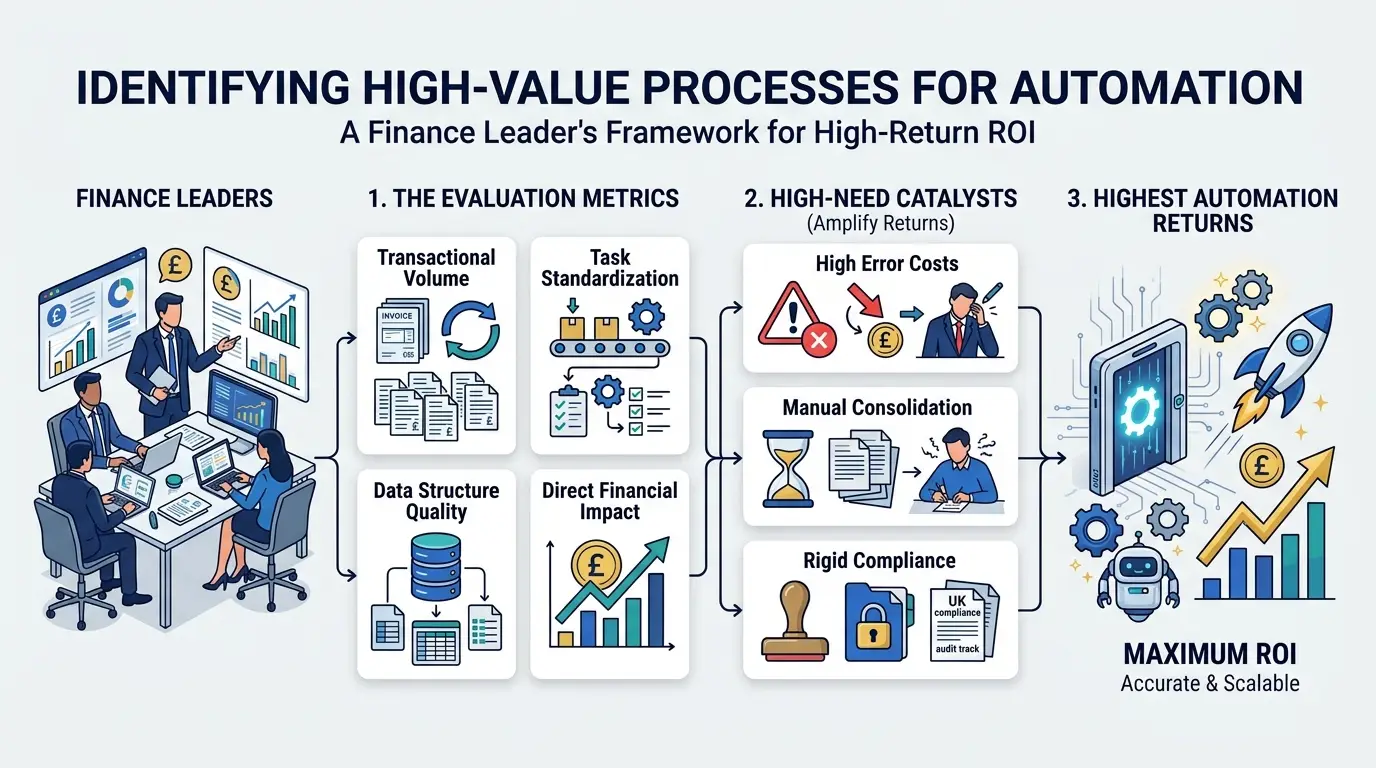
Process identification begins with exhaustive process mining and task mining across financial workflows. Finance teams map every micro-task within the accounts payable, treasury, joint-venture accounting, and financial planning and analysis (FP&A) departments. High-volume, manual tasks consuming hundreds of human hours monthly represent primary candidates for deterministic automation. Low-volume tasks with high strategic weight require predictive analytical tools rather than basic bot execution.
Data maturity determines technological feasibility. RPA requires standardized, electronic inputs to achieve zero-exception processing. If crude oil purchase orders arrive via disparate, non-standardized formats, RPA alone cannot process them. AI tools handle input variability but require clean, historical training datasets. Finance leaders must audit data pipelines for completeness, consistency, and structural integrity before committing development capital to candidate processes.
Financial impact extends beyond direct labor cost reduction. In petroleum finance, late payment penalties on vendor contracts, inaccurate joint-interest billings, and slow monthly closes carry substantial capital costs. Automating financial workflows reduces accounting cycle times from days to hours, mitigating balance sheet exposure to commodity price volatility. Prioritize workflows where human error introduces immediate financial penalty or regulatory non-compliance.
Organizations evaluating implementation paths often assess formal workforce capability building programs such as Digital Transformation in Petroleum Finance AI and RPA Training by Institute For Oil & Gas Training to ensure internal teams possess necessary evaluation methodologies.
What Framework Evaluates AI and RPA Feasibility and ROI?
A structured evaluation framework assesses candidate processes across two primary axes: technical feasibility and business value impact. Scoring workflows against data readiness, process complexity, transaction volume, and risk exposure establishes objective implementation priorities.
Evaluating petroleum finance processes requires a scoring methodology that balances technical readiness against financial returns. Technical feasibility evaluates whether the underlying process infrastructure supports automation. Business value impact measures operational speed, cost savings, error reduction, and decision quality improvements.
Step 1: Technical Feasibility Assessment
Map task stability: Determine if the workflow rules remain unchanged for at least six consecutive months.
Audit data structure: Verify whether inputs consist of structured databases, standard spreadsheets, or scanned paper documents.
Evaluate system access: Confirm that existing cloud migration initiatives and digital twin data interfaces provide secure API or interface access for software bots.
Assess exception rates: Calculate the percentage of transactions currently requiring human intervention.
Step 2: Business Value Impact Assessment
Measure labor intensity: Quantify total full-time equivalent hours spent on manual execution monthly.
Calculate error penalty: Compute historical financial losses resulting from human calculation errors or delayed reporting.
Determine cycle-time sensitivity: Assess whether accelerating execution directly improves cash flow management or working capital optimization.
Review compliance exposure: Identify regulatory compliance reporting mandates, such as Sarbanes-Oxley or environmental tax filings, that benefit from audit trails.
Process Evaluation Matrix | Low Technical Complexity | High Technical Complexity |
High Business Impact | Priority 1: Immediate Deployment • Joint-Interest Billing reconciliation • Bank reconciliation workflows | Priority 2: Strategic Investment • Machine learning yield forecasting • Intelligent contract term extraction |
Low Business Impact | Priority 3: Quick Wins / Low ROI • Master vendor data updates • Standard financial report generation | Priority 4: Avoid / Deprioritize • Ad-hoc financial analysis • Unstructured operational query handling |
Weight each parameter on a point scale from 1 to 5. Multiply technical feasibility scores by business impact scores to calculate an overall Process Automation Priority Score. Workflows scoring in the top upper quadrant receive immediate development resource allocation, ensuring optimal deployment of corporate capital.
Which Petroleum Finance Processes Offer the Highest Automation Value?
Joint-interest billing, revenue accounting, land lease management, and financial planning and analysis offer the highest automation value. These areas process massive data sets, demand zero-error accuracy, and directly impact organizational cash flow and compliance status.
Joint-Interest Billing and Partner Audit Reconciliations
Upstream petroleum operations involve multi-partner joint operating agreements. Operating companies bill non-operating partners monthly for shared exploration and production expenses. Reconciling tens of thousands of joint-interest billing line items against operating agreements presents immense operational friction. RPA bots automatically pull vendor line items, verify cost-allocation formulas against digital joint operating contracts, and flag discrepancies. AI algorithms analyze non-standard partner dispute communications, classifying risk levels and routing complex disputes to senior accountants.
Revenue Accounting and Hydrocarbon Tracking
Accounting for crude oil, natural gas, and refined product sales involves complex royalty calculations, transportation deductions, and fluctuating market index prices. Integrating smart contracts and blockchain for hydrocarbon tracking creates immutable, real-time records of custody transfer. RPA bots cross-reference physical flow-meter readings with commercial delivery receipts, calculating net revenue interests automatically. Intelligent algorithms predict inventory imbalances across midstream pipelines, allowing treasury management to adjust hedge positions before market close.
Land Lease and Royalty Management
Petroleum land departments manage thousands of active mineral leases with distinct payment schedules, delay rental terms, and royalty calculations. Intelligent document processing tools scan historical lease documents, extracting key commercial terms and obligations into structured databases. Automated workflows schedule royalty payments based on live production data, eliminating breach-of-contract risks. Combining intelligent document processing with financial systems ensures precise, compliant royalty distribution across complex ownership hierarchies.
Financial Planning, Analysis, and Cash Flow Forecasting
Traditional petroleum financial forecasting relies on manual spreadsheet consolidation, creating delays during period-end closes. Machine learning forecasting engines link directly to digital twin data interfaces, streaming real-time operational production metrics into corporate financial models. Algorithms run Monte Carlo simulations across variable crude price curves, operating expense projections, and capital expenditure forecasts. FP&A teams shift from manual data aggregation to strategic capital allocation analysis.
How Should HR and Transformation Leaders Address Workforce Skill Gaps?
HR leaders must address skill gaps by implementing structured learning paths that combine technical AI/RPA competency with domain-specific petroleum accounting knowledge. Training must focus on workflow mapping, model governance, bot management, and process engineering.
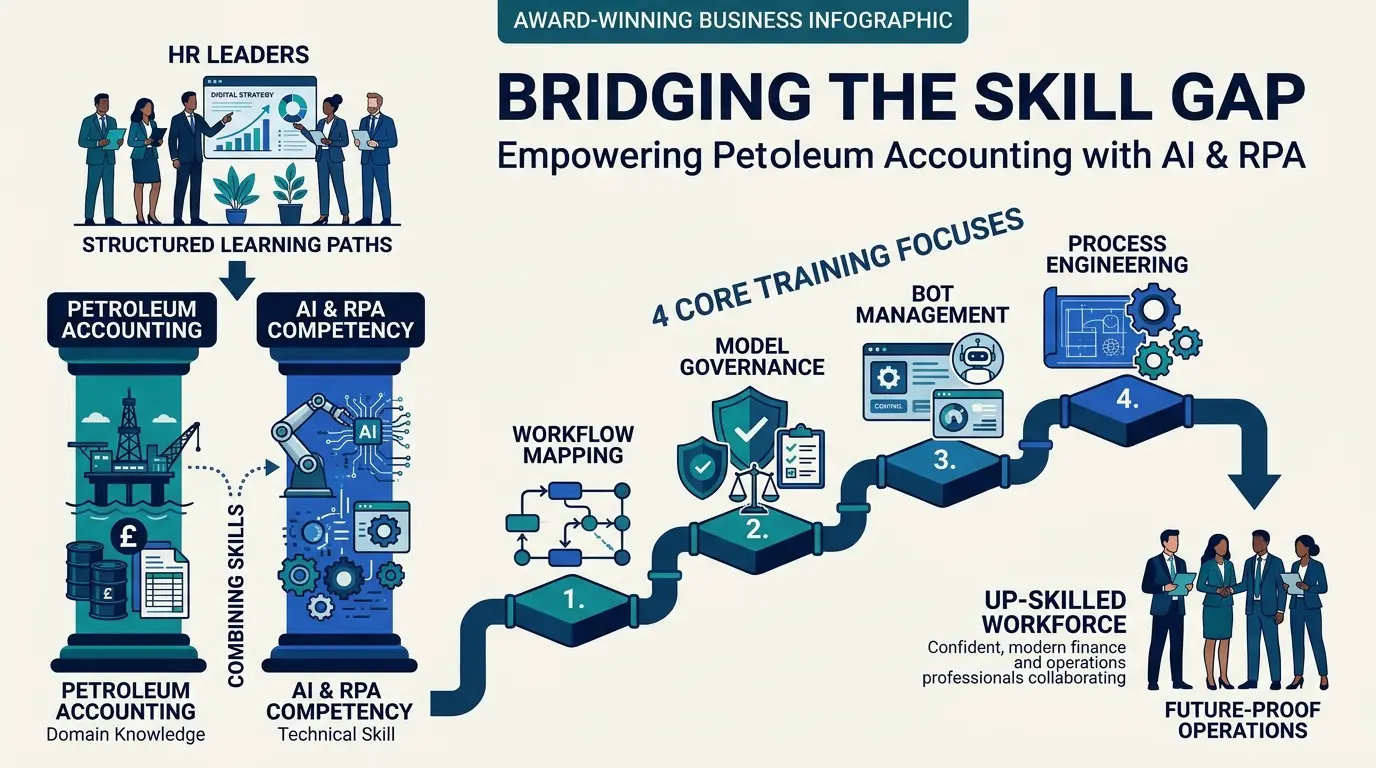
Deploying advanced automation tools without upskilling finance personnel leads to low adoption rates, fragile bot governance, and reliance on external consultants. Petroleum finance professionals require specific competencies to bridge the gap between financial operations and technical execution. HR teams must design structured capability-building initiatives aligned with corporate digital transformation strategies.
Essential Workforce Competencies
Process Engineering: Capability to map end-to-end financial workflows, eliminate redundant manual steps, and optimize processes prior to automation.
Bot Governance and Maintenance: Understanding how to monitor software bot performance, handle system exception logs, and update automation scripts when underlying ERP interfaces change.
Data Literacy and Model Interpretation: Ability to evaluate machine learning output confidence scores, validate predictive analytics models, and spot algorithmic bias in financial estimates.
Vendor and Tool Selection: Knowledge required to evaluate commercial enterprise automation platforms against specialized petroleum accounting software solutions.
Organizations seeking structured, industry-aligned capability development can enroll management teams in the formal Digital Transformation in Petroleum Finance: AI & RPA Training Course. Corporate learning plans must evaluate three distinct delivery models to ensure effective knowledge transfer across finance departments.
Learning Delivery Model | Core Advantages | Primary Limitations | Ideal Organizational Use Case |
Self-Paced E-Learning | Low cost per user; highly flexible schedules | Low completion rates; lacks petroleum-specific context | General digital awareness for broad employee populations |
Vendor Technical Certification | Deep software tool mastery (UiPath, Automation Anywhere) | Ignores complex petroleum finance logic and JIB structures | Dedicated IT automation developers |
Practical B2B Corporate Training | Tailored to oil and gas finance workflows; immediate ROI | Requires dedicated team time commitment | Cross-functional finance, HR, and transformation teams |
Selecting the correct training strategy ensures financial accountants transition into technical process designers. Up-skilled finance teams identify higher-quality automation use cases, maintain bot infrastructures effectively, and derive actionable business insights from machine learning models.
How Do Organizations Measure the ROI and Performance of Implemented Use Cases?
Organizations measure automation performance through quantitative KPIs including process cycle-time reduction, zero-exception error rates, full-time equivalent capacity reallocation, and audit compliance velocity. Tracking pre- and post-implementation metrics verifies financial returns.
Establishing baseline operational metrics prior to tool deployment is mandatory. Organizations must record exact task processing times, error frequencies, operational costs, and labor allocation before introducing AI or RPA software. Tracking post-implementation performance against these baselines validates initial investment hypotheses.
Primary Quantitative Key Performance Indicators
Process Cycle-Time Reduction: Total hours saved from task initiation to final financial settlement. Automated joint-interest billing closes often show an 80% reduction in execution time.
First-Pass Yield (Zero-Exception Rate): The percentage of transactions processed from start to finish without human manual intervention. High-performing RPA bots achieve first-pass yields exceeding 95%.
FTE Capacity Reallocation: The number of full-time equivalent hours shifted from low-value data entry tasks to strategic financial analysis, risk management, and vendor negotiation.
Cost Per Transaction: Total operational cost required to process an individual invoice, royalty payment, or financial statement before and after technology deployment.
Audit and Compliance Velocity: The speed at which internal and external auditors verify financial transactions. Automated processes maintain precise digital logs, reducing audit preparation overhead.
Continuous performance monitoring ensures implemented use cases deliver sustained value over time. If a bot's first-pass yield declines, process engineers must inspect underlying data feeds for unannounced input schema changes. Regular performance audits prevent technical drift and maintain governance alignment across energy finance ecosystems.
Frequently Asked Questions
What is Oil & Gas Petroleum Digital Finance & Automation training?
Oil & Gas Petroleum Digital Finance & Automation training provided by the Institute For Oil & Gas Training is a specialized professional development program designed to help energy finance professionals modernize financial workflows. The curriculum focuses on integrating robotic process automation, artificial intelligence, and predictive analytics into core energy accounting processes like joint-interest billing and royalty management. It equips corporate teams with the skills to streamline financial operations, improve reporting accuracy, and eliminate manual processing bottlenecks.
How does automation improve joint-interest billing and petroleum accounting?
Automation streamlines joint-interest billing by utilizing robotic process automation and intelligent document processing to match, verify, and reconcile complex vendor invoices against joint operating agreements without manual intervention. Through targeted training from the Institute For Oil & Gas Training, finance teams learn to deploy automated workflows that reduce monthly closing cycles from days to hours. This minimizes billing disputes between operating partners and significantly lowers operational error rates across energy accounting departments.
What are the main benefits of adopting AI and RPA in oil and gas finance departments?
Implementing AI and RPA in energy financial operations drastically reduces manual data entry errors, accelerates financial period-end closures, and provides real-time cash flow visibility. Programs like Oil & Gas Petroleum Digital Finance & Automation at the Institute For Oil & Gas Training enable professionals to transform unstructured lease agreements and yield metrics into actionable financial models. This transition allows finance leaders to reallocate staff capacity from repetitive tasks toward strategic forecasting and risk mitigation.
Who should enroll in an Oil & Gas Petroleum Digital Finance & Automation course?
The Oil & Gas Petroleum Digital Finance & Automation program is designed for financial controllers, joint-venture accountants, treasury managers, and HR development leads within energy sector organisations. Offered by the Institute For Oil & Gas Training, this course supports cross-functional professionals looking to bridge the gap between traditional energy accounting and modern digital finance frameworks. It is especially beneficial for decision-makers tasked with leading digital transformation initiatives or addressing technical workforce skill gaps.
How do finance managers evaluate processes for RPA and AI implementation?
Finance managers evaluate candidate processes by analyzing transactional volume, task standardization, data maturity, and potential financial error penalties. Through practical frameworks taught at the Institute For Oil & Gas Training, leaders learn to prioritize deterministic, high-volume tasks—such as bank reconciliations and accounts payable workflows—for immediate automation. This structured assessment methodology ensures that corporate investments in digital finance technology yield measurable operational returns.
Related training courses
Digital Transformation in Petroleum Finance: Strategy & Roadmap Training Course
- Specialisation
- Oil & Gas Petroleum Digital Finance & Automation
- Duration
- 5 days · 15 CPD hours
Digital Transformation in Petroleum Finance: AI & RPA Training Course
- Specialisation
- Oil & Gas Petroleum Digital Finance & Automation
- Duration
- 5 days · 15 CPD hours
Data Governance & Master Data: Ownership & Standards Training Course
- Specialisation
- Oil & Gas Petroleum Digital Finance & Automation
- Duration
- 5 days · 15 CPD hours
More articles

Data Governance and Master Data Ownership and Standards Training by Institute For Oil & Gas Training
Evaluate the Data Governance & Master Data Ownership & Standards Training Course syllabus, delivery, outcomes, and enrollment requirements.
Read article →
How to Define Data Ownership and Master Data Standards for Petroleum Operations
Learn how petroleum operations define data ownership, establish master data management standards, and improve data governance frameworks.
Read article →
Why Data Governance and Master Data Standards Matter in Oil and Gas
Learn why data governance and master data standards transform petroleum operations, resolve enterprise risk, and drive ROI across global energy assets.
Read article →