
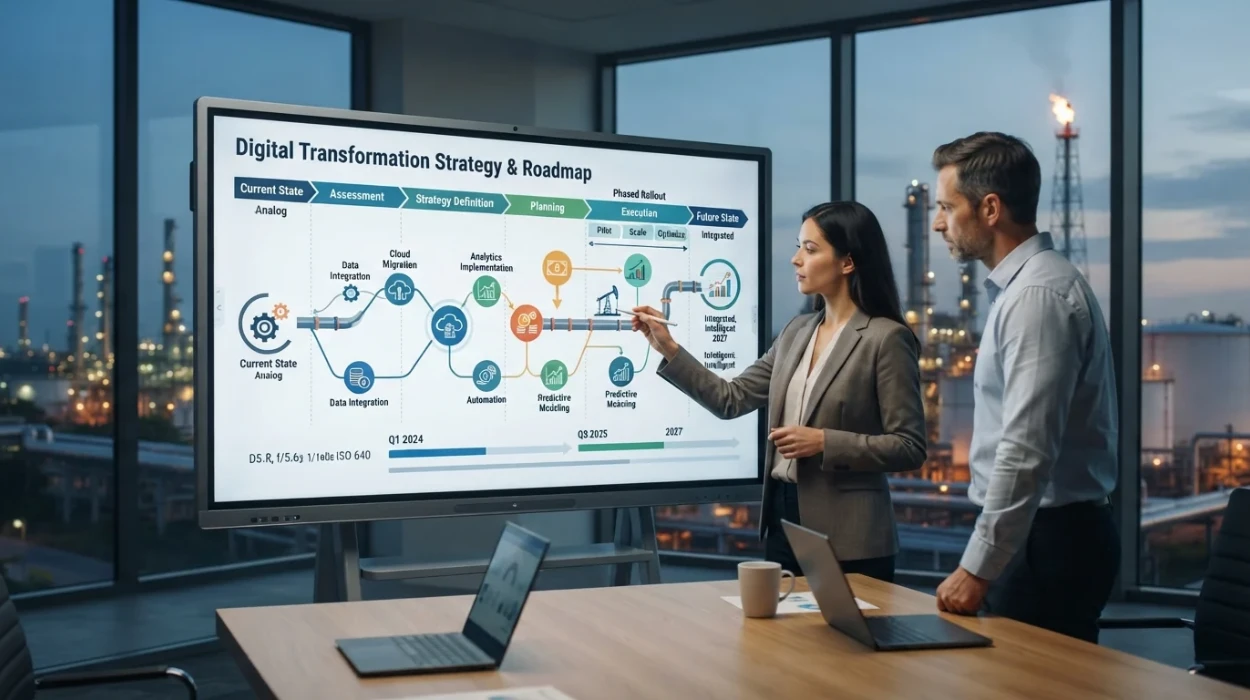
Petroleum finance operations face unique structural pressures, from volatile commodity pricing and complex Joint Operating Agreements (JOAs) to intricate production sharing contracts (PSCs). Establishing a clear digital strategy allows energy finance leaders to modernise legacy accounting systems, streamline risk management, and automate complex reporting loops across global operational assets.
To successfully transition from traditional financial controls to real-time analytics, leadership teams must first understand the fundamental operational drivers that necessitate modern technology systems. A foundational examination of Why Digital Transformation Matters in Petroleum Finance highlights how legacy manual systems create severe reporting latency, heightening fiscal exposure across upstream and downstream portfolio assets. Building a resilient strategy requires evaluating frameworks, setting target architectures, and addressing critical workforce skill gaps.
What Is a Digital Transformation Strategy in Petroleum Finance?
A digital transformation strategy in petroleum finance is an operational blueprint that aligns modern software technologies, automated accounting workflows, and data governance models with the strategic financial management goals of upstream, midstream, or downstream oil and gas enterprise operations.
Financial transformation in the energy sector differs significantly from standard corporate finance initiatives due to specialized accounting treatments like Unproved Property Acquisition costs, Successful Efforts vs. Full Cost accounting methods, and complex Joint Venture (JV) billing arrangements. A comprehensive digital transformation strategy moves an organisation away from fragmented spreadsheets toward unified cloud Enterprise Resource Planning (ERP) environments, integrated business intelligence dashboards, and machine-learning-driven cash flow forecasting.
Building this strategy requires establishing a structured digital maturity assessment. Energy organisations evaluate their current infrastructure across four distinct stages of technological capability:
Ad-Hoc / Legacy: Heavy reliance on manual data entry, disconnected legacy systems, high error rates in joint venture accounting, and reactive financial reporting.
Standardised: Initial process standardisation achieved across core general ledgers, though data silos remain between operational production systems and corporate finance.
Integrated: Centralised data lakes feed automated reporting modules, supporting cross-departmental visibility and standardized risk management protocols.
Optimised / Intelligent: Real-time financial modeling, predictive capital expenditure (CapEx) tracking, automated joint interest billing, and advanced cloud-based audit trails.
The ultimate objective of the strategy is establishing a future-proof Target Operating Model (TOM). The TOM defines how people, processes, technology, and governance structures interact to deliver robust financial controls, eliminate operational redundancy, and ensure strict compliance with international accounting standards.
How Do You Assess Digital Maturity in Oil and Gas Finance Operations?
Assessing digital maturity requires systematically evaluating an organisation's current financial processes, technology stack, data integrity, and workforce skills against industry benchmark standards to identify severe operational bottlenecks, high manual intervention points, and technical debt across finance functions.
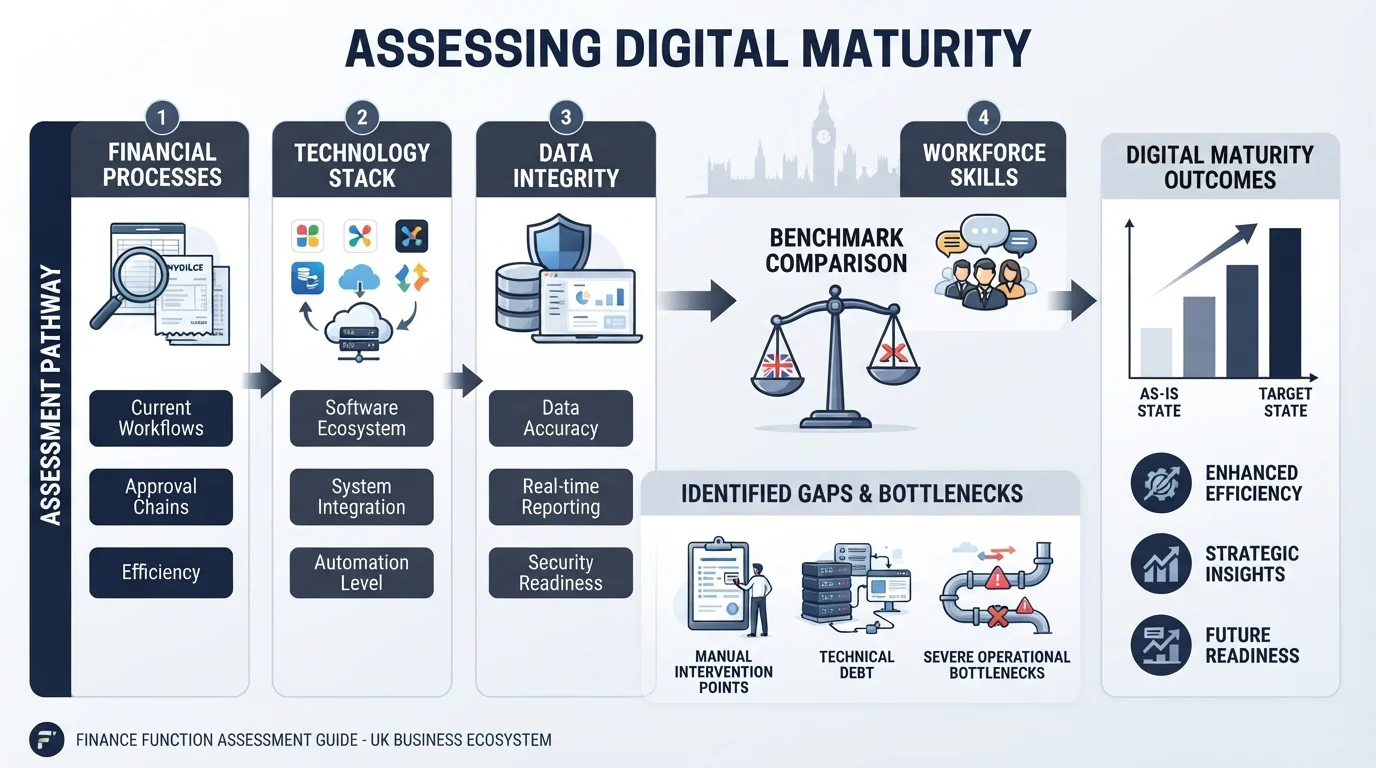
A successful digital maturity assessment evaluates both back-office capabilities and field-level financial integration. In petroleum finance, manual processing directly increases risk when handling massive capital allocations, dynamic hedging portfolios, and fluctuating royalty payments.
Organizations conduct this assessment across three core operational dimensions:
Process Standardisation and Automation Maturity
Finance teams audit routine transactional workflows to measure manual labor requirements. High-value targets for automation include accounts payable, joint interest billing, revenue distribution, and regulatory compliance reporting. Process standardisation ensures that sub-units, international branches, and operating affiliates handle financial data using identical rulebooks before system automation occurs.
Enterprise Technology Stack Health
The assessment reviews legacy software systems to determine integration readiness, scalability, and security posture. Upstream finance departments frequently run legacy software that cannot process high-velocity data feeds from modern IoT field sensors, creating severe delays in lease operating expense (LOE) tracking and field-level margin analysis.
Workforce Capability and Skill Gaps
Human capital forms the critical link in digital evolution. Human Resource (HR) directors and chief financial officers must identify skill deficits within accounting teams regarding data analytics, automated financial modeling, and cloud software navigation. Without workforce readiness, enterprise software investments fail to deliver projected operational gains.
Evaluating these dimensions establishes a baseline score, allowing leadership to formulate a business case for digital investment that highlights clear cost reductions, error mitigation metrics, and expected return on capital spent.
What Are the Key Components of a Petroleum Finance Transformation Roadmap?
A petroleum finance transformation roadmap is an actionable multi-year execution schedule that phases technology deployments, process standardisations, target operating model restructurings, change management initiatives, and skill development programs to minimise operational disruption and guarantee measurable value creation.
Structuring the roadmap logically prevents system shock and avoids common execution pitfalls. The roadmap must group work streams into coherent, manageable phases that build upon foundational process improvements.
Phase 1: Foundation and Process Standardisation (Months 1–6)
This phase focuses on eliminating non-standard accounting practices across operational business units. Core activities include rationalising chart of accounts (COA) structures, mapping data lineage from field production systems to financial ledgers, and delivering targeted training to upskill key personnel. Establishing core competencies early ensures smooth transitions during later software rollouts.
Phase 2: System Architecture Modernisation and SSC Integration (Months 7–18)
During this phase, organisations execute their technology stack selection and consolidate transactional finance functions into a centralised Shared Service Centre (SSC). The SSC model centralises repetitive high-volume tasks—such as vendor invoice processing, intercompany reconciliations, and payroll processing—yielding immediate economies of scale and uniform policy enforcement.
Engineers and software architects deploy integrated enterprise resources platforms, connecting field operational databases directly to central financial reporting software. Implementation teams apply automated Joint Interest Billing (JIB) and Revenue Distribution modules during this window to accelerate monthly close cycles.
Phase 3: Advanced Analytics, Automation, and Benefits Realisation (Months 19–36)
The final phase introduces predictive financial analytics, machine-learning-driven treasury management tools, and real-time capital allocation models. Strategic emphasis moves toward tracking benefits realisation, ensuring the company systematically measures cost savings, reduced cycle times, and operational efficiency improvements against the initial business case.
How Do You Select the Right Technology Stack for Energy Sector Finance?
Selecting the right technology stack involves evaluating software scalability, security architectures, native oil and gas functionality, integration capabilities with production engineering systems, and total cost of ownership against the organization's long-term operational requirements and target operating model.
Energy sector financial architectures demand specialized functionality that off-the-shelf enterprise software packages cannot deliver without extensive customization. Leaders must evaluate vendors against rigid operational requirements.
Evaluating technology options requires comparing enterprise-wide software solutions against targeted niche modules across essential operational metrics:
Selection Criteria | Core Cloud ERP Platform | Specialized Energy Niche Software | Best-of-Breed Modular Stack |
System Integration Effort | Low; native data flows between general ledger, HR, and procurement. | Moderate; requires API connectors to sync with central financial ledgers. | High; demands custom middleware, API maintenance, and rigorous governance. |
Industry Functionality | Moderate; requires industry add-ons for JIB, AFE tracking, and royalties. | High; purpose-built specifically for complex petroleum accounting rules. | High; allows selecting exact tools for specific operational accounting tasks. |
Scalability & Maintenance | High; single-vendor updates, uniform security protocols, predictable vendor roadmap. | Variable; dependent on vendor size, development resources, and update cycles. | Complex; multiple software update cycles can break custom system integrations. |
Total Cost of Ownership | Predictable enterprise licensing; lower long-term maintenance overhead. | Moderate subscription costs; potential integration maintenance overhead. | High indirect management costs; requires specialised internal IT skills. |
Organizations must prioritize robust application programming interface (API) frameworks. APIs allow real-time data flow between field production databases (measuring barrel volumes, flow rates, and transport losses) and central financial ledgers, preventing dangerous discrepancies between physical inventory and book values.
What Are the Main Approaches to Training Finance Teams for Digital Transformation?
Training finance teams effectively requires structured learning frameworks—spanning vendor-led technical certifications, internal peer-to-peer mentoring, external specialized industry workshops, and hands-on simulation labs—that bridge the gap between traditional accounting standards and digital system execution.
Workforce transformation represents the most common point of failure in enterprise digital initiatives. HR departments and financial leaders face a choice between distinct training models, each offering unique trade-offs regarding cost, delivery time, and practical workplace application.
Selecting the appropriate learning architecture determines how quickly staff adopt new workflows and maintain compliance standards across energy finance functions.
Vendor-Led Technical Certification
Software vendors provide deep technical instruction covering the mechanics, menus, and system administration rules of their specific software packages.
Pros: Deep technical instruction on specific software mechanics, direct system troubleshooting knowledge, standard user certification.
Cons: Often lacks energy-industry context, fails to address broader process standardisation, neglects strategic target operating model goals.
Internal Peer-to-Peer Mentoring and Super-User Cascades
Organisations train select internal "super-users" who then cascade technical system knowledge down to their respective regional teams.
Pros: Low direct financial cost, utilizes existing organizational domain context, builds localized support networks.
Cons: High risk of perpetuating legacy inefficient habits, slow execution timeline, places heavy administrative burden on top operational talent.
External Industry-Contextualised Technical Training
Specialised external training programs blend technical software instruction with energy-sector financial strategy, process governance, and practical implementation scenarios. Enterprise leaders often choose targeted programs like the Digital Transformation in Petroleum Finance: Strategy & Roadmap Training Course to upskill leadership teams on change adoption techniques, modern target operating models, and technology integration methodologies.
Pros: Combines strategic finance frameworks with industry-specific operational realities, accelerates change adoption, provides clear benchmarks for ROI.
Cons: Requires dedicated time commitment away from daily operational duties, higher upfront training budget allocation.
Comparative Framework Evaluation
To select the correct learning delivery model, HR directors and CFOs evaluate these approaches using a structured decision matrix:
Evaluation Metric | Vendor-Led Training | Internal Cascade Mentoring | External Contextualized Course |
Operational Relevance | Low (Focuses solely on generic software UI) | High (Grounded in current internal processes) | Exceptional (Combines strategy, energy accounting, & software) |
Time-to-Competency | Rapid for software tools; slow for strategy | Slow; dependent on internal mentor availability | Rapid; structured intensive learning delivery |
Scalability Across SSCs | High; standardized vendor curriculum | Low; variable quality across mentors | High; creates uniform capabilities across sites |
Change Adoption Impact | Moderate; addresses tool mechanics, not culture | Low; prone to resistance against new methods | High; addresses leadership alignment and team buy-in |
Choosing an enterprise training strategy that combines structural frameworks with practical application ensures the workforce can operate automated software systems efficiently from day one.
How Do You Overcome Organisational Resistance to Digital Transformation in Energy Finance?
Overcoming resistance requires driving active leadership sponsorship, establishing transparent cross-departmental communication, offering practical skill development opportunities, aligning individual KPIs with strategic transformation goals, and demonstrating rapid value delivery through early quick wins.
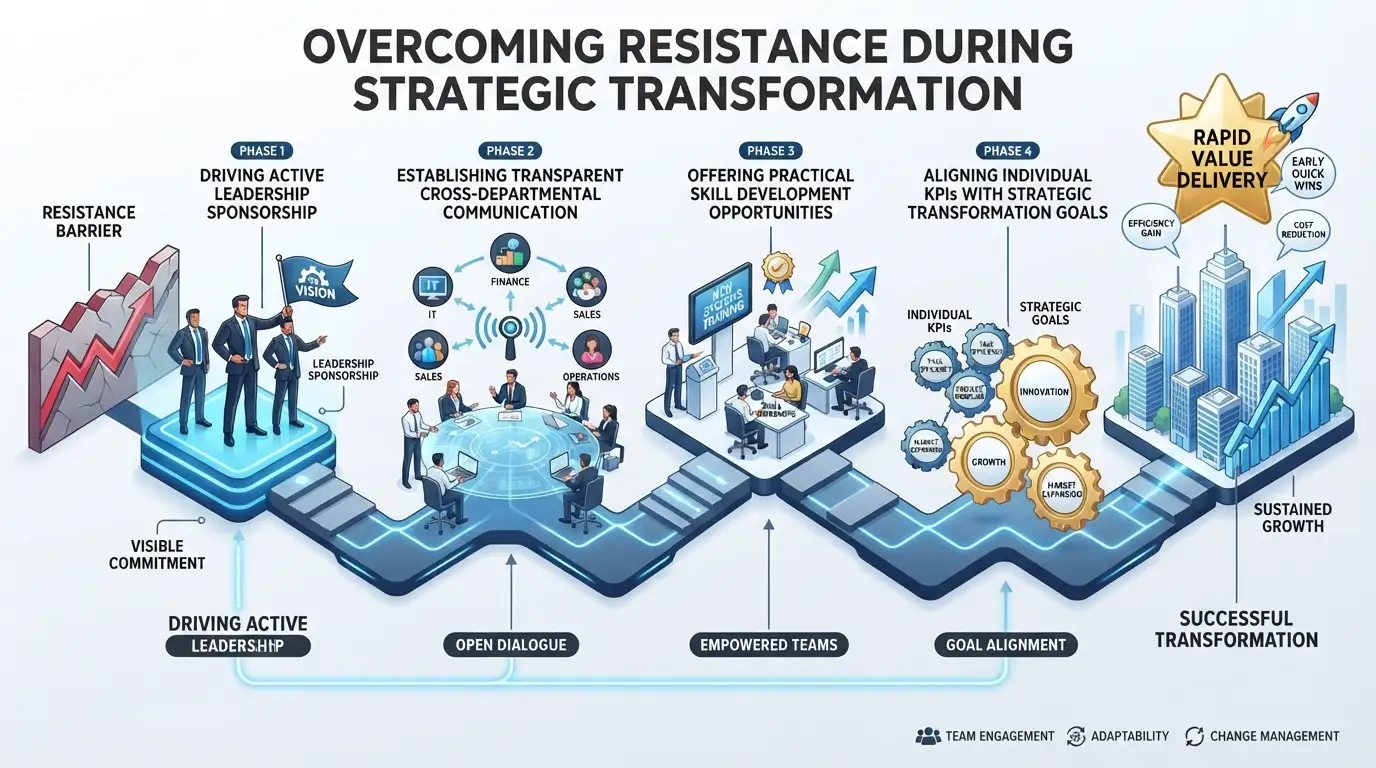
Human resistance to digital change stems primarily from fear of job redundancy, lack of familiarity with new analytics tools, and comfort with established legacy routines. In long-standing petroleum finance departments, employees often rely on personal, complex macro-enabled spreadsheets built over decades. Transitioning these professionals to structured cloud architectures requires a structured change adoption plan.
Executive leadership must deploy key strategies to drive cultural alignment:
Establish Clear Executive Sponsorship: Transformation cannot be treated as a pure IT project. The CFO, VP of Finance, and HR Director must publicly co-own the roadmap, communicating the strategic necessity of the transformation regularly.
Design Role-Specific Capability Pathways: Reassure staff by offering structured career progression tracks. Position digital tools as capability enhancers that eliminate tedious data entry, enabling accountants to perform high-value financial analysis.
Implement a "Quick Win" Strategy: Target small, high-friction operational pain points early—such as automating manual Joint Venture invoice matching. Demonstrating immediate workload relief builds trust across operational teams.
Incorporate Digital KPIs into Performance Management: Align individual performance reviews with process standardisation and new system adoption rates. Reward team members who actively contribute to data governance and efficiency improvements.
Organizations seeking structured guidance on building executive-led transformation roadmaps, designing operating models, and executing change initiatives often enroll key leadership in the formal Digital Transformation in Petroleum Finance Strategy and Roadmap Training by Institute For Oil & Gas Training. Structured capability development aligns management teams on risk mitigation, benefits realization, and workforce transition management.
How Is ROI and Benefits Realisation Measured in Finance Transformation?
Measuring ROI and benefits realisation requires tracking clear quantitative metrics—including finance operating cost reductions, accelerated monthly close timelines, reduced manual processing error rates, and capital expenditure allocation improvements—against baseline pre-transformation performance data.
A robust business case for digital investment depends on continuous performance measurement. Finance leadership must establish key performance indicators (KPIs) before software deployment and monitor them continuously throughout implementation phases.
Core financial metrics used to track transformation success include:
Financial Close Cycle Time: Measuring the number of business days required to perform monthly, quarterly, and annual financial consolidations. Modern digital environments systematically reduce close cycles from 15+ days down to 3–5 days.
Cost Per Transaction: Tracking the fully loaded operational cost to process an individual vendor invoice, joint interest bill, or payroll cycle before and after Shared Service Centre deployment.
Cash Flow Optimization and JIB Recovery Speed: Quantifying the reduction in Days Sales Outstanding (DSO) for joint venture billings. Automated billing systems drastically reduce dispute resolution timelines with non-operating partners.
Workforce Productivity and Capacity Reallocation: Calculating the percentage of working hours shifted from low-value data collection and manual reconciliation to high-value financial planning, analysis, and strategic capital allocation.
By establishing strict benefits realization frameworks, energy companies ensure that digital transformation initiatives deliver continuous, quantifiable financial value, maintaining long-term enterprise competitiveness across shifting global energy markets.
Frequently Asked Questions
What is oil and gas petroleum digital finance and automation training?
Oil and gas petroleum digital finance and automation training is a specialized professional development program that teaches finance professionals how to modernize financial workflows in the energy sector. Delivered by the Institute For Oil & Gas Training, this course covers automated joint venture accounting, digital maturity assessment, and modern technology stack selection. Participants learn to replace manual financial processes with streamlined cloud-based architectures to improve accuracy and operational efficiency.
How does finance automation benefit oil and gas companies?
Finance automation reduces monthly close cycles, minimizes billing errors in joint interest operations, and lowers overall transactional costs across energy enterprises. The Institute For Oil & Gas Training helps organizations build a robust petroleum finance digital strategy that aligns target operating models with real-time financial tracking. This enables finance teams to optimize capital expenditure allocations and improve regulatory compliance reporting across complex upstream and downstream assets.
What topics are covered in a petroleum finance digital transformation strategy course?
A comprehensive petroleum finance digital transformation strategy course covers enterprise data governance, financial process standardization, and shared service centre consolidation. Through training with the Institute For Oil & Gas Training, participants explore practical frameworks for oil and gas petroleum digital finance and automation implementation. Key modules include change adoption management, business case development for digital investments, and tracking benefits realization.
Who should take an oil and gas financial automation and strategy training course?
This training is designed for CFOs, finance directors, corporate controllers, accounting managers, and HR development leads in the energy sector. Professionals looking to upskill their teams in oil and gas petroleum digital finance and automation gain strategic insights through structured programs at the Institute For Oil & Gas Training. It is particularly valuable for personnel responsible for leading enterprise resource planning (ERP) modernizations and financial process overhauls.
How long does it take to implement a petroleum finance digital transformation roadmap?
A typical petroleum finance digital transformation roadmap spans 18 to 36 months, broken down into foundational process standardization, system integration, and advanced analytics deployment. The Institute For Oil & Gas Training prepares leadership teams to execute each phase effectively while minimizing operational disruption during software transitions. Building strong internal digital capabilities ensures faster technology adoption and measurable long-term return on investment.
Related training courses
Royalties, Bonuses & Government Take: Fiscal Waterfall Modelling Training Course
- Specialisation
- Oil & Gas Petroleum Fiscal Regime
- Duration
- 5 days · 13 CPD hours
Fiscal Regime Comparison Across Contract Types Training Course
- Specialisation
- Oil & Gas Petroleum Fiscal Regime
- Duration
- 5 days · 15 CPD hours
Fiscal Regime Comparison & Reform Risk Training Course
- Specialisation
- Oil & Gas Petroleum Fiscal Regime
- Duration
- 5 days · 15 CPD hours
More articles

Data Governance and Master Data Ownership and Standards Training by Institute For Oil & Gas Training
Evaluate the Data Governance & Master Data Ownership & Standards Training Course syllabus, delivery, outcomes, and enrollment requirements.
Read article →
How to Define Data Ownership and Master Data Standards for Petroleum Operations
Learn how petroleum operations define data ownership, establish master data management standards, and improve data governance frameworks.
Read article →
Why Data Governance and Master Data Standards Matter in Oil and Gas
Learn why data governance and master data standards transform petroleum operations, resolve enterprise risk, and drive ROI across global energy assets.
Read article →