

Petroleum sector financial managers, commercial analysts, and government relations teams frequently face complex fiscal alignment challenges when evaluating asset portfolios. Upstream petroleum projects require tailored financial mechanisms to remain commercially viable across varying geological, technical, and operational risk profiles. The Institute For Oil & Gas Training delivers this specialized technical course to bridge critical analytical skill gaps within commercial, legal, and finance departments.
Understanding why shallow water, mature basins, and high-cost offshore assets demand distinct contractual frameworks is fundamental to successful asset valuation. To establish foundational concepts regarding asset risk profiles and government take, review Why Marginal and Deepwater Oil Fields Require Different Fiscal Approaches. Building upon these principles, this course provides the practical mechanisms needed to model, negotiate, and optimize host government contracts for complex petroleum developments.
What Is the Course and What Problem Does It Solve?
The Fiscal Regime Comparison for Marginal & Deepwater Fields Training Course by Institute For Oil & Gas Training resolves critical corporate skill gaps in fiscal model analysis, contractual risk allocation, and regulatory compliance for upstream asset evaluation.
In upstream oil and gas operations, applying standardized concessions or production sharing contracts to non-standard assets creates significant financial misallocations. Marginal fields often suffer from low reserves, limited flow rates, and high initial expenditure relative to total revenue. Conversely, deepwater petroleum projects demand billions in capital expenditure before initial production, exposing operators to long payback periods and severe price volatility risks.
Corporate finance and joint venture management teams frequently struggle to evaluate competing contractual terms across different regulatory jurisdictions. Without rigorous modeling capability, commercial teams risk misinterpreting how marginal field fiscal incentives, deepwater sliding scale terms, and gas specific fiscal terms impact net present value (NPV) and internal rate of return (IRR). This lack of analytical clarity leads to flawed bid strategies, missed farm-in opportunities, or unprofitable field development plans.
The Institute For Oil & Gas Training structured the Fiscal Regime Comparison for Marginal & Deepwater Fields Training Course to provide an operational solution to these analytical failures. The curriculum transforms raw fiscal data into actionable financial models. Participants learn to isolate specific fiscal levers, evaluate government take versus investor return, and structure commercial proposals that balance risk and reward across diverse operational environments.
HR directors and department heads utilize this training to standardize asset evaluation frameworks across cross-functional teams. By aligning commercial, tax, and engineering personnel on fiscal mechanics, organizations reduce multi-disciplinary friction and accelerate corporate investment decision cycles.
Why Is This Course Structured This Way?
This professional syllabus is structured sequentially to progress participants from foundational fiscal mechanics to multi-variable financial modeling, enabling systematic comparative evaluation of global upstream petroleum regimes.
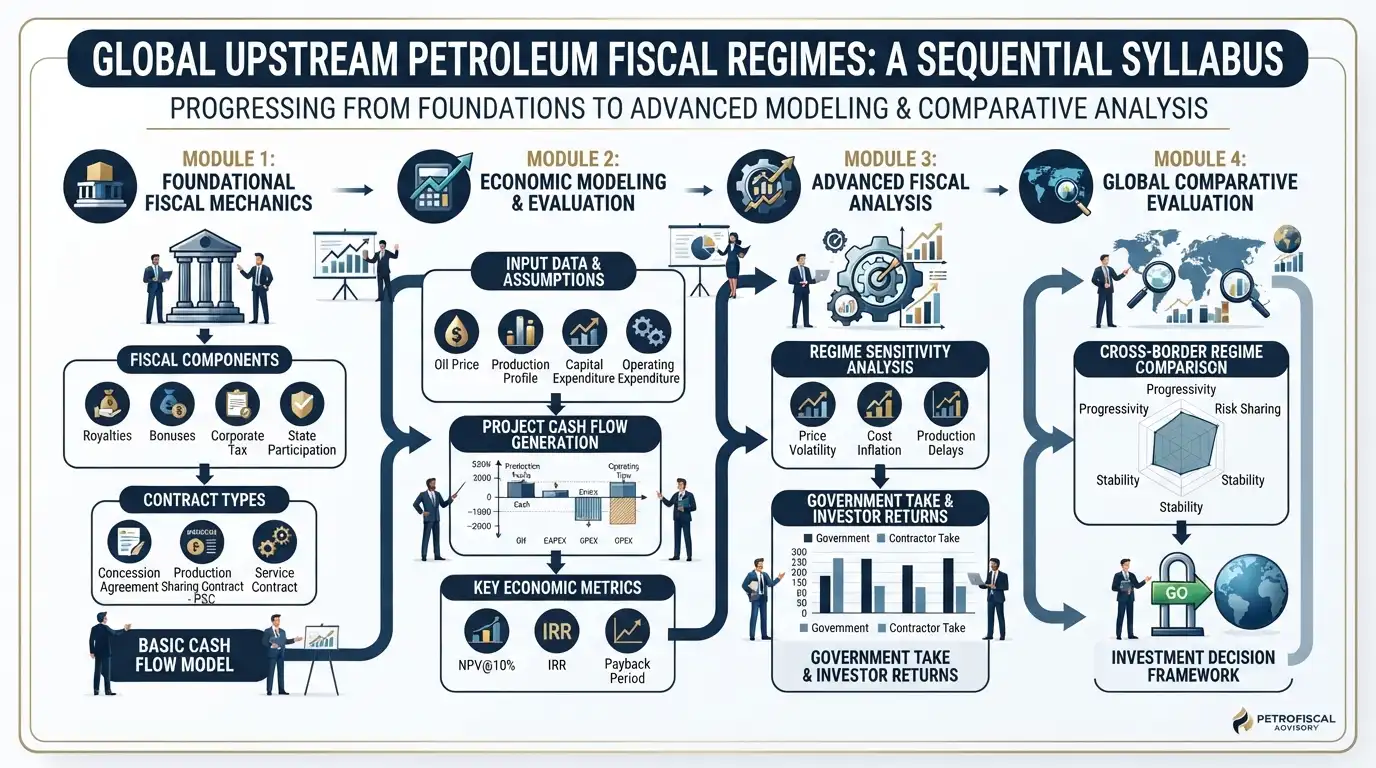
Upstream fiscal analysis demands a progressive pedagogical structure that combines economic theory with empirical spreadsheet engineering. The course begins with core fiscal mechanisms before introducing complex asset variables such as water depth, infrastructure proximity, and fluid composition. This sequence ensures analysts master basic tax and royalty mechanics before modeling complex sliding scale production sharing contracts.
To effectively benchmark complex asset terms and select optimal fiscal structures, commercial teams should consult How to Evaluate Fiscal Regime Options for Marginal Fields and Deepwater Petroleum Projects. The curriculum directly reflects these decision-making frameworks by placing comparative regime analysis at the center of the learning journey.
The Institute For Oil & Gas Training designs its course structures around functional workplace requirements rather than academic theory. Commercial analysts must not only understand fiscal terms in isolation, but also analyze how terms interact under shifting commodity price scenarios. The module sequence builds this exact operational capability through progressive exposure to real-world concessionary, contractual, and service agreement systems.
By structuring the learning flow from isolated mechanisms to integrated financial models, the Institute For Oil & Gas Training ensures complete knowledge retention. Participants gain immediate confidence in manipulating fiscal variables within corporate financial models, direct investment memos, and joint venture negotiations.
What Will Participants Learn?
Participants master practical techniques to audit, model, and negotiate complex fiscal mechanisms, including investment allowances, ring fencing rules, sliding scale systems, and domestic supply obligations.
The course delivers direct operational competencies focused on upstream fiscal engineering and commercial risk management. Training modules focus on real-world asset datasets, ensuring participants acquire immediately transferable analytical skills.
Module Breakdown and Technical Skill Coverage
Module 1: Fundamentals of Petroleum Fiscal Systems
Analysis of concessionary systems, production sharing contracts (PSCs), and risk service contracts.
Calculation of effective royalty rates, signature bonuses, and surface rentals.
Mechanics of corporate income tax, windfall profit taxes, and resource rent taxes.
Determining the baseline economic limit of mature and marginal production assets.
Module 2: Fiscal Terms for Marginal Field Development
Applying marginal field fiscal incentives to lower early-stage capital friction.
Structuring tax holidays and reliefs to improve early asset cash flows.
Evaluating the financial impact of investment allowance and uplift mechanisms on development capital costs.
Modeling domestic supply obligation (DSO) impact on net realized gas and oil prices.
Module 3: Deepwater Fiscal Architecture and Risk Allocation
Designing and auditing deepwater sliding scale terms tied to daily production rates, cumulative production, or R-factors.
Structuring gas specific fiscal terms to account for long infrastructure build-outs and complex LNG supply chains.
Comparative analysis of ring fencing versus consolidation provisions across multi-field corporate portfolios.
Evaluating decommissioning liabilities, abandonment security funds, and tax deductibility schedules.
Module 4: Advanced Financial Modeling and Comparative Analysis
Building dynamic cash flow models incorporating multi-tiered fiscal regimes.
Executing sensitivity analysis across commodity price fluctuations, cost overruns, and production delays.
Benchmarking Government Take, Investor Return, Effective Tax Rate, and Front-End Loading metrics.
Simulating international fiscal terms negotiation scenarios between national oil companies (NOCs) and international oil companies (IOCs).
How Is the Course Delivered?
The course is delivered via structured professional workshops, live interactive online sessions, hybrid learning modules, or dedicated corporate onsite programs tailored to organizational schedules.

The Institute For Oil & Gas Training maintains flexible delivery formats to accommodate international corporate schedules while preserving rigorous instructional standards. All delivery channels utilize the same standardized curriculum, practical exercise suites, and financial modeling templates.
Instructional Methodology and Practical Execution
Training sessions balance technical lectures with intensive practical financial modeling labs. Participants receive pre-built spreadsheet shells that are systematically expanded throughout the course to handle complex fiscal calculations.
Instructors utilize real-world petroleum contracts, tax legislation excerpts, and host government concessions to ground every session in real commercial practice. Case studies involve actual asset data from North Sea marginal developments, West African deepwater blocks, Gulf of Mexico deepwater fields, and Southeast Asian shallow-water gas projects.
Assessment is continuously integrated into the practical modeling exercises. Participants complete progressive financial modeling assignments, individual fiscal regime audits, and a final group negotiation simulation. This multi-tiered evaluation methodology verifies that every participant achieves verified operational capability prior to course completion.
What Results Can Be Expected?
Graduates demonstrate measurable performance gains in upstream asset valuation, contract auditing, commercial negotiation preparation, and cross-departmental financial governance.
Enrolling workforce personnel in the Fiscal Regime Comparison for Marginal & Deepwater Fields Training Course delivers direct, quantifiable benefits to corporate finance, commercial, and business development operations.
Measurable Skill Outcomes and Corporate Impact
Accurate Asset Valuation: Commercial analysts gain the capability to model complex fiscal terms with zero formulaic errors, resulting in precise asset NPV and IRR estimations during farm-in and licensing round evaluations.
Enhanced Negotiation Capability: Commercial teams identify hidden value drivers in host government contracts, enabling strategic deployment of trade-offs between royalties, cost recovery caps, and profit splits during fiscal terms negotiation.
Rigorous Fiscal Auditing: Tax and accounting specialists effectively audit joint venture billing statements, ensuring historical cost recovery claims, investment allowance and uplift calculations, and tax deductions match contractual definitions.
Optimized Portfolio Strategy: Portfolio managers learn to evaluate the commercial impact of ring fencing versus consolidation rules across international business units, optimizing corporate tax exposures.
Streamlined Inter-Departmental Workflows: Alignment between legal, financial, technical, and executive management accelerates project decision gates and investment board approvals.
HR managers and corporate learning heads track these performance gains through pre- and post-course skill evaluations conducted by the Institute For Oil & Gas Training. These metrics demonstrate clear return on investment (ROI) through improved team speed, reduced reliance on third-party financial consultants, and heightened accuracy in corporate investment proposals.
How Does Enrollment Work?
Enrollment involves a structured qualification review, candidate background evaluation, format selection, and formal corporate registration via the Institute For Oil & Gas Training admissions portal.
To maintain high instructional quality and collaborative peer engagement, candidates must meet clear professional prerequisites before acceptance into the program.
Candidate Prerequisites
Professional Background: Minimum of two years of professional experience in petroleum engineering, commercial analysis, corporate finance, accounting, legal counsel, or energy policy formulation.
Technical Proficiency: Working knowledge of Microsoft Excel, including financial functions, cash flow modeling, and scenario management.
Conceptual Understanding: Familiarity with basic upstream petroleum operations, field development terminology, and standard corporate accounting principles.
Corporate Registration Path
Upon successful completion of all practical modeling assignments and the final fiscal evaluation case study, graduates receive a formal Certificate of Completion from the Institute For Oil & Gas Training. This credential verifies advanced proficiency in upstream fiscal regime analysis, comparative financial modeling, and commercial contract evaluation.
To build workforce capability in upstream fiscal analysis and secure immediate access to upcoming training cohorts, enroll in this program today.
Frequently Asked Questions
What is an oil and gas petroleum fiscal regime?
An oil and gas petroleum fiscal regime is the legal, contractual, and tax framework that governs the financial relationship between host governments and commercial oil companies. These systems determine how revenue, risk, and profits from petroleum extraction are shared through mechanisms such as royalties, corporate income taxes, production sharing contracts, and cost recovery caps. The Institute For Oil & Gas Training provides specialized training to help commercial, legal, and financial teams model and evaluate these complex fiscal terms.
What are the main types of petroleum fiscal regimes?
The two primary types of petroleum fiscal regimes are concessionary systems and contractual systems. Concessionary systems allow private companies to hold title to extracted resources while paying royalties and taxes to the state, whereas contractual systems, such as Production Sharing Contracts (PSCs) and Risk Service Contracts, retain resource ownership with the host government and compensate operators through profit splits or service fees. The Institute For Oil & Gas Training delivers comprehensive courses comparing how these structural differences impact overall project economics and asset valuation.
How does a fiscal regime impact upstream petroleum investment decisions?
A petroleum fiscal regime directly dictates a project's net present value (NPV), internal rate of return (IRR), and overall risk profile for commercial investors. High front-end taxes or restrictive cost recovery terms can render marginal or deepwater developments economically unviable, whereas targeted investment allowances and tax holidays can incentivize international investment. Commercial analysts trained by the Institute For Oil & Gas Training learn to run sensitivity analyses on these fiscal variables to guide strategic portfolio and bidding decisions.
What is the difference between progressive and regressive petroleum fiscal terms?
Progressive petroleum fiscal terms automatically adjust the government's take upwards as field profitability or oil prices increase, ensuring higher investor returns during low-margin periods. Conversely, regressive terms take a fixed percentage regardless of project profitability, which places a heavier financial burden on high-cost or low-yield assets like marginal fields. Understanding these mechanisms through Institute For Oil & Gas Training programs enables commercial teams to structure balanced contractual terms during host government negotiations.
Why is fiscal regime comparison critical for energy sector companies?
Comparing international petroleum fiscal regimes allows energy companies to benchmark risk-adjusted returns across multiple global jurisdictions before committing capital. Systematic fiscal comparison identifies how specific provisions, such as ring-fencing rules, domestic supply obligations, and gas-specific terms, affect long-term corporate cash flows. Through professional development programs at the Institute For Oil & Gas Training, corporate finance and business development teams acquire the analytical tools needed to audit and compare competing global petroleum terms effectively.
Related training courses
Royalties, Bonuses & Government Take: Fiscal Waterfall Modelling Training Course
- Specialisation
- Oil & Gas Petroleum Fiscal Regime
- Duration
- 5 days · 13 CPD hours
Fiscal Regime Comparison for Marginal & Deepwater Fields Training Course
- Specialisation
- Oil & Gas Petroleum Fiscal Regime
- Duration
- 5 days · 15 CPD hours
Fiscal Regime Comparison & Reform Risk Training Course
- Specialisation
- Oil & Gas Petroleum Fiscal Regime
- Duration
- 5 days · 15 CPD hours
More articles

Data Governance and Master Data Ownership and Standards Training by Institute For Oil & Gas Training
Evaluate the Data Governance & Master Data Ownership & Standards Training Course syllabus, delivery, outcomes, and enrollment requirements.
Read article →
How to Define Data Ownership and Master Data Standards for Petroleum Operations
Learn how petroleum operations define data ownership, establish master data management standards, and improve data governance frameworks.
Read article →
Why Data Governance and Master Data Standards Matter in Oil and Gas
Learn why data governance and master data standards transform petroleum operations, resolve enterprise risk, and drive ROI across global energy assets.
Read article →