

The Fiscal Disputes, Cost Recovery and Contract Resolution Training Course delivers technical frameworks to audit joint venture expenditures, resolve contract disagreements, and mitigate financial leakages in petroleum assets, helping energy companies protect project margins and strengthen commercial governance.
Petroleum operations operate under intricate regulatory, fiscal, and contractual terms where financial interpretation differences frequently arise. Joint operating agreements, production sharing contracts, and tax frameworks contain multi-layered formulas that govern capital expenditure recovery, royalty calculations, and operating expense allocation. When operating partners, non-operating investors, and host governments apply conflicting interpretations to these fiscal clauses, the resulting friction delays cash flows, increases legal exposure, and consumes executive management time.
Many energy sector organizations struggle with internal skill gaps in petroleum financial auditing and dispute management. Commercial analysts, financial controllers, and legal advisors often understand isolated components of asset management, but lack an integrated understanding of how accounting structures interact with international dispute resolution mechanisms. This operational gap creates systemic exposure during joint venture audits and state tax reviews, leading to unrecovered costs and unbudgeted liabilities. To understand why these underlying financial mechanisms require rigorous oversight, organizations must first examine Why Fiscal Disputes and Cost Recovery Issues Matter in Petroleum Contracts.
The Institute For Oil & Gas Training established this course to solve these structural compliance and financial verification challenges. The program converts complex contractual frameworks into operational audit steps, financial reconciliation protocols, and dispute mitigation workflows. By addressing the root causes of financial misalignment, the training ensures corporate teams can audit expenditures accurately, negotiate settlements effectively, and enforce fiscal compliance across complex petroleum concessions.
Why is the Fiscal Disputes, Cost Recovery and Contract Resolution Training Course structured for financial and legal governance?
This training course uses a sequential, decision-stage structure that aligns legal interpretation, petroleum accounting rules, and audit methodologies, moving participants systematically from core contract mechanics to complex international dispute resolution and cost recovery negotiation.
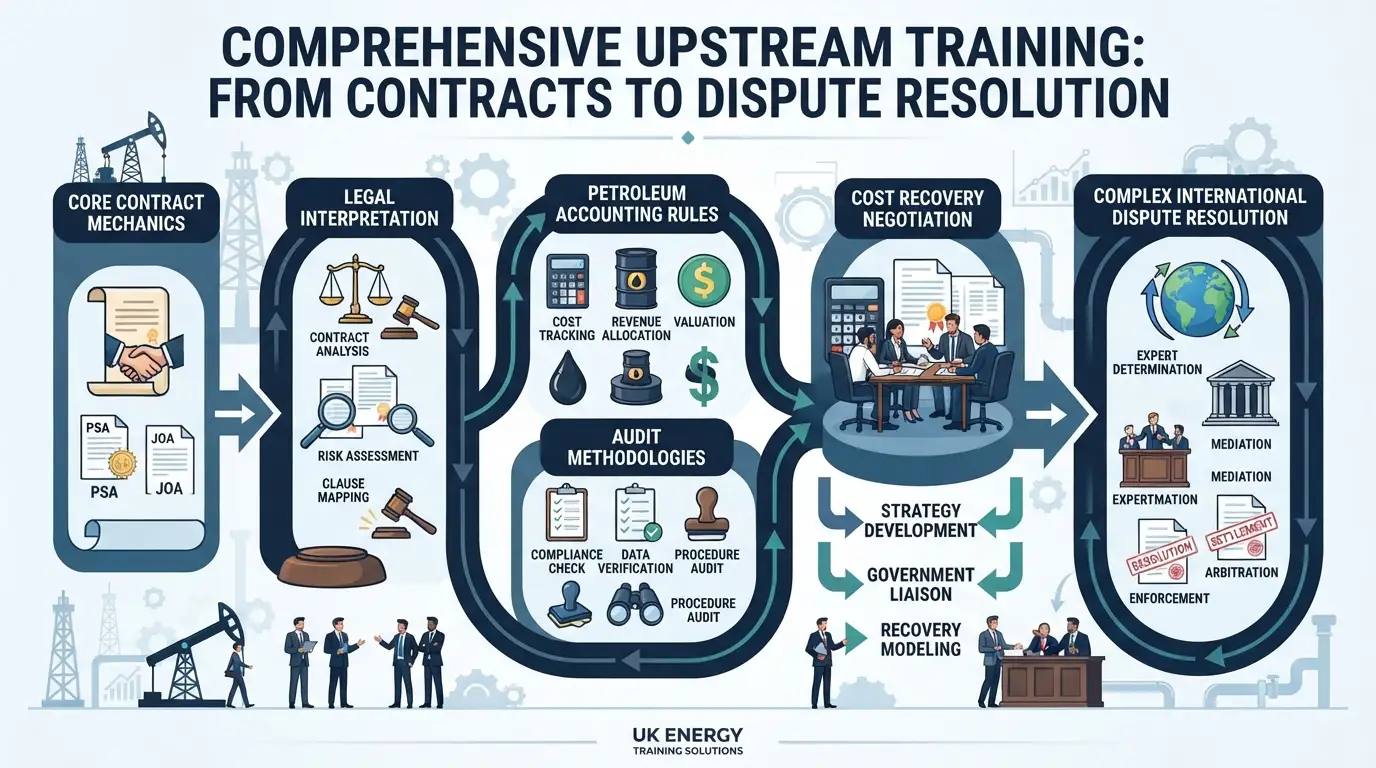
Petroleum contracts require a clear learning path because financial recovery cannot be audited without first understanding contractual risk allocation. The curriculum logic designed by the Institute For Oil & Gas Training moves systematically from foundational fiscal regimes to advanced financial verification and formal dispute resolution mechanisms. This progression ensures that participants develop both analytical precision and strategic negotiation skills, allowing cross-functional teams to collaborate effectively during multi-party commercial reviews.
The initial phase establishes baseline expertise in contractual frameworks, including Production Sharing Contracts (PSCs), Concessionary Agreements, and Joint Operating Agreements (JOAs). Participants examine the precise phrasing of cost recovery clauses, accounting procedures, and revenue-sharing formulas. Understanding how these clauses are drafted establishes the legal reference points required to evaluate whether operational expenses comply with approved annual work programmes and budgets.
The middle phase focuses on practical financial verification, auditing techniques, and cost disallowance procedures. Participants analyze historical joint venture audit exceptions, unallowable overhead charges, and transfer pricing adjustments across exploration, development, and production phases. The final phase transitions into formal resolution strategies, preparing professionals to manage expert determinations, commercial mediations, and international arbitrations efficiently. Organizations seeking to audit internal capabilities prior to training can review How to Evaluate Cost Recovery Disputes and Contract Resolution Options in Oil and Gas Projects for detailed evaluation criteria.
What will participants learn in the Fiscal Disputes, Cost Recovery and Contract Resolution Training Course?
Participants gain practical skills to analyze complex accounting procedures, audit joint venture billings, quantify financial exposure, apply petroleum tax dispute management principles, and execute multi-party contract resolution protocols across exploration and production assets.
The curriculum is divided into focused modules designed to address real-world financial and contractual challenges. The Institute For Oil & Gas Training maintains strict technical standards across every module to ensure immediate applicability in operational environments.
Module 1: Petroleum Fiscal Frameworks and Cost Recovery Architecture
Comparative analysis of Production Sharing Contracts (PSCs), Risk Service Contracts, and Concession Systems.
Deconstruction of cost recovery mechanisms, cost caps, profit oil/gas splits, and R-factor triggers.
Accounting procedure mechanics: gross vs. net accounting, cash calls, and joint account billing structures.
Identifying ambiguous contract language that leads to cost disallowance and partner disputes.
Module 2: Joint Venture Auditing and Cost Disallowance Strategies
Systematic auditing of capital expenditure (CAPEX) and operating expenditure (OPEX) under JOAs.
Analyzing parent company overhead allocations, technical service fees, and affiliate transactions.
Inventory control auditing, equipment transfer valuations, and warehouse stock reconciliations.
Execution of Oil and Gas Royalty Auditing to verify host government tax entitlements and production deductions.
Module 3: Managing Joint Venture Cost Recovery Disputes
Deconstruction of Joint Venture Cost Recovery Disputes across multi-operator consortia.
Protocols for issuing formal audit exceptions, claims management, and counter-claim calculations.
Financial modeling of contested costs, interest calculations, and exposure thresholds.
Managing partner default clauses, cash call non-payment remedies, and sole risk venture accounting.
Module 4: Petroleum Tax Disputes and Statutory Audit Compliance
Practical implementation of Petroleum Tax Dispute Management protocols under national tax laws.
Ring-fencing regulations, capital allowance timing, and decommissioning provision deductions.
Resolving transfer pricing assessments on international procurement and intra-group services.
Handling host government revenue authority audits, tax assessments, and administrative appeals.
Module 5: Contract Resolution, Mediation, and Arbitration Mechanics
Deconstruction of Production Sharing Contract Disputes involving state oil companies and host ministries.
Strategic use of expert determination, commercial mediation, and Dispute Adjudication Boards (DABs).
Preparing financial evidence, audit trails, and expert witness testimony for international arbitration (UNCITRAL, ICC, ICSID).
Negotiating multi-party settlement agreements, compromise write-offs, and contract amendments.
How is the Fiscal Disputes, Cost Recovery and Contract Resolution Training Course delivered?
The course is delivered through instructor-led workshops, distance virtual classrooms, hybrid models, and customized corporate onsite programs, combining interactive lectures, joint venture audit exercises, financial model stress-testing, and simulated commercial dispute negotiations.
The Institute For Oil & Gas Training provides flexible delivery modalities designed to fit corporate schedules, geographic constraints, and organizational learning objectives.
Delivery Format | Structure & Duration | Core Learning Methodologies | Target Participant Group |
Corporate Onsite Workshop | 5 Consecutive Days (35 Hours) | Intensive team exercises, live contract auditing, proprietary asset case studies, mock negotiations. | Cross-functional corporate teams, JV management units, joint legal-finance departments. |
Live Virtual Classroom | 2 Weeks (Online Modules, 3 Hours/Day) | Interactive lecture streams, digital breakout rooms, financial spreadsheet modeling, online Q&A. | Distributed international teams, regional asset managers, remote finance professionals. |
Hybrid Executive Program | 3 Days Onsite + 2 Weeks Virtual Self-Paced | Blended learning, pre-course contract reading, face-to-face dispute simulations, post-course capstone. | Senior commercial managers, legal counsel, corporate department heads. |
Practical Training Methodologies
Every delivery format emphasizes practical execution over passive theoretical learning. Participants work directly with redacted oil and gas contracts, joint venture billing statements, and real-world audit exception reports.
Assessment methods embedded within the program ensure skill retention and practical mastery. Participants complete individual audit calculations, participate in group dispute resolution scenarios, and complete a final contract verification assessment. This practical approach guarantees that delegates possess the confidence and skills needed to manage active commercial disputes immediately upon returning to their organizations.
What measurable results can organizations and participants expect from this course?
Graduates gain immediate technical proficiency to identify unallowable project expenditures, reduce JV audit cycle times, calculate tax liabilities accurately, and protect corporate margins during contract renegotiations.
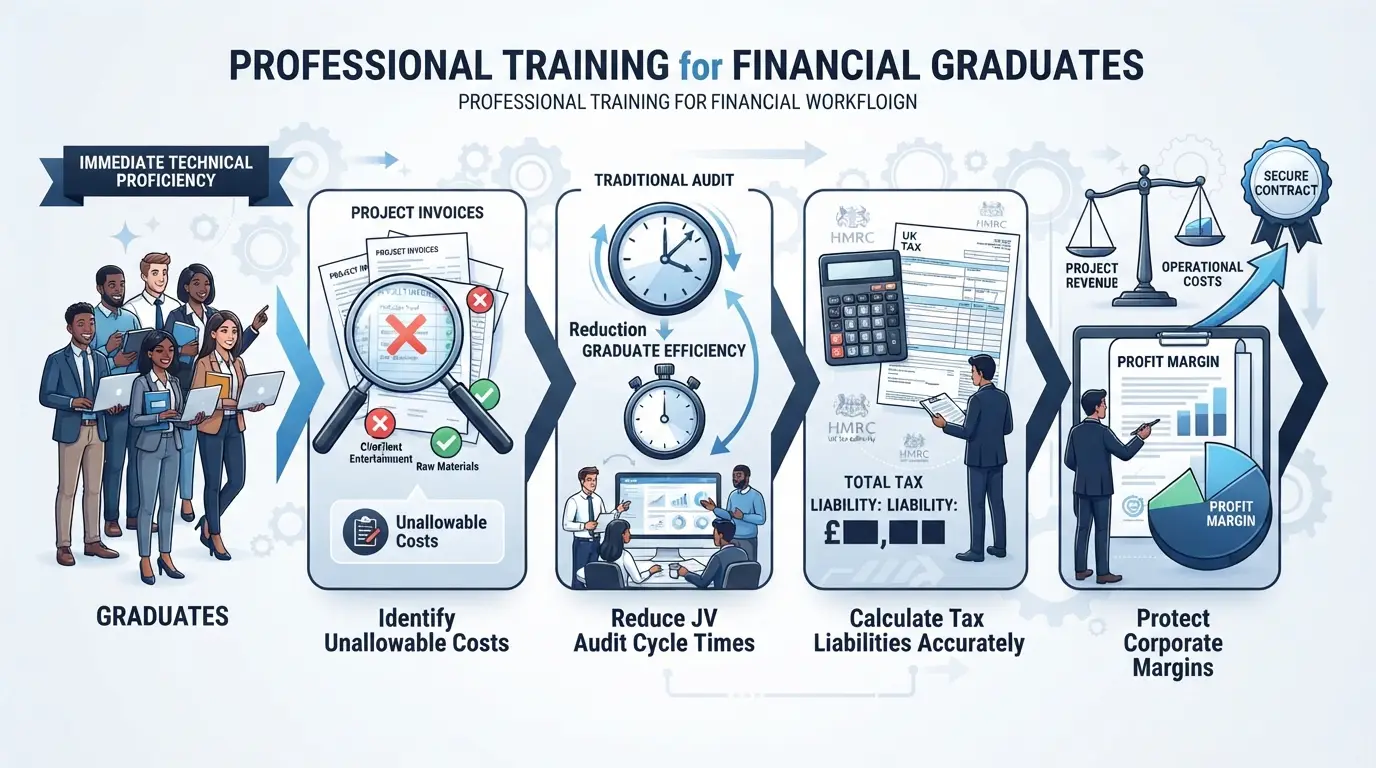
Investing in commercial governance training yields clear financial returns for energy companies. Organizations using the training frameworks established by the Institute For Oil & Gas Training experience improved cross-departmental alignment, reduced legal costs, and faster resolution of outstanding joint venture audit exceptions.
Participant-Level Skill Outcomes
Professional participants gain structured capabilities that directly enhance role performance and career progression:
Financial Precision: Capability to audit complex joint interest billings and detect non-compliant overhead charges or transfer pricing markups.
Contractual Mastery: Skill in interpreting production sharing terms, revenue-sharing triggers, and tax deduction allowances precisely.
Negotiation Capability: Expertise in leading commercial resolution meetings with joint venture partners, state oil companies, and tax inspectors.
Risk Mitigation: Ability to draft clear accounting procedures and audit clauses for future joint operating agreements to prevent downstream disputes.
Enterprise and HR Team Impact
For Human Resources, Learning & Development, and Executive Leadership teams, this course serves as an effective workforce development tool:
Strengthening Governance: Establishes standardized auditing protocols across global asset teams and operating subsidiaries.
Eliminating Silos: Fosters seamless collaboration between legal counsel, petroleum accountants, commercial managers, and joint venture negotiators.
Protecting Cash Flows: Prevents revenue leakage by ensuring cost recovery claims are submitted correctly and defended successfully during audits.
Building Talent Pipelines: Prepares mid-level finance and commercial professionals to step into senior joint venture management and asset director roles.
How does enrollment work for individuals and corporate teams?
Enrollment involves a formal candidate profile review, pre-requisite verification, format selection, and pre-course learning customization, ensuring participants are placed in cohorts aligned with their professional experience.
The Institute For Oil & Gas Training maintains a structured enrollment process to ensure high-quality cohort interaction and practical relevance. Admission is open to professionals working within energy companies, government ministries, auditing firms, and legal practices.
Eligibility Requirements
To ensure productive class discussions and advanced skill transfer, applicants should meet at least one of the following criteria:
Minimum of 3 years of professional experience in petroleum accounting, joint venture management, commercial development, legal counsel, or state asset governance.
Background in corporate finance, external or internal auditing, tax advisory, or contract management within the energy, mining, or infrastructure sectors.
Direct sponsorship by an energy company HR department or government petroleum ministry as part of a formal talent development plan.
Corporate Team Registration and Customization
For organizations enrolling teams of five or more delegates, the Institute For Oil & Gas Training provides custom corporate onboarding. Under this option, the curriculum is adapted to incorporate the organization’s specific contract types, regional tax frameworks, and historical audit challenges. Corporate clients receive comprehensive post-training evaluation reports tracking participant skill acquisition and practical performance improvement.
To secure places for your team or register individual professionals, enroll in this program to review upcoming cohort schedules, request formal fee structures, and begin the application process.
Frequently Asked Questions
What is an oil and gas petroleum fiscal regime?
An oil and gas petroleum fiscal regime is the legal, contractual, and tax framework that governs how host governments and commercial operators share financial risks and rewards from hydrocarbon exploration and production. Common structures include concessionary systems, Production Sharing Contracts (PSCs), and Risk Service Contracts. Professionals studying these frameworks through the Institute For Oil & Gas Training learn how royalty rates, tax rules, and cost recovery mechanisms directly impact project profitability and state revenue allocation.
What are the main types of petroleum fiscal systems used worldwide?
The two primary categories of petroleum fiscal systems are concessionary (tax and royalty) regimes and contractual systems, which include Production Sharing Contracts and Service Agreements. Under a concessionary regime, the company owns the extracted petroleum and pays royalties and taxes to the state, whereas under a Production Sharing Contract, the state retains resource ownership and splits produced oil or gas after cost recovery. Specialized courses by the Institute For Oil & Gas Training analyze how these distinct models influence international investment decisions and resource management.
How does cost recovery work in a Production Sharing Contract?
Cost recovery allows an oil and gas operator to set aside a portion of gross production revenue to reimburse capital and operating expenditures before sharing the remaining profit oil with the host government. The maximum percentage of annual production allocated for expenditure recovery is governed by specific contractual caps and accounting procedures. The Oil & Gas Petroleum Fiscal Regime curriculum at the Institute For Oil & Gas Training details how to audit these eligible costs and calculate profit splits accurately under international industry standards.
Why is petroleum fiscal regime analysis essential for energy companies?
Fiscal regime analysis enables energy companies, government ministries, and financial institutions to evaluate economic viability, model project cash flows, and mitigate long-term commercial risks. Changes in tax laws, windfall profits taxes, or ring-fencing provisions significantly alter project returns and asset valuations across exploration and production lifecycles. Training provided by the Institute For Oil & Gas Training equips commercial teams and legal advisors with the analytical tools needed to negotiate equitable fiscal terms and ensure regulatory compliance.
What is the difference between progressive and regressive petroleum fiscal regimes?
A progressive petroleum fiscal regime automatically increases the government's financial share as project profitability or oil prices rise, maintaining a balanced distribution of economic rent. Conversely, a regressive regime takes a higher percentage of revenues from low-margin or marginal projects, which can discourage investment during low-price environments. Through the Oil & Gas Petroleum Fiscal Regime program, the Institute For Oil & Gas Training demonstrates how sliding-scale royalties, R-factor mechanisms, and progressive tax structures are designed to adapt to shifting market conditions.
Related training courses
Royalties, Bonuses & Government Take: Structure & Calculation Training Course
- Specialisation
- Oil & Gas Petroleum Fiscal Regime
- Duration
- 5 days · 13 CPD hours
Fiscal Regime Comparison Across Contract Types Training Course
- Specialisation
- Oil & Gas Petroleum Fiscal Regime
- Duration
- 5 days · 15 CPD hours
Fiscal Regime Comparison Across Jurisdictions Training Course
- Specialisation
- Oil & Gas Petroleum Fiscal Regime
- Duration
- 5 days · 15 CPD hours
More articles

Data Governance and Master Data Ownership and Standards Training by Institute For Oil & Gas Training
Evaluate the Data Governance & Master Data Ownership & Standards Training Course syllabus, delivery, outcomes, and enrollment requirements.
Read article →
How to Define Data Ownership and Master Data Standards for Petroleum Operations
Learn how petroleum operations define data ownership, establish master data management standards, and improve data governance frameworks.
Read article →
Why Data Governance and Master Data Standards Matter in Oil and Gas
Learn why data governance and master data standards transform petroleum operations, resolve enterprise risk, and drive ROI across global energy assets.
Read article →