

Managing enterprise resource planning (ERP) environment security presents unique operational challenges within the energy sector. Oil and gas companies run complex financial workflows, international joint ventures, upstream operations, and multi-tier supply chains through unified enterprise systems. Without rigorous role design, unauthorized transaction posts, unapproved master data edits, and segregation of duties (SoD) violations threaten organizational compliance. Organizations frequently suffer from permission creep, where staff gain excessive system privileges over time, creating significant internal control vulnerabilities. The Institute For Oil & Gas Training developed this technical program to resolve these vulnerabilities through systematic IT general controls and structured authorization management. To understand the baseline security risks inherent in enterprise architectures, review our introductory analysis on Why Access Controls Are Essential for Oil and Gas ERP Systems.
What is the ERP Systems Access Controls Training Course and what problem does it solve?
This course provides a comprehensive framework for configuring, auditing, and maintaining secure ERP access environments in energy companies. It resolves permission creep, segregation of duties conflicts, unauthorized financial postings, and inadequate transaction logging across upstream and downstream operational accounting modules.
In many energy organizations, enterprise software setup leaves critical control gaps. Cross-functional personnel often hold overlapping access rights across procurement, general ledger, and asset management systems. A joint-venture accountant might hold permission to set up new vendor records and approve invoice disbursements simultaneously. This dual privilege violates basic internal control standards and exposes the company to financial fraud, accounting errors, and compliance failures during statutory audits.
Standard corporate software training focuses purely on operational feature usage rather than structural risk management. General system courses rarely address industry-specific configurations like joint interest billing, field asset tracking, or crude oil trade settlement authorizations. The Institute For Oil & Gas Training addresses this skill shortage directly. This program teaches system administrators, internal auditors, finance managers, and IT governance personnel how to align software authorization roles with corporate delegation-of-authority policies.
Participants analyze real-world system architecture blueprints to identify hidden access risks. They learn to replace legacy, broad-brush authorization profiles with granular role design. This operational transition stops unauthorized data alterations at the database level and ensures that every system transaction traces directly to a verified user profile.
Why is this training course structured around role-based access design?
The course structure follows a logical progression from foundational system architecture to advanced security configuration. This phased method ensures professionals master core access mechanics before attempting complex segregation of duties matrix builds, system integration monitoring, and automated control auditing.
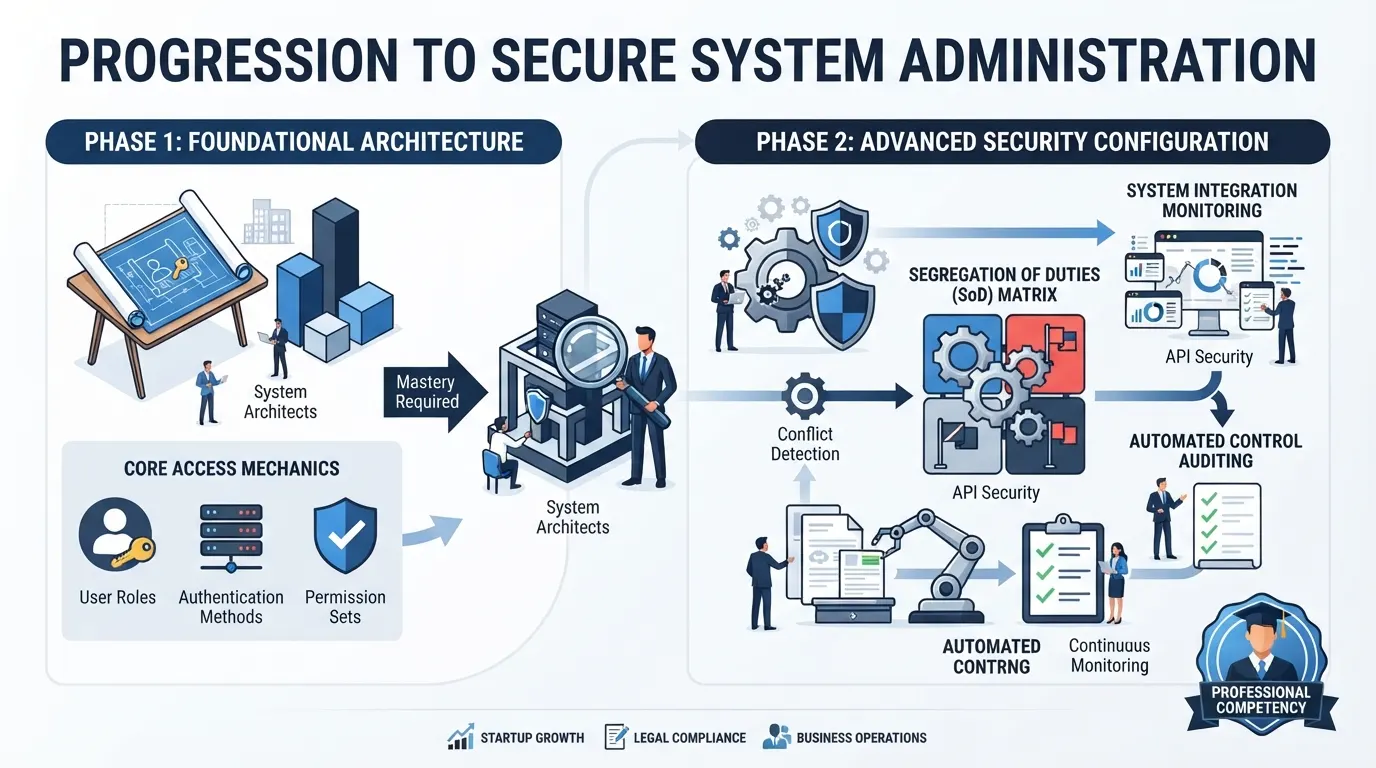
Enterprise software security relies on proper structural hierarchy rather than ad-hoc user assignments. The program begins by examining underlying system architectures, transactional authorization objects, and core database tables. Participants review how operational units handle master data, purchase requisitions, and inventory movements. Understanding these transactional pathways allows security teams to map system permissions accurately against actual job requirements.
The second phase transitions into technical authorization modeling. Students evaluate job functions within energy operations to create lean user profiles based on least-privilege principles. The curriculum focuses on isolating display rights from execute permissions across sensitive accounting tables. This structure ensures that staff members can view necessary operational data without receiving balance-altering privileges.
The final phases move into advanced control design and continuous system monitoring. Participants construct complete matrix structures for segregation of duties, configure workflow execution logic, and build automated exception reports. The Institute For Oil & Gas Training utilizes this specific sequence to build practical operational competency. Learners gain the technical ability to reconstruct legacy access frameworks into fully audit-compliant environments.
What will participants learn in the ERP Systems for Oil & Gas: Access Controls Training Course?
Participants learn to design permission models, configure automated posting controls, enforce segregation of duties, monitor system interfaces, and execute detailed audit trail investigations. The curriculum covers both standard functional setups and advanced custom query security.
Module 1: IT General Controls and Authorization Architecture
This module establishes the foundational technical principles governing security in oil and gas software platforms. Participants analyze access management frameworks, password enforcement parameters, user lifecycle management processes, and emergency elevated access protocols.
Security architecture concepts across major enterprise systems.
User account creation, modification, and termination workflows.
Emergency elevated privileges and privilege management log reviews.
System landscape transport security and client copy controls.
Module 2: Role Based Access Design and Segregation of Duties
Learners master the practical techniques required to build robust, role-based authorization structures. The course details how to construct matrix rules that prevent conflicting permissions in sensitive financial operations.
Least-privilege authorization design for operational roles.
Constructing custom segregation of duties rule-books for joint-venture operations.
Identifying and eliminating critical authorization overlaps in procurement.
Mapping human resource job descriptions directly to system authorization objects.
Module 3: Workflow and Approval Configuration and Automated Posting Rules
This section details the functional setup of financial workflows, threshold limits, and automated posting mechanics. Participants configure execution boundaries that align with corporate governance policies.
Configuring multi-tiered approval workflows for capital expenditure projects.
Enforcing automated posting rules to block manual journal overrides.
Delegation-of-authority matrix setup within finance modules.
Setting up automated tolerance checks for vendor payments and invoice matching.
Module 4: Interface Monitoring, Audit Trails, and Data Security
The final module covers active security management, log analysis, system interface verification, and reporting control measures. Participants gain the skills required to audit system activity and protect proprietary operational data.
Monitoring automated interface data transfers between production and finance applications.
Audit trail configuration and system log analysis.
Controlling standard versus custom reporting permissions.
Securing data extraction and query tools against unauthorized data downloads.
How does this training integrate financial control evaluation criteria?
The training incorporates real-world accounting evaluation criteria by teaching participants how to model, test, and validate internal controls within enterprise software modules. It aligns technical permissions directly with financial governance frameworks used across the energy industry.
To properly evaluate control environments, finance and IT security teams must analyze how permissions operate across interlinked modules. For an in-depth breakdown of evaluation methodologies, examine our guide on How to Evaluate ERP Access Controls and Segregation of Duties in Oil and Gas Finance. The Institute For Oil & Gas Training embeds these practical verification steps into hands-on lab sessions.
Control Area | Operational Challenge in Energy | Technical Configuration Solution |
Procurement & Payables | Unapproved vendor setups paired with payment release capability | Dual-control vendor creation roles and enforced segregation of duties rules |
Capital Expenditure | Field project managers exceeding approved budget limits | Hard-stop automated posting rules tied to delegation-of-authority thresholds |
Joint Venture Billing | Incorrect cost allocation adjustments between partners | Restricting custom reporting tools and locking manual adjustment journal entries |
Asset Accounting | Unauthorized reclassification or retirement of field machinery | Segregating physical asset tracking roles from asset book valuation updates |
System Integration | Data alteration during automated transfer from field systems | Continuous interface monitoring logs and hash-verification batch controls |
Participants practice building automated control matrices that immediately highlight permission conflicts. They run simulated system audits to identify active accounts holding unsafe transaction combinations. By working through these practical scenarios, students learn to translate high-level compliance policies into specific system technical configurations.
The course also demonstrates how to secure ad-hoc data queries. Unrestricted access to data extraction tools allows users to bypass module-level security screens and view restricted financial details. The program provides step-by-step instructions for locking table-level access, ensuring data privacy across all operational departments.
How is the course delivered by the Institute For Oil & Gas Training?
The course offers flexible delivery through intensive live virtual workshops, on-site corporate programs, and blended interactive formats. Every delivery mode incorporates live enterprise software sandboxes, structured case studies, and instructor-led technical exercises.
Course delivery centers around applied technical execution rather than passive lecture streaming. Students gain access to functional software environments configured with realistic energy company data sets. They work through realistic scenarios, such as rearchitecting a flawed user authorization model or resolving complex segregation of duties conflicts.
Instructors bring extensive enterprise security experience from the global energy industry. They provide immediate, line-by-line feedback on participant role designs, workflow logic setups, and rule-book configurations. Small group sizes maintain high instructional engagement and allow deep discussions on specific operational software configurations.
For corporate clients, the Institute For Oil & Gas Training tailors class exercises around the company's specific enterprise software platform, internal rule-books, and authorization hierarchy. This direct customization allows corporate cohorts to solve active organizational control issues during the training program itself.
What measurable results and performance gains can organizations expect?
Organizations gain immediate risk reduction through clean segregation of duties, audit-ready permission models, reduced external audit fees, and enhanced protection of financial data. Individual participants earn industry-recognized technical governance competencies.
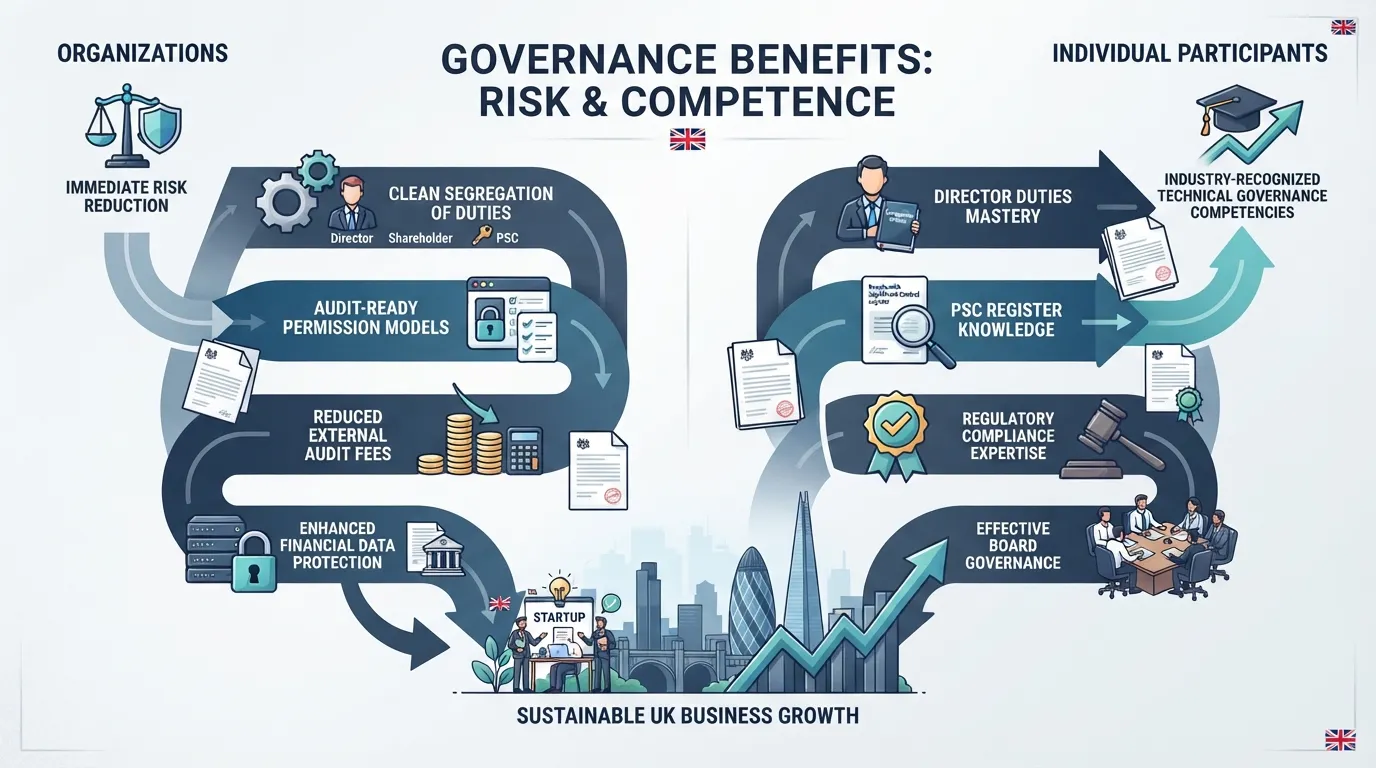
When human resource managers send finance and IT staff to this program, they build long-term organizational capacity. Companies reduce their reliance on third-party security consultants by developing in-house technical authorization expertise. Internal teams gain the skills needed to design, implement, and maintain secure system environments independently.
Internal audit teams experience significant efficiency gains. Rather than performing manual, sample-based account checks, trained auditors learn to run automated system queries that instantly identify control violations. This capability reduces audit preparation cycles, minimizes internal control findings, and provides external regulators with verifiable audit documentation.
From a broader talent pipeline perspective, this training establishes clear technical benchmarks for IT governance and financial controller roles. The Institute For Oil & Gas Training ensures that every graduate demonstrates verified capability in configuring and maintaining secure, audit-compliant enterprise systems.
How does enrollment work for individuals and corporate teams?
Enrollment requires a simple three-step process: application review, technical background assessment, and seat confirmation. Candidates must hold basic familiarization with finance, internal audit, or IT systems administration before starting the program.
The enrollment process ensures that all class cohorts maintain a consistent level of technical background. Applicants submit their professional credentials and current job descriptions for review by the admissions team at the Institute For Oil & Gas Training. This step verifies that participants possess sufficient contextual knowledge of corporate finance or IT management to succeed in the course.
Corporate HR teams managing bulk registrations receive dedicated support. Account coordinators manage group scheduling, custom content configuration, and progress tracking for team cohorts. Organizations can schedule dedicated delivery dates that align with corporate software implementation schedules or audit cycles.
Upon acceptance, participants receive access to preparatory reading materials and sandbox environments. This pre-course setup allows students to verify system connectivity, complete foundational reading, and start the program ready for advanced technical execution. To secure a seat for upcoming cohorts or schedule corporate team training, enroll in this program today.
Frequently Asked Questions
What is Oil & Gas Petroleum Digital Finance & Automation training?
Oil & Gas Petroleum Digital Finance & Automation training by the Institute For Oil & Gas Training is a specialized professional development program designed to modernize energy sector financial workflows. The curriculum covers the implementation of automated accounting systems, digital transaction processing, joint venture billing automation, and real-time financial reporting tailored for upstream and downstream operations. It equips finance teams with the technical skills needed to streamline data extraction, optimize ERP integrations, and eliminate manual reconciliation errors.
How does financial automation benefit energy sector accounting teams?
Financial automation replaces labor-intensive spreadsheet management with automated posting rules, streamlined workflow approvals, and standardized data extraction tools. By integrating digital finance methodologies through the Institute For Oil & Gas Training, energy companies reduce transaction processing times, enhance internal audit controls, and eliminate common segregation of duties conflicts. This digital transformation improves financial reporting accuracy and allows accountants to focus on strategic capital allocation and risk management.
Who should enroll in an oil and gas digital finance program?
The Oil & Gas Petroleum Digital Finance & Automation program is designed for petroleum accountants, financial controllers, corporate auditors, ERP system administrators, and HR teams seeking targeted workforce transformation. It provides structured training for professionals responsible for joint-interest billing, capital expenditure tracking, enterprise resource planning, and financial compliance. The course helps finance departments build practical expertise in digital governance, interface monitoring, and automated ledger management.
What core skills are covered in digital finance and automation training?
Participants learn to configure automated approval workflows, implement role-based access controls, manage system interface logs, and secure financial query tools. The Institute For Oil & Gas Training emphasizes hands-on applications, including building automated reporting dashboards, enforcing delegation of authority rules, and conducting audit trail analysis. Graduates gain measurable competencies in optimizing corporate financial technology and reducing operational control risks.
Why is digital finance training essential for enterprise ERP management?
Legacy enterprise resource planning systems in the energy industry frequently suffer from data silos, custom reporting inefficiencies, and permission creep across departments. Specialized Oil & Gas Petroleum Digital Finance & Automation training ensures that systems are configured to support automated posting rules and robust IT general controls. This structural optimization lowers statutory audit preparation costs, accelerates month-end financial closing cycles, and protects enterprise accounting architecture.
Related training courses
Royalties, Bonuses & Government Take: Valuation & Deductions Training Course
- Specialisation
- Oil & Gas Petroleum Fiscal Regime
- Duration
- 5 days · 15 CPD hours
Fiscal Regime Comparison Across Contract Types Training Course
- Specialisation
- Oil & Gas Petroleum Fiscal Regime
- Duration
- 5 days · 15 CPD hours
Fiscal Regime Comparison & Reform Risk Training Course
- Specialisation
- Oil & Gas Petroleum Fiscal Regime
- Duration
- 5 days · 15 CPD hours
More articles
Data Governance and Master Data Ownership and Standards Training by Institute For Oil & Gas Training
Evaluate the Data Governance & Master Data Ownership & Standards Training Course syllabus, delivery, outcomes, and enrollment requirements.
Read article →
How to Define Data Ownership and Master Data Standards for Petroleum Operations
Learn how petroleum operations define data ownership, establish master data management standards, and improve data governance frameworks.
Read article →
Why Data Governance and Master Data Standards Matter in Oil and Gas
Learn why data governance and master data standards transform petroleum operations, resolve enterprise risk, and drive ROI across global energy assets.
Read article →