

Petroleum sector tax compliance requires precise technical execution across multi-jurisdictional contracts, cross-border service arrangements, and complex contractor billing structures. Financial teams operating without targeted withholding tax expertise routinely trigger substantial penalty assessments, double taxation disputes, and unrecoverable statutory withholdings. Why Withholding Tax Matters on Oil and Gas Contractor and Service Payments demonstrates how regulatory non-compliance severely impacts operational cash flows and corporate profitability across upstream, midstream, and downstream joint ventures.
The Institute For Oil & Gas Training delivers specialized corporate training designed to resolve these technical compliance bottlenecks. This course provides energy sector tax specialists, corporate accountants, and finance managers with the statutory frameworks, double tax treaty mechanics, and contractual gross-up calculation methodologies needed to eliminate non-compliance liabilities across all contractor payment workflows.
What is the Withholding Tax on Contractor and Service Payments Training Course and what operational tax challenges does it resolve?
The Withholding Tax on Contractor & Service Payments Training Course is an intensive professional training program that equips petroleum tax specialists with technical competencies to accurately classify cross-border contractor payments, apply correct statutory withholding rates, and manage compliance obligations.
Oil and gas extraction projects rely on international service providers, engineering consultants, equipment lessors, and specialized technical contractors. Financial departments frequently struggle to determine whether incoming invoices represent technical service fees, royalties and licence fees, or business profits attributable to a permanent establishment risk. Misclassifying these payments leads directly to under-withholding penalties imposed by revenue authorities or over-withholding disputes raised by key contractors.
Uncertainty surrounding withholding tax rates and statutory exemptions delays cross-border vendor payments and disrupts project supply chains. When finance departments lack clear internal standard operating procedures, personnel make inconsistent tax deductions on payments to non-residents, exposing the enterprise to systemic audit exposure.
Contractual complexities such as tax gross-up clauses complicate invoice settlements further. Without practical computational skills, accounting personnel miscalculate the actual withholding obligation on net-of-tax vendor contracts, leading to unbudgeted operational costs and unresolvable audit findings during tax authority examinations.
Corporate financial governance requires a systematic, risk-based approach to petroleum tax administration. The Institute For Oil & Gas Training structured this curriculum to bridge the technical knowledge gap between general corporate accounting practices and the statutory realities of energy sector taxation.
Through structured exposure to international tax rules, statutory deduction schedules, and practical compliance workflows, participants gain direct capabilities in auditing vendor invoices before disbursement. This capability ensures that corporate finance teams consistently protect company margins while maintaining complete statutory compliance across all active operating regions.
Why is the Withholding Tax on Contractor & Service Payments Training Course structured in this technical progression?
The curriculum follows a modular, risk-based learning progression that transitions participants from foundational statutory definitions to complex international tax treatments, treaty application rules, and enterprise-level tax administration frameworks tailored specifically to energy sector operating environments.
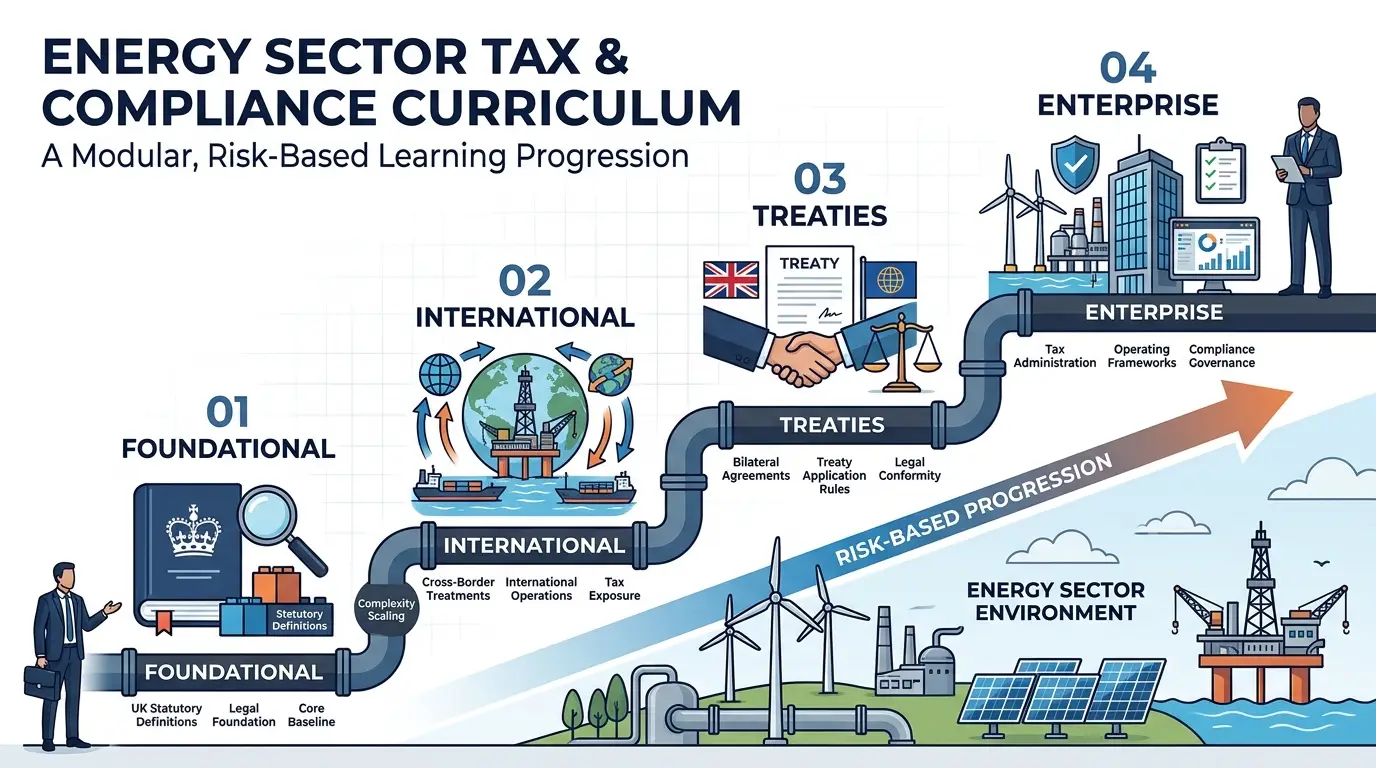
Effective professional development requires a logical sequence that reflects real-world operational workflows. Learning begins with clear statutory definitions and basic statutory reporting rules before moving into complex cross-border contractual arrangements. How to Determine Withholding Tax Obligations for Petroleum Contractors and Service Providers provides detailed context on how technical tax classifications dictate specific compliance pathways across different joint operating agreements.
Understanding statutory definitions establishes the baseline required to analyze complex commercial contracts. The curriculum introduces primary tax legislation, statutory deduction schedules, and local tax administration requirements early to ensure all participants share a robust understanding of baseline legal obligations.
Once participants master statutory definitions, the curriculum advances to treaty mechanics and cross-border payment structures. This stage focuses heavily on double taxation avoidance agreements, foreign tax credits, and the administrative processes required to secure official withholding tax certificates and credits for international vendors.
The final structural phase addresses administrative compliance, audit readiness, and contractual risk mitigation. Participants learn to integrate tax review steps directly into corporate procurement and accounts payable systems, transforming theoretical legal knowledge into repeatable daily finance operations.
The Institute For Oil & Gas Training designs curriculum progressions that prioritize direct practical execution over theoretical abstract principles. Every module builds directly upon prior concepts, ensuring that participants develop comprehensive end-to-end management capabilities over contractor tax administration.
This structured approach ensures that finance professionals build confidence progressively. By systematically resolving real-world practical scenarios at each stage, participants master the technical tools needed to handle complex tax audits and contractor disputes efficiently.
What technical knowledge, practical modules, and core skills will participants master during the training program?
Participants master statutory payment classification, treaty interpretation, net-of-tax gross-up computations, permanent establishment evaluation, and administrative compliance procedures required to manage petroleum sector contractor and service provider tax obligations efficiently.
The syllabus is organized into five targeted learning modules designed to build complete operational capability across all aspects of contractor tax administration:
Module 1: Statutory Frameworks and Contractor Payment Classification
Statutory definitions of technical service fees, management fees, and consulting services within energy operations.
Criteria for distinguishing between offshore equipment rentals, software licensing, and royalties and licence fees.
Analysis of local tax legislation governing statutory withholdings on domestic and foreign service providers.
Mapping payment flows across joint operating agreements, production sharing contracts, and service contracts.
Module 2: Cross-Border Payments, Non-Residents, and Treaty Mechanics
Statutory rules governing payments to non-residents and foreign corporate entities.
Application of double taxation avoidance agreements to reduce or eliminate local withholding taxes.
Protocol for verifying beneficiary status and substance requirements under international tax standards.
Administrative workflows for obtaining and validating official withholding tax certificates and credits.
Module 3: Permanent Establishment Exposure and Contractual Risk Management
Technical triggers for fixed place of business and service permanent establishment risk in petroleum operations.
Evaluating time-threshold rules for offshore drilling rigs, seismic surveys, and engineering installation projects.
Tax treatment of mobilized personnel, secondment arrangements, and intercompany management charges.
Designing risk assessment matrices for new vendor onboarding and contract drafting.
Module 4: Mathematical Execution of Gross-Up Clauses and Interest Withholding
Formulations for calculating net-of-tax settlements under complex gross-up clauses.
Tax implications and withholding requirements on interest withholding from intra-group project financing.
Practical accounting entries for recording withheld tax, tax liabilities, and vendor ledger reconciliations.
Scenario modeling for contract negotiations to prevent unbudgeted corporate tax absorption.
Module 5: Corporate Governance, Tax Audits, and Administrative Compliance
Establishing standardized accounts payable tax validation protocols for energy finance departments.
Preparation of statutory monthly withholdings returns, annual summaries, and audit trail documentation.
Managing tax authority queries, desk audits, and formal compliance assessments effectively.
Implementing internal control frameworks to monitor ongoing legislative and regulatory updates.
Participants complete intensive computational exercises in every module to verify mathematical and analytical accuracy. The Institute For Oil & Gas Training curriculum guarantees that attendees exit the program with immediate, actionable technical expertise applicable directly to their daily operational responsibilities.
Mastering these core skills protects energy organizations from costly administrative oversights. Finance staff return to their roles equipped with complete technical tools to audit complex vendor invoices accurately and defend tax positions confidently during regulatory reviews.
How is the training program delivered, scheduled, and evaluated across different corporate learning environments?
The course offers flexible delivery formats including instructor-led classroom workshops, interactive virtual live sessions, customized on-site corporate programs, and blended hybrid models supported by rigorous practical assessments.

Flexible training delivery options accommodate the demanding operational schedules of energy sector finance professionals. Organizations can select the delivery format that best aligns with their operational structure, geographic distribution, and internal learning objectives.
Delivery Format | Structure & Duration | Primary Learning Methodology | Ideal Corporate Application |
Instructor-Led Classroom | 3 to 5 Consecutive Days (Full-time) | Intensive face-to-face instruction, group case studies, and live computational exercises. | Key finance staff, tax managers, and senior accountants seeking immersive skill development. |
Virtual Live Interactive | 2 to 3 Weeks (Part-time / Modular) | Real-time digital lectures, interactive breakout rooms, and digital document analysis. | Distributed finance teams, regional tax specialists, and multi-office corporate units. |
Customized On-Site Corporate | Tailored Duration & Schedule | Dedicated company-specific training using actual corporate contracts and internal systems. | Complete finance departments, procurement teams, and cross-functional joint venture units. |
Blended Hybrid Model | Self-Paced Modules + Live Sessions | Foundational video lectures combined with live expert-led problem-solving clinics. | Busy executives, corporate controllers, and operational heads requiring flexible learning. |
Every format incorporates rigorous practical exercises based on real-world energy sector documentation. Participants analyze redacted contracts, calculate statutory deductions, and draft formal tax positions using actual regulatory frameworks.
Assessment methods verify real technical capability rather than passive attendance. Attendees complete practical computational exams, invoice audit simulations, and contract evaluation assignments throughout the program duration.
The Institute For Oil & Gas Training maintains strict instructional standards across all delivery channels. Professional facilitators bring extensive international oil and gas tax accounting experience, ensuring that every session provides direct operational value.
Post-training evaluations measure individual competence across all core module topics. Organizations receive detailed feedback regarding participant progress, confirming that internal finance teams possess the functional capability required to execute withholding tax responsibilities accurately.
What measurable operational results and performance improvements can energy organizations expect post-training?
Organizations achieve measurable risk reduction, complete elimination of under-withholding tax penalties, streamlined procurement workflows, precise financial forecasting, and enhanced tax audit readiness across all operating units.
Investing in targeted professional development yields immediate, quantifiable financial and operational returns. Corporate finance departments that complete this training demonstrate marked improvements across critical operational metrics.
Direct financial benefits include the complete avoidance of statutory non-compliance penalties, interest charges, and administrative fines imposed by tax authorities. By standardizing invoice review protocols, finance teams eliminate under-withholding liabilities before payment execution.
Operational efficiency improves significantly as accounts payable teams process cross-border contractor invoices faster. Clear guidelines for validating withholding tax certificates and credits eliminate payment holds and maintain healthy relationships with critical international service providers.
Contract procurement and negotiation outcomes improve substantially when legal, procurement, and finance teams understand tax gross-up implications. Organizations avoid absorbing unexpected tax liabilities by correctly structuring vendor contracts during pre-award negotiations.
The Institute For Oil & Gas Training structures all learning outcomes to deliver permanent organizational capability. Corporate leadership receives a fully upgraded finance function capable of protecting company capital while maintaining flawless regulatory standing.
Long-term organizational resilience increases as internal teams develop in-house technical confidence. Energy enterprises reduce their reliance on expensive external tax advisory services for routine contractor payment classifications and compliance reviews.
How does the corporate enrollment process work, and what are the participant eligibility requirements?
Enrollment involves a formal candidate profile review, pre-course technical assessment, customized learning path selection, and structured corporate registration designed for finance, tax, procurement, and legal professionals within the energy sector.
To maintain standard instructional quality, candidates must meet specific professional and educational prerequisites before enrollment confirmation. This requirement ensures that all cohort members possess sufficient baseline knowledge to participate in advanced technical analyses.
Professional Prerequisites and Target Participant Profiles
Target Roles: Corporate Tax Managers, Senior Project Accountants, Finance Controllers, Joint Venture Accountants, Procurement Managers, and Legal Counsel handling energy contracts.
Educational Background: Bachelor’s degree in Accounting, Finance, Economics, Law, or a related business discipline.
Professional Experience: Minimum 2 to 3 years of direct experience in corporate finance, financial accounting, tax administration, or commercial contract management within the oil, gas, or energy sector.
The enrollment process begins with an online profile submission outlining candidate experience and corporate learning objectives. The admissions team reviews each profile to ensure alignment with curriculum technical requirements.
Upon profile approval, prospective participants complete a diagnostic pre-course assessment. This evaluation identifies specific technical knowledge gaps, allowing instructors to adjust session emphasis to address group learning requirements effectively.
Corporate group enrollments receive customized scheduling and tailored case study selections. The Institute For Oil & Gas Training coordinates directly with HR managers and department heads to align course schedules with operational workflows and month-end closing cycles.
Participants receive comprehensive learning materials, statutory reference guides, and practical calculation templates upon final registration. These resources serve as practical workspace tools during and after program completion.
To upgrade your finance team's technical tax capabilities and protect your organization against contractor compliance exposure, apply for course access today to secure your corporate cohort placement.
Frequently Asked Questions
What is oil and gas petroleum taxation training and who should attend?
Oil and gas petroleum taxation training covers the complex fiscal frameworks, royalty systems, ring-fencing rules, and production sharing contract (PSC) tax obligations unique to the energy sector. Offered by the Institute For Oil & Gas Training, this specialised instruction is designed for tax managers, corporate accountants, financial controllers, and legal advisors working within upstream, midstream, and downstream petroleum operations. Participants gain practical skills in managing compliance, cross-border tax risks, and international withholding tax obligations.
Why is specialized tax training necessary for petroleum sector finance teams?
Petroleum operations operate under highly intricate tax regimes involving revenue-sharing contracts, capital expenditure allowances, windfall profit taxes, and complex cross-border service arrangements. General corporate accounting frameworks rarely address these sector-specific fiscal nuances, leaving energy companies exposed to costly compliance penalties and tax audit exposure. Institute For Oil & Gas Training delivers targeted Oil & Gas Petroleum Taxation courses to ensure finance personnel can accurately interpret double taxation treaties, execute contractor withholding taxes, and safeguard corporate profitability.
What core topics are covered in an oil and gas petroleum taxation course?
A practical course in Oil & Gas Petroleum Taxation explores resource rent taxes, petroleum profit tax calculations, permanent establishment risks, and transfer pricing in energy supply chains. Practical modules delivered by the Institute For Oil & Gas Training also address contractual gross-up clauses, foreign tax credits, and statutory reporting requirements for joint operating agreements. This comprehensive curriculum equips professionals to navigate evolving international tax regulations and domestic revenue authority audits efficiently.
How does understanding petroleum taxation help manage contractor withholding tax risks?
Petroleum operators routinely engage international contractors and engineering service providers, creating complex withholding tax obligations on technical service fees and equipment leases. Improper payment classification or treaty application can lead to severe under-withholding penalties or unrecoverable tax liabilities. Training from the Institute For Oil & Gas Training in Oil & Gas Petroleum Taxation teaches tax professionals how to correctly audit contractor invoices, verify residency certificates, and structure tax gross-up clauses to prevent unbudgeted cost overruns.
What delivery formats are available for petroleum taxation corporate training?
The Institute For Oil & Gas Training provides flexible delivery options for its Oil & Gas Petroleum Taxation programs, including instructor-led classroom workshops, live virtual sessions, and customized on-site corporate courses. These delivery models allow international energy enterprises, joint venture units, and corporate finance departments to train distributed teams without disrupting critical operational schedules. Courses include real-world case studies, contract analyses, and computational exercises to ensure immediate workplace application.
Related training courses
Oilfield Production Chemicals and Treatment Applications Training Course
- Specialisation
- Oil & Gas Process Engineering and Operations
- Duration
- 5 days · 15 CPD hours
API 510 Pressure Vessel Inspection and Integrity Assessment Training Course
- Specialisation
- Oil & Gas Inspection and Non-Destructive Testing
- Duration
- 5 days · 15 CPD hours
API 653 Storage Tank Inspection and Integrity Assessment Training Course
- Specialisation
- Oil & Gas Inspection and Non-Destructive Testing
- Duration
- 5 days · 15 CPD hours
More articles

How to Determine Withholding Tax Obligations for Petroleum Contractors and Service Providers
Determine withholding tax obligations for oil and gas contractors. Learn PE risk, gross-up clauses, and compliance evaluation methods.
Read article →
Why Withholding Tax Matters on Oil and Gas Contractor and Service Payments
Learn how withholding tax impacts oil and gas contractor payments, compliance risks, corporate training methods, and workforce performance.
Read article →
Petroleum Taxation Training for Indirect Taxes and Duties in Oil and Gas
Master petroleum taxation for indirect taxes and duties. Evaluate curriculum, outcomes, and delivery for corporate energy enrollment.
Read article →