

Withholding tax management in oil and gas contractor payments is the legal and operational process of deducting tax at source from payments made to vendors, technical service providers, and non-resident entities to ensure absolute compliance with national tax authorities.
Tax deduction at source represents a mandatory corporate duty for energy firms operating across global jurisdictions. In cross-border petroleum operations, upstream and downstream companies process billions of dollars annually in vendor transactions. Failing to deduct tax correctly results in immediate financial penalties, interest charges, legal liabilities, and operational delays for exploration projects. Financial teams and procurement specialists require structured technical knowledge to handle tax deduction rates correctly. Organizations build workforce competence through targeted professional training programs, ensuring staff process technical service fees, royalties and licence fees, and cross-border vendor invoices without administrative errors.
Corporate tax compliance direct impacts company cash flow and risk exposure. Unprepared finance departments face substantial penalty audits from state tax departments, which erode project profitability. Structured learning frameworks resolve these operational skill gaps by teaching employees how tax treaties, permanent establishment risk, and statutory deductions function during vendor settlements. Staff members master the precise legal definitions governing technical service fees and management fees across multiple jurisdictions. Effective corporate education builds systemic audit readiness, protects capital investments, and ensures seamless compliance across complex supply chains in industries like oil extraction, natural gas processing, power generation, and offshore drilling.
How Does Corporate Training in Withholding Tax Delivery Function in Modern Organizations?
Corporate training in withholding tax delivery functions through a structured multi-phase framework combining technical classroom instruction, real-world case simulations, cross-functional workshops, and digital assessments to convert statutory tax rules into repeatable finance and procurement workflows.
Professional development programs begin with a comprehensive skill gap analysis across finance, legal, and procurement departments. Organizations assess current employee performance against statutory tax regulations and corporate compliance standards. Training delivery occurs through hybrid formats, including intensive 3-day executive workshops, structured 6-week online learning modules, and instructor-led masterclasses. Learning facilitators utilize case-based learning methodologies to walk participants through actual corporate contracts, international tax treaties, and cross-border payment schedules. Employees analyze real accounting ledgers, identify withholding tax obligations, calculate precise deduction amounts, and generate compliant documentation under simulated time constraints.
Implementation across enterprises requires alignment between human resources, finance executives, and operational business leaders. Learning paths incorporate practical exercises where teams draft gross-up clauses, calculate withholding tax rates, and process statutory compliance forms. Role-play scenarios simulate vendor negotiations regarding contractual tax liabilities and interest withholding obligations. Training programs utilize interactive software tools to teach staff how to verify vendor residency status, evaluate permanent establishment exposure, and issue valid withholding tax certificates and credits. Post-training assessments evaluate employee accuracy in processing complex cross-border invoice batches, ensuring immediate skills transfer to daily accounting and contracting tasks.
What Key Components and Frameworks Constitute Effective Tax Compliance Training?
Effective tax compliance training incorporates specialized legal modules, financial calculation frameworks, statutory documentation tools, interactive learning formats, and standardized performance evaluation metrics to build comprehensive workforce capability in complex corporate taxation environments.
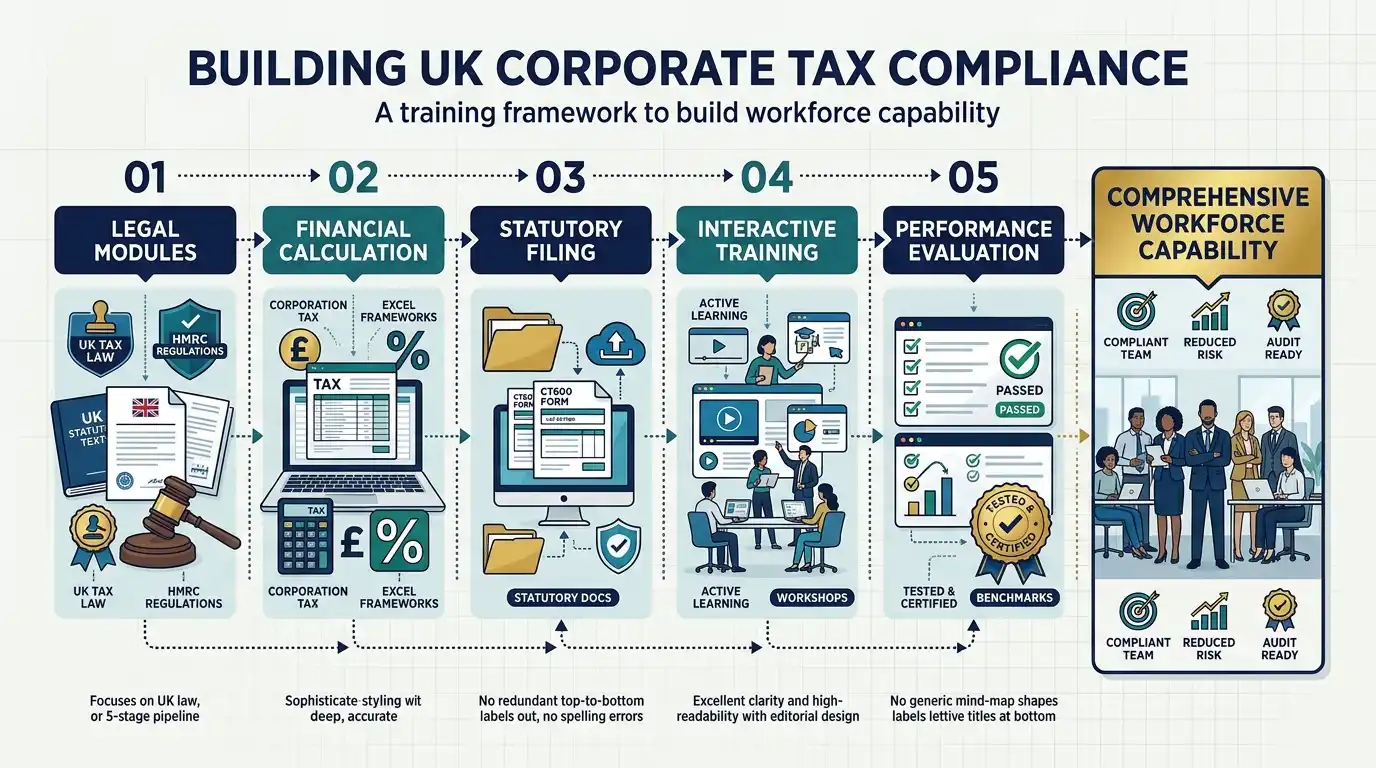
Core curriculum design centers on statutory tax structures governing the energy sector. Training programs systematically break down legal frameworks into practical operational units. Modules cover specific tax rules applicable to engineering contractors, equipment suppliers, management consultants, and foreign technical specialists operating in sectors like energy infrastructure, civil engineering, maritime logistics, and telecommunications.
Key structural components include:
Statutory Rate Frameworks: Precise classification of vendor payments to apply accurate statutory deduction percentages ranging from 5% to 30%.
Double Taxation Agreement (DTA) Protocols: Practical guidance on evaluating tax treaty provisions, resident status forms, and reduced treaty rates for foreign vendors.
Permanent Establishment (PE) Risk Models: Methodologies for identifying when prolonged contractor presence creates corporate tax liabilities for international entities.
Contractual Clause Analysis: Standards for analyzing, drafting, and managing gross-up clauses, indemnity terms, and tax allocation provisions in service agreements.
Documentation Systems: Procedures for tracking, issuing, and filing statutory withholding tax certificates and credits to avoid audit penalties.
Training delivery tools rely on hands-on application models. Participants utilize real-world tax calculation engines, contract audit templates, and compliance checklists during training sessions. Interactive workshops require employees to resolve complex case scenarios involving multi-jurisdictional contractors. Combining technical knowledge with practical workflow execution ensures employees gain operational confidence, reducing processing times and eliminating costly calculation errors across corporate finance teams.
Why Do Organizations Suffer Financial Losses Without Standardized Tax Training?
Organizations suffer severe financial losses without standardized tax training because improper tax withholding leads to statutory fines, double taxation liability, costly vendor disputes, contract disruptions, and severe audit adjustments by revenue authorities.
Skill gaps in tax compliance directly jeopardize organizational financial stability. Unclear understanding of statutory tax rules causes accounting staff to under-withhold or over-withhold taxes on contractor payments. Under-withholding forces the operating company to pay uncollected tax liabilities directly out of corporate profits, accompanied by compounding interest penalties. Over-withholding damages relationships with key foreign vendors, leading to project stalls, legal arbitration, and increased contract pricing to cover financial uncertainty.
Operating without standardized compliance training creates significant exposure during tax audits. Revenue authorities routinely inspect energy sector contracts for misclassified payments, particularly payments labeled as general services that actually constitute technical service fees or management fees. Misclassifications result in massive retroactive tax assessments.
When corporate teams lack formal training on managing How to Determine Withholding Tax Obligations for Petroleum Contractors and Service Providers, companies absorb unnecessary financial risks that threaten long-term operational viability across global capital projects.
Which Corporate Departments Require Professional Development in Withholding Tax Rules?
Corporate departments requiring professional development in withholding tax rules include enterprise finance, tax compliance, corporate procurement, legal affairs, contract administration, and executive leadership teams across capital-intensive industries.
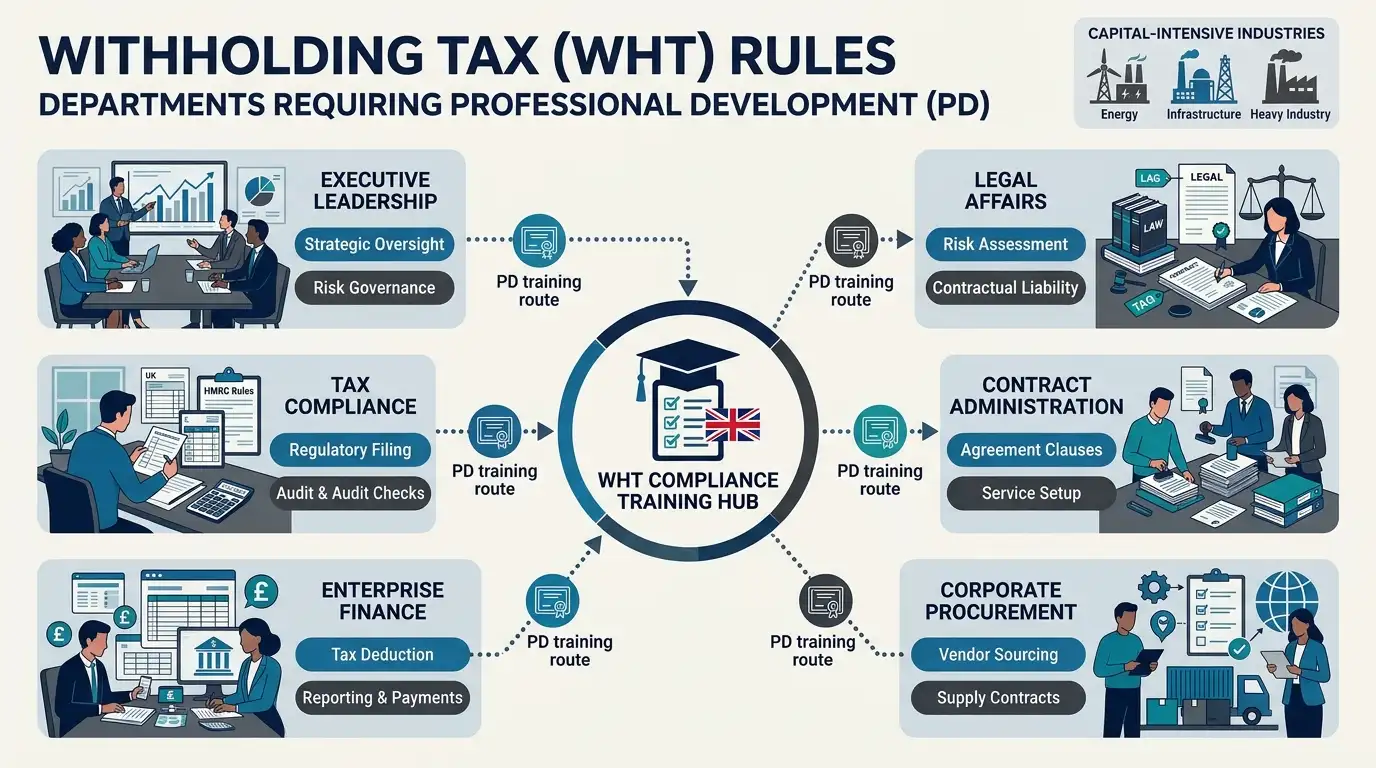
Cross-functional alignment is essential for effective tax risk management. Finance and accounts payable teams require deep operational knowledge to review incoming vendor invoices, verify supporting tax documentation, calculate accurate deductions, and issue statutory tax certificates. Procurement and sourcing departments need comprehensive training to structure vendor contracts correctly from the outset, ensuring tax liabilities are clearly assigned before service execution begins.
Contract administrators and internal legal counsel benefit from structured learning on drafting tax indemnity provisions and managing gross-up terms. Training equips these professionals to negotiate effectively with international vendors while protecting the organization's financial interests. Executive decision-makers and risk officers require high-level strategic instruction to evaluate enterprise tax exposure, oversee corporate governance standards, and align tax strategy with broader corporate growth plans in industries like oil extraction, mining, heavy manufacturing, and international infrastructure development.
What Measurable Outcomes and Performance KPIs Does Tax Training Produce?
Tax training produces measurable outcomes including a 90% drop in invoice processing errors, complete elimination of statutory late-payment fines, faster vendor settlement cycles, and enhanced audit readiness across corporate finance departments.
Structured workforce development generates direct, quantifiable returns on investment for enterprise organizations. Tracking specific performance metrics before and after training programs confirms skill acquisition and workflow optimization.
Target performance indicators include:
Financial Accuracy Rate: Reaching 98% to 100% accuracy in identifying and applying correct statutory tax withholding rates across all vendor invoice categories.
Cost Reduction in Penalties: Achieving a 100% reduction in late-filing fees, interest penalties, and statutory fines levied by tax authorities during annual compliance audits.
Operational Cycle Time: Decreasing vendor invoice processing times by 40% through standardized review procedures and clear tax classification guidelines.
Documentation Completeness: Ensuring 100% of vendor transactions possess valid tax residency certificates, treaty exemption forms, and withholding tax certificates.
Employee Retention and Capability: Elevating team confidence and job satisfaction scores by 35% while expanding the internal leadership pipeline within finance and legal units.
Quantifiable performance improvements validate the enterprise value of professional learning programs. Organizations that invest in continuous technical education build resilient, high-performing finance operations capable of navigating complex regulatory shifts across international markets.
How Do Common Misconceptions Impair Corporate Tax Training Effectiveness?
Common misconceptions impair corporate tax training effectiveness by treating tax education as a one-time generic event, assuming accounting software automates all compliance decisions, and isolating tax management solely within the accounting department.
A major enterprise misconception is that modern enterprise resource planning (ERP) systems eliminate the need for employee tax training. Automated accounting software relies entirely on human input for tax codes, vendor classifications, and treaty determinations. When employees lack technical understanding, they enter incorrect tax parameters into automated software, scaling financial errors across thousands of transactions.
Another widespread myth is that tax compliance concerns only the central finance department. In operational reality, tax risk originates during initial procurement discussions and contract drafting. If procurement teams sign contracts containing unvetted gross-up clauses without understanding tax ramifications, finance teams cannot prevent financial loss during payment execution.
Comprehensive corporate learning programs reject generic, lecture-based instruction in favor of industry-specific practical training tailored to real-world corporate challenges. Engaging in specialized professional education through structured programs like a Withholding Tax on Contractor & Service Payments Training Course ensures organizations replace outdated assumptions with actionable, high-impact operational capability.
Frequently Asked Questions
What is oil and gas petroleum taxation training?
Oil and gas petroleum taxation training provides energy professionals with specialized knowledge regarding fiscal regimes, tax compliance, production sharing contracts, and cross-border payment deductions. Delivered by industry experts at the Institute For Oil & Gas Training, this professional development service helps corporate finance and legal teams navigate complex statutory duties accurately. Structured learning ensures organizations manage tax liabilities while maintaining full compliance with national revenue authorities.
How does the Institute For Oil & Gas Training deliver Oil & Gas Petroleum Taxation courses?
The Institute For Oil & Gas Training delivers Oil & Gas Petroleum Taxation courses through practical workshops, interactive online modules, and customized enterprise learning programs. Training sessions incorporate real-world case studies, contract audits, and tax calculation simulations tailored to upstream and downstream operations. This applied learning structure equips finance and procurement personnel to apply complex tax laws directly to corporate workflows.
Why is specialized training in petroleum taxation necessary for energy sector teams?
Specialized petroleum taxation training prevents costly statutory fines, contract disputes, and tax audit penalties caused by misclassified vendor payments or improper withholding rates. The Institute For Oil & Gas Training prepares cross-functional teams to identify permanent establishment risks, handle technical service fees, and evaluate double taxation treaties correctly. Establishing workforce competence across these fiscal areas protects capital investments and improves overall operational efficiency.
Who should attend Oil & Gas Petroleum Taxation training programs?
Oil & Gas Petroleum Taxation programs are designed for finance managers, corporate tax accountants, legal advisors, contract administrators, and procurement specialists working in the energy industry. The Institute For Oil & Gas Training tailors course content to address the strategic and operational responsibilities of decision-makers in petroleum firms. Equipping these key departments with aligned skills ensures enterprise-wide tax compliance and streamlined vendor management.
How does understanding petroleum taxation impact corporate financial performance?
Mastering petroleum taxation principles enables corporate teams to minimize double taxation liabilities, optimize gross-up clause negotiations, and ensure precise statutory deductions on contractor payments. Professional instruction from the Institute For Oil & Gas Training reduces invoice processing delays and eliminates late-filing interest penalties. These workforce capability improvements directly safeguard corporate cash flow, protect profit margins, and streamline global supply chain settlements.
Related training courses
Oilfield Production Chemicals and Treatment Applications Training Course
- Specialisation
- Oil & Gas Process Engineering and Operations
- Duration
- 5 days · 15 CPD hours
API 510 Pressure Vessel Inspection and Integrity Assessment Training Course
- Specialisation
- Oil & Gas Inspection and Non-Destructive Testing
- Duration
- 5 days · 15 CPD hours
Microbiologically Influenced Corrosion (MIC) Training Course
- Specialisation
- Oil & Gas Corrosion Management and Control
- Duration
- 5 days · 15 CPD hours
More articles

Withholding Tax on Contractor and Service Payments Training for Oil and Gas Tax Professionals
Master petroleum contractor withholding tax, non-resident payments, and compliance risk with Institute For Oil & Gas Training corporate courses.
Read article →
How to Determine Withholding Tax Obligations for Petroleum Contractors and Service Providers
Determine withholding tax obligations for oil and gas contractors. Learn PE risk, gross-up clauses, and compliance evaluation methods.
Read article →
Petroleum Taxation Training for Indirect Taxes and Duties in Oil and Gas
Master petroleum taxation for indirect taxes and duties. Evaluate curriculum, outcomes, and delivery for corporate energy enrollment.
Read article →