

Petroleum operators face unique fiscal complexities when managing cross-border payments, technical services, and contractor agreements. Determining withholding tax obligations requires a structured analysis of contract terms, tax residence, and service delivery locations. Misclassification leads to substantial financial penalties, delayed cost recovery under Production Sharing Contracts (PSCs), and dispute risks with host country tax authorities.
Evaluating corporate compliance mechanisms requires a baseline understanding of international tax exposure across upstream operations. Organizations must review their foundational framework alongside initial risk assessments, such as Why Withholding Tax Matters on Oil and Gas Contractor and Service Payments, to build robust tax compliance workflows. Managing compliance across diverse joint ventures demands consistent evaluation of domestic tax laws, double tax treaties (DTTs), and specific contractual obligations. Tax accounting teams must execute detailed reviews of cross-border service agreements to eliminate audit exposure and streamline tax administration.
How Do Tax Authorities Define Withholding Tax Liabilities in Upstream Contracts?
Tax authorities define withholding tax liabilities by evaluating the place of performance, tax residence of the service provider, and local statutory rates. Compliance requires assessing domestic tax legislation, international treaty networks, and specific contractual terms governing cross-border service fee transfers.
The legal basis for withholding tax (WHT) rests on source-based taxation principles. Host governments mandate that local operating entities deduct tax at source when remitting payments to foreign contractors or non-resident service providers. Determining the appropriate deduction requires analyzing domestic tax codes alongside applicable double tax treaties to establish sovereign taxation rights.
Contractors providing offshore drilling, seismic acquisition, engineering, or management support frequently operate across multiple tax jurisdictions. Foreign contractors often trigger local tax presence depending on contract duration, onshore activities, and equipment deployment. Tax teams must assess the nature of the underlying service to apply correct withholding tax rates, which typically range between 5% and 20% on gross invoice values depending on local jurisdiction and applicable treaty relief.
Differentiating between technical, administrative, and general services remains critical for accurate tax execution. Misapplying treaty benefits or failing to deduct required taxes leaves the operating company directly liable for unpaid taxes, accrued interest, and administrative penalties. Petroleum companies must systematically audit vendor payments prior to processing remittances.
Which Payment Categories Trigger Withholding Tax for Oil and Gas Services?
Withholding tax is triggered across core service payments including technical support, management fees, equipment leasing, intellectual property licensing, and loan interest. Each category carries distinct statutory rates, treaty definitions, and specific documentation requirements under host nation tax laws.
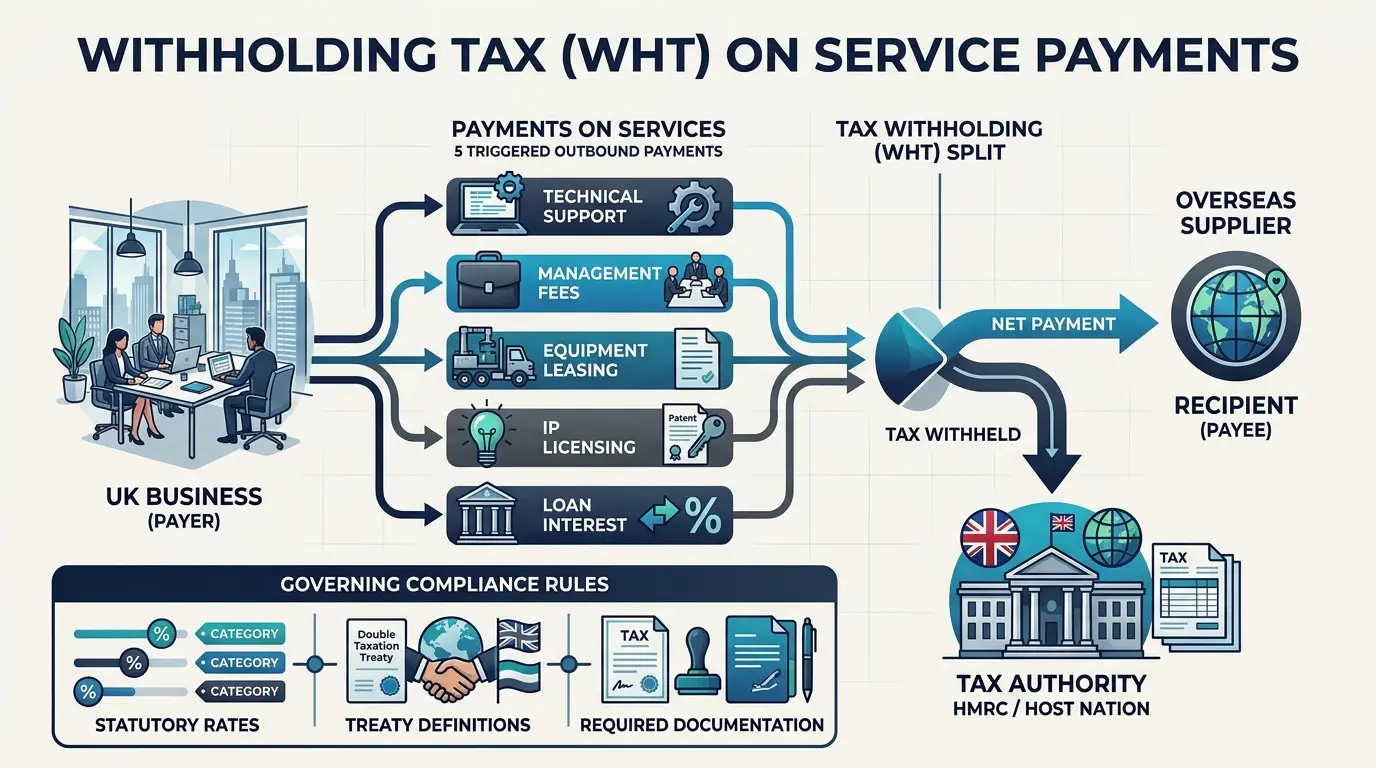
Cross-border oil and gas operations rely on specialized technical expertise and capital equipment. Standard fiscal regimes categorize vendor payments into distinct streams, each subject to specific WHT treatment:
Payments to non-residents: Remittances sent to foreign entities without a local presence trigger default withholding rates unless statutory exemptions or double tax treaty provisions explicitly apply.
Technical service fees: Payments for specialized engineering, geological modeling, subsea installation, and reservoir studies fall under high-scrutiny technical categories. Local laws routinely classify these fees as source-country income regardless of where foreign technicians perform the actual work.
Management fees: Corporate overhead allocations, regional management charges, and shared service center billing face strict deductibility limits. Tax authorities scrutinize these transfers to prevent profit shifting, often demanding clear evidence of direct benefit to host nation operations.
Royalties and licence fees: Payments for proprietary exploration software, patented drilling technology, and specialized extraction techniques attract withholding charges. Tax teams must distinguish between hardware equipment rentals and intellectual property licensing.
Interest withholding: Upstream projects financed through shareholder loans or third-party debt must deduct WHT on outbound interest payments. Thin capitalization rules and debt-to-equity ratios further limit tax-deductible interest expenses.
Service / Payment Category | Common Scope in Oil & Gas | Primary Tax Exposure | Key Compliance Requirement |
Technical Service Fees | Seismic processing, reservoir engineering, subsea maintenance | High statutory rates; source-country reclassification | Proof of service delivery and local/foreign time allocation |
Management Fees | Corporate overhead, shared HR/IT services, regional oversight | Non-deductibility under local PSC rules; transfer pricing audits | Cost-allocation documentation and benefit test evidence |
Royalties & Licence Fees | Drilling software, patented technology usage, proprietary tools | Incorrect classification as equipment lease rather than IP | Clear separation of software tools from operator services |
Interest Withholding | Intercompany loan financing, project debt servicing | Thin capitalization limits; excess interest reclassification | Arm's length debt ratio validation and interest rate benchmarks |
Equipment Rentals | Rig hire, supply vessel chartering, specialized tool lease | Permanent establishment exposure for mobilization periods | Bareboat vs. fully crewed charter contract breakdown |
How Does Permanent Establishment Risk Impact Tax Obligations?
Permanent establishment risk arises when contractor activities, long-term equipment deployment, or local operational hubs create a taxable fixed place of business. Creating a permanent establishment shifts tax liabilities from gross withholding tax to net corporate income tax.
The presence of contractors in a host nation often alters the underlying tax framework. When foreign service providers operate inside a country beyond specified treaty thresholds, their tax status transitions from limited source withholding to full corporate taxation.
Determining permanent establishment risk requires examining contract duration, physical presence, and operational authority:
Construction and Installation Duration
Most double tax treaties set time limits—frequently 6 or 12 months—for construction, assembly, or installation projects. Offshore platform fabrication, pipeline construction, and facility commissioning that cross these duration thresholds create a permanent establishment (PE) for the foreign contractor.
Service PE Provisions
Treaties increasingly incorporate service PE clauses. If foreign personnel provide technical or supervisory services within the host country for periods exceeding 183 days in any 12-month period, the foreign enterprise establishes a taxable presence.
Agency Permanent Establishment
Contractors possessing authority to conclude contracts on behalf of a parent company or operating unit establish an agency PE. Local tax authorities assess whether field managers make binding commercial decisions inside host jurisdictions.
When a contractor triggers a PE, gross withholding tax no longer satisfies local tax obligations. The contractor must register locally, file corporate tax returns, and pay net income tax on attributed profits. Operating companies failing to identify contractor PE status face joint liability for unpaid corporate taxes and uncollected payroll withholdings.
How Do Gross-Up Clauses Influence Contract Costs and Tax Calculations?
Gross-up clauses obligate the operating company to bear the contractor's local tax burden by adjusting payment amounts upward. This arrangement ensures the contractor receives the targeted net payment while increasing total operational expenditure and tax liabilities.

Commercial negotiations between international contractors and oil operators frequently center on net-of-tax terms. Contractors seek to mitigate host country tax risks by inserting gross-up clauses into service agreements. These clauses require the operator to pay an inflated invoice amount so that after deducting local withholding tax, the remaining net sum equals the contractually agreed fee.
Calculating a tax gross-up requires applying a specific mathematical formula rather than simply adding the WHT percentage to the base invoice. The standard gross-up formula determines the revalued gross payment ($G$) based on the net payment amount ($N$) and the applicable withholding tax rate ($r$):
$$G = \frac{N}{1 - r}$$
For an agreed net payment of $1,000,000$ at a statutory WHT rate of $15\%$, the calculation illustrates the financial impact:
$$G = \frac{1,000,000}{1 - 0.15} = \frac{1,000,000}{0.85} = 1,176,470.59$$
The operating company remits $176,470.59$ to the host government tax authority and pays $1,000,000$ to the contractor. This mechanism increases project expenditure by $17.65\%$, rather than the headline $15\%$ tax rate.
Operators must evaluate the cost-recovery status of grossed-up taxes under Joint Operating Agreements (JOAs) and Production Sharing Contracts (PSCs). State oil companies and tax authorities frequently disallow grossed-up tax portions as recoverable petroleum costs, forcing the operator to absorb the financial burden.
How Do Companies Administer Withholding Tax Certificates and Credits?
Administering withholding tax certificates involves issuing formal tax receipts, tracking cross-border remittances, and providing documentation for foreign tax credit claims. Proper administration prevents double taxation and supports legal tax recovery across operating jurisdictions.
Executing withholding tax compliance requires rigorous documentation and process tracking. Operating entities must remit withheld taxes to the host government within statutory deadlines, often within 15 to 30 days following the payment date. Upon receipt of payment, the tax authority issues official withholding tax certificates and credits documentation verifying the tax withheld at source.
Foreign contractors require these original certificates to claim foreign tax credits in their parent company home jurisdiction. Without valid certificates, home tax authorities reject credit claims, resulting in double taxation on the same revenue stream.
Tax departments must establish centralized management systems to handle compliance workflows:
Verification of Tax Identification: Confirming local and international tax numbers for foreign vendors before invoice processing.
Treaty Relief Documentation: Securing Tax Residence Certificates (TRCs) and beneficial ownership declarations prior to applying reduced treaty rates.
Certificate Distribution: Tracking, archiving, and transmitting host country tax receipts to contractors systematically.
Reconciliation Audits: Reconciling monthly tax filings against general ledger accounts to verify that all deductions match statutory obligations.
Incomplete tax certificate trails lead to vendor disputes, commercial delays, and direct financial losses during joint venture audit reconciliations.
How Can Organizations Evaluate Tax Compliance Approaches and Frameworks?
Organizations evaluate tax compliance approaches by comparing manual processing, outsourced tax advisory services, and specialized internal capability development. Selection depends on transaction volume, operational complexity, geographic footprint, and long-term risk tolerance.
Managing tax risks across petroleum operations requires determining the optimal operational framework. Energy organizations select between distinct models to handle cross-border compliance, contractor audits, and tax withholdings.
Selecting the appropriate operational approach requires evaluating key performance criteria:
Transactional Accuracy: The rate of correct tax classifications across complex service agreements.
Operational Velocity: The time required to clear invoices, calculate withholdings, and issue remittances without causing project delays.
Cost Efficiency: Managing direct advisory fees against the overhead costs of specialized internal teams.
Risk Mitigation: Lowering exposure to penalty assessments, disallowed PSC costs, and vendor disputes.
Organizations assessing institutional tax capability must evaluate their operational readiness. When internal teams require targeted competence in managing complex cross-border contractor taxes, structured professional development provides a direct path to compliance mastery. Evaluating specialized training programs, such as the Withholding Tax on Contractor & Service Payments Training Course, allows organizations to build internal technical authority across corporate tax, finance, and legal divisions.
Evaluating structured learning options ensures tax teams gain functional competency in navigating host country laws, joint venture audits, and double tax treaty applications. Enterprise workforce development bridges knowledge gaps between finance personnel, legal counsel, and procurement managers.
For organizations seeking to upskill their corporate finance and tax departments, structured professional training offers a sustainable solution. Organizations evaluating direct capability development can enroll in dedicated professional programs such as the Withholding Tax on Contractor and Service Payments Training for Oil and Gas Tax Professionals to establish compliant, audit-ready operational frameworks.
Compliance Evaluation Criteria | Manual In-House Processing | Full External Advisory Outsourcing | Structured In-House Capability Development |
Primary Focus | Ad-hoc compliance using basic accounting software | External reliance for complex transaction reviews | Systematic internal execution via trained specialists |
Cost Profile | Low direct cost; high penalty exposure | High ongoing external advisory billing | One-time training investment; low recurring cost |
Processing Velocity | Fast on basic invoices; slow on complex treaties | Delayed processing due to third-party review cycles | Real-time invoice review by trained internal teams |
Audit Readiness | Variable; higher risk of missing documentation | Strong external support; fragmented internal records | Consistent, institutionalized documentation standards |
Ideal Operational Fit | Small domestic operators with single asset profiles | Mid-tier firms entering new foreign markets quickly | Established energy firms managing complex international operations |
How Should HR and Finance Leaders Select the Right Training Approach for Tax Teams?
HR and finance leaders select training approaches by matching learning formats to operational complexity, project schedules, and compliance targets. Effective selection balances self-paced technical learning, live instructor workshops, and customized corporate capability programs.
Designing capability development plans for corporate tax and finance teams requires aligning learning delivery models with commercial schedules. HR learning leads and Chief Financial Officers must evaluate how training formats impact day-to-day operations and skill retention.
Self-Paced E-Learning Models
Self-paced digital modules suit foundational training across distributed workforce groups. Finance staff acquire basic knowledge regarding WHT definitions, standard rates, and documentation workflows without disrupting daily schedules. However, self-paced models offer limited interactive analysis required for multi-jurisdictional oil and gas contracts.
Live Technical Workshops
Interactive, instructor-led workshops provide real-time engagement with experienced international tax practitioners. Tax professionals analyze real-world contract clauses, practice gross-up calculations, and evaluate permanent establishment scenarios. This format promotes rapid knowledge transfer and equips staff to resolve immediate commercial disputes.
Customized Enterprise Capability Programs
Customized corporate training integrates an operator's specific PSC terms, joint venture agreements, and regional tax profiles into the curriculum. HR managers coordinate multi-departmental sessions involving tax accountants, legal counsel, and procurement officers. Cross-functional alignment ensures that contract drafters incorporate optimal tax protection mechanisms prior to final execution.
Measuring training return on investment (ROI) involves tracking reduced external tax advisory spend, decreased tax audit penalties, and faster vendor invoice processing times. Investing in structured corporate training turns tax management from a reactive compliance burden into a proactive commercial advantage.
Frequently Asked Questions
What is covered in an Oil & Gas Petroleum Taxation training course?
An Oil & Gas Petroleum Taxation course covers host government contracts, Production Sharing Contracts (PSCs), ring-fencing rules, and cross-border withholding taxes. Participants learn how to handle joint venture audits, deductibility of capital expenditures, and international double tax treaties. The curriculum delivered by Institute For Oil & Gas Training provides practical frameworks to manage fiscal risks across upstream, midstream, and downstream operations.
How do Production Sharing Contracts impact petroleum taxation obligations?
Production Sharing Contracts (PSCs) dictate how gross hydrocarbon production is divided between the host government and operating oil companies through cost recovery and profit oil splits. These agreements establish specific tax regimes, cost deductibility limits, and royalty obligations that override general corporate tax codes. Through specialized Oil & Gas Petroleum Taxation programs, Institute For Oil & Gas Training helps finance and legal professionals evaluate PSC fiscal terms to ensure full regulatory compliance.
How is withholding tax applied to foreign oil and gas contractors?
Withholding tax is deducted at source on cross-border payments made to foreign contractors for technical services, management fees, equipment leases, and intellectual property royalties. Host country tax authorities enforce these deductions to capture tax revenue from non-resident entities operating within their jurisdiction. Professionals trained in Oil & Gas Petroleum Taxation at Institute For Oil & Gas Training learn to correctly calculate gross-up clauses, evaluate permanent establishment risks, and administer foreign tax credit certificates.
Who should undertake training in petroleum fiscal systems and taxation?
Petroleum taxation training is designed for corporate tax managers, oil and gas accountants, finance directors, legal counsel, and joint venture auditors. It is also essential for government regulators and HR learning teams seeking to bridge technical skill gaps within energy finance departments. The Institute For Oil & Gas Training delivers tailored Oil & Gas Petroleum Taxation modules to help cross-functional teams optimize fiscal strategy and mitigate audit exposure.
Why is petroleum taxation different from standard corporate taxation?
Petroleum taxation differs from standard corporate tax due to high capital intensity, long project lifecycles, resource rent taxes, and specialized cost-recovery mechanisms like ring-fencing. Oil and gas operators face unique fiscal instruments including signature bonuses, royalties, windfall profit taxes, and complex joint-operating accounting rules. Studying Oil & Gas Petroleum Taxation with Institute For Oil & Gas Training equips industry practitioners with the technical expertise needed to navigate these sovereign fiscal frameworks effectively.
Related training courses
Oilfield Production Chemicals and Treatment Applications Training Course
- Specialisation
- Oil & Gas Process Engineering and Operations
- Duration
- 5 days · 15 CPD hours
API 653 Storage Tank Inspection and Integrity Assessment Training Course
- Specialisation
- Oil & Gas Inspection and Non-Destructive Testing
- Duration
- 5 days · 15 CPD hours
Microbiologically Influenced Corrosion (MIC) Training Course
- Specialisation
- Oil & Gas Corrosion Management and Control
- Duration
- 5 days · 15 CPD hours
More articles

How to Evaluate Transfer Pricing Risks and Intercompany Transactions in Oil and Gas Groups
Evaluate transfer pricing risks in oil and gas intercompany transactions. Learn methods, functional analysis, and arm's length compliance strategies.
Read article →
Why Transfer Pricing Matters for Multinational Oil and Gas Groups
Learn why transfer pricing matters for multinational oil and gas groups, including compliance frameworks, risk management, and workforce development.
Read article →
Withholding Tax Compliance and Treaty Relief Training for Oil and Gas Tax Professionals
Master cross-border oil and gas tax compliance. Evaluate syllabus, delivery, and outcomes for the Institute For Oil & Gas Training course.
Read article →